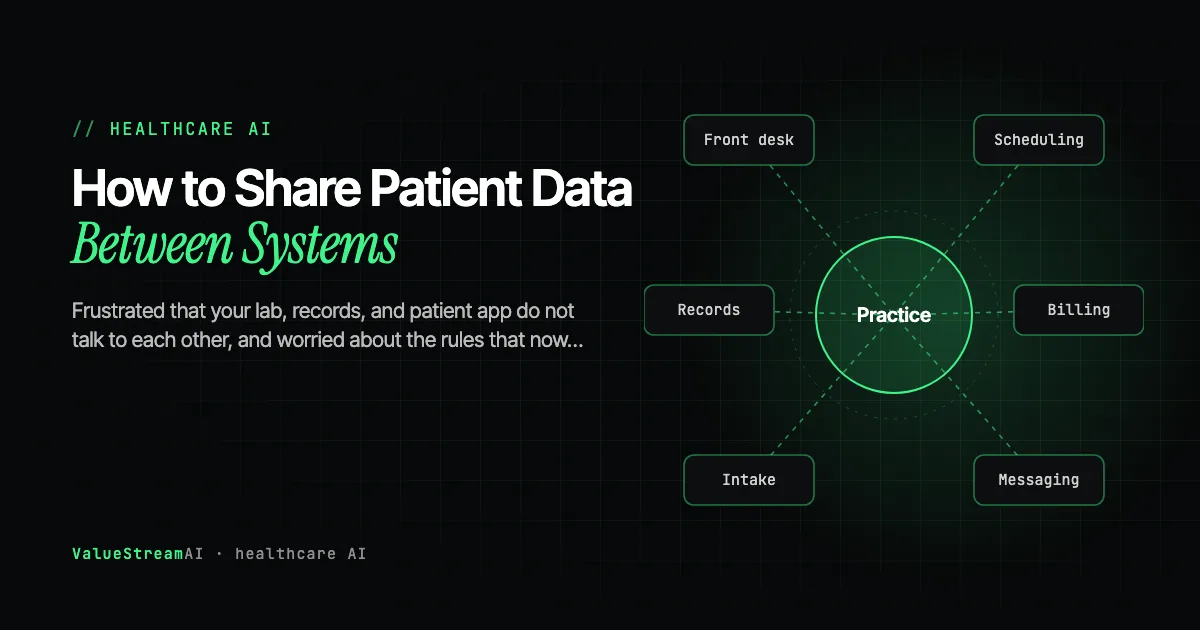
Ask any practice owner what frustrates them most about their technology, and somewhere near the top of the list is that nothing talks to anything else. The lab system does not speak to the records system. The records system does not speak to the patient app. Getting one piece of software to share data with another feels like it should be simple, and yet it routinely turns into a custom project that costs real money and never quite works.
The healthcare industry has spent years solving this problem, and the solution has a name: FHIR (pronounced "fire"), the modern standard for how health data should be structured and shared. FHIR is the common language. But a language needs something that actually speaks it, and by far the most widely used free tool for doing that is HAPI FHIR.
HAPI FHIR is a free, open-source engine that lets software create, read, validate, and exchange health data in the FHIR standard. It is not a product your front desk uses; it is the connective tissue that sits between systems and lets them share data cleanly. It quietly underpins interoperability across a huge swathe of the healthcare industry, and understanding it, even at a high level, helps you make far better decisions about integration, patient data access, and AI. This guide explains it in plain language.
| Fact | Detail |
|---|---|
| What it is | Free, open-source engine for the FHIR data standard |
| Language it speaks | HL7 FHIR, the modern healthcare interoperability standard |
| Licence | Apache 2.0 (free for commercial use) |
| Built in | Java; used to build FHIR servers and connectors |
| Maintained by | Open community, backed by Smile Digital Health |
| Main job | Let healthcare systems share data cleanly and correctly |
First, What Is FHIR? A Plain-English Explanation
Before HAPI FHIR makes sense, the standard underneath it needs one clear paragraph.
Imagine every piece of healthcare software stored patient information in its own private shorthand. One system calls a field "DOB," another "birth_date," another "PatientBornOn." A date in one is day-month-year, in another month-day-year. Multiply that across thousands of data points, and you see why systems struggle to share anything. FHIR is the agreed-upon common format that says: here is exactly how a patient, a medication, a lab result, an appointment should be structured, named, and represented, so that any system speaking FHIR can understand any other system speaking FHIR. It is the shared vocabulary and grammar of modern health data.
FHIR matters to you even if you never think about technology, because regulators now expect it. Rules in the United States around patient access to their own records and around "information blocking" effectively push the whole industry toward FHIR-based data sharing. Being able to share data in FHIR is increasingly not optional; it is the direction the entire system is moving.
So What Is HAPI FHIR?
FHIR is the language. HAPI FHIR is the free, ready-made engine that lets a piece of software actually read, write, check, and exchange data in that language without a team having to build all of that capability from scratch.
Concretely, HAPI FHIR gives developers the tools to do four things reliably:
- Create properly formatted FHIR data (build a correct patient record, medication, or result)
- Read and parse FHIR data coming from another system
- Validate that data is correctly structured, catching errors before they cause problems
- Exchange data between systems over the internet in a standard, secure way
You can think of HAPI FHIR as a fluent, tireless translator and clerk combined. When your records system needs to send information to a lab, a patient app, an analytics tool, or an AI, HAPI FHIR is the component that packages it correctly, checks it is valid, and hands it over in the shared FHIR language, and does the reverse when data comes back.
Between your records system and anything it exchanges data with, HAPI FHIR creates correctly formatted FHIR data, reads and parses incoming data, validates its structure and exchanges it securely, in both directions, with labs, patient apps, analytics tools and AI.
It is open source under the business-friendly Apache 2.0 licence, meaning free to use, including commercially, with no royalties. It is built in Java, a mature and widely trusted programming language, and it is designed to add FHIR capability to existing software rather than replace it. It is maintained by an active open community with commercial backing from Smile Digital Health, so it is both free and well supported.
Why This Matters for Your Practice Even Though You Will Never Touch It
No practice owner interacts with HAPI FHIR directly. Its relevance is entirely in what it makes possible, and there are four practical payoffs worth understanding.
1. Integration stops being a nightmare. The single biggest reason connecting healthcare systems is expensive is that everything speaks a different dialect. When systems support FHIR, and HAPI FHIR is often what makes that support real, connecting them becomes a far more standardised, predictable job. That translates directly into lower cost and less risk on any integration project you commission.
2. You can meet patient-access and info-blocking expectations. The regulatory push toward giving patients easy access to their records, and toward not blocking the flow of health information, is fundamentally a FHIR-based expectation. Systems built with FHIR support are positioned to meet it; older closed systems are not.
3. You avoid getting trapped. When your data can be expressed and exported in an open standard like FHIR, you are far less locked into any single vendor. If your records live only in a proprietary format, moving or connecting them later is painful and expensive. FHIR support is a form of insurance against that trap, and it is a recurring theme in our thinking, because vendor lock-in is one of the most underestimated risks in healthcare technology.
4. AI becomes far easier to add. This is the payoff that matters most going forward, and it deserves its own section.
HAPI FHIR and AI: The Clean Doorway Principle
We give every business owner who asks about AI a simple test to predict whether an AI project will be smooth or painful. Look at the core systems your practice runs on and ask, for each one: does it offer a proper, documented way for other software to connect to it? In healthcare, the clearest possible version of "yes" is: does it speak FHIR?
Here is why that test is so reliable. An AI tool is only as good as its ability to read from and write to your systems. If your data is locked in a closed format with no clean way in, an AI has to resort to clumsy, fragile workarounds, effectively operating your software the awkward way a human would, through the screen, which is slow, brittle, and expensive to maintain. But if your systems expose their data through FHIR, the AI walks through a clean, standard, documented front door. The work becomes predictable, faster to build, and far less likely to break when something changes.
HAPI FHIR is one of the main tools that builds those clean front doors. When a system supports FHIR through HAPI FHIR, any AI initiative you pursue later, a tool that summarises records, an intelligent patient intake assistant, an agent that coordinates care, connects through a stable, standard interface rather than a fragile hack. Modern FHIR-native platforms like Medplum are built on exactly this principle, and it is why they make future AI projects so much cheaper than bolting AI onto a closed legacy system.
Data locked in a closed format. AI resorts to fragile workarounds, operating software through the screen the awkward way a human would.
Systems expose their data through a standard, documented interface.
The practical lesson: when you are choosing or evaluating any healthcare software, asking "does it support FHIR?" is one of the most useful non-technical questions you can ask, because a yes signals clean integration and easy AI down the line, while a no signals friction and cost.
HAPI FHIR and Compliance: Interoperability Meets Privacy
Interoperability and privacy can sound like opposites, sharing data more freely versus protecting it more tightly, but a well-built FHIR foundation actually serves both. Here is how it fits the rules.
HIPAA and secure exchange. HAPI FHIR supports the secure, standardised exchange of health data, which is precisely what HIPAA expects when information moves between systems. Because FHIR exchange happens over standard, securable internet interfaces, it can be wrapped in the encryption, access controls, and audit logging that HIPAA requires. The tool provides the standardised, checkable pipe; your team's security configuration around it makes the exchange compliant. As always, no software is automatically HIPAA-compliant on its own; it gives you the means, and your configuration completes it.
Patient access and information blocking. United States rules increasingly require that patients can access their own health data easily and that providers do not improperly block the flow of information. These rules are built around FHIR-based access. A practice whose systems speak FHIR is positioned to comply; one whose data is trapped in a closed format is exposed to the opposite risk.
Data validation reduces errors, and errors are a compliance risk. One quietly valuable feature of HAPI FHIR is validation, checking that data is correctly structured before it moves. Malformed or mismatched health data is not only an operational problem; incorrect information about a patient is a safety and liability concern. A tool that catches structural errors before data is exchanged reduces that risk at the source.
GDPR and international exchange. For practices touching EU or UK patients, FHIR-based exchange fits privacy-by-design expectations, because the data is structured, controllable, and moves through interfaces you can secure and audit. The same on-premises-versus-cloud considerations we cover in our cloud AI versus local AI guide apply to where your FHIR infrastructure lives.
What HAPI FHIR Is Not: Setting Expectations
To make good decisions, it helps to be clear about what HAPI FHIR does not do.
It is not an EHR or a records product. HAPI FHIR is a building block for exchanging and handling FHIR data, not a finished system your staff log into. Platforms and products are built using it; it is not itself the product.
It is not, by itself, a database you buy and switch on. It is a toolkit that developers use to add FHIR capability to software or to stand up a FHIR server. Turning it into something useful for your practice requires technical work.
It does not make integration free, only far more standardised. FHIR and HAPI FHIR dramatically reduce the pain of connecting systems, but a real integration still needs skilled hands to design, secure, and test. The savings come from working with a standard instead of a hundred private dialects, not from eliminating the work entirely.
It does not replace the need for a skilled technical partner. As with every powerful open tool in this space, the software is free but the expertise to use it well is where value is created.
Getting Value From HAPI FHIR: A Practical Path
For a practice, the goal is rarely "use HAPI FHIR" as an end in itself. It is usually "connect these systems," "give patients access to their data," or "prepare for AI." HAPI FHIR is a means to those ends, and the practical path is straightforward.
- 01Name the actual goal
Connecting two systems, enabling patient access, or feeding an AI tool each shape the design differently.
- 02Audit whether your systems speak FHIR
The single most informative fact about how easy or hard an integration will be.
- 03Put a technically fluent owner on the design
Someone who understands both FHIR and the clinical goals, not a non-technical project manager alone.
- 04Build securely and validate everything
Proper security, HAPI FHIR's validation to catch errors early, tested against synthetic data first.
1. Name the actual goal. Are you trying to connect two systems, enable patient record access, feed data to an analytics or AI tool, or prepare your data foundation for the future? Each goal shapes the design.
2. Audit whether your systems speak FHIR. Before commissioning anything, find out which of your existing tools already support FHIR. This is the single most informative fact about how easy or hard an integration will be, and it is the healthcare-specific version of the integration test every owner should run.
3. Put a technically fluent owner on the design. Someone who understands both FHIR and your clinical and operational goals should design the exchange, whether that is on your team or a partner's. This is not a task to hand to a non-technical project manager alone.
4. Build securely and validate everything. Wrap the exchange in proper security, use HAPI FHIR's validation to catch errors before they spread, and test thoroughly, ideally against synthetic data first, before real records flow.
Open Source vs. Commercial: What Are the Paid Alternatives?
HAPI FHIR is free, but "free" does not mean the total cost of running it is zero, and it helps to see where it sits against paid options. On the fully open end, HAPI FHIR's own license costs nothing; if your organisation already runs a Kubernetes/DevOps team managing other services, the incremental infrastructure cost of running a HAPI FHIR server has been estimated at around $23,000 per year.
On the fully commercial end, Smile Digital Health, built on HAPI FHIR but sold as a supported commercial platform, typically costs $500,000 to $700,000 for its Health Data Platform license alone, before implementation. In between sit the cloud-managed options: Microsoft Azure API for FHIR and Google Cloud Healthcare API both use consumption-based pricing tied to usage rather than a flat license fee, and managed interoperability services like Redox and 1upHealth exist specifically for organisations that want someone else to handle the plumbing entirely, for a price. InterSystems IRIS for Health is generally considered the gold-standard choice for very high-volume, mission-critical interoperability.
The honest advice for most practices: you will almost never run a FHIR server yourself, your technical partner or EHR vendor will. But knowing this spectrum, free and self-managed, cloud consumption-based, fully managed service, or six-figure commercial license, means you can ask a vendor exactly where their solution sits and whether you are paying for infrastructure you could get for a fraction of the cost.
Frequently Asked Questions
What is HAPI FHIR in simple terms?
HAPI FHIR is a free, open-source engine that lets healthcare software create, read, check, and exchange patient data using FHIR, the modern common language of health data. It is not something your staff use directly; it is the connective component that lets different systems share information cleanly and correctly. It is one of the most widely used tools for building this kind of interoperability across the healthcare industry.
What is FHIR, and why does it matter to my practice?
FHIR is the agreed-upon standard format for how health data should be structured and shared, so that any system speaking FHIR can understand any other. It matters because regulators increasingly require easy patient access to records and discourage blocking the flow of health information, and these requirements are built around FHIR. Systems that speak FHIR are positioned to comply and to connect easily; systems with data locked in closed formats are not.
Is HAPI FHIR really free?
Yes. HAPI FHIR is open source under the Apache 2.0 licence, which allows free use including for commercial purposes, with no royalties. It is maintained by an active community with commercial backing from Smile Digital Health, so it is both free and well supported. The investment in a real project is the technical expertise to design and build the integration, not the software.
Do I need to understand HAPI FHIR to run my practice?
No. You will never interact with it directly. What is worth understanding is the concept: FHIR is the common language of health data, and asking "does this software support FHIR?" is one of the most useful questions you can ask when choosing or evaluating any healthcare system, because a yes signals easy integration, patient data access, and smoother AI projects later.
How does HAPI FHIR relate to AI?
AI tools need a clean way to read from and write to your systems. When your systems support FHIR, often built with HAPI FHIR, AI connects through a standard, documented interface rather than fragile workarounds, which makes AI projects faster, cheaper, and more reliable. In short, FHIR support is one of the strongest signals that your data is ready for AI.
Is HAPI FHIR an EHR I can buy?
No. HAPI FHIR is a building block used to add FHIR capability to software or to stand up a FHIR server, not a finished records product. EHRs and digital health platforms are built using tools like it. Turning it into something useful for your practice, such as a working integration or a patient-access feature, requires technical work by a skilled team or partner.
The Bottom Line for Your Practice
HAPI FHIR is invisible to almost everyone in a medical practice, and yet it represents one of the most important shifts in healthcare technology: the move from every system speaking its own private dialect to a shared, open language that lets data flow cleanly and safely. It is the free engine that makes that shared language real across much of the industry.
You will never operate it, but its existence should change how you think. When you choose software, ask whether it speaks FHIR. When you plan an integration, find out which of your systems already support it. When you consider AI, remember that FHIR support is the clearest sign your data is ready for it. Those simple habits, grounded in understanding what HAPI FHIR enables, will save your practice money and keep every future option open.
If you are trying to connect systems, enable patient data access, or prepare your data foundation for AI, and you want it designed and built on open, future-proof standards, ValueStreamAI's healthcare team can help. Start with our AI for Medical Practices hub, see how it fits a modern platform in our Medplum guide, or get in touch to talk through your integration goals.
The standard is open, the engine is free, and the industry is moving this way. The value is in building on it wisely.
Our healthcare AI development service builds these interoperability layers in production, using HAPI FHIR and Mirth Connect where a direct integration path does not exist.
Syed Rayyan is co-founder of ValueStreamAI, leading research and marketing. He runs the firm's evaluation of emerging AI and healthcare tooling and translates technical capability into clear guidance for non-technical decision-makers. Connect on LinkedIn →