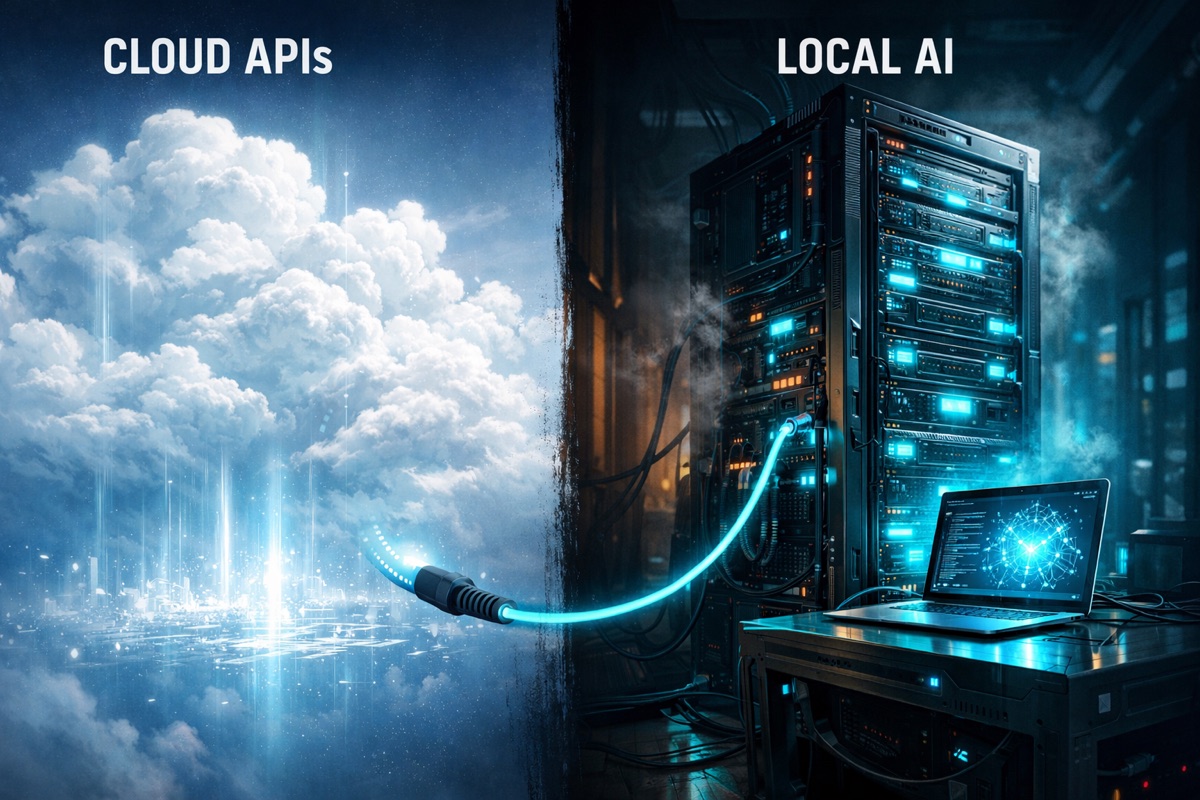
Self-Hosting AI: Local LLMs vs. Cloud APIs (2026 Technical Guide)
| Metric | Result |
|---|---|
| Cost Savings (3-Year) | 70-80% vs Cloud APIs |
| Data Privacy | 100% Air-Gapped / Zero-Retention |
| Inference Latency | < 20ms (Local BUS) |
| Model Capability | Matches GPT-5 / Claude 5 Level |
The landscape of Artificial Intelligence has bifurcated into two distinct paths: the ultra-powerful, proprietary models hosted in the cloud, and the increasingly capable, private models running on local hardware. For enterprise CTOs and AI engineers, the choice is no longer simple. IDC forecasts worldwide AI infrastructure spending will surpass $200 billion over the next five years, with a growing proportion shifting toward private and on-premises deployments as data sovereignty requirements tighten.
In February 2026, we are seeing a dramatic shift back to "on-premise," but for inference. With the release of heavyweights like GPT-5.3-Codex and Claude 5 (Fennec), the cloud offers unmatched reasoning capabilities. However, open-weights models like Qwen3-Coder-Next, Kimi K2.5, DeepSeek-R1, and the massive DeepSeek V4 Pro are challenging the notion that you need a proprietary API to achieve state-of-the-art results. This guide compares them head-to-head.
This guide provides a rigorous technical comparison to help you decide between renting intelligence or building your own.
The Contenders: A 2026 Snapshot
The Cloud Giants (Proprietary API)
These models are accessed via API. You pay per token, and your data leaves your premise.
| Model | Provider | Key Strength | Context Window |
|---|---|---|---|
| GPT-5.3-Codex | OpenAI | Agentic "o5" Reasoning Stack | 2M Tokens |
| Claude 5 (Fennec) | Anthropic | Highest Human-Level Planning | 1M Tokens |
| Claude Sonnet 5 | Anthropic | State-of-the-Art Coding Speed | 500k Tokens |
| Gemini 3.7 Flash | Agentic tasks, 4x speed vs Pro | 1M Tokens | |
| Gemini 3.5 Pro | Long-context reasoning, coding | 2M Tokens | |
| Gemini 3.1 Pro | Benchmarks, SVG/3D code gen | 1M Tokens |
Gemini pricing context: Gemini 3.7 Flash is priced at $1.50 input / $9 output per 1M tokens, significantly below frontier model pricing from OpenAI and Anthropic for comparable agentic task performance. For high-volume production agents where data sovereignty concerns permit cloud API use, Gemini 3.7 Flash is currently the most cost-efficient frontier-class model available.
The Open Weights Challengers (Self-Hosted)
These models can be downloaded and run offline. You control the hardware, the data, and the weights. For a practical guide to model discovery platforms and how to evaluate community models for business use, see our overview of Hugging Face, CivitAI, and AI model repositories.
| Model | Provider | Parameters (Active/Total) | Best Use Case |
|---|---|---|---|
| DeepSeek V4 Pro | Meta | 17B / 400B (MoE) | Multilingual Enterprise Reasoning |
| Qwen3-Coder-Next | Alibaba | 3B / 80B (MoE) | High-Speed Coding Agent Development |
| Kimi K2.5 | Moonshot | 32B / 1T (MoE) | Multimodal (Video/Reasoning) Agents |
| DeepSeek-R1 | DeepSeek | 67B (Dense) | Logic & Math Quantitative Tasks |
| Yi-Large | 01.AI | 70B (Dense) | High Efficiency, Low Latency Deployment |
Technical Deep Dive: Making Local Work
Running a 70B+ parameter model locally is not as simple as downloading an .exe file. It requires understanding the entire inference stack.
1. VRAM Requirements: The "Golden Ratio"
The bottleneck for LLM inference is almost always Memory Bandwidth and VRAM Capacity, not Compute. Use this table to size your hardware:
VRAM Requirements for Different Quantizations (Approximate):
| Model Size | FP16/BF16 (Full) | 8-bit (Int8) | 4-bit (Q4_K_M) | Recommended GPU Setup |
|---|---|---|---|---|
| 7B | 16 GB | 8 GB | 6 GB | 1x RTX 4060 Ti (16GB) |
| 13B / 14B | 28 GB | 16 GB | 10 GB | 1x RTX 4070 Ti Super (16GB) |
| 34B | 70 GB | 38 GB | 22 GB | 1x RTX 4090 (24GB) |
| 70B / 80B | 145 GB | 78 GB | 44 GB | 2x RTX 4090 (48GB Total) |
| 110B (Qwen) | 230 GB | 120 GB | 70 GB | 3x RTX 4090 or 1x A100 (80GB) |
| 400B (DeepSeek V4) | 820 GB | 410 GB | 230 GB | 4x A100 (80GB) or 8x RTX 4090 |
Pro Tip: Always leave ~2-4GB of VRAM overhead for the context window (KV cache). A 24GB card can realistically host a 20-21GB model comfortably.
2. Formats: The Rise of GGUF
The community has settled on GGUF (GPT-Generated Unified Format) as the standard for CP/GPU inference.
- Why GGUF? It allows models to be mapped into memory (mmap), meaning you can load a model larger than your RAM if you have slow swap (not recommended) or split it across CPU and GPU storage seamlessly.
- Safetensors: The gold standard for security. Unlike the older Python
picklearchives (.binor.pth), safetensors cannot execute arbitrary code. Always prioritize these formats for safety.
3. Quantization: The Art of Compression
Quantization is the process of reducing the precision of the model's weights to fit into memory.
- FP16 / BF16 (16-bit Floating Point): The native training precision. Requires massive VRAM. A 70B model needs ~140GB of VRAM.
- 8-bit (Int8): Halves the size with virtually zero loss in reasoning capability.
- 4-bit (Q4_K_M or Q4_0): The sweet spot for local deployment. A 70B model shrinks to ~40GB.
- The Specifics:
- Perplexity (PPL): This measures how "surprised" a model is by new text. Lower is better.
- The Trade-off: Going from FP16 to 4-bit usually increases perplexity by less than 1-2%, which is imperceptible for most tasks. However, going below 3-bit (e.g., Q2_K) results in "brain damage" where the model becomes incoherent.
4. Precision: FP16 vs FP32 vs BF16
Most modern training (H100/B100 clusters) happens in BF16 (BFloat16). This format keeps the dynamic range of 32-bit floats but with lower precision.
- For Inference: You rarely need FP32. Even FP16 is often overkill compared to optimized 4-bit or 6-bit quantization (EXL2 or GGUF formats).
5. The Serving Stack: What Actually Runs the Model
Downloading a GGUF file and picking a quantization level gets you a model on disk. Something still has to load it into memory, expose it as an endpoint your applications can call, and give a human something to type into. Four tools cover almost every real deployment:
- llama.cpp, the inference engine most of this ecosystem is built on top of. Written in C++, runs on CPU or GPU, and is the reason GGUF exists in the first place.
- Ollama, the fastest path from zero to a running model.
ollama pull qwen3:32band you have a local API endpoint in minutes. Best for prototyping, single-user workstations, and teams without a dedicated MLOps function, but it degrades past roughly 3–4 simultaneous connections. - vLLM, the production option once more than a handful of people or agents query the model at once. Continuous batching means it doesn't hit the concurrency wall Ollama does, which is why our Enterprise Inference tier below is built on it.
- Open WebUI, the interface layer. Points at an Ollama or vLLM endpoint and gives a team a ChatGPT-style screen, chat history, multi-user accounts, document upload for RAG, so "self-hosted AI" doesn't mean everyone SSHing into a terminal to use it.
For teams building autonomous agents on top of any of these, not just a chat window, Pi is worth knowing: a model-agnostic, open-source coding-agent CLI, MIT-licensed, no SaaS backend, that talks to a self-hosted endpoint the same way it talks to a cloud API.
The Hardware Reality: What Do You Need?
The bottleneck for LLM inference is almost always Memory Bandwidth, not Compute.
Tier 1: The Enthusiast / Dev Workstation (Local Testing)
- GPU: Dual NVIDIA RTX 4090 (24GB x 2 = 48GB VRAM) or RTX 5090 (32GB x 2 = 64GB VRAM).
- Capability: Can run Qwen 72B or DeepSeek V4 comfortably at 4-bit quantization with 8k+ context.
- Token Speed: Fast (30-50 tokens/sec).
Tier 2: The Small Office Server (Privacy Focused)
- GPU: 4x RTX 6000 Ada Generation (48GB each) or Mac Studio M3 Ultra (192GB Unified Memory).
- Capability: Can run unquantized FP16 70B models or quantized 400B+ MoE (Mixture of Experts) models like Grok-1 or large Qwen variants.
- Mac Note: Apple Silicon is great for memory capacity but slower on bandwidth (token generation) compared to NVIDIA CUDA cores.
Tier 3: Enterprise Inference (Production)
- GPU: NVIDIA H100 / H200 or B200 HGX clusters.
- Capability: Full FP16 precision, massive concurrent user batches, and extremely high throughput.
- Cost: $30,000+ per card. This is usually where "Cloud" becomes cheaper unless you have 24/7 distinct usage.
Cost Analysis: Rent vs. Buy (3-Year TCO)
Is self-hosting actually cheaper? It depends on your scale.
| Cost Factor | Cloud API (GPT-5.3 / Claude 4.6) | Self-Hosted (Local Qwen3/Kimi Cluster) |
|---|---|---|
| Upfront Hardware | $0 | ~$6,500 (2x 4090) - $50k (A100/H100) |
| Ongoing OpEx | Electricity (~$50-200/mo)Engineering Ops | |
| Data Privacy | "Z-R-A" Compliance (Trust-based) | Physical Air-Gap Capable (Guaranteed) |
| Latency | 200ms - 800ms Network Roundtrip | <10ms Local BUS Speed (Zero Hop) |
| Breakeven Point | N/A | ~3-5 Months at high volume |
The Verdict on Cost
- For Spiky Traffic: Cloud wins. Don't buy hardware that sits idle 90% of the time.
- For Sustained "Always-On" Agents: Local wins. If your AI agents are running background tasks 24/7, the API costs will bleed you dry (thousands per month). A $6,500 server pays for itself quickly.
Cloud API: $0.
Cloud API: ~$15/1M input tokens, ~$45/1M output tokens.
Cloud API: 200ms-800ms network roundtrip.
Cloud API: not applicable.
ValueStreamAI's 5-Pillar Agentic Architecture (On-Prem Edition)
We don't just "install LLMs." We build resilient agentic systems that run entirely on your infrastructure.
- Autonomy: Agents running on local Cron jobs, triggering automatically based on database events, the same category of self-hosted autonomous agent that open-source projects like Hermes Agent (Nous Research) have popularised in 2026.
- Tool Use: Secure connections to internal SQL/ERP systems without API gateways.
- Planning: Local reasoning chains using DeepSeek V4 Pro for task decomposition.
- Memory: Private Pinecone or local ChromaDB instances for document RAG, paired with Mem0 (open-source, self-hostable) when the agent itself needs to remember facts and preferences across sessions, not just retrieve documents.
- Multi-step Reasoning: Logic-driven workflows that never leave your VPC.
Project Scope & Pricing Tiers
Transparency is a core value. Here is how we price our On-Premise AI deployments:
| Service Level | Cost Range | Best For |
|---|---|---|
| Local LLM Prototype | $15,000 - $30,000 | Qwen3-Coder-Next setup, RAG integration, Pilot MVP. |
| Custom Fine-Tuned Model | $45,000 - $80,000 | Training DeepSeek V4 Pro or Kimi Linear on proprietary logic. |
| Enterprise AI Cluster | $120,000+ | Multi-node H100 / B200 / Blackwell-200 architecture. |
Fine-Tuning: The Secret Weapon
Self-hosting allows for Fine-Tuning. Instead of paying for a massive generalist model like GPT-5.3-Codex, you can take a smaller, efficient model (like Mistral NeMo 2 or DeepSeek V4) and train it specifically on your company's documents.
- LoRA / QLoRA: Low-Rank Adaptation allows you to fine-tune a model on a single consumer GPU by only updating a small fraction of the weights.
- Result: A fine-tuned 12B model often outperforms GPT-5.2 on the specific task it was trained for, while running fast and cheap on local hardware.
Privacy & Data Sovereignty
For industries like Finance (FCA), Healthcare (NHS/HIPAA), and Legal, sending data to OpenAI is a non-starter.
- Self-Hosted: You can air-gap the machine. The ethernet cable can be unplugged. The model still works.
- Cloud: You rely on "Zero Retention" agreements, which are legal contracts, not physical guarantees.
The Systems Access Problem: Sovereignty Starts Before the Model
Data sovereignty is often discussed as a model-level decision, which API does the data go through. But for organisations operating on legacy infrastructure, the harder sovereignty problem is internal: can you actually get your data to the model at all, regardless of whether it's self-hosted or cloud?
Many regulated organisations we work with, fintech firms, healthcare providers, legal practices, have compliance-relevant data distributed across systems with inconsistent access. The core banking database doesn't have an API. The document management system was built by a contractor who has since departed and left no documentation. The client records platform has an API but it's locked behind a support tier the firm isn't on.
When evaluating self-hosted AI, this matters because the business case often assumes the model will process data from these internal systems. If the systems aren't accessible programmatically, self-hosting the model doesn't solve the problem, it just moves the bottleneck from the API to the internal data pipe. A thorough self-hosting assessment must include a data access audit across all source systems the AI needs to reach, before hardware decisions are made.
For organisations where self-hosting is the right architectural choice, typically those with high sustained inference volume, air-gap requirements, or data that genuinely cannot leave the building, this audit is part of the initial engagement. We map every data source the AI needs to interact with, confirm access availability, identify integration gaps, and factor the remediation cost into the total self-hosting investment. That number is consistently larger than the hardware cost alone.
Conclusion
If you need the absolute pinnacle of reasoning for a complex, one-off problem, use GPT-5.3-Codex or Claude 5. However, if you are building a production system processing millions of tokens daily, or if your data is sensitive, Self-Hosting is the answer.
By leveraging GGUF quantization, 4-bit precision, and modern open-weights models like Qwen3-Coder-Next or DeepSeek V4 Pro, you can build a private intelligence engine that rivals the giants at a fraction of the long-term cost. (Keep an eye on the upcoming DeepSeek V4 Behemoth for 2T+ parameter scale).
Need Help Building Your AI Infrastructure?
ValueStreamAI specializes in architecting high-performance, private AI clusters. Whether you need a local RAG pipeline or a fine-tuned agentic workflow, we can design the hardware and software stack that fits your security needs. Contact us today for a consultation.
Frequently Asked Questions
What hardware do I need to run GPT-5.3 level models locally?
To run a model comparable to GPT-5.3-Codex (like DeepSeek V4 Pro 400B or Qwen3-480B), you typically need an enterprise cluster with 4-8 NVIDIA H100 or the newer Blackwell B200 GPUs. However, smaller MoE models like Qwen3-Coder-Next (80B) can run effectively on dual RTX 4090s using 4-bit quantization and achieve similar speeds for coding tasks.
Is self-hosting AI more secure than using Claude Opus 4.6?
Yes. While Claude 4.6 offers high-tier compliance, self-hosting allows you to physically air-gap the machine. This ensures your PII, HIPAA-protected data, or trade secrets never traverse the open internet or a third-party server.
Muhammad Kashif is co-founder of ValueStreamAI, leading technical delivery and AI strategy. He designs and ships custom agentic AI and healthcare automation systems for clients across the US and UK. Connect on LinkedIn →