A small business owner asking what AI consulting costs usually gets one of two answers: a vague "it depends", or an hourly rate with no idea how many hours it will take. Neither helps you budget. This guide gives you the real ranges for AI consulting cost for small businesses in 2026, explains the four ways consultants charge, shows what pushes a quote up, and gives you a way to judge whether a price is fair before you sign anything.
We are an AI consulting and build company, so read our figures with that in mind. Where we quote our own prices, we say so. Where we quote the market, we name the source and the caveat.
| Metric | 2026 Benchmark |
|---|---|
| Independent AI consultant, hourly | About $100 to $350 an hour |
| Large consultancy, hourly | $500 an hour and up |
| Small fixed-scope AI project | About $5,000 to $25,000 |
| US businesses using AI (Census, Dec 2025 to May 2026) | 17% to 20% |
| UK firms with 0 to 9 staff using AI (ONS, June 2026) | 28% |
The hourly and project ranges come from 2026 pricing guides published by consultants and agencies. Treat them as indicative: almost every source selling the service also publishes the price list. The adoption figures come from the US Census Bureau's Business Trends and Outlook Survey and the Office for National Statistics.
Why AI Consulting Cost Is Hard to Pin Down
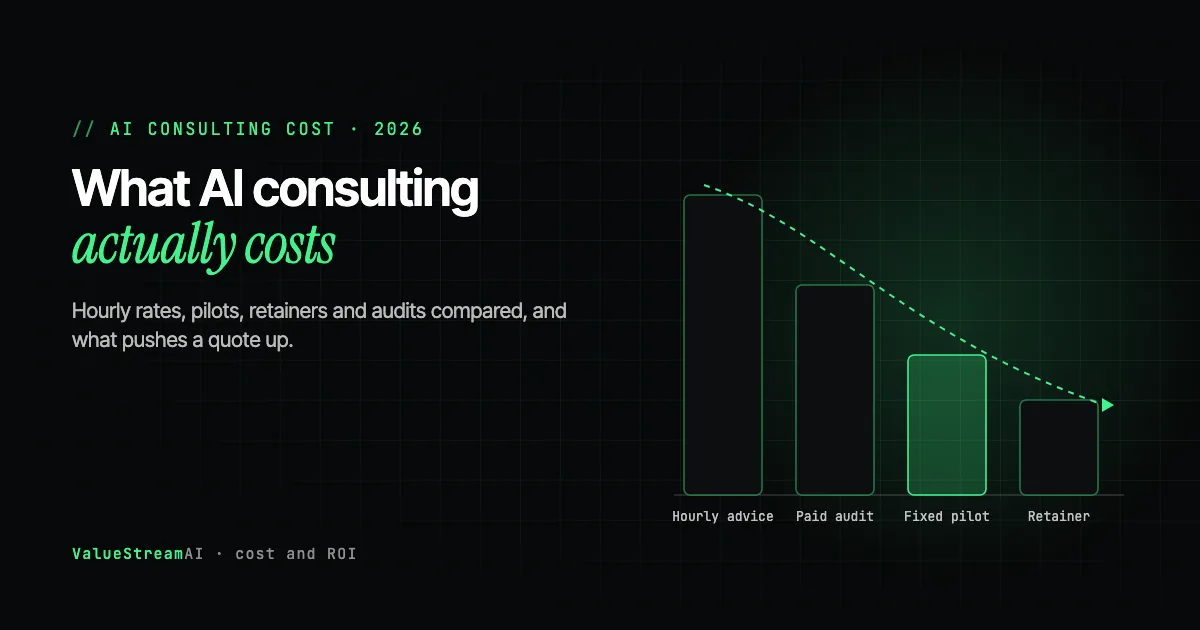
The short answer is that "AI consulting" covers four different products. One person sells you an hour of advice. Another sells a strategy report. A third builds one working system for a fixed price. A fourth takes a monthly fee to keep building. Those can all appear under the same heading on a website, and their prices differ by a factor of fifty.
The second reason is that the cost of AI work is driven less by the AI and more by your existing software. A consultant can quote the model and the prompts with confidence. What they cannot quote without looking is whether your booking system, CRM or accounting package lets anything connect to it. That one question moves timelines from two weeks to two months, which is why honest quotes for small businesses start with a short look at your tools.
The third reason is that the market is young. The ONS found that UK adoption roughly tripled between September 2023 and June 2026, from around 12% to around 35% of firms with ten or more staff. When demand moves that fast, pricing has not settled, and you will see wildly different quotes for similar work.
AI Consultant Hourly Rates in 2026
Hourly rates are the most visible number and the least useful one for a small business. Here is the range published across 2026 pricing guides.
| Consultant type | Typical hourly rate | What you usually get |
|---|---|---|
| Independent consultant | About $100 to $350 | One person, advice and sometimes light building |
| Boutique AI firm | About $250 to $500 | A small team that can usually build |
| Large consultancy | $500 and up | Strategy and governance, building often subcontracted |
UK freelancers publish lower figures, roughly £75 to £180 an hour in one 2026 guide. Generative AI specialists sit at the top of each band.
Two things about hourly pricing matter more than the rate itself. First, an hourly consultant is paid for time, not for a result, so the incentive is to advise rather than finish. Second, a small business rarely knows how many hours a project needs, so an hourly rate does not tell you the total. Our own ad hoc consulting rate is $150 an hour, but we never bill builds, pilots or retainers by the hour, for exactly that reason.
The Four Ways AI Consulting Is Priced
The answer for most small businesses is that a fixed-price pilot is the safest first purchase, and a paid audit is the riskiest. Here is why.
Flexible and cheap to start. The catch: nobody is accountable for a result, only for time spent.
A fixed fee for a study. The catch: you still need someone to build what it recommends.
One workflow, built and measured. The catch: it is narrow by design, so it is a start, not the whole programme.
Ongoing builds and support. The catch: worth it only once you have more than one workflow to automate.
1. Hourly advice
You buy a block of hours, usually for workshops, a review of a proposal, or help choosing tools. It is the cheapest way to get an outside view and the right choice if you already have someone who can build. It is the wrong choice if you do not, because you end up with advice and the same hiring problem you started with.
2. Paid audits and strategy reports
A fixed fee buys a document: an assessment of where AI could help, a roadmap and sometimes a business case. Prices vary widely. The risk is simple. A report does not save any hours. In our experience, the hard problems in a small-business AI project, such as a tool with no API (a documented way for other software to connect to it) or data spread across three spreadsheets, only show up when someone starts building. A study that never builds rarely finds them.
That is why we do not sell paid audits. The discovery work is the first stage of a pilot, not a product on its own.
3. Fixed-price pilots
You pay a fixed amount for one working workflow, scoped before any work starts. Our pilots start at $5,000, most fall between $5,000 and $15,000, and they run in about 14 days. We describe exactly what happens in those two weeks in what a 14-day AI pilot actually looks like.
The value of a pilot is that you measure the result in your own business. If the hours saved do not justify a bigger investment, you stop, having spent the price of one workflow rather than a programme.
4. Monthly retainers
A retainer buys ongoing capacity: more workflows, changes as your business shifts, monitoring and support. Our retainers start at $1,500 a month for companies of up to about fifteen people, $2,500 to $3,000 for fifteen to fifty, and from $7,000 for larger teams. Advisory-only retainers elsewhere are often quoted at $2,000 to $5,000 a month.
A retainer makes sense once you have proved one workflow and have a list of others. Signing one before that means paying for capacity you do not yet know how to use.
| Pricing model | Typical small-business cost | Best when | Main risk |
|---|---|---|---|
| Hourly advice | $100 to $350 an hour | You have people who can build | Advice with no delivery |
| Paid audit | A few thousand dollars and up | You need a document for a board or lender | A report that saves no hours |
| Fixed-price pilot | $5,000 to $15,000 (ours) | You want proof in your own numbers | Narrow by design |
| Retainer | From $1,500 a month (ours) | One workflow is proven and more are queued | Paying for unused capacity |
What Drives AI Consulting Cost for a Small Business
Five factors account for most of the difference between a $5,000 quote and a $25,000 one. The biggest is not the AI at all.
Your software's connection points. Before quoting anything, run a simple test: for each core tool your business runs on, does it offer an API, an MCP server (a newer standard that lets AI tools plug in) or a documented integration? When the answer is yes for your main tools, a clean integration is very likely, and in our experience the success rate is well above 90%. When a key tool has no API, the project either needs a workaround or a change of software, and the price rises with it. We cover how to check this yourself in webhooks and APIs explained for practice managers, which applies to any small business.
The state of your data. If the information an automation needs lives in one system, the build is straightforward. If it lives across email, a spreadsheet and somebody's memory, part of the project becomes tidying that up first.
Regulated data. Patient records, financial data and personal data bring extra work on access control, logging and where the data is processed. That cost is real and worth paying. Our guide to AI automation under UK GDPR and HIPAA explains what it involves.
The number of systems involved. Each extra system the workflow touches adds testing and failure points.
Volume. Surprisingly, volume affects ongoing cost more than build cost. Automating 50 invoices a week and 500 a week is mostly the same build. The larger volume costs more to run, and it saves far more.
Human Hours vs Automation: Pricing the Work You Want to Hand Over
The fairest way to judge any AI consulting cost is against what the work costs you today. Here is that comparison for a typical admin workflow.
Assumptions: a repetitive admin task such as data entry between two systems, at 10, 20 or 40 hours a week by hand. The hourly rate is the US median for secretaries and administrative assistants, $47,460 a year or about $22.82 an hour (Bureau of Labor Statistics, May 2024). Base salary only, so the true cost with taxes and benefits is higher. After automation, we assume 15% of the time remains for a person to review output and handle exceptions. Automation is never zero people.
| Volume | Hours by hand a year | Cost by hand | Human time with automation | Cost with automation |
|---|---|---|---|---|
| 10 hours a week | 520 | ~$11,870 | ~78 hours | ~$1,780 |
| 20 hours a week | 1,040 | ~$23,730 | ~156 hours | ~$3,560 |
| 40 hours a week | 2,080 | ~$47,460 | ~312 hours | ~$7,120 |
The other side of the ledger: a pilot from $5,000, most between $5,000 and $15,000, plus ongoing maintenance or a retainer if you keep building. At 10 hours a week the build takes well over half a year to pay back. At 20 hours or more it usually pays back within the first year. Our pricing page sets out what each option includes, and the free automation quote tool gives you a ballpark price for your own workflow in five questions, with no email required.
What the numbers leave out: work done outside office hours, fewer copy-paste errors, and the fact that the person freed up does something more valuable. They also leave out the cases where automation is the wrong answer, such as a task that changes every time.
Run your own figures in our free hire vs automate calculator.
What Affordable AI Consulting Actually Looks Like
Affordable does not mean cheapest per hour. It means the smallest amount of money that gets you a measured result. For a small business that usually looks like this:
A small business starts with a free call to find the task that costs the most hours and check the tools can connect. If the tools connect, a fixed-price pilot builds one workflow and measures the hours it saves. If the saving justifies it, a retainer adds more workflows. If not, the business stops having spent only the pilot.
Three habits keep the cost down:
- Start with the task that eats the most hours. It is easier to justify, easier to measure, and usually more repetitive.
- Use the software you already pay for. Many small businesses already have AI features inside Microsoft 365, Google Workspace or their CRM. A good consultant tells you when those are enough.
- Buy one result before buying capacity. A pilot first, a retainer second.
If your budget is tight, our guide to AI automation companies under $5,000 covers what that budget can realistically buy.
Red Flags in an AI Consulting Quote
Some quotes look cheap and end up expensive. Watch for these.
- No look at your tools before quoting. A firm price without asking what software you use is a guess.
- A proposal built on a familiar four-part stack. A database, an OpenAI API key, documents loaded into a vector store and a simple screen on top. That combination gets renamed for every industry: a "compliance agent" for law firms, a "CV parser" for HR, a "medical assistant" for clinics. It is good at searching documents and weak at the work it is usually sold for. Ask what the system actually does, not what it retrieves.
- A polished demo and no client system. AI tools have made convincing demos cheap to produce, so a demo has stopped being proof of skill. Ask to see something running for a real client.
- Open-ended hourly billing on a build. You carry all the risk of overruns.
- No mention of what happens after launch. Models change, tools update, and something needs to watch the system.
We go deeper on vetting in how to tell if an AI agency can actually build it.
The Competitor Pulse Check
| Factor | ValueStreamAI Approach | Typical AI consulting offer |
|---|---|---|
| First step | Free 30-minute call | Paid discovery or audit |
| Pricing for builds | Fixed price, agreed before work starts | Hourly or day rate |
| Proof | One working workflow in about 14 days | A strategy document |
| Who builds | The same engineers who scoped it | Often handed to a separate team |
| Ongoing cost | Retainer from $1,500 a month, sized to team | Advisory retainer, building billed separately |
| Honesty about fit | We say when AI is not worth it yet | Engagement continues regardless |
Frequently Asked Questions
How much does AI consulting cost for a small business?
Independent AI consultants publish hourly rates of roughly $100 to $350 in 2026, and small fixed-scope projects typically cost $5,000 to $25,000. Our own pilots start at $5,000, with most between $5,000 and $15,000, and retainers start at $1,500 a month for teams of up to about fifteen people.
Is there affordable AI consulting for small businesses?
Yes, if you measure affordability by result rather than hourly rate. A free first call plus one fixed-price pilot is usually the cheapest way to get a working, measured result. Avoid open-ended hourly builds and paid reports that do not build anything.
Why do AI consulting quotes vary so much?
Because "AI consulting" covers advice, reports, fixed builds and retainers, and because the biggest cost driver is your existing software. A business whose tools all have APIs is far cheaper to automate than one whose key system cannot connect to anything.
Should I pay for an AI audit before building anything?
Usually not, for a small business. An audit produces a document but saves no hours, and the hard problems tend to appear only during a build. A fixed-price pilot gives you a working result and the same discovery work for a similar budget.
What is the hourly rate for an AI consultant?
Most 2026 pricing guides put independent consultants at about $100 to $350 an hour, boutique firms at about $250 to $500, and large consultancies at $500 and up. These ranges come mainly from firms that sell the service, so treat them as indicative.
How long does it take to see a return on AI consulting?
For a workflow that takes 20 or more staff hours a week, a pilot usually pays back within the first year. For smaller tasks it takes longer, and sometimes the honest answer is to wait until volume grows.
What's Next
If you want a figure for your own business rather than a range, book a free call through our AI consulting for small business page. We will look at the task that costs you the most hours, check whether your tools can connect, and give you a fixed price before any work starts.
Not ready to talk? Start with is an AI consultant worth it to work out the return first, or read the full AI for small business guide for the bigger picture.
Prefer to talk it through? Contact us with a short description of the task, or check our pricing first.
Syed Rayyan is co-founder of ValueStreamAI, leading research and marketing. He runs the firm's evaluation of emerging AI and healthcare tooling and translates technical capability into clear guidance for non-technical decision-makers. Connect on LinkedIn →