You have seen this movie before. A vendor demos something impressive, you approve a "pilot," and three months later you have a slide deck, an invoice, and no measurable change to your operation. So when someone proposes a 14-day AI pilot, the honest reaction is skepticism: what can anyone possibly prove in two weeks that the last pilot could not prove in a quarter? This breakdown answers that question day by day, because the difference is not speed for its own sake. It is a structure designed to reach a real, measured result before your budget or your patience runs out.
This is written for the person deciding whether to spend, not the engineer doing the building. The goal is simple: by the end, you should know exactly what happens on each of the 14 days, what we need from you, and how you will know on day 14 whether it worked. No jargon, no black box.
| Metric | 2026 Benchmark |
|---|---|
| Working system delivered in | 14 days |
| Generative AI pilots that never scale (MIT) | ~95% |
| AI pilots that never reach production at all (Gartner) | ~88% |
| Typical pilot investment | $5,000–$15,000 |
| Invoice if the agreed numbers do not move | $0 |
Those middle two numbers are why the structure matters. Let me show you how a well-run pilot avoids joining them.
Why Most AI Pilots Fail Before They Start
The failure rate for AI pilots is not a little bad. It is staggering. The widely quoted MIT figure that roughly 95% of generative AI pilots never scale deserves an asterisk, and we break down why in why AI pilots fail, but the numbers around it hold up. Gartner data shows around 88% of AI pilots never reach production at all, regardless of company size. S&P Global found 42% of enterprises abandoned most of their AI initiatives in 2025, up from 17% a year earlier. These are not stories about the technology being incapable. They are stories about how the pilot was set up.
The common failure pattern is almost always one of three things. The pilot had no baseline, so nobody could say afterward whether it worked. The pilot chased a small, safe, low-value task to minimize risk, proved it worked, and then died because saving four minutes a week convinced no one to fund the next phase. Or the pilot was owned by a contractor who delivered a technically-correct demo, collected the fee, and left, with no one accountable for whether it survived contact with real users.
A 14-day pilot done right is engineered to defeat all three. It starts with a baseline, it targets your highest-value problem on purpose, and it is owned by a team with skin in the game. That last point is the one that changes everything, so let me start there.
What Makes This Different: Ownership, Not Contracting
The single biggest reason our pilots reach a result is that we do not run them like contractors. We run them like part of your team.
A traditional agency sells you a scoped deliverable, hands it over, and moves on. The incentive is to satisfy the document, not the outcome. We come in the opposite way: as your team, with skin in the game, accountable for the result end to end. That is not a slogan. It is backed by the terms. If the numbers we agree on day one do not move by day 14, there is no invoice. A contractor cannot afford to work that way, because a contractor is paid for activity. We can, because we are paid for outcomes, and we structure the two weeks to produce one.
This is also why we do not disappear behind a project manager. The senior technical people in the room during the diagnosis are the same people building through the pilot and on the call with you when the results come in. If you want the deeper argument for why that structure matters, our companion guide on the AI automation agency vs in-house hire decision covers it in full. Here, just hold onto the core idea: the people who diagnose your problem are the people accountable for solving it.
The Framework: Diagnosis, Build, Measure, Scale
The 14 days follow four phases. Each has a job, and each hands the next phase exactly what it needs.
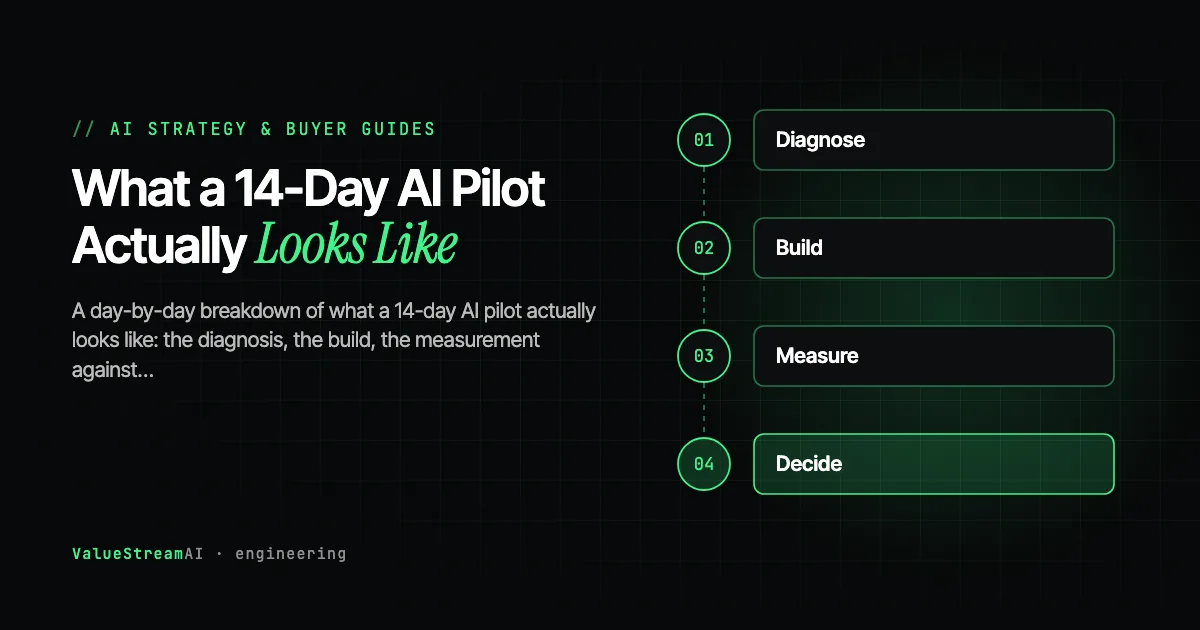
- Diagnosis (Days 1–3): Find the single automation that will move the most value, and confirm it is technically feasible.
- Build (Days 4–10): Build that one system properly, in a safe environment, before it touches anything live.
- Measure (Days 11–13): Run it against real inputs and compare the result to the day-one baseline.
- Scale or stop (Day 14): Decide, on evidence, whether to expand or walk away.
Notice what is not here: a two-week attempt to automate your entire operation. That would fail, and it would fail for good reasons I will explain. The pilot does one thing extremely well. Here is each phase in detail.
Days 1–3: The Value Stream Diagnosis
The first three days are not build days. They are the days that decide whether the build will matter. We call this the Value Stream Diagnosis, and it does three jobs.
Job one: find the highest-value target. This is the most important strategic decision of the whole pilot, and it runs against the instinct most vendors follow. The safe move is to pick a small, low-risk task and prove the concept. We do the opposite. We deliberately target the most complex, highest-value automation you believe will make the biggest difference to your business. There is a reason. If we can prove out the hardest, most valuable workflow first, the smaller and related tasks around it are easier by comparison and fall into place during the scale phase. Attacking the biggest win first means the quick wins of lesser complexity do not get in the way of proving whether the thing that actually matters is possible. It also means that if the pilot succeeds, you have proof on the problem worth funding, not a toy.
Job two: confirm it can actually be built. Most businesses do not have a clear picture of what their own systems expose. You know you use a particular CRM or booking platform, but whether it has a documented API, who controls the credentials, and whether the person who built your internal tool three years ago is still reachable, those answers are often missing. This is the most overlooked blocker in AI projects, and discovering it in week seven of a build is far more expensive than discovering it on day one. There is a fast test any non-technical owner can run, which I break down in our AI implementation roadmap: for each core tool, does it offer an API or a documented integration path? If yes, integration is very likely clean. If no, the pilot plans around a more fragile, browser-based approach from the start instead of hitting the wall mid-build.
Job three: agree on what "correct" looks like. Before anyone writes code, the relevant stakeholders, the operations lead, the person who owns the process, whoever signs off, agree on what a correct output actually is and what number we are trying to move. This sounds obvious and it is rarely done. The most frustrating outcome in this entire field is a system that is "working as designed but not what we wanted." Settled in advance, that is a single conversation. Discovered after launch, it is an expensive rebuild. This conversation is also where we lock the baseline: the current cost, time, or error rate we will measure against on day 13.
Days 4–10: Build the Highest-Value Automation First
With the target chosen, feasibility confirmed, and success defined, the build phase has a clear job: make the one system work, properly, in a way that survives real use.
Two disciplines separate a real build from a demo. The first is that nothing gets built directly against your live systems. AI agents behave unexpectedly in edge cases, and the moments where they take real actions, sending an email, updating a record, triggering a notification, are exactly where real-world consequences happen. So the build runs in a sandboxed environment that mirrors production: a test database, a staging copy of the CRM, mocked responses for anything that sends money or messages. We have been called in to recover businesses from the alternative, a runaway agent writing bad data into a live CRM, and it is always avoidable. Production is never the place to discover edge cases.
The second discipline is building for the fact that the core technology is non-deterministic. Large language models do not behave like traditional software. Even with the same input, the output can vary across versions and prompt changes. That is a property of the technology, not a bug to be fixed once. So a proper build wraps the model in guardrails: input validation to block malformed or out-of-scope requests, output checks before any action is taken, defined fallback paths for failure, and logging of every decision. This is the difference between an automation you can trust to run and a demo that works until it does not. Our guide on why no-code fails at enterprise scaling covers what happens when this layer is skipped.
Every request is validated before it reaches the model, every output is checked before any action is taken, failures go down a defined fallback path, and every decision is logged. All of it runs in a sandbox that mirrors production, with a test database, a staging CRM and mocked responses for anything that sends money or messages.
By the end of day 10, you do not have a slide about what could be built. You have a working system, running against realistic data, doing the highest-value job you picked on day one.
Days 11–13: Measure Against the Day-One Baseline
This is the phase most pilots skip, and skipping it is why most pilots cannot prove anything. The system now meets reality.
We run it against real inputs and, where the workflow is customer-facing, a controlled batch of real user interactions with full logging. This matters because internal testing has a systematic blind spot: the people testing know what the system is supposed to do, so they test the expected path. Real users do not know the expected path. They use their own words, their own mental models, and edge cases nobody on the team imagined. Across every deployment we have run, the first 100 real interactions surface three to five failure modes that survived weeks of internal testing. Finding them now, during the measured phase, is the entire point.
Then we compare the result to the baseline we locked on day one. Not a vibe, not a demo, a number: the hours saved, the error rate reduced, the response time cut, whatever we agreed was the metric that matters. Because that baseline exists, the day-14 conversation is about evidence, not opinion. You can see the same measurement discipline applied in production in our B2B prospecting automation case study.
Day 14: Scale or Stop
The final day is a decision, and it is an honest one. We put the measured result next to the target and there are two outcomes.
If we hit the target, we move to the scale phase: a 90-day plan to expand from the one proven automation to the related workflows around it, with cost projections you can actually plan against. This is where those smaller, lesser-complexity tasks come in, and they come in fast, because the hardest part is already solved and proven.
If we did not hit the target, we tell you, and there is no invoice. That is the promise that makes the whole thing credible. We are not asking you to bet a quarter and a six-figure sum on a hope. We are asking for two weeks to produce a measured result, and we only get paid if it lands. That is only possible because we own the outcome instead of billing for the activity.
The Competitor Pulse Check
Here is the honest contrast between a structured 14-day pilot and the pilots that produce the 95% failure rate.
| Factor | Typical AI Pilot / POC | The 14-Day Pilot |
|---|---|---|
| Target chosen | Small, safe, low-value task | Highest-value, highest-complexity workflow |
| Baseline defined | Rarely, so results are unprovable | Locked on day one, measured on day 13 |
| Where it is built | Often straight against live systems | Sandboxed environment first |
| Tested by | Internal team only | Real users, fully logged |
| Who owns the result | A contractor who then leaves | An embedded team, accountable end to end |
| Time to a measured result | A quarter or more | 14 days |
| If it does not work | You paid anyway | No invoice |
Typical pilot: small, safe, low-value task.
Typical pilot: rarely, so results are unprovable.
Typical pilot: often straight against live systems.
Typical pilot: internal team only.
Typical pilot: you paid anyway.
What We Need From You
A pilot this fast only works if the buyer side is ready. This is short, and it is the whole list:
- One decision-maker who can commit. Not a committee. One person who can agree on the target, approve the baseline, and make the day-14 call.
- Access to the target system. Read access at minimum, and a clear answer on who controls credentials. This is where the day-1 feasibility check pays off.
- Two or three hours of the right people's time in the first three days. The diagnosis needs the person who actually does the process today, not just the person who manages them.
- Agreement on the metric before we build. We will drive this conversation, but the sign-off has to be yours.
That is genuinely it. If you can supply those four things, two weeks is enough. Our AI readiness check will tell you in a few minutes whether your systems are set up for a clean pilot.
What a 14-Day Pilot Costs
A pilot sits at the entry point of our engagement model, and the pricing is deliberately transparent rather than hidden behind a "contact us" wall:
- Pilot (fixed scope): $5,000–$15,000 to prove your single highest-value automation against a baseline.
- Retainer (ongoing partner): a monthly engagement sized to your budget that scales into the surrounding workflows once the pilot lands.
- Embed (full-scale): a dedicated engineer inside your operation, scoped to the project, for company-wide or compliance-grade transformation.
The pilot is intentionally the smallest, lowest-risk commitment. It exists so you can find out whether the economics work before you scale into a retainer. Compare that against the alternative of a $300,000 fully loaded first-year in-house hire, laid out in our cost breakdown of an AI agency vs an in-house hire, or the full cost of AI agents in 2026. Full detail is on our pricing page.
Prove your single highest-value automation against a baseline.
- The smallest, lowest-risk commitment
Scales into the surrounding workflows once the pilot lands.
A dedicated engineer inside your operation.
- For company-wide or compliance-grade transformation
Related reading from our team:
- If you are starting from zero, our step-by-step guide on how to implement AI in your business is the place to begin.
A pilot proves value; production takes longer. See how long AI automation takes to implement for what happens after day 14.
Frequently Asked Questions
What is a 14-day AI pilot?
It is a two-week engagement structured to prove, with a measured result, whether AI automation can move a specific number in your business. It runs in four phases: a Value Stream Diagnosis to pick the highest-value target and confirm feasibility, a build phase in a safe sandboxed environment, a measurement phase against a day-one baseline, and a scale-or-stop decision on day 14. It targets one high-value workflow deliberately, rather than trying to automate everything at once.
Can you really build something useful in only 14 days?
Yes, because the pilot solves one carefully chosen problem, not your entire operation. We target the single highest-value automation, prove it against a baseline, and leave the surrounding lower-complexity tasks for the scale phase. A full enterprise multi-agent rollout genuinely takes two to three months, but proving the highest-value piece and measuring the result fits in two weeks.
Why do you target the hardest task first instead of an easy win?
Because proving the hardest, highest-value workflow is what tells you whether the project is worth funding. If we prove the difficult part, the smaller related tasks become straightforward by comparison and fall into place during scaling. Leading with an easy, low-value win proves almost nothing and is the most common reason pilots die without a second phase.
What happens if the pilot does not hit its target?
If the numbers we agreed on day one do not move, there is no invoice. That is only possible because we take ownership of the outcome rather than billing for activity. You are risking two weeks and some access, not a quarter and a large fixed fee.
How is this different from a normal agency proof of concept?
Three things: we define and lock a baseline so the result is provable, we deliberately target your highest-value workflow rather than a safe demo, and we own the outcome as an embedded team rather than handing over a deliverable and leaving. Those three differences are precisely what separate the pilots that scale from the roughly 95% that do not.
What do we need to provide to run a pilot?
One empowered decision-maker, access to the target system with a clear answer on who controls credentials, two to three hours of the right people's time in the first three days, and agreement on the success metric before the build starts. If you can supply those four things, the timeline holds.
What to Do Next
The reframe to take away is this: a good pilot is not about doing AI quickly. It is about reaching a measured result before your budget, patience, or organizational goodwill runs out, and doing it in a way where you only pay if it works.
If you want to check whether your systems are ready for a clean two-week pilot, start with our AI readiness check or get a scoped estimate through our automation quote tool. When you are ready to pick a target and set a baseline, our AI automation development service is where the diagnosis begins. Two weeks, one high-value problem, a number that moves or no invoice.
A pilot is step one of a longer programme. Our complete guide to business automation covers what comes after, and why most organisations never get past this stage.
Muhammad Kashif is co-founder of ValueStreamAI, leading technical delivery and AI strategy. He designs and ships custom agentic AI and healthcare automation systems for clients across the US and UK. More about Muhammad Kashif →