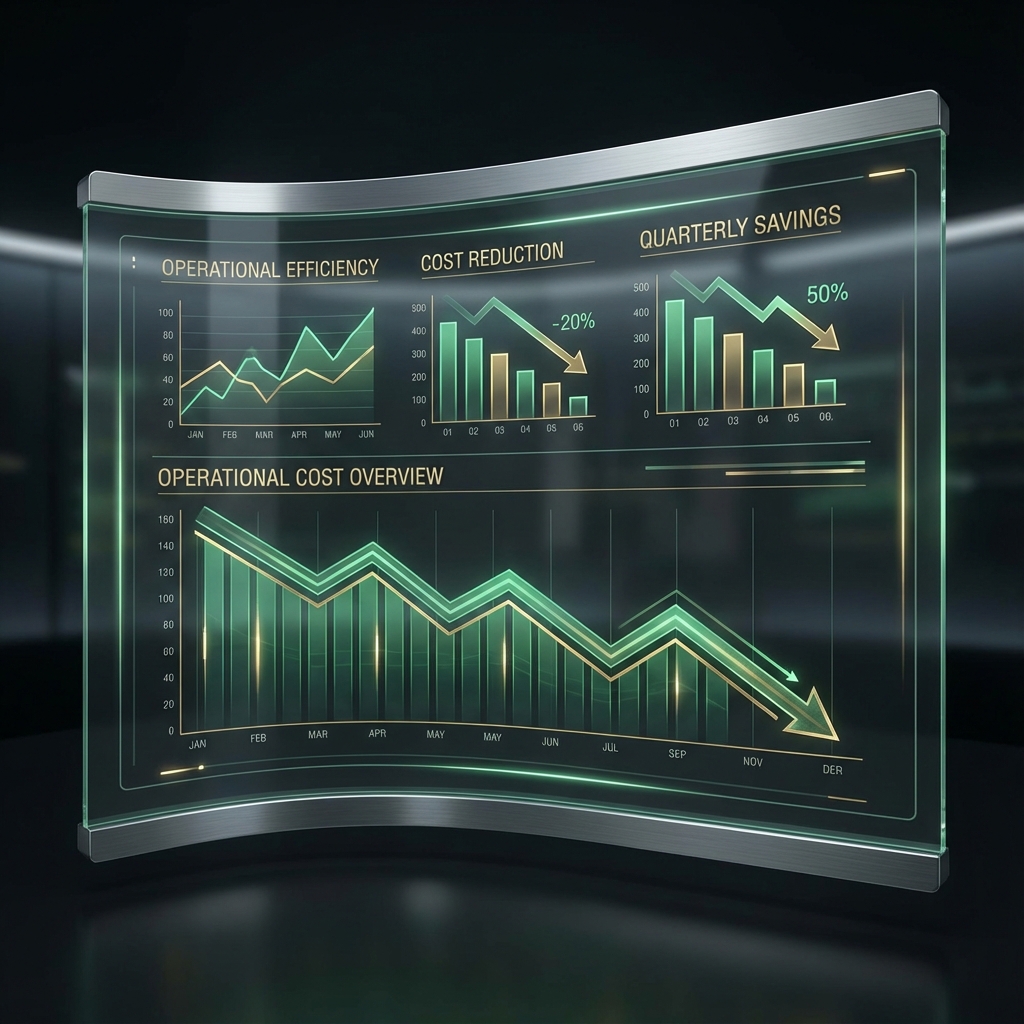
Ask how much can AI save my business and you will get a percentage: 30%, 60%, 80%. Those numbers are not invented, but almost all of them share a problem worth understanding before you plan around one. They are measured across companies that completed a deployment. The ones that abandoned theirs are not in the sample, which means the published averages describe the winners rather than the field.
This guide gives you something more useful than a headline percentage: the arithmetic to calculate your own figure, honest benchmark ranges by category, and the one step that separates a savings claim you can defend from one you cannot.
| Metric | 2026 Benchmark |
|---|---|
| Reported average return on AI automation spend | ~$3.70 per $1, among completed deployments |
| Typical payback period, well-scoped project | 3 to 6 months |
| Cost per customer interaction, human vs automated | £6 to £12 vs £0.40 to £1.60 |
| Recommended annual maintenance budget | 15 to 20% of build cost |
Start Here: Baseline Before You Build
The most consequential step in calculating AI savings happens before any automation exists, and skipping it is the most common reason a project that genuinely worked cannot prove it.
Measure what the process costs you today. Not an estimate, a measurement. How many times a week does it run, how long does each run take, who does it, and what is their fully loaded hourly cost. If you cannot answer those four questions for a process, you cannot credibly claim a saving on it afterwards, and you will end up in the common position of having a working system and an unconvinced finance director.
This matters more than it sounds. Baselining is where most of the disagreement about AI ROI actually originates: a business that never measured the before-state is comparing a real after-number against a remembered before-number, and memory reliably overstates how long things used to take on good days and understates it on bad ones.
The Calculation
The core arithmetic is not complicated, and doing it per-process rather than for "AI" in general is what makes it usable.
Annual labour cost of a process = (minutes per run ÷ 60) × fully loaded hourly cost × runs per week × 52
A worked example. An admin task taking 15 minutes, running 40 times a week, performed by someone at a fully loaded cost of $35 an hour:
(15 ÷ 60) × 35 × 40 × 52 = $18,200 a year
That is one process. Most businesses that run this exercise across their top five repetitive processes are surprised by the total, not because any single number is large but because nobody had ever added them up.
Then apply a realistic automation rate. Full elimination is rare and you should not model it. 60 to 80% of the time on a well-chosen, rule-based process is a defensible planning assumption, with the remainder going to exception handling and review. On the example above, that is roughly $10,900 to $14,500 a year recovered from a single process.
Against that, weigh the total cost: build cost, plus 15 to 20% of build annually for maintenance, plus your own team's time in discovery and testing. Our complete guide to AI automation cost covers the build side by engagement model.
Where the Savings Actually Come From
Four categories account for most of what businesses recover, and they behave differently.
Labour-intensive data work. Copying between systems, formatting reports, manual entry. This is the highest-confidence category because the work is measurable, repetitive, and has a clear correct answer. Typical recoverable volumes we see: 4 to 8 hours a week per finance team member on invoice and purchase order matching, 2 to 3 hours a day per sales rep on CRM entry from calls and emails, 6 to 10 hours a week per operations manager on reconciliation.
Customer interaction cost. The economics here are structural rather than incremental: human support cost scales linearly with volume, automated does not. Industry cost benchmarks put a live agent interaction at £6 to £12 against £0.40 to £1.60 for automated handling of routine queries. The saving is real but the framing matters, since the goal is usually shifting humans to complex escalations rather than reducing headcount.
Document and compliance processing. Manual document processing typically runs £0.50 to £2.50 per document against £0.01 to £0.05 automated at production scale. For a business handling 10,000 documents monthly that is a large annual gap. There is a separate compliance benefit that does not show up as cost saving: AI can audit 100% of transactions where human sampling covers perhaps 10%.
Revenue recovered, not just cost saved. The category most businesses leave out of the calculation entirely, and often the largest. Slow lead follow-up is the clearest example: five-minute responders convert at around 21% against 2.3% for those responding after 24 hours. If you are in the second group, the saving from automating follow-up is not an hourly-cost saving at all, it is revenue you were losing. Our guide to AI lead follow-up covers that calculation specifically.
The Comparison Most Businesses Should Actually Run
For a lot of small businesses the real decision is not "automate or carry on," it is "automate or hire." That comparison is more concrete and usually more decisive.
A US junior engineer runs roughly $85,580 a year, about $7,100 a month. Even an intern averages about $26.79 an hour, roughly $4,400 a month. A part-time administrator is less, but still a recurring, permanent cost that scales with the hours you need covered and does not cover evenings or weekends.
Against that, a scoped automation build in the $5,000 to $15,000 range is a one-off cost plus maintenance. If it genuinely removes 15 to 20 hours a week of routine work, the comparison against even a part-time hire usually resolves within the first year, and the automation continues working at 11pm on a Sunday.
The honest counterweight: a hire brings judgment, handles the exceptions the automation escalates, and absorbs work you have not thought of yet. The correct answer is often both, with the automation removing routine load so the hire is doing work worth their salary. Our hire vs automate calculator runs this comparison against your actual numbers.
Why the Published Percentages Are Higher Than What You Will Get
Three reasons, and understanding them is the difference between a plan that survives contact with reality and one that does not.
Survivor bias. Averages like $3.70 returned per $1 are drawn from completed deployments. Projects abandoned partway are not counted, so the figure describes projects that worked rather than projects that were attempted.
Definition differences. Some studies count only hard cost removal, others include revenue gains and quality improvements. A 60% figure and a 20% figure can describe the same deployment measured differently. When you see a percentage, ask what it is a percentage of.
Pilot-clean inputs. The savings modelled in a business case almost always use pilot data, which is cleaner and more predictable than production reality. The genuine number solidifies 60 to 90 days after launch, once real usage has driven a round of tuning. Budget for that phase rather than treating go-live as the finish line.
A Worked Example Across a Whole Small Business
Single-process arithmetic is useful but it understates the picture, because the value is usually in the total rather than any one line. Here is the exercise run across a hypothetical 25-person services business, using the formula above.
| Process | Minutes | Runs/week | Loaded rate | Annual cost |
|---|---|---|---|---|
| CRM entry from calls and emails | 90/day | 5 (per rep, x3 reps) | $35 | $40,950 |
| Invoice and PO matching | 20 | 60 | $35 | $36,400 |
| Quote and proposal drafting | 45 | 15 | $45 | $26,325 |
| Report compilation | 120 | 5 | $40 | $20,800 |
| Inbound enquiry triage and routing | 6 | 150 | $30 | $23,400 |
| Total | $147,875 |
Apply a 60 to 80% recovery assumption to the automatable portion and you are looking at roughly $89,000 to $118,000 a year in recoverable labour cost. Against a build in the $25,000 to $50,000 range for a system covering several of these, plus 15 to 20% annual maintenance, the payback maths is not close.
Two honest caveats on that table. First, recovered hours only become money if the time goes somewhere useful, either redeployed to revenue-generating work or absorbing growth you would otherwise have hired for. If the hours simply disappear into a less busy week, the saving is real for the employee and invisible on the P&L. Second, this business would not automate all five at once. Doing one properly, measuring it, and then moving to the next is both cheaper and far more likely to work than a simultaneous five-process programme.
When the Honest Answer Is That AI Will Not Save You Much
Worth stating plainly, since a page about AI savings published by an AI automation company has an obvious incentive to overstate.
Automation returns little when the process runs infrequently. Below roughly 50 executions a month, the build cost rarely recovers within a year regardless of how tedious the task is. It also returns little when the process is genuinely judgment-heavy rather than rule-heavy, when the underlying data is inconsistent enough that most of the project becomes data cleanup, or when the process changes so often that the automation needs rebuilding each time.
There is also a common case where the numbers work but the timing does not: a business already mid-way through a system migration. Automating against systems you are about to replace is spending twice. Wait for the new stack.
If several of those describe your situation, the useful conclusion is not "AI does not work," it is that this particular process is the wrong first candidate. Pick the highest-frequency, most rule-based thing you do instead.
The Competitor Pulse Check
| Factor | A Defensible Savings Claim | A Typical Vendor Claim |
|---|---|---|
| Baseline | Measured before build | Estimated after the fact |
| Automation rate assumed | 60 to 80%, exceptions accounted for | Implied 100% |
| Costs counted | Build, maintenance, internal time | Build only |
| Timing | Measured 60 to 90 days post-launch | Measured at launch |
| Scope | Per process, specific | "Up to X%" across the business |
Typical vendor claim: estimated after the fact.
Typical vendor claim: implied 100%.
Typical vendor claim: build only.
Typical vendor claim: measured at launch.
Typical vendor claim: "up to X%" across the business.
Frequently Asked Questions
How much can AI realistically save a small business?
For a well-chosen repetitive process, expect to recover 60 to 80% of the time it currently consumes, not 100%. On a process costing $18,000 a year in labour that is roughly $11,000 to $14,500 recovered annually. The total depends entirely on how many such processes you have, which is why the per-process calculation is more useful than any site-wide percentage.
How do I calculate AI savings for my own business?
Multiply minutes per run by fully loaded hourly cost and annual frequency to get the current cost of each process, then apply a 60 to 80% recovery assumption and subtract build cost plus 15 to 20% annual maintenance. Do it per process rather than in aggregate, and measure the baseline before you build.
How long does AI automation take to pay for itself?
Well-scoped projects typically reach payback in three to six months, and revenue-side automations like lead follow-up can be faster because the gain is new revenue rather than recovered hours. Anything projecting payback in weeks is usually excluding maintenance or internal time.
Is it cheaper to automate or to hire someone?
For routine, high-frequency work, automation usually wins on a one to two year view, since a US junior hire runs about $7,100 a month against a one-off $5,000 to $15,000 build. For work requiring judgment and exception handling, the hire wins. Most businesses need both, with automation clearing routine load so the hire does higher-value work.
What is the most common mistake in calculating AI savings?
Not measuring the before-state. Without a baseline you have a working system and no defensible claim, which is the most common reason a successful first project fails to get funding for a second.
What's Next
Once you have a number, the next question is what it costs to get there: our complete guide to AI automation cost covers pricing by engagement model, and what $5,000 actually buys covers the entry tier. If the honest answer is that your savings are concentrated in lost revenue rather than wasted hours, start with AI lead follow-up. And if the headcount question is really what is behind this, will AI replace my employees covers that directly. For a low-risk way to test the numbers before committing, see what a 14-day AI pilot actually looks like.
Want the number without doing the arithmetic yourself? The savings calculator estimates your annual Automation Tax in about 60 seconds, the ROI calculator models the return, and the hire vs automate calculator settles the staffing comparison. All free on our tools page, or talk to our team for a scoped assessment.
Muhammad Kashif is co-founder of ValueStreamAI, leading technical delivery and AI strategy. He designs and ships custom agentic AI and healthcare automation systems for clients across the US and UK. More about Muhammad Kashif →