A customer opens ChatGPT and types: "Who's a good roofer in Clearwater?" It names three companies. You are not one of them. If you are wondering how to get ChatGPT to recommend your business, you are asking the right question at the right time: more buyers now ask an AI assistant before they ever open Google.
This guide explains, without jargon, how ChatGPT, Claude, Gemini, Perplexity and Grok decide which businesses to suggest, why you cannot simply pay to be named, how to check what they say about you today, and the seven things that genuinely make a difference.
| Metric | 2026 Benchmark |
|---|---|
| ChatGPT weekly users | 900 million+ (OpenAI, February 2026) |
| Can you pay to be recommended? | No. ChatGPT ads exist but OpenAI says they do not change answers |
| Share of website visits from AI platforms | 0.32% (SE Ranking, 2026) |
| Share from normal search | 42.75% (SE Ranking, 2026) |
| What helps most | Your website, reviews and mentions on other sites |
The short answer. You cannot buy a ChatGPT recommendation. AI assistants suggest businesses they can find clear, consistent, trustworthy information about: a website that plainly says what you do, where and for whom; genuine reviews; and mentions on directories, local news and trade sites they already trust. Ask the assistants about your trade and town today to see where you stand, fix your website first, then build reviews and mentions. The same work also helps you on Google, which still sends far more visitors.
Key takeaways
- There is no sign-up or paid slot for recommendations. OpenAI says ChatGPT's ads are labelled and separate, and do not change answers.
- Assistants repeat what the web says about you. Your website and other sites' mentions are the raw material.
- Plain facts win. Who you serve, where, what it costs and what customers say, written so anyone could quote it.
- Test it yourself monthly. Answers vary, so look for the pattern across assistants.
- Google still matters more for visits. The good news is the same fixes serve both.
How Does ChatGPT Decide Which Businesses to Recommend?
When you ask an AI assistant for a recommendation, it does one of two things. Either it answers from what it learned during training, or, increasingly, it searches the web in that moment, reads a handful of pages and summarises them. ChatGPT, Gemini, Claude, Perplexity and Grok can all search the web, and Perplexity and ChatGPT's search show the sources they used.
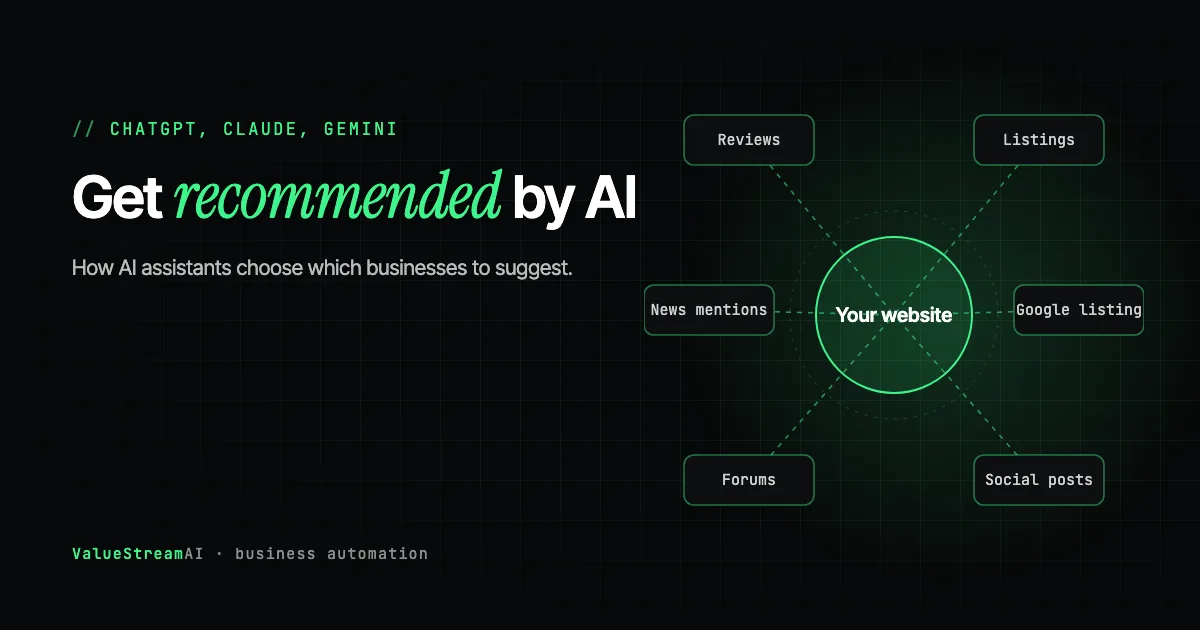
Either way, the assistant can only recommend you if it has found trustworthy information about you. It is, in effect, reading what the internet says about your business and repeating the consensus. None of these companies publishes an exact formula, and each weighs sources differently, but the sources themselves are the same everywhere:
- Your own website, especially pages that plainly describe a service in a place.
- Reviews on Google and the review sites in your trade.
- Directories and listings, from Yelp to industry associations.
- News and articles that mention you, from local papers to trade magazines.
- Your Google listing (Gemini in particular draws on Google's own data).
- Forums and social posts where customers discuss who they used.
If those sources are thin, contradictory or out of date, the assistant either skips you or describes you wrongly.
Can You Pay to Be Recommended by ChatGPT?
No, not as a recommendation. OpenAI began testing ads in ChatGPT in February 2026 for some users. Its own announcement says ads are clearly labelled, shown separately from the answer, and do not influence the answer itself (OpenAI). So you can buy a labelled advert, in some countries and plans, but you cannot buy a place in the assistant's own answer.
That is worth knowing because agencies now sell "AI search packages" promising placement. Nobody can guarantee what ChatGPT will say. What an agency can honestly do is improve the information the assistants read about you, which is the work described below.
Is It Worth Bothering Yet? The Honest Numbers
AI assistants are huge. OpenAI said in February 2026 that ChatGPT had passed 900 million weekly users. But most people still click through from Google. SE Ranking tracked 101,574 websites from January 2025 to April 2026 and found AI platforms sent 0.32% of all website visits, against 42.75% from normal search (SE Ranking).
So why bother? Because the visits AI sends are often the most decided ones. Someone who asked an assistant for three recommended builders and then clicked yours is close to calling. We see it in our own analytics: ChatGPT has sent visitors straight to our published Search Console results, the page that proves what our work did. AI assistants send people to evidence.
The practical answer: do not choose between Google and AI. The same work serves both, and Google still pays the bills.
The Five-Minute Test: What Do AI Assistants Say About You?
Before changing anything, find out where you stand. Open ChatGPT, Gemini, Claude, Perplexity and Grok and ask each the same questions:
- "Who is a good [your trade] in [your town]?" This is the question your customers ask.
- "What do you know about [your business name] in [your town]?" This shows what the assistant believes about you, including mistakes.
- "What does [your business] charge for [your main service]?" Many assistants will guess if you do not publish anything.
Write down the answers and, where shown, the sources each assistant used. Those sources are a map of where you need to be mentioned. Repeat the test every month: answers change from run to run, so the pattern matters more than any single reply.
Seven Things That Make AI Assistants Recommend You
1. A Clear Page for Each Service and Area
An assistant answering "best kitchen fitter in Tampa" looks for a page that plainly says "kitchen fitting in Tampa". If your website has one general services page, there is nothing specific to find. A page per service, and per area you serve, gives both Google and AI something to match. This is also the most common gap we find on small business websites, explained in why your business isn't showing up on Google.
2. Plain Facts Anyone Could Quote
AI assistants lift sentences. Write the basics so they stand alone: "Smith Roofing is a family roofing company in Clearwater, Florida, founded in 1998, repairing and replacing residential roofs across Pinellas County." Add what you charge or a typical price range, how long jobs take, and who you work with. Vague marketing lines ("passionate about excellence") give an assistant nothing to repeat.
We built a page that does exactly this for our own company, our reviews and recognition page, which gathers our facts and every third-party listing in one place so a person or an AI assistant can confirm the basics at once.
3. Genuine Reviews, and Replies to Them
Reviews are the clearest signal of what customers think, and assistants read them. Ask every satisfied customer, make it easy with a direct link, and reply to every review, good or bad. Detailed reviews that mention the service and the town are worth more than "Great!". Never buy or fake reviews: it breaks the platforms' rules and the pattern is easy to spot.
4. Accurate Listings on the Directories Assistants Trust
Assistants that search the web often land on directories: Google, Yelp, Bing Places, Apple Maps, your trade association, and the industry directories in your field. Make sure you are listed on the ones that matter in your trade, with full and correct details. A listing with your old phone number teaches the assistant the wrong thing.
5. Mentions in Local News and Trade Sites
When an independent site writes about you, an AI assistant treats it as evidence that you are real and respected. Sponsor a local event, win or enter a trade award, share a genuinely useful story with a local paper, or contribute an article to a trade publication. These mentions also help on Google, which counts links from other sites as part of how well known a business is.
6. Answer the Questions Customers Actually Ask
People ask assistants questions: "How much does a new roof cost in Florida?", "Do I need planning permission for a garden room?" If your website answers those questions clearly, with your own experience and figures, you become a source the assistant can use. A short FAQ on each service page is a good start; a few genuinely useful guides are better.
7. The Same Details Everywhere
If your website, Google listing and directories disagree about your name, address, phone number or services, assistants get confused and may skip you or mix you up with another business. Pick one exact version of your details and use it everywhere.
How AI Recommendations Come Together
A customer asks an assistant for a recommendation. The assistant answers from what it learned or searches the web. It reads your website, reviews, listings and mentions on other sites. If the information is clear and consistent it can name you; if it is thin or contradictory it names someone else.
What Does This Cost?
Much of this you can start yourself this week: run the test, finish your listings, ask for reviews and rewrite your about page in plain facts. The larger job is usually the website. If yours has one page for everything, the fix is a website structured around what customers ask.
Our websites, built to be found on Google and by AI assistants, cost $5,000 to $10,000, depending on scope, and are built for Google and AI assistants together: a page per service and area, plain facts and questions answered, your listings set up, and a system you can add pages to yourself. Ongoing work, including reviews, listings and articles that earn mentions, is a monthly retainer from $1,500. The SEO and digital marketing service page lists what is included, and the pricing page shows every option.
What to Do If ChatGPT Gets Your Business Wrong
Sometimes the problem is not that an assistant ignores you, but that it describes you wrongly: an old address, a service you stopped offering, prices from years ago, or a mix-up with a business that has a similar name. This happens because the assistant is repeating what it found, and some of what it found is out of date.
You cannot edit ChatGPT's answer directly. You can fix what it reads:
- Correct the source. If the answer shows sources, open them. An old directory listing or a stale page on your own site is often the culprit. Update it or ask the directory to.
- State the facts plainly on your website. A short "About" section with your current name, address, services, areas and founding year gives assistants a clear, current version to repeat.
- Use the same details everywhere. Mismatched listings are the most common reason assistants confuse two businesses.
- Give it time and check again. Assistants that search the web can pick up corrections within weeks. What one learned during training changes only when it is updated, so repeat the test monthly.
Several assistants also let you rate an answer or report a mistake. It is worth doing, but fixing the sources is what lasts.
Common Mistakes That Keep Businesses Out of AI Answers
- A website that says nothing specific. "Quality service you can trust" gives an assistant nothing to quote. "Roof repairs in Clearwater, from about $450" does.
- Everything on one page. One general services page cannot match a specific question about one service in one town.
- No prices at all. Customers ask assistants what things cost. If you publish nothing, the assistant quotes a competitor or guesses.
- Hiding behind social media. A Facebook page is harder for assistants to read in depth than a proper website.
- Buying fake reviews or mentions. Platforms remove them, and the pattern can damage trust in the genuine ones.
- Expecting one change to work overnight. This is steady work across your website, reviews and listings, checked monthly.
The Competitor Pulse Check
| Factor | ValueStreamAI approach | Typical "AI search package" |
|---|---|---|
| Promise | Better information for assistants to read; no guarantees | "Get recommended by ChatGPT" |
| Where the work goes | Your website, reviews, listings, mentions | Often a report and a few listings |
| Google and AI | Same work serves both | Sold as a separate product |
| Proof | Published client results | Screenshots of single answers |
| Testing | Monthly checks across five assistants | One-off |
| Price | Website $5,000 to $10,000; retainer from $1,500 a month | Varies |
Frequently Asked Questions
How do I get ChatGPT to recommend my business?
Make it easy for ChatGPT to find clear, consistent, trustworthy information about you: a website with a page for each service and area written in plain facts, genuine reviews, accurate directory listings and mentions on other reputable sites. There is no form to fill in and no way to buy the recommendation.
How do I get my business on ChatGPT?
There is no listing to submit. ChatGPT learns about businesses from the web and, when it searches, reads pages in real time. Being on ChatGPT means being well described on your own website and on the sites it reads, such as review sites, directories and local news.
Can I pay ChatGPT to recommend my business?
No. OpenAI started testing labelled ads in ChatGPT in 2026, but it says ads are shown separately and do not influence the answers. Be wary of anyone promising guaranteed placement in AI answers.
Does this also work for Claude, Gemini, Perplexity and Grok?
Yes, broadly. Each assistant weighs sources differently, and Gemini leans on Google's own data, but all of them rely on what the web says about you. Clear pages, reviews, accurate listings and independent mentions help across all of them.
How long does it take to start being recommended by AI?
Assistants that search the web can pick up changes within weeks of them being published and found. What an assistant learned in training changes only when it is retrained, which can take months. Expect gradual progress and check monthly.
Is AI search more important than Google now?
Not for visits yet. In SE Ranking's 2026 study, AI platforms sent 0.32% of website visits and normal search sent 42.75%. AI assistants matter because they shape shortlists, so do the work that serves both.
How much does it cost to get recommended by AI assistants?
The groundwork can cost only time. A website rebuilt to be found by Google and AI assistants costs $5,000 to $10,000 with us, depending on scope, with optional ongoing work from $1,500 a month.
What's Next
Run the five-minute test today. If the assistants name your competitors and not you, send us what they said. On a free call we will show you which sources they relied on and what would put you in the answer.
→ Start here: why your website isn't generating enquiries
→ See how we get businesses found on Google and by AI assistants
→ Why your business isn't showing up on Google
→ See our pricing, or talk to us
Syed Rayyan is co-founder of ValueStreamAI, leading research and marketing. He has run SEO for client websites since 2020, across technical audits, on-page work and link building, and leads the marketing side of every build. He also runs the firm's evaluation of emerging AI tooling and translates technical capability into clear guidance for non-technical decision-makers. Connect on LinkedIn →