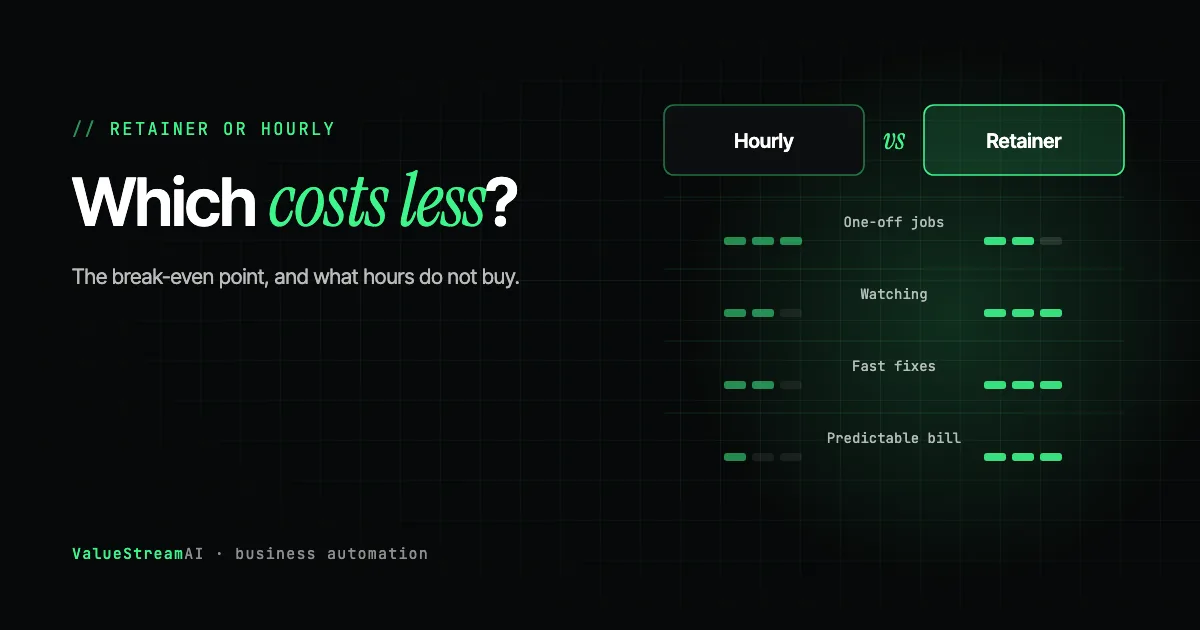
Your web developer offers two ways to pay: $100 an hour when you need something, or a fixed monthly retainer. Your AI developer offers the same choice. Monthly retainer vs hourly rate: which costs less? The honest answer is "it depends how much you use them", and there is a simple way to work it out.
This guide compares published hourly rates for web, SEO and development work, explains what a retainer buys that hours do not, shows the break-even maths, and is clear about when paying by the hour is the better deal.
| Metric | 2026 Benchmark |
|---|---|
| SEO providers, average hourly rate (Ahrefs, 439 providers) | About $111 an hour |
| Freelance web developers, average (Arc) | About $61 to $80 an hour |
| Web development companies on Clutch, average | About $25 to $49 an hour |
| Our website and SEO retainer | From $900 a month |
| Our AI and development retainer | From $1,500 a month |
The short answer. Paying by the hour costs less when you need occasional, well-defined work: a few fixes a year, one new page, a single change. A monthly retainer costs less when the work is regular, when things need watching between requests, or when you need fast help if something breaks. The break-even point is simple: divide the retainer by the hourly rate. A $900 retainer at $111 an hour breaks even at about 8 hours a month. If you regularly need more than that, or need someone responsible for the result, a retainer usually wins.
Key takeaways
- Hourly suits occasional, defined jobs. You pay only for what you use.
- A retainer suits ongoing work and anything that must be watched or fixed quickly.
- Break-even = retainer price divided by the hourly rate. $900 at $111 is about 8 hours.
- Hourly rates hide the cost of waiting. Urgent fixes depend on someone being free.
- A good retainer lists what is done every month, so you can compare it with the hours it replaces.
What Do Agencies and Freelancers Charge by the Hour?
- 1SEO provider, average (Ahrefs)survey of 439 providers$0
- 2Freelance web developer, average (Arc)top of $61 to $80 band$0
- 3Web development company on Clutchtop of $25 to $49 band$0
| Who | Published hourly rate | Source |
|---|---|---|
| SEO providers | Average about $111 an hour; most common $75 to $100 | Ahrefs survey of 439 providers |
| Freelance web developers | Average about $61 to $80 an hour | Arc freelance rates |
| Web development companies on Clutch | Average about $25 to $49 an hour | Clutch pricing |
Rates vary widely with location, experience and specialism. Clutch's agency average includes many offshore firms, which is why it sits below freelancer averages.
Monthly Retainer vs Hourly Rate: The Break-Even Maths
Divide the retainer by the hourly rate you would otherwise pay.
| Retainer | Hourly rate | Break-even hours a month |
|---|---|---|
| $900 | $111 | About 8 |
| $900 | $80 | About 11 |
| $1,500 | $111 | About 13.5 |
| $1,500 | $80 | About 19 |
If you regularly need fewer hours than that, pay hourly. If you need more, or the work is unpredictable, a retainer is cheaper. But hours are not the whole story.
What a Retainer Buys That Hours Don't
Watching between requests. Hourly help only works when you notice a problem. A retainer pays someone to check your website, app or AI system before something breaks: backups, security updates, form checks, AI answers that have drifted, a model about to be retired.
Speed when it matters. An hourly freelancer fixes your broken booking form when they are free. A retainer puts you in a queue with agreed response times.
Context. A team on a retainer knows your systems, so a 10-minute change takes 10 minutes, not an hour of finding their way around.
Responsibility. Hourly work delivers tasks. A good retainer owns an outcome: the site stays up and keeps bringing enquiries, the AI agent stays accurate.
When Paying by the Hour Is the Better Deal
We say this plainly because it is true:
- Your website or system rarely changes, and nothing breaks when nobody looks for a month.
- You have a defined one-off job, such as a new page or a single integration.
- You have someone in-house who handles the routine and you only need occasional expert help.
- You are testing a new provider before committing to a monthly relationship.
What Our Retainers Include
Our retainers state what happens every month, so you can compare them with the hours they replace.
- Website & SEO Care, from $900 a month: hosting oversight, updates, backups, security, content edits and new pages, your Google listing, search improvements, enquiry checks and a monthly report. See website maintenance cost per month.
- AI & Development Care, from $1,500 a month: one AI agent, automation or app monitored, updated when models change, fixed and improved, with a monthly report. See AI system maintenance cost.
- Website + Growth ($3,000), AI Operations ($5,000) and Full Stack / Healthcare ($7,000) combine services for businesses running several systems. All five are explained in agency retainer fees.
We also work by project: website builds from $5,000 to $10,000 for most sites (up to $15,000 for larger ones), and AI pilots from $2,000 to $3,000. If you only need a project, you do not need a retainer.
Retainer, Hourly or Hire?
If the work would fill a full-time job, neither model is cheapest; hiring is. A web developer's median US salary is $90,930 and a software developer's $133,080 (BLS, May 2024). Run your own comparison in the hire vs automate calculator, and see AI agency vs in-house hire for the AI side.
How to Choose
If the work is a one-off job, pay hourly or by project. If it is ongoing, compare your usual monthly hours with the retainer price divided by the hourly rate. Below break-even with nothing to watch, pay hourly. Above break-even, or if systems must be watched or fixed fast, choose a retainer. If the work fills a full-time job, consider hiring.
A Worked Example: The Same Year, Both Ways
These are illustrations, not client figures, using the published averages above.
A florist with a simple website. Over a year: a new seasonal page four times, a price update every quarter, one broken plugin. Roughly 12 hours of work. At $80 an hour that is about $960 for the year. A $900-a-month retainer would cost $10,800. Hourly is clearly right.
A clinic with a booking site and an AI phone assistant. Over a year: monthly updates and checks on the website, new service pages, the AI assistant's answers reviewed every month, two model updates from the AI provider, a booking integration that broke after the practice software updated, and a dozen small changes. Easily 15 to 25 hours a month across website and AI work, plus the cost of a missed problem (lost bookings) if nobody is watching. A retainer is cheaper and safer.
A growing firm adding AI agents. New agents being built, existing ones monitored, monthly reports for the partners. Here hours are hard to predict, and a retainer with a defined scope (our AI Operations tier from $5,000 a month) gives a predictable bill and someone responsible for the whole system.
The Hidden Costs of Paying by the Hour
Hourly billing looks cheaper because you only see the invoices. It also has costs that do not appear on them:
- Waiting. Urgent fixes wait until someone is free. A broken booking form for three days costs bookings.
- Re-learning. Each new piece of work can start with the developer re-familiarising themselves with your systems, on your clock.
- Nobody watching. Hourly help reacts to problems you notice. Problems you do not notice (a failed backup, an AI answer that drifted) wait until they become expensive.
- Your time managing it. Writing up each request, chasing it, checking it.
None of these make hourly wrong. They are why the break-even point is not the only number that matters.
The Hidden Costs of a Retainer
To be fair, retainers have their own:
- Paying in quiet months. Some months need little work, and you pay anyway.
- Vague scopes. A retainer that only promises "support" can become a subscription to nothing.
- Lock-in. Long notice periods and accounts held by the agency make leaving hard.
The fix for all three is the same: a written monthly scope, a short notice period, and every account in your name.
Questions to Ask Before Choosing Either
- How many hours did I actually use in the last 12 months?
- What broke last year, and how long did it take to fix?
- Which of my systems would cost me money if they stopped for a day?
- What exactly is included in the retainer each month?
- What is the hourly rate for work outside the retainer?
- What is the notice period, and do I get everything when I leave?
How Our Retainers Start
We rarely start with a retainer. Most clients begin with a project, either a website build or a 14-day AI pilot, because it shows how we work before any monthly commitment. Once the system is live and earning its keep, a retainer takes over the monitoring, fixes and improvements. If after a few months the work turns out to be light, we will suggest stepping down a tier or moving to hourly. A retainer that is not paying for itself is a bad deal for both sides.
Work We Do Without a Retainer
- Website builds, from $5,000 to $10,000 for most sites, up to $15,000 for larger ones.
- AI and automation pilots, $2,000 to $3,000, about 14 days.
- Larger builds, quoted per project: apps, AI agents, multi-agent systems, voice AI.
- One-off fixes and audits, by the hour.
What Changes With AI
AI has changed the retainer question in one important way. A website, once built, can sit still for months; an AI system cannot. AI providers retire models on published schedules, answers can drift after updates, and connected tools change. That makes AI systems the clearest case for a retainer rather than hourly help: the work is ongoing whether or not you notice it. We explain this in AI system maintenance cost.
Pricing Terms in Plain English
- Retainer: a fixed monthly fee for an agreed scope of ongoing work.
- Hourly rate: a price for each hour actually worked.
- Project price: a fixed price for a defined piece of work, such as building a website.
- Scope: the written list of what is included.
- Response time: how quickly the provider agrees to start on a problem.
- Notice period: how long before you can end the arrangement.
- Overage: work above what the retainer covers, usually billed hourly.
Common Mistakes When Choosing How to Pay
- Choosing hourly to save money, then paying for emergencies. A missed security update or a broken booking form can cost more than a year of retainer.
- Choosing a retainer with no scope. If it only says "support", you cannot tell what you are paying for.
- Never reviewing usage. Check every six months whether the tier still fits.
- Paying a retainer for a system nobody uses. Put only the systems that matter on it.
- Not asking for the hourly rate outside the retainer. Extra work should be priced up front.
A Simple Rule of Thumb
If you can list what your developer or agency did for you in each of the last six months, and most months had something, a retainer probably saves you money. If most months had nothing, pay by the hour and keep the savings.
The Competitor Pulse Check
| Factor | ValueStreamAI retainers | Typical hourly arrangement |
|---|---|---|
| Pricing | Fixed, from $900 or $1,500 a month | Per hour, often $61 to $111 |
| Scope | Written list of monthly work | Whatever you ask for |
| Proactive checks | Included | Not unless requested |
| Response time | Agreed | When they are free |
| Projects without a retainer | Yes | Yes |
| When we recommend hourly | When usage is low and nothing needs watching | Always |
Frequently Asked Questions
Is a monthly retainer cheaper than an hourly rate?
It is when you need more hours a month than the retainer price divided by the hourly rate, or when systems need regular watching and fast fixes. For occasional, well-defined jobs, paying hourly is cheaper.
What is the difference between a retainer and hourly billing?
Hourly billing charges for each hour worked. A retainer is a fixed monthly fee for an agreed scope of ongoing work, usually including proactive checks and agreed response times.
How many hours should a retainer include?
Good retainers are defined by what gets done, not only by hours: updates, checks, reports and a set amount of changes. If a retainer is defined only by hours, compare it directly with the hourly rate.
What do agencies charge per hour for SEO and web work?
Ahrefs' survey of 439 SEO providers found an average of about $111 an hour. Arc reports freelance web developers averaging about $61 to $80 an hour, and Clutch lists web development companies averaging $25 to $49.
Can I switch from hourly to a retainer later?
Usually, yes. Many businesses start with a project or hourly work, see how much they use, and move to a retainer once the work is regular.
Do retainers lock you in?
A fair retainer has a clear notice period and hands over all accounts, code and documentation when you leave. Check both before signing.
Are unused retainer hours refunded?
Usually not; a retainer pays for availability and responsibility as well as hours. That is why a retainer should be defined by what gets done each month, and why low-usage businesses are often better off paying hourly.
Other monthly costs in this series: fractional CTO cost, website maintenance cost per month, virtual assistant cost per month.
What's Next
Tell us how much you used your developer or agency last year. On a free call we will tell you whether a retainer would save money, or whether staying hourly is the better deal.
Syed Rayyan is co-founder of ValueStreamAI, leading research and marketing. He has run SEO for client websites since 2020, across technical audits, on-page work and link building, and leads the marketing side of every build. He also runs the firm's evaluation of emerging AI tooling and translates technical capability into clear guidance for non-technical decision-makers. Connect on LinkedIn →