You need someone senior to make technology decisions: which systems to buy, what to build, whether to use AI and how. A full-time Chief Technology Officer is out of reach, so you look at a fractional CTO: a senior technologist for a few days a month. What does a fractional CTO cost, what do you actually get, and when is a different kind of help the better buy?
This guide sets out published fractional CTO rates, compares them with a full-time hire, and explains when a technology retainer (a team that advises, builds and runs your systems) does more for the same money.
| Metric | 2026 Benchmark |
|---|---|
| Fractional CTO, 10 to 15 hours a month (A.Team) | About $4,000 to $10,000 a month |
| Fractional CTO, 20 to 40 hours a month (A.Team) | About $10,000 to $25,000 a month |
| Technology manager median salary (BLS, May 2024) | $171,200 a year |
| Our AI Operations retainer | From $5,000 a month |
| Our Full Stack / Healthcare retainer | From $7,000 a month |
The short answer. A fractional CTO typically costs about $4,000 to $10,000 a month for 10 to 15 hours of advisory time, and $10,000 to $25,000 for 20 to 40 hours of active involvement, according to A.Team's 2026 rate guide. That buys senior judgement: strategy, vendor choices, hiring and oversight. It usually does not include building or running the systems. If your main need is getting websites, apps and AI built and kept running, a technology retainer that includes senior advice, such as our $5,000 or $7,000 a month tiers, often delivers more for similar money.
Key takeaways
- Fractional CTO rates are mostly about hours: about $4,000 to $10,000 for 10 to 15 hours a month.
- You buy judgement, not hands. Building is usually extra.
- A full-time technology leader costs a median $171,200 in salary before benefits (BLS).
- A technology retainer combines advice with a team that builds and runs the systems.
- Choose by need: investor-facing strategy points to a CTO; getting things built and running points to a retainer.
What Is a Fractional CTO?
A fractional CTO is a senior technology leader who works for your business part time, often a few hours a week, on a monthly fee. They set technology direction, choose vendors, review what developers build, help hire engineers, and represent technology to investors or the board. For a growing company without the budget for a full-time CTO, it is a sensible way to get senior judgement.
Fractional CTO Cost: Published Rates
| Level of involvement | Hours a month | Monthly cost |
|---|---|---|
| Advisory | 10 to 15 | About $4,000 to $10,000 |
| Active | 20 to 40 | About $10,000 to $25,000 |
| Near full-time or interim | 40+ | About $20,000 to $40,000 |
Source: A.Team fractional CTO rate guide, 2026. Other published guides put most fractional CTOs at about $200 to $400 an hour. These figures come from firms that place fractional executives, so treat them as market ranges, not quotes. Rates also vary with whether the person writes code themselves.
Fractional CTO vs Full-Time Hire
The US Bureau of Labor Statistics puts the median salary for computer and information systems managers, the category that includes technology leaders, at $171,200 a year in May 2024 (BLS). That is salary only, before benefits, equity and recruitment, and a startup CTO with a strong track record can cost far more.
| Option | Yearly cost | What you get |
|---|---|---|
| Fractional CTO, advisory | About $48,000 to $120,000 | 10 to 15 senior hours a month |
| Full-time technology leader | $171,200 median salary | One person, full time, before benefits |
| AI Operations retainer | $60,000 at the starting price | Several AI systems built, run and reported on |
| Full Stack / Healthcare retainer | $84,000 at the starting price | Website, SEO, AI agents and voice AI under one team |
What You Get From a Fractional CTO, and What You Don't
You get: technology strategy, a second opinion on every major decision, vendor and contractor vetting, help hiring engineers, architecture reviews, and a credible technology voice for investors.
You usually do not get: someone who builds the systems, monitors them at night, or fixes them when they break. A fractional CTO typically directs other people's work. If there are no other people yet, you will be paying for both the CTO and the builders.
When a Technology Retainer Is the Better Buy
For many small and mid-sized businesses, the problem is not a lack of strategy. It is that the website, the booking system, the AI agent and the phone line need building and then keeping running, and nobody in the business can do it.
A technology retainer combines senior advice with a team that does the work. Ours, at the higher tiers, look like this:
- AI Operations, from $5,000 a month: several AI agents and automations run as one system, with deployment, monitoring of every agent, performance reports, priority fixes and one small new build a month.
- Full Stack / Healthcare, from $7,000 a month: website, SEO, AI agents and voice AI under one team, HIPAA-aware monitoring for clinics, and priority support.
Both include the senior judgement a small business usually wants from a CTO: what to build next, what not to buy, which AI tools are worth paying for and which a $20 plan already covers. What they do not replace is a CTO who sits on your board or leads an in-house engineering team.
Our longest engagement shows what this looks like over time: the one-year AI development partnership case study covers a year of retained building and running.
Which Do You Need?
If you need technology leadership for investors or an in-house engineering team, choose a fractional CTO. If your main need is getting systems built and kept running, choose a technology retainer that includes senior advice. If you need both, a fractional CTO can direct a retainer team.
Questions to Ask a Fractional CTO or a Retainer Provider
- How many hours a month are included, and what happens above that?
- Do you build, or only advise? If you only advise, who builds and what does that cost?
- Who is responsible when a system breaks at night?
- Will all accounts, code and documentation be in our name?
- What did you deliver for a client like us in the last year?
If you are weighing AI consultants specifically, AI consulting cost for small business compares hourly, project and retainer options.
Fractional CTO vs Agency vs In-House Team
| Need | Best fit | Why |
|---|---|---|
| Investor-ready technology strategy | Fractional CTO | Senior judgement and credibility |
| Leading an in-house engineering team | Fractional or full-time CTO | Someone to manage engineers |
| Getting a website, app or AI system built | Agency or retainer team | People who build |
| Keeping several systems running | Technology retainer | Monitoring, fixes and reporting each month |
| One technical question | A paid consultation | No ongoing cost |
Many growing businesses use more than one: a fractional CTO sets direction and a retainer team builds and runs what is decided.
What a Fractional CTO Should Deliver in the First 90 Days
If you hire one, agree on outcomes, not just hours:
- A clear picture of your current technology: what you run, what it costs, where the risks are.
- A short list of priorities for the next six to twelve months, with reasons.
- Decisions on the big choices: build or buy, which vendors, whether and where to use AI.
- A plan for who does the work: hires, contractors or an agency.
- Fixes to the most urgent risks, such as security gaps or systems nobody understands.
Red Flags When Hiring a Fractional CTO
- No clear hours or outcomes, just "strategic support".
- Pushes one vendor or tool they are paid to recommend.
- Cannot explain technical choices in plain English.
- Wants to rebuild everything before understanding what works.
- No recent hands-on experience with the technology you need, such as AI agents.
Where AI Changes the Picture
AI tools have made building faster and demos cheap, which makes senior judgement more valuable, not less: someone has to tell the difference between a convincing demo and a system a business can depend on. Whether that judgement comes from a fractional CTO or a technology partner, ask how they decide when a $20 AI subscription is enough and when a custom system is worth building. The answer tells you a lot. We set out our own view in personal AI agents vs business automation.
How Our Technology Retainer Works in Practice
For businesses that choose a retainer over a fractional CTO, the first months usually look like this:
- Map what you run. Every system, who owns it, what it costs, what depends on what, and where the risks are.
- Agree the priorities. Usually three or four: fix what is fragile, finish what is half-built, then build what brings the most return.
- Fix the fragile things first. Security gaps, systems nobody can update, missing backups, accounts in someone else's name.
- Build in small, measured steps. A pilot for each new AI agent or automation, measured against what it replaces, before anything larger.
- Run what is built. Monitoring, fixes, model updates and a monthly report you can show a partner or investor.
Throughout, you get the judgement a CTO would give: what to buy rather than build, which AI tools are worth paying for, which vendors to avoid. What you also get is the team that does the work.
What We Build Under a Technology Retainer
- Websites and CMS built to be found on Google and by AI assistants.
- Mobile and web apps built on widely used technology with tests and documentation.
- AI agents connected to your real systems, with rules enforced in code.
- Agentic ecosystems: several agents that share data and pass work between them.
- Voice AI for phones, including HIPAA-aware setups for clinics.
- Automations that remove repetitive admin.
All of it is built from the ground up for your business, with accounts and code in your name.
Technology Leadership Terms in Plain English
- CTO (Chief Technology Officer): the senior person responsible for a company's technology decisions.
- Fractional: part time, shared with other companies, on a monthly fee.
- Interim: a temporary full-time leader, often between permanent hires.
- Technology retainer: a monthly fee to a team that advises on, builds and runs your systems.
- Agentic ecosystem: several AI agents that share information and pass work between them across a business.
- Technical debt: shortcuts in past technology work that make future changes slower and more expensive.
Common Mistakes When Buying Senior Technology Help
- Hiring strategy when you need building. A CTO who advises while nobody builds produces plans, not systems.
- Hiring building when you need strategy. A team that builds whatever you ask can build the wrong thing quickly.
- No agreed outcomes. Agree what the first 90 days should deliver, not just hours.
- Accounts in someone else's name. Whoever you hire, your code, domains and cloud accounts should be yours.
- Skipping a small first project. A pilot or a short audit shows how someone works before a long commitment.
The Competitor Pulse Check
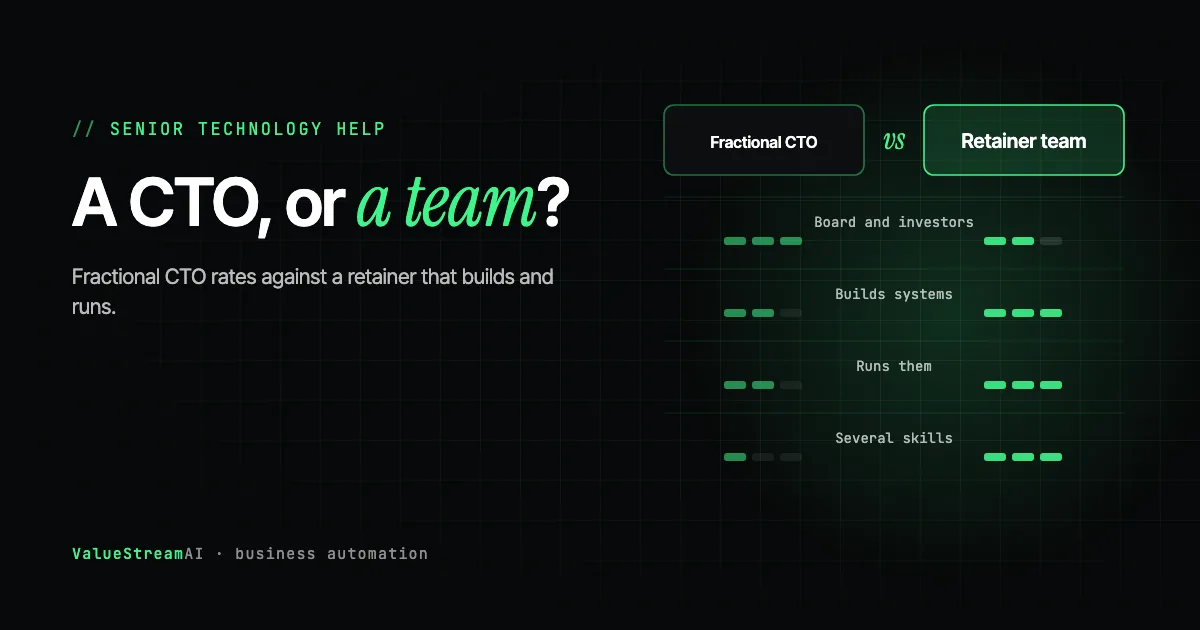
| Factor | ValueStreamAI technology retainer | Typical fractional CTO |
|---|---|---|
| Monthly cost | From $5,000 (AI Operations) or $7,000 (Full Stack) | About $4,000 to $10,000 for 10 to 15 hours |
| Strategy and advice | Included | Core offer |
| Builds systems | Yes: websites, apps, agents, agentic ecosystems | Usually extra |
| Runs and monitors them | Yes | Rarely |
| Board and investor role | No | Yes |
| Team skills | Web, mobile, AI, voice, SEO | One person |
Frequently Asked Questions
How much does a fractional CTO cost?
A.Team's 2026 guide puts fractional CTOs at about $4,000 to $10,000 a month for 10 to 15 hours of advisory work and $10,000 to $25,000 for 20 to 40 hours of active work. Other guides quote about $200 to $400 an hour.
What are typical fractional CTO rates per hour?
Published guides commonly quote about $200 to $400 an hour, with monthly retainers priced by the hours included and by whether the CTO also writes code.
Is a fractional CTO cheaper than a full-time CTO?
Usually. A full-time technology manager's median US salary is $171,200 (BLS, May 2024) before benefits, while an advisory fractional CTO costs about $48,000 to $120,000 a year.
What does a fractional CTO do?
Sets technology strategy, chooses vendors, reviews technical work, helps hire engineers and represents technology to investors and the board. Most do not build or run systems themselves.
What is the alternative to a fractional CTO for a small business?
A technology retainer with a team that advises, builds and runs your systems. Ours run from $5,000 a month for AI Operations to $7,000 a month for website, SEO, AI agents and voice AI together.
Do I need a CTO to use AI in my business?
Not usually. You need sound advice on what to build and someone to build and maintain it. A retainer or a small pilot often gets you further faster than hiring senior leadership first.
How many hours does a fractional CTO work?
It depends on the agreement. A.Team's guide describes advisory arrangements of 10 to 15 hours a month, active involvement of 20 to 40 hours, and near full-time or interim work above 40 hours.
Other monthly costs in this series: retainer vs hourly rate, AI agent cost per month, app maintenance cost.
What's Next
Tell us what you need a senior technologist for. On a free call we will tell you honestly whether a fractional CTO, a technology retainer or a one-off consultation fits best.
→ Agency retainer fees: what a monthly retainer should cost
Syed Rayyan is co-founder of ValueStreamAI, leading research and marketing. He has run SEO for client websites since 2020, across technical audits, on-page work and link building, and leads the marketing side of every build. He also runs the firm's evaluation of emerging AI tooling and translates technical capability into clear guidance for non-technical decision-makers. Connect on LinkedIn →