WebMCP: Preparing Your E-commerce Business for the Agentic Web
| Metric | Impact of WebMCP |
|---|---|
| Agent Task Reliability | 99.9% (vs 65% for Scraping) |
| Checkout Latency | 85% Reduction in Execution Time |
| API Surface Security | Granular Tool-Level Permissions |
The era of "browsing" is coming to an end. By 2028, a significant portion of e-commerce transactions will be initiated and completed not by humans clicking through menus, but by autonomous AI agents acting on their behalf.
The bottleneck has always been how these agents interact with your store. Raw DOM scraping is fragile, slow, and prone to error. Enter WebMCP (Model Context Protocol for the Web), a standard that allows your website to play an active, structured role in the agentic ecosystem.
At ValueStreamAI, we are already engineering "Agent-Ready" storefronts for our clients in Paisley and across the UK, ensuring they are the first to be indexed by high-intent shopping agents.
From Scraping to Structured Autonomy
For the last two years, AI agents have tried to "see" your website like a human. They look at HTML, guess where the "Add to Cart" button is, and hope they don't click a pop-up by mistake.
This is a failure-prone strategy.
WebMCP replaces this guesswork with two core APIs that redefine the relationship between your server and the agent:
- Declarative API: By using structured HTML annotations, you tell the agent exactly what a form does. No more guessing. "This form handles SKU 1234 configuration."
- Imperative API: For complex tasks (like real-time inventory checks or personalized dynamic pricing), you expose JavaScript-based "tools" that the agent can call directly.
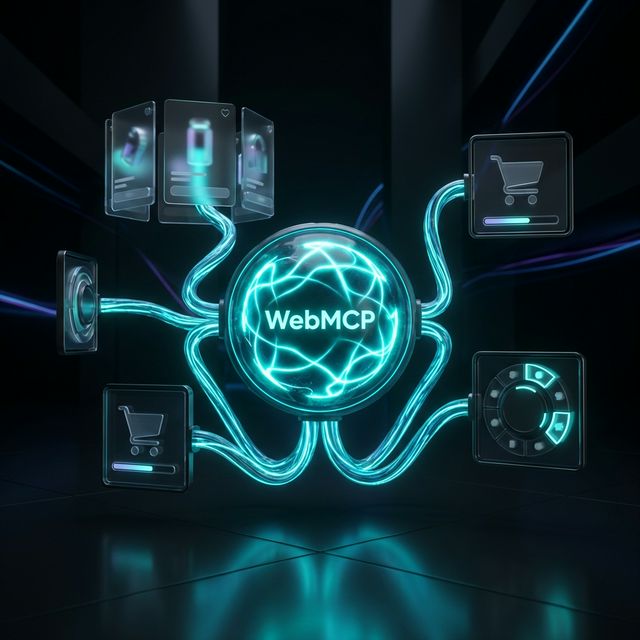
Today a buying agent reads your HTML and guesses where the buttons are, which breaks on pop-ups and redesigns. With WebMCP the store declares what each form does through structured annotations, and exposes JavaScript tools such as live inventory checks and dynamic pricing that the agent calls directly.
The E-commerce Advantage: 2026-2028
If you run an e-commerce business, WebMCP isn't just a technical upgrade; it is a fundamental shift in your sales funnel.
1. The "Configurator" Agent
Imagine a user tells their personal AI, "Find me a custom road bike with a 54cm frame, carbon wheels, and a blue finish, under $4,000."
Without WebMCP, the agent struggle with your dropdown menus. With WebMCP, your site exposes a search_bikes and configure_bike tool. The agent selects the exact specs with 100% precision and presents the final quote to the user in seconds.
2. Frictionless Checkout
The "Checkout Bottleneck" is where most sales die. Agents equipped with WebMCP can navigate your checkout flow using structured data, bypassing UI-heavy steps and interacting directly with your payment logic. This results in near-instant conversions.
3. Deep Integration vs. "Wappy" Wrappers
We've talked before (see our Voice AI Development Guide) about the danger of "No-Code" wrappers. The same applies to WebMCP. A generic plugin might "enable" WebMCP, but it won't understand your unique business logic.
To win in the agentic web, you need an engineering-led approach. You need to map your entire business process into a library of secure, high-performance tools that an AI can understand.
2-Year Roadmap: How Businesses Can Take Advantage
The next 24 months will define the winners of the agentic economy.
- Year 1: Auditing the Surface. Audit your current website and identify the most valuable user actions (Search, Filter, Configure, Purchase). Begin prototyping standard actions using the Declarative API.
- Year 2: Imperative Tooling. Build a "Tool Layer" for your business. This isn't just for external agents; these same WebMCP tools will power your own internal AI Customer Service Agents and Sales Bots.
Platform Access and Vendor Lock-In: The Questions to Ask Before Building
Before committing to a WebMCP or agentic e-commerce architecture, two questions determine whether your implementation will be extensible or boxed in.
First: does your current e-commerce platform expose the APIs your agent will actually need? Most major platforms (Shopify, BigCommerce, WooCommerce) have reasonable API coverage for standard storefront operations. The gaps appear at the edges, loyalty systems, custom fulfilment integrations, third-party review platforms, bespoke pricing rules, where the data the agent needs exists in a connected system that may not have clean API access. Mapping the full data access requirements before architecture design prevents discovering mid-build that a critical data source is behind a scrape-only interface or a vendor that charges for API access separately.
Second: how much of your agent's logic will be locked to this platform's specific tool schema? The deeper a WebMCP implementation is coupled to one platform's endpoints, the more expensive it becomes to migrate or extend when the platform changes pricing, deprecates APIs, or doesn't support a capability your next phase requires. Designing with an abstraction layer between your business logic and the platform-specific tool calls preserves optionality.
The gaps appear at the edges: loyalty systems, custom fulfilment, bespoke pricing rules.
An abstraction layer between business logic and platform-specific tool calls preserves optionality.
The 90-Second Test We Run Before Any Agentic Build
After scoping dozens of integration projects, we've found that a non-technical business owner can predict, with surprising accuracy, whether an agentic build will be smooth or painful, without understanding a line of code. Here is the test we walk clients through on the first call.
List every core tool your store runs on: the e-commerce platform itself, your payment processor, your inventory system, your shipping and fulfilment software, your loyalty or reviews platform. For each one, ask a single question: does it offer an API, an MCP server, or a documented integration path?
If the answer is yes for your key tools, in our experience there is a well-above-90-percent chance those workflows can be cleanly wired into AI agents. An API or MCP server is a formal, stable, documented doorway the vendor built on purpose. The agent walks through the front door, the build is predictable, and it does not shatter the next time the vendor ships a redesign.
If the answer is no, the project is still possible, but the shape changes completely. Without a doorway, the agent has to operate the software the way a human does, through the screen: browser automation that clicks buttons and reads pages, or in some cases scraping. That works, and sometimes it is the only option, but it is inherently brittle. It breaks when someone moves a button or renames a field, it runs slower, and it carries a permanent maintenance cost. It is the difference between a door and a window you have to climb through every time.
This one check lets you predict the rough cost and risk profile of an agentic project before spending a penny on discovery. It is also the deeper reason WebMCP matters: a WebMCP-enabled storefront is you building that front door on purpose, so buying agents never have to climb through the window.
What Usually Goes Wrong: The Systems Access Blocker
The most common reason an agentic e-commerce project stalls is not the AI. It is that the business does not actually know what its own systems expose. Owners know they "use Shopify" or "have a custom fulfilment tool," but the specifics, whether an API exists, who controls the vendor credentials, which contractor built the internal pricing tool three years ago and whether they are still reachable, often are not there.
This matters because a purchasing agent has to read from and write to those systems. If your core operations software has no API layer, or an internal tool was built by a developer who left without documentation, you are not looking at a three-week integration. You are looking at a prerequisite re-architecture. Discovered in week seven mid-build, that blocker is far more expensive than the same discovery in week one. The fix is boring and effective: audit systems access before design, not during the build.
The Technical Moat: Security and Sovereignity
The biggest concern with allowing agents to "call tools" on your site is security. WebMCP is designed with this in mind. Unlike giving a bot access to your entire DOM, WebMCP allows for granular tool-level permissions. You control exactly what data the agent sees and what actions it can perform.
As an AI strategy Scotland leader, ValueStreamAI ensures that your WebMCP implementation is "Privacy by Design," masking sensitive data and ensuring every agent action is logged and verifiable.
Frequently Asked Questions
What is the difference between an API and WebMCP?
Standard APIs (REST/GraphQL) are built for developers. WebMCP is built for models. It includes self-describing metadata that tells the AI what the tool does, how to call it, and what to expect back, without the agent needing to read a single page of documentation.
Does this replace traditional SEO?
No, it evolves it. "Agent SEO" will become a critical discipline. Instead of optimizing for keyword density to please a search engine, you will optimize your Tool Schema to ensure your business is the most "usable" for a buying agent.
How do I get started in the UK?
If you are looking for AI software development Paisley based or Enterprise AI UK services, contact our engineering team. We are currently accepting participants for WebMCP prototyping and agentic architecture audits. For the wider picture, see our UK AI automation hub and our complete guide to AI agent development.
Muhammad Kashif is co-founder of ValueStreamAI, leading technical delivery and AI strategy. He designs and ships custom agentic AI and healthcare automation systems for clients across the US and UK. More about Muhammad Kashif →