| What the numbers say | Verified figure |
|---|---|
| Crypto stolen in hacks in 2025 (Chainalysis) | ~$2.7–3.4 billion across exchanges and DeFi |
| Total lost to crypto fraud and scams in 2025 | ~$17 billion (industry estimates) |
| Largest single hack ever (Bybit, 2025) | ~$1.4 billion in a single breach |
| Share of crypto scam losses that are unrecoverable | 95% — once funds move, they rarely come back |
| Our alert latency | Sub-5 seconds from on-chain confirmation |
| Platform uptime delivered | 99.9% across four chains, 24/7 |
The Bybit breach in 2025 drained roughly $1.4 billion in a single transaction sequence — the largest crypto theft in history. The funds were laundered across chains within hours. By the time most monitoring dashboards refreshed, the money was gone. In a market where 95% of stolen crypto is never recovered, the entire game is won or lost in the first few seconds after a transaction confirms. That is the problem our cross-chain token monitoring system was built to solve.
This case study explains how ValueStreamAI engineered a low-latency, multi-chain alerting engine for a blockchain analytics startup — one that "hears" Ethereum, BSC, Polygon, and Solana the instant a block is produced, and turns raw on-chain noise into context-rich intelligence traders and security analysts can act on. Serving clients from our Florida HQ to the UK tech hubs, we build the kind of enterprise-grade data infrastructure that off-the-shelf tools simply can't match.
Project Overview
Client: Confidential (Blockchain Analytics Startup) Industry: Web3 / Blockchain Security Technologies: Ethereum (ETH), Binance Smart Chain (BSC), Polygon, Solana, WebSockets, Node.js, Redis, custom alerting engine, AI sentiment integration
Executive Summary
In the rapidly expanding Web3 ecosystem, tracking token movements across multiple blockchains is a monumental engineering task. Our client needed a system that could deliver real-time alerts for whale movements, liquidity changes, and suspicious transactions across the major networks — fast enough to matter in a market where minutes mean millions. ValueStreamAI engineered a scalable, low-latency tracking solution that gives traders and security analysts instant on-chain intelligence, normalised across four very different chains into a single coherent view.
Why On-Chain Monitoring Is No Longer Optional
For years, blockchain monitoring was treated as a "nice to have" — a dashboard you glanced at occasionally. The 2025 loss figures ended that conversation. Industry estimates put total crypto fraud and scam losses at roughly $17 billion for the year, with Chainalysis attributing $2.7–3.4 billion specifically to hacks of exchanges and DeFi protocols. Individual incidents were staggering: Cetus ($223 million), Balancer ($128 million), and Phemex ($73 million) all fell inside a single year, on top of the record Bybit breach.
The pattern across nearly every one of these events is the same: the exploit happens, and then the attacker moves funds across chains and through mixers faster than human analysts can react. Because blockchains are irreversible and pseudonymous, 95% of those losses are never recovered. There is no chargeback. There is no fraud department to call. The only defence is speed of detection — knowing a wallet has moved, a pool has been drained, or a contract is behaving abnormally within seconds, not minutes.
That is a data-engineering problem before it is a crypto problem, and it is exactly the kind of high-throughput, low-latency challenge that breaks no-code tooling. We explain why in Why No-Code Fails at Enterprise Scaling.
The Challenge: Solving the Fragmentation of Web3 Data
The primary hurdle in blockchain monitoring is fragmentation. Each chain has its own node structure, indexing latency, consensus timing, and data format. Ethereum thinks in blocks and gas; Solana thinks in slots and lamports; BSC and Polygon each have their own quirks. The client required:
- Unified multi-chain tracking — simultaneously monitoring Ethereum, BSC, Polygon, and Solana through one normalised pipeline.
- Low-latency alerting — notifications delivered within seconds of on-chain confirmation, not after a polling cycle.
- Complex filter logic — per-token, per-wallet, and per-volume alert rules configurable by each user.
- Actionable intelligence — moving beyond raw data to context: is this transfer bullish accumulation or sell pressure?
The Solution: A Scalable, Interoperable Monitoring Engine
1. Robust Data Ingestion via WebSockets
Instead of relying on slow REST polling, we implemented high-speed WebSocket subscriptions and direct node connections. This lets the system "hear" new blocks and transactions as they happen rather than asking for them on a timer — the single biggest factor in achieving sub-5-second latency.
- Cross-chain listeners: A dedicated listener per network ingests its native event stream and normalises it into one structured schema, so downstream logic never has to care which chain an event came from.
- Token filtering at the edge: Thousands of tokens flow through every second; the system filters to each user's watchlist before anything propagates further, keeping the pipeline lean under load.
This event-driven design follows the same production-monitoring principles we document in AI Monitoring in Production and the architecture patterns in our AI System Architecture Essential Guide.
2. Intelligent Alerting and Notification Layer
We built a tiered alerting system that classifies events by severity and type:
- Whale alerts — large transfers capable of moving market price.
- Liquidity alerts — significant adds or removals on DEXs like Uniswap and PancakeSwap, the early signal of both opportunities and rug pulls.
- Security alerts — detection of rug-pull patterns, abnormal contract interactions, and the rapid cross-chain hops that characterise a laundering attempt.
Given that the average rug pull drained around $510,000 in 2025 and the largest cost corporate investors over $500 million, the liquidity and security tiers are not academic — they are the difference between exiting a position and watching it go to zero.
3. Integrated AI Insights
Raw data tells you what happened; the client needed what it means. We integrated an AI layer that analyses the impact of a transaction in context. A large transfer of a token to an exchange is flagged as "Potential Sell Pressure"; the same volume moving to a cold wallet is flagged as "Bullish Accumulation." This contextual scoring is what turns a firehose of transfers into a feed an analyst can actually trade on, and it is built on the same agentic reasoning we describe in How to Build AI Agents.
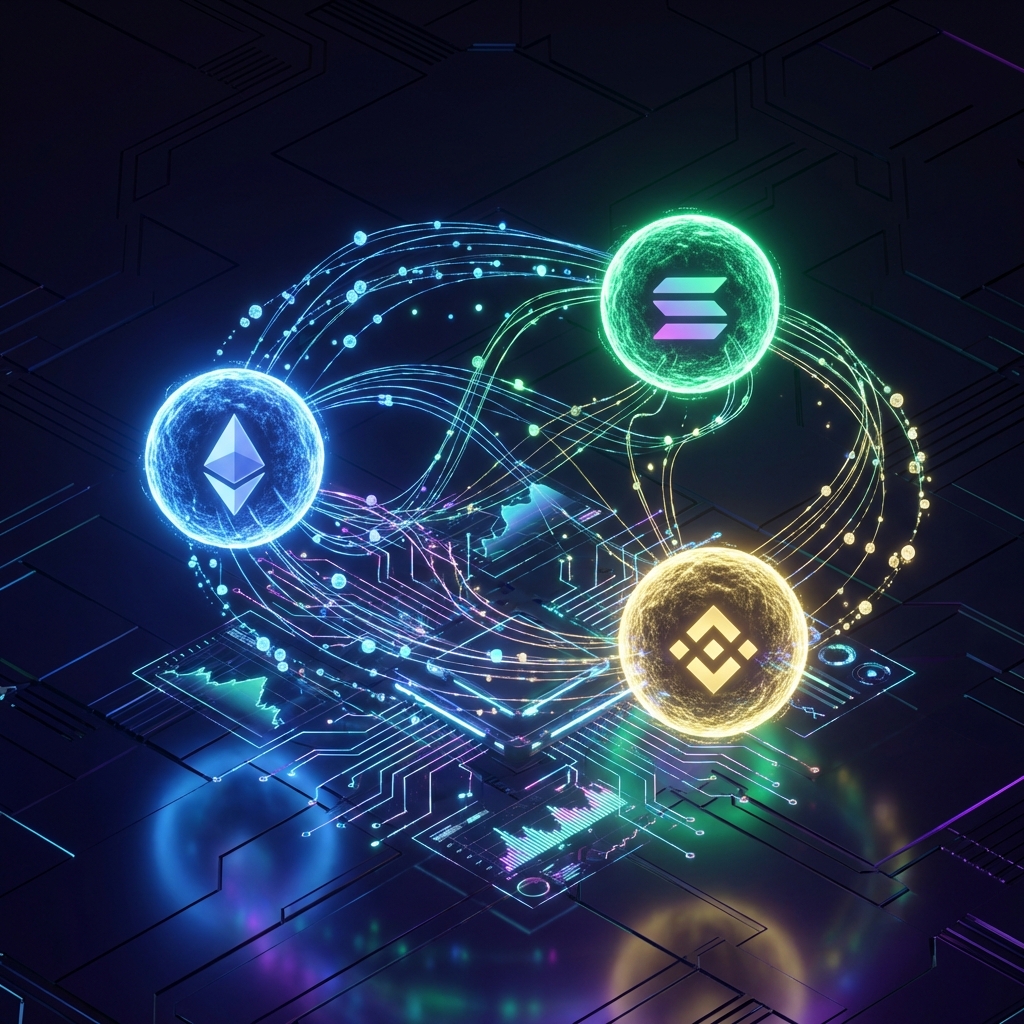
Each chain has its own isolated listener and adapter, and every native event is translated into one canonical schema. Each user's watchlist rules are evaluated against that stream at the edge, so only matching events reach Redis and the AI scoring layer, which labels intent and adds a plain-language explanation before delivery to Telegram, Discord or mobile push.
Technical Implementation Highlights
- Event-Driven Architecture: Built with Node.js and Redis to absorb millions of transactions per day without bottlenecks. Redis pub/sub decouples ingestion from alerting so a spike on one chain never stalls another.
- Normalisation Layer: The hardest engineering in the project — collapsing four incompatible data models into one schema so a "large transfer" means the same thing whether it happened on Solana or Ethereum.
- Multi-Platform Notifications: Alerts dispatched via Telegram, Discord, and mobile push, so users get the signal wherever they already are.
- Horizontal Scalability: Adding a fifth or sixth chain requires only a new listener module; the normalisation, alerting, and AI layers are entirely chain-agnostic.
This sits alongside our other FinTech engineering work, including the AI crypto trading bot for Binance and our institutional-grade stock analysis platform.
Inside the Build: From Raw Blocks to Actionable Alerts
The system came together in four engineering phases, each solving a distinct technical problem.
Phase 1 — Node connectivity and the listener fleet
We began by standing up resilient connections to each chain. For Ethereum, BSC, and Polygon that meant WebSocket subscriptions to full nodes with automatic failover to backup providers; for Solana, whose throughput dwarfs the EVM chains, it meant subscribing to slot and account-change notifications and aggressively pre-filtering at the source. Each listener runs as an isolated process so a problem on one chain — a node going stale, a provider rate-limiting — never cascades into the others.
Phase 2 — The normalisation schema
This was the heart of the project. A "transfer" on Solana and a "transfer" on Ethereum share almost nothing at the data level: different units, different address formats, different ways of representing token contracts. We designed a single canonical event schema and wrote per-chain adapters that translate each native event into it. Downstream, every component — filtering, alerting, AI scoring — operates on this one schema and never needs to know which chain an event originated on. That decision is what makes adding a fifth chain a week of work instead of a rewrite.
Phase 3 — The filter and alert engine
With a clean event stream in place, we built the rule engine. Each user's watchlist compiles into an in-memory rule set that the engine evaluates against every normalised event in real time. Compound rules — "alert me only if a wallet on my watchlist moves more than X of token Y to a known exchange" — are evaluated at the edge so that the expensive notification and AI-scoring steps only run for events that already matter. Redis pub/sub fans matched events out to the notification workers.
Phase 4 — AI context and delivery
Finally, matched high-value events pass through the AI scoring layer, which classifies intent (accumulation, sell pressure, liquidity event, suspicious hop) and attaches a plain-language explanation. The enriched alert is then delivered through whichever channels the user configured — Telegram, Discord, or mobile push — typically within five seconds of the originating transaction confirming on-chain.
- 01Node connectivity and the listener fleet
Resilient WebSocket connections per chain, each listener isolated so one failure never cascades.
- 02The normalisation schema
A single canonical event schema so a transfer means the same thing on Solana or Ethereum.
- 03The filter and alert engine
Compound rules evaluated at the edge so expensive AI scoring only runs on events that matter.
- 04AI context and delivery
Intent classification and plain-language explanation, delivered within five seconds.
Human Hours vs Automation: Watching Four Chains Around the Clock
The system watches Ethereum, BSC, Polygon and Solana continuously and alerts within about 5 seconds. Here is what the same watch would cost with people, with the assumptions stated.
The assumptions. A week has 168 hours and one full-time person covers 40. The rate is the US median for information security analysts, $124,910 a year (Bureau of Labor Statistics, May 2024), about $60 an hour. With automation, the team spends about 1 hour a day triaging alerts.
| Coverage | Human hours per year | Cost per year |
|---|---|---|
| One analyst, office hours, all four chains | 2,080 | ~$124,900 |
| One seat watched around the clock | 8,736 | ~$524,600 |
| One seat per chain, around the clock | 34,944 | ~$2.1 million |
| This system, with daily alert triage | ~365 | ~$21,900 |
The honest point is that no staffing level reproduces the system: a person cannot read four chains' blocks as they confirm and react within 5 seconds. People are best used where they are here, deciding what an alert means. The other side of the ledger is the build, node or provider fees, and keeping each chain's integration current. Run your own figures through our hire versus automate calculator.
The Competitor Pulse Check
| Factor | ValueStreamAI Engine | Off-the-Shelf Trackers | Why It Matters |
|---|---|---|---|
| Data ingestion | WebSocket + direct node (push) | REST polling (pull) | Polling adds seconds of lag; push is near-instant |
| Chains | ETH, BSC, Polygon, Solana, normalised | Often single-chain or siloed | One coherent view instead of four dashboards |
| Alert logic | Per-token, per-wallet, per-volume | Fixed thresholds | Real strategies need precise, compound rules |
| Context | AI impact scoring (accumulation vs sell pressure) | Raw amounts only | Analysts need meaning, not just numbers |
| Latency | Sub-5 seconds | 30s–several minutes | In a 95%-unrecoverable market, seconds decide outcomes |
| Extensibility | New chain = new listener module | Vendor roadmap dependent | You're never blocked waiting for the vendor |
Off-the-shelf trackers: REST polling (pull).
Off-the-shelf trackers: often single-chain or siloed.
Off-the-shelf trackers: raw amounts only.
Off-the-shelf trackers: 30s to several minutes.
Verified Excellence in AI and Blockchain
Trust and technical competence are non-negotiable in the blockchain space, so here is what independent directories show about us:
- Goodfirms: featured among the Top AI Companies in Florida for 2026; background in our Goodfirms announcement.
- Clutch: two client reviews on our Clutch profile, one of them for a web application built for a stock market analysis company.
The Results: Empowering the Next Generation of Traders
- Sub-5-second latency: Alerts delivered almost instantly, giving users a genuine edge in fast markets.
- 99.9% uptime: Engineered for 24/7 reliability across all four supported blockchains, with health checks and automatic listener restarts.
- 40% increase in daily active users: The client reported that intuitive alert customisation drove a 40% jump in daily active users on their platform — proof that monitoring people actually trust is monitoring people actually use.
Beyond the headline metrics, the operational impact was qualitative too. Security analysts on the client's team reported catching abnormal liquidity events early enough to warn their own users before losses spread, and traders cited the AI context layer — not just the raw alerts — as the reason they kept the dashboard open all day. In a category where most tools drown users in undifferentiated notifications, the combination of precise filtering and plain-language context was the differentiator that drove retention.
Frequently Asked Questions
Which blockchains are supported? Ethereum, BSC, Polygon, and Solana out of the box. Adding a new chain requires a custom listener — the normalisation, alerting, and AI layers handle the rest unchanged.
How fast are alerts? Sub-5 seconds from on-chain confirmation. WebSocket node connections eliminate the polling lag common in REST-based tools.
Can it catch rug pulls? Yes — the security tier flags sudden liquidity removals, abnormal contract calls, and rapid cross-chain laundering hops within seconds.
Can I set per-token alert thresholds? Yes. The filter engine supports per-token, per-wallet, and per-volume thresholds configured via the user dashboard.
What does the AI actually add? Context. It scores whether a transfer is likely sell pressure or accumulation, so you get meaning instead of just a number.
Conclusion
The ValueStreamAI Cross-Chain Monitoring System represents the practical state of the art in on-chain intelligence. By bridging four fragmented blockchains into a single low-latency lens — and layering AI context on top of raw events — we give traders and security teams the one thing the market never gives back: time. In an ecosystem where $17 billion vanished to fraud in a single year and almost none of it came back, seconds of warning are worth millions.
Need a dedicated blockchain monitoring or AI automation tool?
Scale your Web3 project with ValueStreamAI — Florida's experts in custom AI and blockchain development. For a ballpark on what a monitoring build like this costs, the automation quote generator answers in five questions, and the full set of calculators sits on the free tools page.