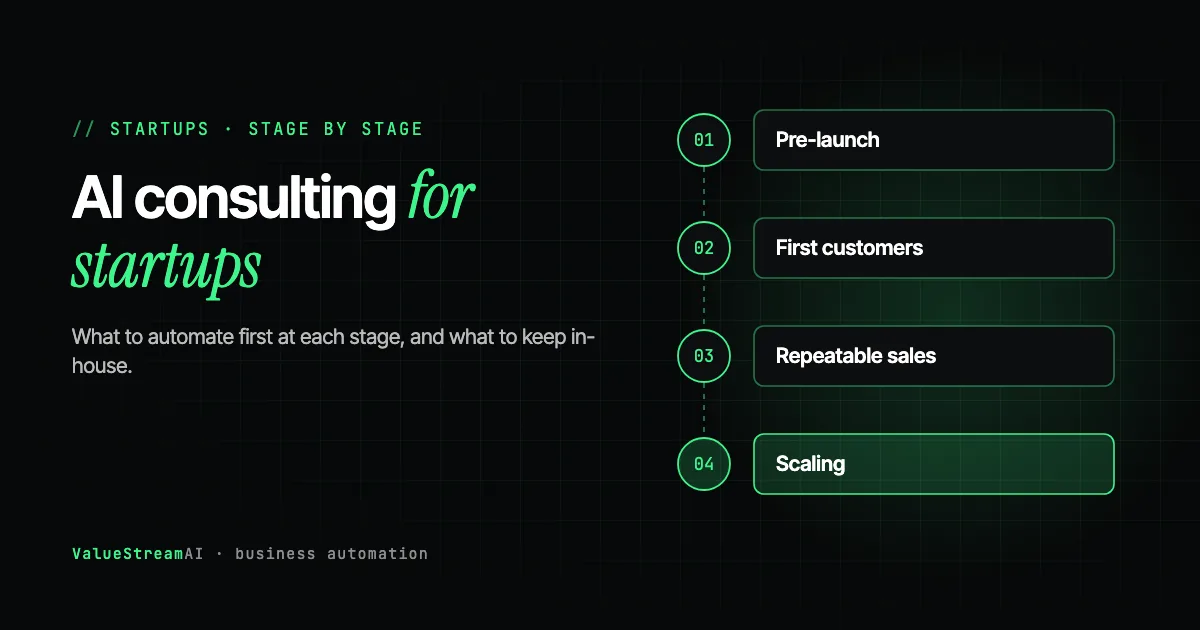
Every startup is told to "use AI". Very few are told what that should mean at their stage. A two-person team before launch and a forty-person company with repeatable sales need completely different things, and paying for the wrong one is an easy way to burn runway. This guide to AI consulting for startups works through each stage of growth: what to automate first, what to keep in-house, and how to buy outside help without committing to a long contract.
| Metric | 2026 Benchmark |
|---|---|
| US firms with 4 or fewer staff using AI (Census, Dec 2025 to May 2026) | Less than 20% |
| US firms with 250+ staff using AI (same period) | 37% |
| UK firms with 0 to 9 staff using AI (ONS, June 2026) | 28% |
| US median wage, customer service representatives (BLS, 2024) | $20.59 an hour |
Sources: the US Census Bureau, the Office for National Statistics and the Bureau of Labor Statistics. The Census Bureau found AI use rose among firms with 20 or more employees over that period but did not change significantly among smaller ones.
Why AI Consulting for Startups Is Different
The answer is speed of change. An established business has processes that have barely moved in years, so automating them pays back for a long time. A startup's processes change every few months as it learns what customers want. Automating a process too early locks in something you will rewrite.
That changes what good AI consulting looks like for a startup. It should be short, fixed in scope, and focused on work that is already stable. It should never come with a long roadmap or a multi-month contract before you have a repeatable process to automate. And it should leave your core product alone. Your product is the company. Outside help should automate the work around it.
The adoption figures reflect this. The smallest firms use AI least, and the gap with large firms is wide: under 20% against 37% in the US, 28% against 49% in the UK. Part of that is capacity. Small teams lack the time and expertise to work out where AI fits. The ONS found lack of expertise is one of the most cited barriers to adoption.
What to Automate First at Each Stage
Before launch: automate almost nothing custom
Before you have customers, your job is learning, not efficiency. Use the AI already built into your tools, such as an assistant in your email or documents, for drafting, research and summarising. Do not pay anyone to build a custom system yet. There is no stable process to automate, and anything built now will be rebuilt.
The one exception is a task you already know will repeat at volume from day one, such as processing applications for a marketplace. Even then, a lightweight off-the-shelf tool is usually enough.
First customers: support and onboarding
Once customers arrive, the first job that repeats at volume is usually answering them. The same questions come up again and again: how to set up, how billing works, what to do when something breaks. This is where outside AI help starts to pay off.
A sensible first automation drafts answers to repeat questions from your own help content, routes anything unusual to a founder, and logs every conversation. That last part matters more than it sounds. Your support history is the best product research you have, and an automation that captures it cleanly is worth more than one that only saves time.
Repeatable sales: lead handling and the CRM
When you can describe how a deal moves from first contact to signature, the work around it can be automated. Typical first targets: instant follow-up on inbound enquiries, qualification questions, booking calls and keeping CRM records complete. Our guide to AI lead follow-up and CRM automation covers this in detail.
Scaling: build a shared foundation
At this stage most startups make the same mistake. They have built a support bot and a lead bot, each with its own data access and wiring, and they call AI adoption done. Each is useful alone and a dead end architecturally, because the next automation has to start from scratch again.
The fix is a shared data and integration layer that every new automation plugs into. With that in place, the third and fourth automations cost far less than the first. Without it, every new one costs as much as the first.
What to Keep In-House
The short answer: anything that is your competitive advantage.
| Keep in-house | Good fit for outside AI help |
|---|---|
| Core product features and the AI inside them | Support triage and repeat answers |
| Your product roadmap | Lead follow-up and CRM hygiene |
| Customer relationships and key accounts | Reporting and dashboards |
| Hiring decisions | Finance admin such as invoices and expenses |
| Pricing and positioning | Scheduling and onboarding paperwork |
If the AI is your product, for example a startup whose whole offering is an AI model, then AI engineering is a core hire, not something to outsource. Outside help still makes sense for the operations around it.
Human Hours vs Automation: Customer Support at a Growing Startup
Assumptions: customer support tickets at three volumes: light (100 a week), typical (300) and heavy (800). By hand, each takes about 6 minutes to read, look up and answer. With AI triage that drafts answers to repeat questions and routes the rest, we assume 20% of the time remains for a person to review drafts and handle complex cases. The hourly rate is the US median for customer service representatives, $20.59 an hour (BLS, 2024). In many startups a founder does this work, so the real cost per hour is much higher.
| Tickets a week | Hours by hand a year | Cost by hand | Human time with AI triage | Cost with AI triage |
|---|---|---|---|---|
| 100 | 520 | ~$10,710 | ~104 hours | ~$2,140 |
| 300 | 1,560 | ~$32,120 | ~312 hours | ~$6,420 |
| 800 | 4,160 | ~$85,650 | ~832 hours | ~$17,130 |
The other side of the ledger: a fixed-price pilot from $5,000, with most between $5,000 and $15,000, then a retainer from $1,500 a month if you keep building. At 100 tickets a week the case is marginal. At 300 it pays back within the first year. At 800 it is the difference between hiring two support people and hiring none. Our pricing page sets out what each option includes, and the free automation quote tool gives you a ballpark price for your own workflow in five questions, with no email required.
What the numbers leave out: faster first replies, answers at night and at weekends, and a clean record of every customer question. They also leave out the cost of a wrong answer, which is why complex or sensitive questions should always go to a person.
Try your own numbers in the hire vs automate calculator.
How a Fixed-Scope Pilot Limits Startup Risk
Runway is the constraint, so the safest way to buy AI consulting is a fixed price for a fixed result. A pilot builds one workflow, runs in about 14 days, and measures the saving against the manual version. If it works, you have proof in your own numbers. If not, you have spent the price of one workflow and learned something.
First decide whether the process is stable. If it changes every month, wait and use off-the-shelf tools. If it is stable, check the tools can connect, then run a fixed-scope pilot on one workflow. Measure the saving. If it pays back, add the next workflow on a shared foundation. If not, stop with only the pilot spent.
Avoid long contracts at this stage. A startup that pivots should not be paying for infrastructure built for the old plan. We explain the two-week shape in what a 14-day AI pilot actually looks like.
Three Ways Startups Waste Money on AI
If the way you onboard customers changes every month, automating it locks in a process you will throw away.
Each new bot with its own data access and wiring costs as much as the first. A shared foundation makes the next one cheaper.
Your core product is your company. Outside help should automate the work around it.
Automating before the process exists. If your onboarding changes every month, automating it bakes in this month's version.
Buying a demo instead of a system. AI-assisted development has made polished demos cheap to produce, so a demo has stopped being evidence that someone can build. Ask any consultant to show you how their system handles a failed connection, a retry, or an input it has not seen before. A team that built it can answer in detail.
Hiring for one skill when the work needs several. One production automation touches the integration with your tools, the data, the AI itself, testing and deployment. A single hire with one of those skills rarely covers the rest. Our comparison of an AI automation agency vs an in-house hire runs the numbers.
Hiring AI Consulting for Startups: What to Ask
| Question | Good answer | Warning sign |
|---|---|---|
| What would you automate first for us? | One named task, with hours attached | A roadmap of ten initiatives |
| What should we keep in-house? | Your product and anything that differentiates you | Offers to build your core product |
| How long is the commitment? | One fixed-scope pilot, then decide | A six or twelve month contract up front |
| What happens if we pivot? | Shared foundation is reusable | Silence |
| Can I see something you built for a client? | A running system | Only a demo |
If you are based in Florida, our guide to AI startup consultants in Florida covers the local market.
How AI Consulting Companies for Startups Differ From the Rest
The short answer: the good ones treat your runway as the constraint and your product as off-limits.
A consultancy built for large companies tends to start with discovery workshops, a maturity assessment and a roadmap. That suits an organisation with stable processes and a budget for change. It does not suit a team that may change its business model in the next quarter.
A consultancy that works well with startups usually shows three habits:
- Short, fixed engagements. One workflow, a fixed price, a measured result, then a decision.
- Reusable foundations. The data access and integrations built for the first automation are designed to be reused when you change direction.
- Honest scoping. They tell you when a task is not worth automating yet, and when an off-the-shelf tool will do.
It is also worth asking how a consultancy handles the tools startups typically use: a modern CRM, a help desk, a billing platform and a shared workspace. Most of these offer APIs (documented ways for other software to connect), which is good news. It means the integration work is predictable, and the cost is mostly in deciding what the automation should do.
A Startup AI Checklist by Stage
| Stage | Automate | Use off-the-shelf | Leave alone |
|---|---|---|---|
| Pre-launch | Nothing custom | AI in your email, docs and notes | Every process, it will change |
| First customers | Support triage, onboarding messages | Help desk with AI features | Pricing, key accounts |
| Repeatable sales | Lead follow-up, CRM hygiene, booking calls | Scheduling tools | Negotiation |
| Scaling | Shared data foundation, reporting, finance admin | Accounting integrations | Product roadmap |
Use the checklist as a sense check rather than a rule. A marketplace startup may need application processing on day one; a services startup may not need support automation until much later. The test is always the same: is the process stable, and does it repeat at volume?
The Competitor Pulse Check
| Factor | ValueStreamAI Approach | Typical startup AI consulting |
|---|---|---|
| Engagement shape | One fixed-scope pilot, no long contract | Multi-month roadmap or retainer up front |
| Scope | The operational work around your product | Offers to build the product itself |
| Proof | Hours saved, measured in about 14 days | Demo and projected savings |
| Pivot risk | Shared foundation built to be reused | Bespoke builds tied to one plan |
| Price | Pilot from $5,000, retainer from $1,500 a month | Hourly billing with no total |
Frequently Asked Questions
What does AI consulting for startups include?
Good AI consulting for startups identifies the one repetitive task worth automating at your current stage, checks your tools can connect, and builds it for a fixed price. It should focus on the work around your product, such as support, sales admin and reporting, and leave the product itself in-house.
What should a startup automate first?
After the first customers arrive, customer support and onboarding are usually first, because the same questions repeat at volume. Once sales are repeatable, lead follow-up and CRM updates come next. Before launch, avoid custom automation altogether.
How much does AI consulting cost for a startup?
Our pilots start at $5,000, with most between $5,000 and $15,000, and retainers start at $1,500 a month for teams of up to about fifteen people. Independent consultants publish hourly rates of roughly $100 to $350 in 2026, but hourly billing gives a startup no fixed total.
Should a startup hire an AI engineer or use a consultant?
If AI is your product, hire. If you want to automate the operations around your product, a fixed-scope engagement is usually cheaper and faster than a hire, because one automation needs several skills that a single junior hire rarely covers.
When is it too early for a startup to use AI consulting?
Before you have a stable, repeating process. If the task changes every month, wait and use off-the-shelf AI tools until it settles. Automating too early locks in a process you will throw away.
What are the best AI consulting companies for startups?
The best fit is a team that builds what it recommends, works in short fixed-scope engagements, shows you a working client system rather than a demo, and tells you what to keep in-house. Avoid anyone who leads with a long contract.
What's Next
If you have a repeating task and want to know whether it is worth automating yet, book a free call on our AI consulting for small business and startups page. We will tell you what to automate now, what to leave, and what it would cost.
For the wider picture, read the AI for small business guide, or see how costs compare in our AI consulting cost guide.
Prefer to talk it through? Contact us with a short description of the task, or check our pricing first.
Syed Rayyan is co-founder of ValueStreamAI, leading research and marketing. He runs the firm's evaluation of emerging AI and healthcare tooling and translates technical capability into clear guidance for non-technical decision-makers. Connect on LinkedIn →