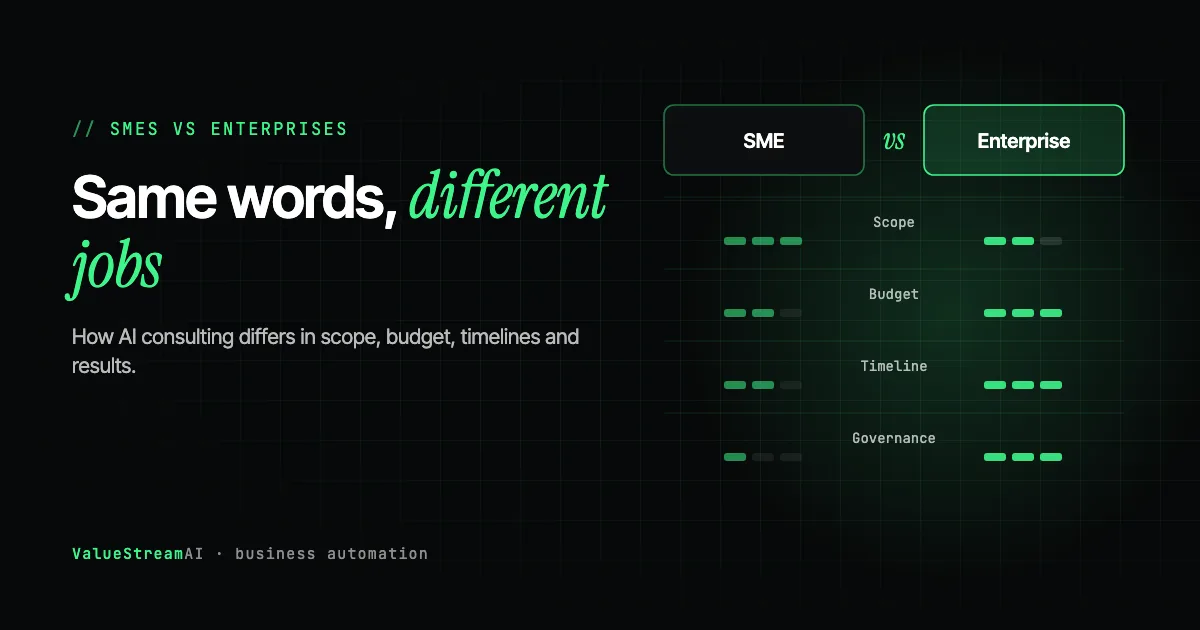
A consultancy that serves a 3,000-person bank and one that serves a 30-person firm can use the same words on their websites: strategy, roadmap, governance, transformation. The work behind those words is completely different. Buying an enterprise-style engagement as a small or mid-sized business is one of the most common ways to overpay for AI. This guide compares AI consulting for SMEs vs enterprises on scope, budget, timelines, governance and results, so you can tell which kind your business actually needs.
| Metric | 2026 Benchmark |
|---|---|
| US firms with 250+ staff using AI (Census, Dec 2025 to May 2026) | 37% |
| US firms with 4 or fewer staff using AI (same period) | Less than 20% |
| UK firms with 250+ staff using AI (ONS, June 2026) | 49% |
| UK firms with 0 to 9 staff using AI (same period) | 28% |
Sources: the US Census Bureau and the Office for National Statistics.
Why AI Consulting for SMEs and Enterprises Are Different Jobs
The short answer: an enterprise is buying change across an organisation, while a small or mid-sized business is buying a result in a specific workflow.
An enterprise AI programme has to coordinate many departments, satisfy risk and compliance teams, integrate with large legacy systems, train hundreds of staff and report to a board. Most of the cost and time goes on those things, not on the AI. A small business has none of that overhead. The owner decides, the systems are few, and the people who will use the automation are in the room.
That is why the adoption gap matters. Large firms use AI at roughly twice the rate of the smallest ones in both the US and the UK. It is tempting to read that as small firms being behind. It is more accurate to say that large firms have teams whose job is to work out where AI fits, and small firms do not. The right consulting engagement for an SME fills that specific gap without importing the enterprise overhead.
Scope: Programme vs Workflow
| SME (under about 50 staff) | Mid-market (about 50 to 500) | Enterprise (500+) | |
|---|---|---|---|
| Typical first scope | One workflow | A few connected workflows | A programme across departments |
| Who decides | The owner or MD | A leadership team | Committees, procurement, risk |
| Systems touched | Two or three tools | Several systems plus a CRM or ERP | Many, often with legacy platforms |
| Main deliverable | A working automation | A small set of agents on a shared base | Strategy, governance and a platform |
For an SME, the right scope is one workflow you can measure. Strategy work beyond that is usually padding. For a mid-market company, the important step is building a shared foundation early, so the third and fourth automations reuse the data access and integrations of the first. Without it, every new automation costs as much as the first one.
For an enterprise, a programme view is genuinely needed, because the risk of fifty teams buying fifty disconnected tools is real.
Budget: What Each Size Usually Spends
These are our own engagement tiers. A small-business pilot on one workflow starts at $5,000, with most between $5,000 and $15,000. A mid-market agent ecosystem across several workflows usually runs $15,000 to $40,000. Enterprise AI infrastructure starts around $40,000 and rises with scope. Retainers follow team size: from $1,500 a month for companies of up to about fifteen people, $2,500 to $3,000 for fifteen to fifty, and from $7,000 for larger organisations.
Market rates for advice follow the same pattern. Independent consultants publish hourly rates of roughly $100 to $350 in 2026, while large consultancies start at around $500 an hour. A small business paying large-consultancy rates is mostly paying for capabilities it does not need: governance frameworks, change programmes and board reporting.
Timelines: Weeks vs Months
The short answer: an SME pilot can run in about 14 days, while an enterprise multi-agent system realistically takes two to three months at minimum.
The difference is not the speed of building. It is the number of real situations the system has to handle correctly before it can run unsupervised. An enterprise agent might serve thousands of users across varied cases, and needs repeated cycles of testing with real users, refining, and testing again. A small business workflow has fewer variations, fewer users and fewer systems.
Our most successful larger engagements have also not looked like a project handoff. They run as six to eight month technology partnerships: audit what data exists, decide what to bring in, build the data layer, prove one use case on it, then expand as the business learns what it can now ask. That shape suits mid-market and enterprise clients. For an SME it is usually more than needed.
Governance and Compliance
Enterprises need formal governance: model approval processes, audit trails across teams, alignment with frameworks such as the EU AI Act, and bias monitoring where AI affects decisions about people. That work is real and often required.
SMEs still have obligations, but they are narrower and more practical. Know where your data goes. Keep a person in charge of decisions about customers and staff. Log what the automation does. If you handle personal or health data, follow UK GDPR or HIPAA as applicable. Our guide to AI automation under UK GDPR and HIPAA covers what that means in practice, and our AI policy template for small business gives you a starting document.
Results: How Each Should Measure Success
| SME | Enterprise | |
|---|---|---|
| Main measure | Hours saved on one workflow | Adoption, risk and value across units |
| Payback expectation | Within about a year on a busy workflow | Multi-year business case |
| Evidence | Before and after, in your own numbers | Programme dashboards and audits |
| Failure mode | Automating a task too small to matter | Pilots that never reach production |
The enterprise failure mode is well documented. MIT NANDA's 2025 research found that only about 5% of the enterprise generative AI pilots it studied produced rapid revenue growth, pointing to tools never connected to real workflows rather than weak models. Small businesses avoid much of that risk by starting with one connected workflow and measuring it.
Human Hours vs Automation: The Same Job at Three Sizes
The clearest way to see the difference is to price one job at three scales.
Assumptions: supplier invoice processing, at about 5 minutes per invoice by hand to check, match and enter. Volumes: an SME at 200 invoices a month, a mid-market firm at 1,500, an enterprise at 10,000. After automation, 15% of the time remains for a person to review exceptions. Hourly rate: US median for general office clerks, $20.97 an hour (BLS, May 2024), base salary only.
| Size | Invoices a month | Hours by hand a year | Cost by hand | Human time automated | Cost automated |
|---|---|---|---|---|---|
| SME | 200 | 200 | ~$4,190 | ~30 hours | ~$630 |
| Mid-market | 1,500 | 1,500 | ~$31,460 | ~225 hours | ~$4,720 |
| Enterprise | 10,000 | 10,000 | ~$209,700 | ~1,500 hours | ~$31,460 |
The other side of the ledger: the SME saving of about $3,560 a year does not justify a $5,000 pilot on invoices alone. It would need to be combined with other tasks or wait for volume. The mid-market saving of about $26,700 a year covers a pilot quickly. At enterprise volume the saving is large, but so are the integration, governance and change costs, which is why enterprise business cases run over years. Our pricing page sets out what each option includes, and the free automation quote tool gives you a ballpark price for your own workflow in five questions, with no email required.
What the numbers leave out: faster payment runs, fewer duplicate payments and better supplier relationships. For enterprises they also leave out the cost of approvals, audits and change management, which can exceed the build.
This is the most useful lesson for an SME: the same automation that is obviously worth it for a larger company may not be worth it for you yet. A good consultant will tell you that. Try your own volumes in the hire vs automate calculator.
Which Engagement Does Your Business Need?
If one owner or managing director makes the decision and the work sits in one or two workflows, an SME pilot fits. If a leadership team decides and several connected workflows are involved, a mid-market engagement on a shared foundation fits. If committees, procurement and formal governance are involved across departments, an enterprise programme fits.
The size of your company is a guide, not a rule. A 40-person firm in a regulated industry may need more governance than a 200-person firm that is not. A fast-growing SME may want a shared foundation earlier than its size suggests.
Interestingly, the ONS found that 41% of UK firms with ten or more staff report no barriers to adopting AI at all. Where barriers exist, lack of expertise is one of the most cited, at around 18% of firms with 100 to 249 staff, while cost affects around 7% to 14% depending on size band. For most firms the blocker is knowing where to start, not budget.
Red Flags When Buying AI Consulting for SMEs
- An enterprise framework on a small business. A 36-month roadmap, an AI governance council or a centre of excellence for a 25-person company.
- Strategy first, building later. For an SME, the build is where the learning happens.
- No question about your tools. Every project depends on whether your software can connect.
- Day rates with no total. Small budgets need fixed prices.
Our guide to choosing an AI automation company covers vetting in more depth.
The Mid-Market Middle Ground
Mid-sized companies, roughly 50 to 500 people, sit in the most interesting position. They are large enough that the same work is spread across several teams and tools, and small enough that a leadership team can decide quickly.
That combination makes the shared foundation the most important decision. A mid-market firm that builds its first few automations as separate tools, one for support, one for sales, one for finance, ends up paying full price for each. A firm that builds a shared data and integration layer first pays a little more for the first automation and much less for every one after it.
Mid-market firms also tend to need some governance, but not the enterprise version. A short policy on what data AI can use, a named owner for each automation, and logging of what the automations do usually cover it. Our guide to protecting business data when using AI covers the basics.
Questions to Ask, by Company Size
| Size | The question that matters most | Why |
|---|---|---|
| SME | Which one task should we automate first, and what does it save? | Budget is small, so the first result must pay back |
| Mid-market | How will the second and third automations reuse the first? | Disconnected tools make every new automation expensive |
| Enterprise | How will this reach production across teams, not just pilot? | Most enterprise pilots stall before production |
If a consultant cannot answer the question for your size, they are probably selling the engagement shape they know rather than the one you need. For more on what to check before signing, see our AI automation proposal checklist.
The Competitor Pulse Check
| Factor | ValueStreamAI Approach | Typical large consultancy |
|---|---|---|
| SME offer | Fixed-price pilot on one workflow, from $5,000 | Scaled-down enterprise programme |
| Mid-market offer | Shared foundation across several workflows | Separate projects per department |
| Enterprise offer | Six to eight month technology partnership | Strategy, then build by another team |
| Who builds | The same engineers who scope it | Often subcontracted |
| Measure of success | Hours saved in your own numbers | Programme milestones |
Frequently Asked Questions
What is the difference between AI consulting for SMEs and enterprises?
Enterprise AI consulting manages change across an organisation, including governance, many systems and large teams. AI consulting for SMEs focuses on getting one measurable workflow running quickly with fewer systems and one decision-maker. The scope, budget and timelines differ accordingly.
How much does AI consulting cost for an SME compared with an enterprise?
Our SME pilots start at $5,000, with most between $5,000 and $15,000. Mid-market agent ecosystems usually run $15,000 to $40,000, and enterprise AI infrastructure starts around $40,000. Large consultancies typically bill from about $500 an hour.
Do SMEs need AI governance?
They need practical governance rather than enterprise frameworks: know where data goes, keep people responsible for decisions about customers and staff, log what the automation does, and follow UK GDPR or HIPAA where relevant. A short written AI policy is usually enough to start.
What does AI consulting for mid-market companies look like?
Mid-market companies usually need several connected workflows on a shared data and integration foundation, so each new automation reuses the last. Engagements tend to run longer than an SME pilot, and the best results often come from a multi-month partnership rather than a one-off project.
Why are large firms more likely to use AI than small ones?
Large firms have people whose job is to find where AI fits and the budget to experiment. Small firms often lack the time and expertise, and the ONS lists lack of expertise among the most cited barriers. The gap is about capacity rather than suitability.
How long does an AI project take for an SME vs an enterprise?
A small-business pilot on one workflow can run in about 14 days. Enterprise multi-agent systems realistically take two to three months at minimum, because they must be tested against far more real-world cases before running unsupervised.
What's Next
If you run a small or mid-sized business, book a free call through our AI consulting for small business page. If you are a larger organisation, start with AI business consulting. Either way, we will tell you which shape of engagement fits before quoting anything.
For more on the numbers, read our AI consulting cost guide or is an AI consultant worth it.
Prefer to talk it through? Contact us with a short description of the task, or check our pricing first.
Syed Rayyan is co-founder of ValueStreamAI, leading research and marketing. He runs the firm's evaluation of emerging AI and healthcare tooling and translates technical capability into clear guidance for non-technical decision-makers. Connect on LinkedIn →