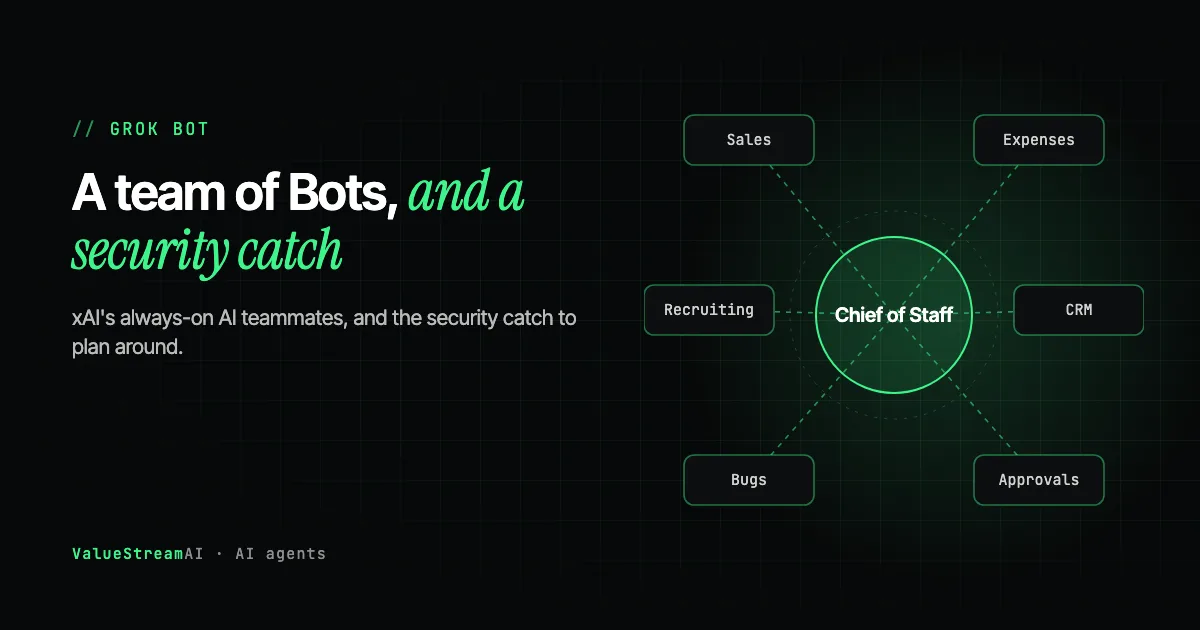
Grok Bot for business is the most ambitious of the 2026 AI agents. Launched in early beta on 11 August 2026 by SpaceXAI (the SpaceX division formerly known as xAI), it lets you set up a team of always-on Bots with job titles (Sales Outbound, Expense Manager, Chief of Staff), teach them a task by showing them once, and let them hand work to each other. This guide explains what Grok Bot does for a business, what it costs, the security catch in xAI's own guidance, and who should and should not use it.
The short answer: Grok Bot is the closest thing on the market to a team of AI staff, and it can work apps that have no connection by using the screen as a person would. That makes it interesting for sales, marketing and operations teams willing to try a beta. But it is early: no performance benchmarks were published, the model is chosen for you, team seats cost $120 a month, organisations are on a waitlist, and xAI's own guidance (as reported) says separate Bots should not be treated as separate security boundaries, because they share one computer, files and logins. Use it for low-risk work with approvals switched on; do not give it customer card data or regulated records.
Key takeaways
- A team of Bots with roles, coordinated by a Chief of Staff Bot, passing work between them.
- Teach by showing: demonstrate a task once and a Bot saves it as a routine.
- Works apps without an API through the screen, which is powerful and fragile.
- Bots share one computer and credentials, according to reporting on xAI's security docs: plan permissions for the whole account.
- Beta, waitlisted, $120 a seat for teams, with no published benchmarks.
| Metric | 2026 Benchmark |
|---|---|
| Launched | 11 August 2026, early beta |
| Team price | $120 per seat a month (Cursor Premium Teams) |
| Individual price | $200 a month (Cursor Ultra); also with SuperGrok Heavy ($300) |
| Published agent benchmarks | None at launch |
What Is Grok Bot?
A set of persistent AI agents, each with a job, that keep working after you close your laptop. According to VentureBeat's launch report, Grok Bot started as an internal prototype that SpaceXAI's own teams used for sales outbound, marketing campaigns, office operations and bug fixes.
What it does:
- Bots with roles. You create Bots for jobs such as Sales Outbound, Talent Scout, Paid Media, Expense Manager, Account Health or Chief of Staff.
- Teamwork. Bots can share a thread, pass work to each other and transfer ownership of a task. Internally, xAI has a Chief of Staff Bot overseeing specialist Bots.
- Teach by showing. Demonstrate a workflow once and the Bot saves it as a routine, which you can correct over time.
- Memory. Bots remember earlier conversations, learn your writing voice, and learn when to ask for approval.
- Works the screen. Bots can use sites and apps that have no API, the way a person would.
- Platforms. macOS, Windows and iPhone at launch, with Android to follow.
The launch examples are business-shaped: a sales Bot that researches accounts, scores contacts and drafts outreach for approval; a Bot that updates the CRM from call notes; one that processes invoices arriving in Gmail.
What Does Grok Bot Cost?
$120 a seat a month for teams, $200 for individuals, with a waitlist for organisations. Grok Bot is sold through SpaceXAI's Cursor subscriptions (SpaceX acquired Cursor in June 2026):
| Plan | Price | What you get |
|---|---|---|
| Cursor Premium Teams | $120 per seat a month | Central billing and settings, a team marketplace for skills, shared usage analytics, single sign-on |
| Cursor Ultra | $200 a month | A computer for your Bots, your tools, scheduled routines, desktop and mobile, higher limits |
| SuperGrok Heavy | $300 a month | Beta access included |
Two cost points matter. Usage limits decide the real bill for agents that run all day, and one independent tester reported a multi-Bot test stalling when weekly limits ran out. And you cannot choose the model: Grok Bot routes each task to a model behind the scenes, so you cannot trade a cheaper model for routine work.
The Security Catch
Reporting on xAI's own security documentation says Bots on an account share one cloud computer, files, browser sessions and command-line credentials, and that separate Bots should not be treated as separate security boundaries. VentureBeat's launch report describes each Bot running in its own computer environment. A guide to Grok Bot by Composio, citing xAI's approvals and security documentation, says the opposite on files and logins. Until xAI clarifies, assume the stricter reading.
What that means in practice: if your Sales Bot has your CRM login and your Expense Bot has your accounts login, you should assume either Bot could reach either. Giving one Bot a narrow job does not, on its own, narrow what it can touch.
The safeguards xAI does offer, as summarised from its documentation:
- Approval rules for sending messages, publishing, deleting data, purchasing or changing production systems.
- Passwords, 2FA codes and CAPTCHAs stay with a person during a computer takeover.
- An auto-review option for consequential actions, where available.
Because Bots on one account reportedly share a computer, files and logins, start from what every Bot on the account may safely touch. If a login is safe for every Bot, connect it with approval rules on consequential actions. If it is not, keep it off the account entirely, and use a separate account or a built workflow for that system.
The wider risk applies to every agent that reads email and web pages: instructions hidden inside content can hijack AI tools that read them (Greshake et al., 2023). A team of Bots that read, act and pass work to each other widens that surface.
Useful for old systems, but screen-driven automation breaks when sites change or ask for a CAPTCHA. Prefer a proper connection where one exists, as xAI itself recommends.
Reported guidance from xAI says separate Bots should not be treated as separate security boundaries. Give the account only what every Bot may safely touch.
You cannot pick or pin the model. That limits your control over cost, speed and consistency.
What Grok Bot Is Genuinely Good At
Low-risk, repetitive work across many web apps, especially in sales and marketing.
| Job | Why it fits |
|---|---|
| Sales prospecting | Research, score and draft outreach for approval: the launch example |
| CRM upkeep | Update records from call notes; reversible if wrong |
| Marketing operations | Campaign set-up and reporting across ad and analytics tools |
| Work in apps with no API | Uses the screen when there is no other way in |
| A personal Chief of Staff | Inbox, follow-ups and briefings, with Bots for each area |
The idea is backed by research on what one person with AI can do: in a Procter & Gamble field experiment with 776 professionals, one person working with AI matched a two-person team without it (Dell'Acqua et al., NBER w33641). Grok Bot is a bet that a person with a team of Bots can go further.
Where Grok Bot Falls Short for a Business
No published benchmarks. SpaceXAI released no measures of how well the Bots complete tasks. Independent research shows why that matters: in the most realistic published office test, the best agent finished 30.3% of tasks on its own (TheAgentCompany, 2025), and in customer-service tests a leading model was right on all eight tries of a request less than a quarter of the time (τ-bench, 2024). Without numbers, test on your own work.
Screen-driven automation is fragile. Working an app through its screen is the right fallback when there is no API, but it breaks when a site changes or asks for a CAPTCHA. Our own order of preference is API first, database second, and screen automation only when there is no other way in, and even xAI recommends using a connector where one exists.
The model is a black box. Auto-routing means you cannot pin a model for consistency or pick a cheaper one for volume. One early tester said the router "wasn't great", though he was told it had improved.
It is a beta with a waitlist. Enterprise availability is still rolling out, Android and some platforms were not ready at launch, and pricing for heavy use depends on limits.
It works for one account. Bots can be a team, but they act with one account's logins. Processes that cross your staff, your accounts package and your job system still need an owner, and that owner should be a workflow with checks, not one account's Bots. We explain the difference in personal AI agents vs business automation.
Who Should Use Grok Bot, and Who Should Not
| You are | Verdict | Why |
|---|---|---|
| A tech, sales or marketing team keen to trial agents | Try it | The launch use cases match; keep approvals on |
| An owner wanting a Chief of Staff for your own work | Consider Dots or Duet too | Grok Bot is pricier for one person |
| Handling customer card data or personal records | Separate those systems | Bots reportedly share logins |
| A regulated practice or firm | Not yet | Beta, no published controls for regulated data |
| Wanting predictable costs | Wait | Usage limits and model routing make the bill hard to predict |
Grok Bot vs Dots vs Claude Duet vs Gemini Agent
| Grok Bot | OpenAI Dot | Claude Duet | Gemini agent | |
|---|---|---|---|---|
| Shape | A team of Bots with roles | One persistent agent | One proactive agent | One agent, or coworker agents |
| Teach by showing | Yes | No | No | No |
| Separation between agents | Reportedly none on one account | One per user | One per user | Own identity per agent |
| Price | $120/seat teams, $200 individual | First Dot with Pro or Business Premium | Pro or Max, US waitlist | Included where Gemini Enterprise is available |
| Status | Early beta | Launched | Research preview | Rolling out |
See OpenAI Dots for business, Claude Duet for small business owners and Google's Gemini agent for business, or the full comparison in our best AI assistant for small business guide.
The Competitor Pulse Check
| Factor | ValueStreamAI Approach | Typical Grok Bot Coverage |
|---|---|---|
| Security | The shared-computer guidance, with what to do about it | Not covered |
| Benchmarks | Says none were published, and what research shows | "AI coworkers that run your apps" |
| Costs | Seat price plus usage limits and routing | Seat price only |
| Screen automation | Useful fallback, fragile, connector preferred | Presented as a superpower |
| Who should not use it | Regulated firms, card data, fixed budgets | Not covered |
How We Help Businesses Trialling Grok Bot
If your team wants to trial Grok Bot, we help you do it without exposing systems you would rather keep separate:
- An access plan by account, so only logins every Bot may safely touch go on the Grok Bot account.
- Proper connections instead of screen automation for the systems your Bots use most, which makes them faster and less fragile.
- Built workflows for the processes Bots should not own: order to invoice, intake, anything regulated, with checks before each action and Bots helping where they are safe.
That is the work of our AI agent development team. Our QA work shows the same discipline applied to screen-driven agents: see how we integrated AI agents with Playwright to test a live e-commerce site.
Frequently Asked Questions
What is Grok Bot?
Grok Bot is SpaceXAI's (formerly xAI's) always-on AI agent product, launched in early beta on 11 August 2026. You create Bots with roles such as Sales Outbound or Chief of Staff, teach them tasks by demonstrating once, and they keep working in the cloud, passing work between them and asking for approval when needed.
How much does Grok Bot cost?
At launch it cost $120 per seat a month for teams through Cursor Premium Teams, and $200 a month for individuals through Cursor Ultra, with access also included in SuperGrok Heavy ($300). Organisations were directed to a waitlist. Usage limits affect the real cost of agents that run all day.
Is Grok Bot safe for business data?
It offers approval rules for sending, publishing, deleting, purchasing and changing production systems, and keeps passwords and 2FA with a person. But reporting on xAI's security documentation says Bots on one account share a computer, files and logins and should not be treated as separate security boundaries. Keep sensitive and regulated systems off the account.
Can Grok Bot use software that has no API?
Yes. Bots can operate sites and apps through their screens, as a person would. That is useful for older software, but it can break when a site changes or asks for a CAPTCHA, and xAI recommends using a proper connector where one exists.
Is Grok Bot better than OpenAI Dots or Claude Duet?
It is more ambitious: a team of Bots with roles, teach-by-showing, and screen automation. Dots and Duet are single personal agents with clearer separation and, in Duet's case, stricter limits on money and signatures. For one owner's admin, Dots or Duet are simpler and cheaper; for a team trialling agents in sales and marketing, Grok Bot is worth a look.
Can Grok Bot replace my staff?
No. It can take repetitive work off people, but it is a beta with no published benchmarks, it acts with one account's logins, and every agent makes mistakes. Processes that cross your team and systems need a workflow with checks, with Bots helping inside it where safe.
What's Next
Grok Bot is a genuinely new idea, a team of agents rather than one assistant, and it is worth watching as it leaves beta. If your sales or marketing team wants to trial Grok Bot, start with one Bot, one low-risk job, approvals on, and only the logins every Bot may safely see. If what you need is a process that runs reliably across your systems, book a call through our AI agent development page, or start with the free AI readiness check.
Muhammad Kashif is co-founder of ValueStreamAI, leading technical delivery and AI strategy. He designs and ships custom agentic AI and healthcare automation systems for clients across the US and UK. More about Muhammad Kashif →