In the space of ten weeks in 2026, every major AI lab launched an always-on personal agent: xAI's Grok Bot in August, Meta's Muse and OpenAI's Dots in September, and Google's Gemini agent and Anthropic's Claude Duet in October. Each one keeps working after you close the app, uses your apps on your behalf, and asks before doing anything consequential. So the question every owner is now asking is a fair one: personal AI agent vs business automation, do I still need the second if I have the first?
For most businesses, yes, and the reason is simple. A personal agent works for a person. A business process belongs to the business: it crosses several people and several systems, it has to run the same way every time, and it has to keep running when any one person is off. This guide explains the difference, what each new agent is genuinely good at, where they stop, and how to tell which one a task needs.
The short answer: Personal agents (Dots, Duet, Grok Bot, Muse) are excellent at one person's work: inbox, follow-ups, research, reports, chasers, with approval before anything is sent or paid. Google's Gemini agent goes furthest towards a business tool, with its own accounts, company rules and logs. None of them is designed to run a process like order to invoice or patient intake across your team and your industry systems, with the same checked result every time. For that you need a built workflow, and the best setups use both: workflows run the business, personal agents help the people in it.
Key takeaways
- A personal agent acts as you. Its permissions, memory and approvals belong to the person who set it up.
- A business process crosses people and systems, and must keep running when that person is on holiday.
- Agents are not consistent enough to run a process unchecked. Research shows large gaps between one good run and every run.
- Most of the hours are lost between systems, often old ones no agent can reach.
- Use both. Workflows for the business, agents for the people.
| Metric | 2026 Benchmark |
|---|---|
| Personal agents launched by major labs in 2026 | Five in ten weeks: Grok Bot, Muse, Dots, Gemini agent, Claude Duet |
| Best agent, realistic office tasks finished | 30.3% (TheAgentCompany, Carnegie Mellon, 2025) |
| Customer requests right on all 8 tries | Under 25% (τ-bench, 2024) |
| One person with AI vs a two-person team without | Matched (P&G field experiment, NBER w33641, 2025) |
What Changed in 2026: Agents That Keep Working
AI went from something you chat with to something that works while you are away. Here is what each lab launched, from vendor announcements and reporting checked on 31 October 2026:
| Agent | Maker | Launched | What it is |
|---|---|---|---|
| Grok Bot | xAI | 11 Aug 2026, beta | A set of always-on agents with roles; teach a task by recording it once |
| Muse | Meta | 8 Sep 2026, US | A consumer agent in its own app and WhatsApp that books, buys and emails |
| Dots | OpenAI | 29 Sep 2026 | ChatGPT agents with their own cloud computer, 4,000+ apps, approval rules |
| Gemini agent | Google Cloud | 8 Oct 2026 | A work agent across Workspace, Microsoft 365 and Slack, with company rules and logs |
| Claude Duet | Anthropic | 21 Oct 2026, preview | A proactive agent for professionals and owners; asks before sending, paying, signing |
These are genuinely useful. In a Procter & Gamble field experiment, one professional working with AI matched the output of a two-person team without it (Dell'Acqua et al., NBER w33641, 2025). An agent that keeps that help going all day is a real step forward for anyone who runs their own inbox, diary and chasers. We cover the two most relevant to owners in OpenAI Dots for business and Claude Duet for small business owners.
Personal AI Agent vs Business Automation: The Core Difference
A personal agent serves one person's goals. Business automation serves a process that belongs to the company.
Think about one order in a small service business. A customer asks for a quote. The office quotes and books it. The field team does the job. The office confirms it is done. Accounts invoice it and chase payment. The customer pays. Four people, at least three systems, six hand-offs.
A personal agent can help each of those people. The office manager's Dot can draft the quote; the owner's Duet can chase the unpaid invoice. But nobody's agent owns the order. If the office manager is off sick, their agent's memory, permissions and approvals are off too. The job booking system and the accounts package still do not talk to each other, so someone still re-types the details. That gap between systems is where most of the hours go.
Business automation works the other way round. It starts from the process, not the person:
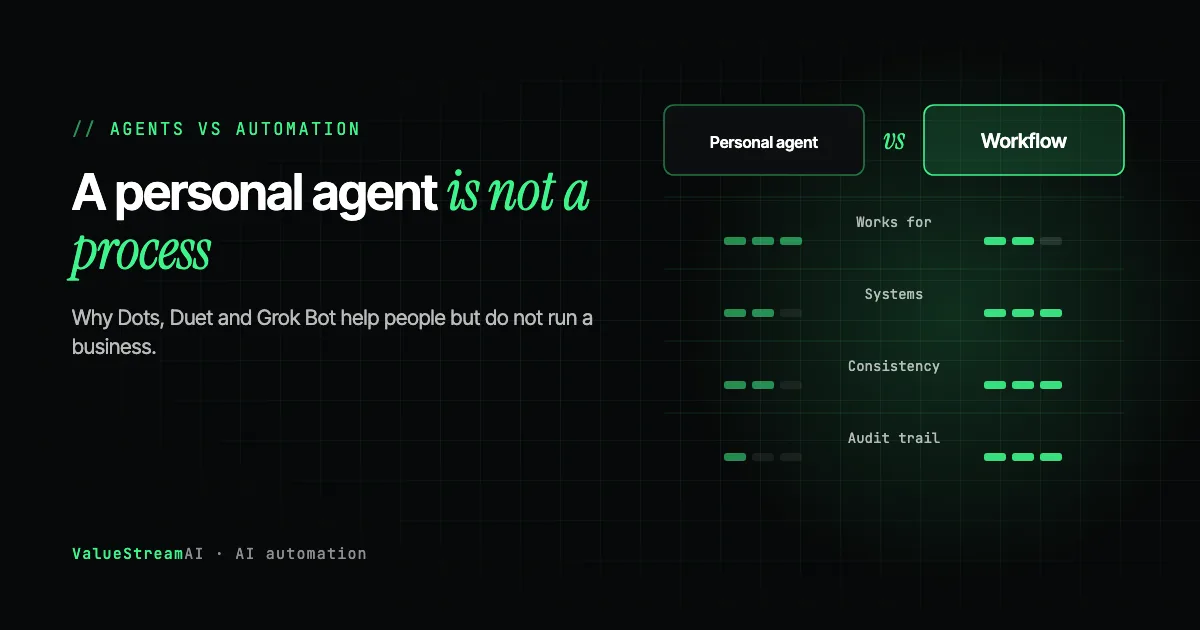
| Personal AI agent | Business automation (built workflow) | |
|---|---|---|
| Works for | The person who set it up | The business |
| Owns | That person's tasks | The whole process, start to finish |
| When that person is off | Pauses with them | Keeps running |
| Systems | The apps in the vendor's catalogue | Your systems, including old ones with no app |
| Same result every time | No: it reasons afresh each time | Yes for the rules, with AI only where judgement helps |
| Checks before acting | Approval prompts to the user | Code checks every action against your rules |
| Audit trail | That person's activity log | Every step, every record, across the team |
| Cost | Per seat or per agent | One build plus running costs |
Where Personal Agents Stop: Five Gaps
1. They act as one person. Every one of these agents inherits the permissions and approvals of the person who set it up. Google's Gemini agent goes furthest the other way, giving agents their own Workspace accounts, with IT rules, spending caps and activity logs set once for the company (Google Cloud, 8 October 2026). That is a real step towards a business tool, and if your business lives in Google Workspace it is worth a serious look.
2. They do not reach your industry systems. Thousands of connectors cover email, chat, payments, e-signature and popular CRMs. They often do not cover a trade's job management system, a practice management system, a freight portal, or an accounts package from 2009 with no connection at all. In our experience, legacy access is the most overlooked blocker in any automation project, and it is exactly where a personal agent runs out of road. The legacy EHR extraction we did for a medical group is what solving it looks like.
3. They are not consistent enough to run a process unchecked. In the most realistic published office test, the best agent finished 30.3% of 175 tasks on its own (TheAgentCompany, Carnegie Mellon, 2025). In customer-service tests, a leading model got about 61% of retail requests right on one try but fewer than 25% right on all eight tries (τ-bench, 2024). Newer models score higher, but the gap between one try and every try remains. The vendors know it: OpenAI says Dots can make mistakes and consequential work should be reviewed, and Anthropic says Duet can misread a thread or misjudge urgency. For a person's own follow-ups that is fine. For 500 invoices a month it is not. More in are AI agents reliable?
4. A confirmation is not proof. On our own production voice lines, a date range added to an out-of-hours rule silently switched off its time window and took an agent off three lines for out-of-hours calls for a week, and nobody noticed because nobody watches the phones at night. Agents and platforms report success; only the record in the system proves it. A business process needs monitoring that checks the outcome, which personal agents do not provide across a team.
5. Security boundaries differ. Personal agents read your email, and researchers have shown that hidden instructions in emails and web pages can hijack AI tools that read them (Greshake et al., 2023). The vendors take this seriously: Duet cannot move money between accounts even with approval, and Dots keep sensitive actions with the user. But xAI's own documentation, as reported at launch, says that all of a user's Grok Bots share one cloud computer and should not be treated as a security boundary between each other. A business workflow can separate what each step is allowed to touch.
What Personal Agents Are Genuinely Best At
To be fair to them: for a lot of work, a personal agent is the right tool and a custom build would be a waste of money.
| Work | Best tool | Why |
|---|---|---|
| Your own inbox, diary and follow-ups | Personal agent | It is your work; you approve |
| Research, briefs and reports | Personal agent | Read-only, low risk, high value |
| Chasing your own invoices | Personal agent | Drafts and waits for your yes |
| One-off analysis or a forecast | Personal agent | No process to repeat |
| Order to invoice across a team | Built workflow | Crosses people and systems |
| Patient or client intake | Built workflow | Regulated data, same steps every time |
| High-volume document processing | Built workflow | Consistency and an audit trail |
| Anything touching an old system with no app | Built workflow | Agents cannot reach it |
If most of your list sits in the top half, keep your subscriptions and skip the build. Our ChatGPT for small business guide covers getting the most from the seats you already pay for, and our business automation tools comparison includes when to buy nothing at all.
How to Tell Which One a Task Needs
If a task is one person's own work, a personal agent is the right tool. If it crosses several people or systems, check whether it repeats often and whether it touches an old or industry system. Frequent cross-team tasks, or any that touch systems the agents cannot reach, need a built workflow. Occasional cross-team tasks can be helped by personal agents with a person co-ordinating.
Human Hours vs Automation: Order to Invoice, Three Ways
Because this guide argues a built workflow saves more than personal agents on a team process, here is that claim priced. Following our rule, nothing is priced as "AI alone": every column keeps people on the work.
Assumptions (our estimates, not client data):
- A service business handling 400 or 1,000 jobs a month.
- Staff alone: 15 minutes per job across quoting, booking, confirming, invoicing and chasing, much of it re-typing between systems.
- Staff with personal agents: 10 minutes per job. Agents draft quotes and chasers, but details are still re-keyed between the job system and accounts.
- Staff with a built workflow: 3 minutes per job for review and exceptions, plus 8.7 hours a month of oversight and rule updates.
- Staff cost at $21.53 an hour, the US median for customer service representatives (BLS, May 2025), base pay only.
| Volume | Staff alone | Cost | With personal agents | Cost | With a workflow | Cost |
|---|---|---|---|---|---|---|
| 400 jobs a month | ~100 hrs | ~$2,150 | ~67 hrs | ~$1,440 | ~29 hrs | ~$620 |
| 1,000 jobs a month | ~250 hrs | ~$5,380 | ~167 hrs | ~$3,590 | ~59 hrs | ~$1,260 |
| 400 a month, for a year | ~1,200 hrs | ~$25,840 | ~800 hrs | ~$17,220 | ~344 hrs | ~$7,420 |
The other side of the ledger. Personal agents cost a seat or subscription per person (from $20 a month, more for agent tiers). A built order-to-invoice workflow starts as a pilot at $2,000 to $3,000, depending on scope, or $15,000 to $40,000 for the full process, plus maintenance. At 400 jobs a month the workflow saves about $800 a month more than personal agents alone, so a $3,000 pilot pays back in about four months and a $15,000 full build in under two years; at 1,000 jobs, the full build pays back in under a year.
What the numbers leave out. Errors from re-typing (a wrong amount on an invoice costs more than the minutes), speed to invoice (cash arrives sooner), and the fact that personal agents still help the same staff with everything else they do. Run your own figures with the headcount vs automation calculator.
The Competitor Pulse Check
| Factor | ValueStreamAI Approach | Typical "AI Agents for Business" Advice |
|---|---|---|
| Starting point | The process and who owns it | The tool and its features |
| Personal agents | Recommended for personal work, with permissions set | "Replace your admin staff" |
| Consistency | Measured with repeated runs; checks in code | Assumed |
| Old systems | Connected directly, as the first job | Not mentioned |
| Proof it worked | The record in your system | The agent's confirmation |
| Honest scope | Says when the seats are enough | Always recommends a build |
How We Combine Personal Agents With Business Automation
The best setups we build do not choose between them.
- 01Keep the seats
ChatGPT, Claude or Gemini stay as each person's assistant, with a written AI policy.
- 02Map one process end to end
Every person, system and hand-off for one process, such as order to invoice.
- 03Build the workflow
Connected systems, checks before each action, approvals at the right person.
- 04Let agents meet it
Personal agents receive finished work to approve, instead of doing the process themselves.
- Keep the seats you already pay for, with a written policy on what goes in.
- Map one process end to end: every person, system and hand-off.
- Build the workflow with connected systems, checks before every action, and approval at the right person, using an AI model inside where judgement helps (reading a document, drafting a reply, sorting a request).
- Let personal agents meet it. The workflow hands finished work to a person, or to their Dot or Duet, for approval, instead of the agent trying to run the process itself.
That is the work of our AI automation solutions team, with AI agent development for the agent parts. You can see a business-wide system in the AI agent ecosystem we built for a 40-doctor network, and every research finding we cite is in our AI research library. For the full comparison of assistants and agents, see our best AI assistant for small business guide.
Frequently Asked Questions
What is the difference between a personal AI agent and business automation?
A personal AI agent, such as OpenAI's Dots or Anthropic's Claude Duet, works for the person who set it up, with that person's permissions and approvals. Business automation runs a process that belongs to the company, across several people and systems, the same way every time. Most businesses benefit from both.
Can OpenAI Dots or Claude Duet automate my business?
They can automate a lot of one person's work, such as inbox triage, follow-ups and reports. They are not designed to own a team process like order to invoice or patient intake, and both vendors say their agents can make mistakes. Those processes need a built workflow with checks and an audit trail.
Is Google's Gemini agent a business automation tool?
It goes further than the others: Google gives each agent its own Workspace account, and IT can set company rules, spending caps and activity logs. For a business that runs on Google Workspace, that makes it a strong option for work inside those tools. Processes that depend on industry or legacy systems outside Workspace still need connecting.
When should a small business build a workflow instead of using AI agents?
When a task crosses several people or systems, repeats many times a month, or touches an old or industry system an agent cannot reach. Order to invoice, client intake and document processing are typical examples. One person's own admin is usually better served by a personal agent.
Are personal AI agents safe for business data?
They are safer than they were, with approval rules, blocked money transfers and hidden passwords. The risks are prompt injection through email and web pages, and agents acting with one person's broad permissions. Start with read-only access, approval on anything that sends or pays, and a written AI policy.
Do I need to choose between AI agents and automation?
No. The best setups use workflows to run the business and personal agents to help the people in it. A good workflow hands finished work to a person, or their agent, to approve.
What's Next
Keep your personal agents: they will save you hours on your own work. Then pick the one process that eats the most time across your team, usually something that involves re-typing between systems, and map it end to end. That is where a workflow pays.
If you would like a second opinion on which of your processes need a workflow and which a personal agent already covers, book a free call through our AI automation solutions page, or start with the AI readiness check.
Muhammad Kashif is co-founder of ValueStreamAI, leading technical delivery and AI strategy. He designs and ships custom agentic AI and healthcare automation systems for clients across the US and UK. More about Muhammad Kashif →