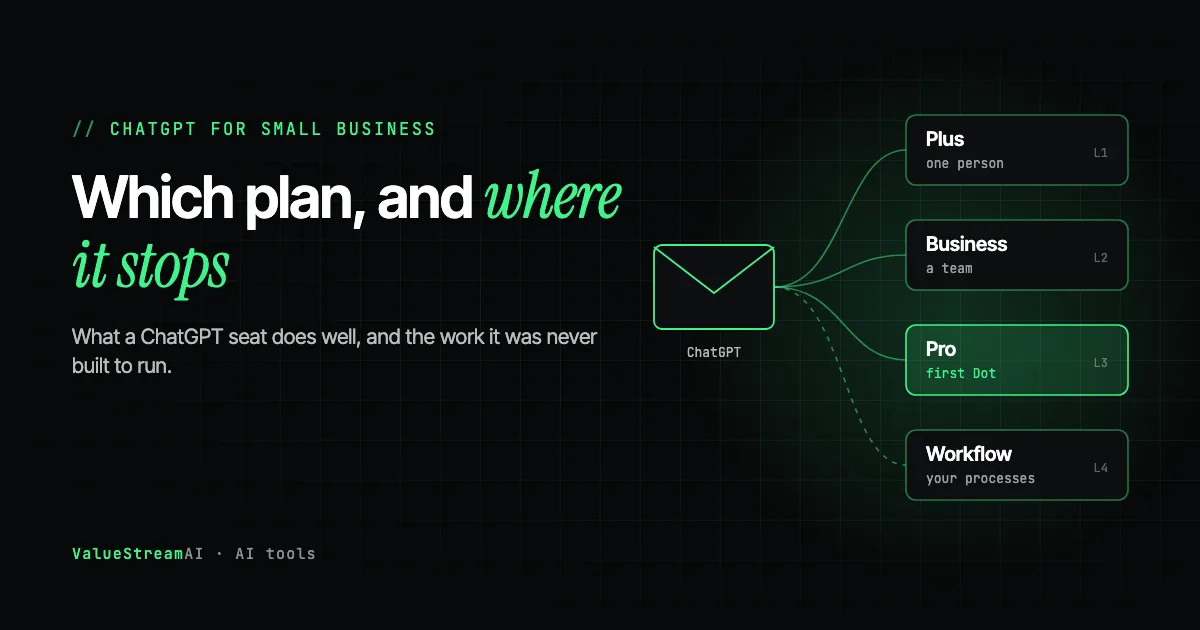
ChatGPT for small business is the most common first step into AI, and for good reason: for about the price of a lunch a month it makes one person noticeably faster at writing, planning and thinking things through. The question owners actually need answered is narrower: which plan, for what work, and where does it stop being the right tool? This guide answers all three, with the research on what it really saves and an honest list of who should not rely on it.
The short answer: Buy Plus ($20 a month) if one person will use it. Buy Business ($25 a user a month, or $20 billed annually, two-seat minimum) as soon as two or more people use it for work, because that is where your data stays out of training by default and you get admin control. ChatGPT is excellent at drafting, summarising and thinking through decisions. It is not a system that runs your business processes: it works as one person's assistant, does not produce the same checked result every time, and does not connect your job system, CRM and accounts into one flow. For that you need a built workflow.
Key takeaways
- Plus for one person, Business for a team. The jump is about data handling and admin, not cleverness.
- Writing is where it pays. A Science study measured 40% less time on professional writing tasks with 18% better quality.
- It helps newer staff most. In a study of 5,179 support agents, AI help lifted output 14%, mostly among the least experienced.
- It is one person's assistant, not a business system. Even the new always-on Dots act for one user.
- Do not put patient data into it unless you are on an OpenAI healthcare or enterprise arrangement with a signed BAA.
| Metric | 2026 Benchmark |
|---|---|
| ChatGPT reach | Around 10% of the world's adults by July 2025 (OpenAI and Harvard, NBER w34255) |
| Time saved on professional writing tasks | About 40%, with 18% higher quality (Noy and Zhang, Science 2023) |
| Support issues resolved per hour with AI help | Up 14% on average, mostly for newer staff (Generative AI at Work, QJE 2025) |
| ChatGPT Business price | $25 per user a month, $20 billed annually, two-seat minimum (checked 31 October 2026) |
Which ChatGPT Plan Should a Small Business Buy?
Plus for a solo owner, Business the moment a second person uses it for work. Prices below were checked on 31 October 2026 against several independent pricing trackers. OpenAI's own pricing page could not be loaded for our check, so confirm the current figure there before you buy.
One person who writes, plans and researches every day.
- Personal account
- Training on chats is a setting you control
- No admin console
Two or more people who share work and need admin control. $20 a user billed annually.
- Two-seat minimum
- Workspace data not used for training by default
- Admin and app controls
Heavy individual use; includes your first Dot (always-on agent).
- Higher limits
- First Dot included
- Still one person's account
| Plan | Price | Best for | Watch out for |
|---|---|---|---|
| Free / Go | $0 / $8 a month | Trying it out | Lower limits; keep business data out |
| Plus | $20 a month | One person who uses it daily | A personal account: no admin, no shared workspace |
| Business | $25 a user a month ($20 annually), 2+ seats | Teams of 2 to roughly 150 | Per-seat cost grows with headcount |
| Pro | From $100 a month | Heavy individual use; includes your first Dot | Still one person's account |
| Business Premium | Higher per seat (check OpenAI) | Teams wanting Dots across the workspace | Price varied between sources; confirm directly |
| Enterprise | Custom | Larger firms, SSO, compliance | Sales process; usually overkill under 50 staff |
Two points matter more than the price.
Data handling. OpenAI states that Business, Enterprise and Edu workspace content is not used to improve its models by default. On personal plans it is a setting each person controls. If staff are pasting customer emails or quotes into a personal Plus account, you have a policy problem, not a technology one. Our free one-page AI policy template fixes that in an afternoon.
Healthcare. No standard Plus or Business plan comes with a HIPAA Business Associate Agreement. Medical practices should read whether ChatGPT is HIPAA compliant before anyone pastes in a patient detail.
What ChatGPT Is Genuinely Good At in a Small Business
Writing, summarising and thinking a decision through. That is not our opinion: it is what both the usage data and the experiments show.
OpenAI's own study of how people use ChatGPT, co-authored with Harvard economist David Deming (NBER w34255, September 2025), found that writing dominates work use, and that much of the economic value comes from decision support: using it to think through a choice, not just to produce text.
The experiments put numbers on it:
- Writing. In a randomised experiment published in Science (Noy and Zhang, 2023), professionals doing realistic writing tasks took about 40% less time and produced work rated about 18% higher in quality. The weakest writers gained the most.
- Customer support. In a study of 5,179 real support agents (Brynjolfsson, Li and Raymond, NBER w31161, published in the QJE), an AI assistant raised issues resolved per hour by about 14%. Almost all of that went to newer and less experienced staff; the most experienced gained little.
In a small business that translates into everyday jobs:
| Task | What ChatGPT does well | What you still do |
|---|---|---|
| Customer emails and quotes | First drafts in your tone, in seconds | Check prices, dates and promises |
| Job adverts and staff handbooks | Structure and clear wording | Make sure it matches your actual policies |
| Marketing copy and social posts | Volume and variations | Keep it accurate; Google penalises thin AI content (our guide) |
| Summarising long documents | Key points from contracts, tenders, reports | Read the clauses that carry risk |
| Thinking through a decision | Options, pros and cons, questions to ask | Make the decision |
| Spreadsheets and simple analysis | Formulas, pivot ideas, charts | Check the numbers against the source |
A useful way to see it, from the research we follow: ChatGPT behaves like a way of giving every member of staff your best person's first draft. That is why the gains land on newer staff, and why it is worth a seat for most small teams.
Where ChatGPT Stops: The Limits a Small Business Hits
It is one person's assistant, not a system that runs a process. Every limit below follows from that.
1. It does not know your business until someone connects it. A seat buys a very capable reader who has never been handed the filing cabinet. ChatGPT Business can connect to apps such as Google Drive and Slack, and the new ChatGPT Space keeps shared pages in sync, but your job management system, your accounts package, the CRM nobody exported, and ten years of email are not in it. The most common failed AI rollout we are called into starts with "we bought seats for everyone and it still does not know anything about our customers". The fix is not a better model; it is getting your data out of the places it lives and into one place the AI can reach.
2. It works as one person. Even OpenAI's new always-on Dots, launched on 29 September 2026, act on behalf of the user who set them up. Each Dot has its own cloud computer and browser and can use more than 4,000 connected apps, but approvals, permissions and memory belong to that person. A business process (an order coming in, a job being booked, an invoice going out, a payment chased) involves several people and systems, and needs to run whether or not any one person's assistant is switched on. We explain the difference in personal AI agents vs business automation, and look at Dots themselves in OpenAI Dots for business.
3. It does not give the same answer twice. Language models are non-deterministic. Customer-service research from Princeton and Sierra found a leading model got about 61% of retail requests right on one try, and under 25% right on all eight tries of the same request (τ-bench, 2024). For drafting, that variation is harmless because you read the draft. For anything that updates a record or sends money, it is the reason checks have to be built in. More in are AI agents reliable?
4. It can be confidently wrong on the wrong kind of task. A Harvard and BCG study of 758 consultants found that on tasks inside the AI's strengths, consultants with AI were faster and better; on a task deliberately placed just outside them, consultants using AI were more likely to reach the wrong answer, because the output was persuasive. Staff need to know where the tool is weak.
5. Hidden instructions are a real risk once it reads your email. Researchers showed in 2023 that instructions hidden inside emails and web pages can take over AI tools that read them (Greshake et al., arXiv 2302.12173). A person sees a normal email; the AI also reads the white-on-white text telling it to forward something. OpenAI keeps sensitive actions with the user and offers approval rules for Dots, which helps, but the safest setup is still narrow permissions.
Who Should Use ChatGPT, and Who Should Not
Most small businesses should have it. Fewer should rely on it as their system.
| You are | ChatGPT is | Why |
|---|---|---|
| A solo owner or freelancer | A great fit (Plus) | Writing, planning and research are most of the admin |
| A team of 2 to 20 in an office | A good fit (Business) | Shared workspace, admin, data kept out of training |
| A trade or field service business | Helpful for office admin | The jobs, schedules and invoices live in other systems |
| A medical, dental or therapy practice | Only for non-patient work | No BAA on Plus or Business; see our private AI for practices guide |
| A business with high-volume repeat processes | Not on its own | Orders, bookings and invoices need a workflow that runs the same way every time |
| A regulated firm (legal, finance) | With a written policy | Confidentiality, record-keeping and accuracy checks first |
If you are in the last three rows, ChatGPT is still worth a seat for drafting. The process itself is what needs building, which is what our AI automation solutions team does.
When ChatGPT Is Enough, and When You Need a Built Workflow
Use this test before spending anything beyond the subscription.
If one person does the task and reads the result before it is used, a ChatGPT seat is enough. If the task repeats across the team, touches your own systems, or updates records and sends money, it needs a built workflow, with ChatGPT or another model inside it.
The honest position: a large share of small businesses never need more than the seats. We say so in our business automation tools comparison, including when to buy nothing at all. Simple, low-volume tasks are often covered by our free automation templates. The build becomes worth it when the same task runs hundreds of times a month across people and systems.
Human Hours vs Automation: Written Admin With ChatGPT
Because this guide says ChatGPT saves time, here is that claim priced. The comparison is the owner working alone against the same owner working with ChatGPT; the owner still checks everything.
Assumptions (stated as assumptions):
- An owner or office manager spends 5, 10 or 15 hours a week on written admin: emails, quotes, adverts, policies, proposals.
- ChatGPT cuts that time by 40%, the figure from the Science experiment on professional writing. Your figure may be higher on routine emails and lower on technical quotes.
- Time valued at $21.53 an hour, the US median wage for customer service representatives (BLS, May 2025). That is a deliberately low floor: an owner's own hour is usually worth more, so the real saving is larger.
- ChatGPT Plus at $20 a month.
| Volume | Owner alone | With ChatGPT | Hours saved a month | Value at $21.53/hr | Subscription |
|---|---|---|---|---|---|
| Light (5 hrs/week) | ~21.7 hrs/month | ~13 hrs | ~8.7 hrs | ~$187 | $20 |
| Typical (10 hrs/week) | ~43.3 hrs/month | ~26 hrs | ~17.3 hrs | ~$373 | $20 |
| Heavy (15 hrs/week) | ~65 hrs/month | ~39 hrs | ~26 hrs | ~$560 | $20 |
| 5 people, typical, a year | ~2,600 hrs | ~1,560 hrs | ~1,040 hrs | ~$22,390 | $1,200 to $1,500 (Business) |
The other side of the ledger. A seat costs $20 to $25 a month, plus the time to set a policy and show people how to use it well. No build is needed for this work.
What the numbers leave out. Quality (the study found it went up), the learning curve in the first weeks, and the time spent checking output, which is real and is already inside the "with ChatGPT" column. To run your own numbers, use the headcount vs automation calculator or the ROI calculator.
The Competitor Pulse Check
Most "ChatGPT for small business" guides are lists of prompts. Here is how the advice differs.
| Factor | ValueStreamAI Approach | Typical Guide |
|---|---|---|
| Plan advice | Plus for one, Business for two or more, because of data handling | "Start with the free version" |
| Evidence | Peer-reviewed time savings, with who gains most | Vendor claims and anecdotes |
| Limits | Named: one-person assistant, no shared process, inconsistent output | Rarely mentioned |
| Healthcare and regulated work | Clear no for patient data without a BAA | Not covered |
| When to build | A simple test, and when not to | "Use Zapier" |
| Agents (Dots) | Explained as personal agents, with the approval rules | Not yet covered |
How We Help Small Businesses Use ChatGPT Properly
Most of our small-business clients already pay for ChatGPT, Claude or Copilot. Our work starts where the seats stop.
- A short audit. Which tasks are drafting (a seat is enough) and which are processes (need building). Our AI readiness check is the free version.
- A policy and a rollout. What goes in, what never does, and who checks what.
- Connecting your data so the AI can answer from your own customers, jobs and documents, not from guesswork.
- Building the processes that need to run the same way every time, with ChatGPT or another model inside them, checks before every action, and a person on the exceptions.
That is the shape of our AI consulting for small business, and you can see the full version in the AI agent system we built for a 40-doctor network. If you are weighing up which assistant to buy in the first place, start with our best AI assistant for small business comparison, and for Anthropic's new agent see Claude Duet for small business owners.
Frequently Asked Questions
Is ChatGPT worth it for a small business?
For most small businesses, yes, as a writing and thinking tool. A Science study measured about 40% less time on professional writing tasks, which at a typical 10 hours a week of written admin is worth far more than a $20 subscription. It is not worth it as a replacement for a system that runs your orders, bookings or invoices.
Which ChatGPT plan is best for a small business?
Plus ($20 a month) for one person, and Business ($25 a user a month, or $20 billed annually, with a two-seat minimum) once two or more people use it for work. Business keeps workspace data out of model training by default and adds admin controls. Prices were checked on 31 October 2026; confirm on OpenAI's site before buying.
Is ChatGPT safe for confidential business information?
On Business and Enterprise plans, OpenAI states workspace content is not used to train its models by default, which covers most everyday business use. Personal accounts depend on each person's settings, so set a written AI policy. Patient health information needs a signed BAA, which standard Plus and Business plans do not include.
Can ChatGPT run my business processes on its own?
Not reliably. Even the new always-on Dots act for one person, and language models do not give the same result every time, which matters when an order, invoice or record is updated. Repeat processes need a workflow with checks and approvals, with ChatGPT or another model inside it.
What are OpenAI Dots, and do I need them?
Dots are always-on ChatGPT agents launched on 29 September 2026, each with its own cloud computer and browser, and the first one is included with Pro and Business Premium. They suit an owner who wants an assistant that keeps working on their own tasks. They are still one person's agent, so they do not replace a business workflow.
Should my staff use ChatGPT or Claude?
Both are strong; the right one depends on your other software and how you work. We compare all four for a team in ChatGPT vs Claude vs Copilot vs Gemini for a 20-person business, and Claude on its own in Claude for small business. Many teams do well with one general assistant and a built workflow for the processes that matter most.
Related reading: if you are weighing ChatGPT against a business chatbot or agent, see AI chatbot cost per month and how much an AI agent costs per month.
What's Next
Buy the seats. ChatGPT will make your team faster at the writing and thinking that fill most office days, and the research backs that up. Then look at the processes that still depend on someone copying information between systems, because that is where a seat stops and the bigger savings start.
If you want a straight answer on which of your tasks need more than ChatGPT, book a free call through our AI consulting for small business page.
Muhammad Kashif is co-founder of ValueStreamAI, leading technical delivery and AI strategy. He designs and ships custom agentic AI and healthcare automation systems for clients across the US and UK. More about Muhammad Kashif →