DSL Warehouse is an online store for networking and telecommunications equipment: DSL modems, routers, fibre and copper cabling, Ethernet extenders and wireless radios, from brands like Cisco, Netgear and Patton. Its sitemap lists roughly 4,450 product URLs today. Stores like this live or die on long-tail search, because nobody types "networking equipment" when they need a specific Ethernet extender. They type a part number.
That is exactly why technical SEO matters more for a catalogue store than for almost anyone else. A few thousand product pages are only worth something if Google can reach them, understand them and trust them. When we started, more than 100 pages had problems that stopped that from happening: redirects that went nowhere useful, internal links that left pages stranded, and content too thin or too duplicated to rank.
| Metric | Result |
|---|---|
| Pages audited and fixed | 100+ |
| Problem types | Redirects, internal links, content |
| Google clicks (Search Console, about 8 weeks of data) | 1,100 |
| Impressions in the same window | 91,700 |
| Average position | 26 |
Why Technical SEO Comes First on a Large Store
The short answer: content cannot rank if Google cannot reach it. On a five-page site you can check every page by hand. On a store with thousands of product URLs, small structural mistakes are multiplied by the size of the catalogue, and they hide. A single discontinued category that redirects to another redirect affects every product link that pointed into it.
Google says this itself. Its documentation on redirects recommends redirecting straight to the final URL, and its crawling guidance explains that Google discovers pages mainly by following links from pages it already knows. A page nothing links to is a page Google may never find, however good it is.
This is the unglamorous part of SEO that most stores skip, because it does not produce anything you can show a customer. It is also the part that decides whether everything else works.
What the Audit Found
The audit covered more than 100 pages and grouped the problems into three kinds.
Redirection issues
Catalogue stores change constantly. Products are discontinued, renamed and merged, categories are reorganised, and each change leaves old URLs behind. Done carelessly, that produces redirect chains (A goes to B, which goes to C), loops, and redirects that land on a generic page rather than the closest replacement. Each wasted hop costs crawl time, and any links other sites had pointed at the old URL lose some of their value on the way.
The fix is simple to describe and tedious to do: every old URL goes in one step to the most relevant live page.
Internal linking issues
Internal links are how Google moves around a site and how it judges which pages matter. On a large store, internal linking problems take two usual forms: product pages linked from nowhere (orphans), and links pointing at URLs that have since been redirected or removed. Fixing those means pointing links at final URLs and making sure every product sits on a real path from the category structure.
Content issues
Product pages on equipment stores often share the manufacturer's description word for word, and variants of the same product carry near-identical text. Google sees duplicates and picks one to show, often not the one you would choose. Thin pages give it too little to work out what they are for. The fix is to make each important page say something distinct about what it is and who it suits.
More than 100 pages were audited and their problems sorted into three kinds: redirection issues, internal linking issues and content issues. Each kind was fixed, and Search Console then showed 1,100 clicks and 91,700 impressions in about eight weeks of data.
What Search Console Showed
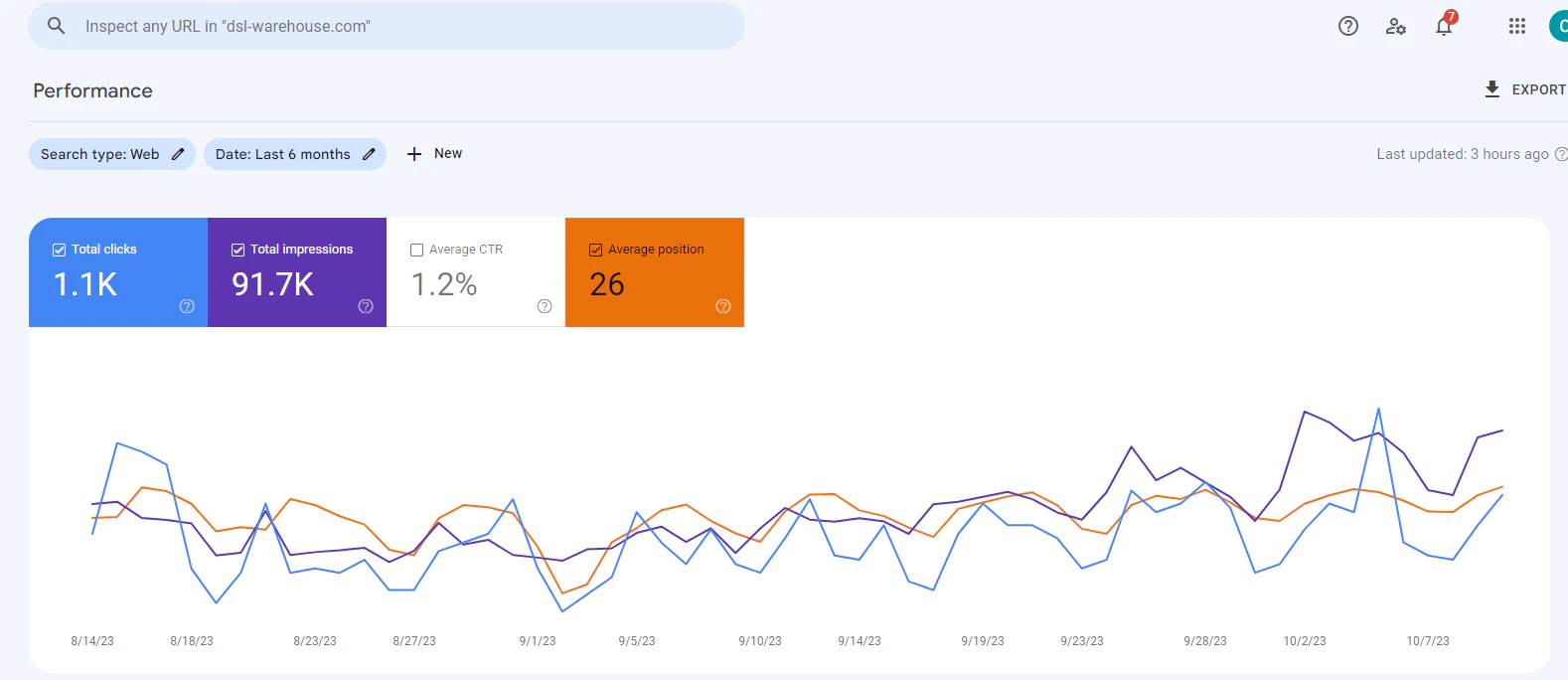
Google Search Console, dsl-warehouse.com. The report is set to the last 6 months but data starts in mid-August 2023: 1.1K clicks, 91.7K impressions, 1.2% CTR, average position 26.
Two details in this screenshot are worth reading carefully.
The data starts in mid-August. The report is set to "last 6 months", yet the chart begins on 14 August 2023. That is what Search Console shows when the property has no data before that point, so this chart covers about eight weeks, not six months. 1,100 clicks and 91,700 impressions in roughly eight weeks is the real pace.
The impressions line rises into October. The purple line, impressions, sits at its highest level in the final two weeks of the chart. Impressions are the leading indicator: Google showing the pages more often, usually before clicks catch up.
The average position of 26 looks modest, and it needs context. On a store with thousands of products, the site appears for a very long tail of part numbers and product names, many of them on page two or three. An average across all of those will always sit lower than a small site's. The 1.2% click-through rate follows from the same thing. The useful question for a store like this is not the average, but whether impressions and clicks are rising for the products that sell, which is what the chart shows.
Organic Clicks vs Paid Clicks: Pricing the Same Traffic
Assumptions, stated plainly:
- Clicks: 1,100 from Search Console, mid-August to early October 2023.
- Cost per click: LocaliQ's 2026 search advertising benchmarks (US data, updated 1 June 2026): $4.14 for shopping and retail, $5.42 across all industries, $5.87 for business services. These are 2026 prices applied to 2023 clicks, so read the result as an illustration of scale.
- Shopping ads: a real store would likely buy many of these clicks as Google Shopping ads, which are priced differently. We use search CPCs because that is the published benchmark.
| Volume | Organic clicks | Same clicks on Google Ads | Ongoing cost organically |
|---|---|---|---|
| About eight weeks of data | 1,100 | about $4,550 to $6,460 | None per click |
| A year at the same pace (our estimate) | roughly 7,000 | roughly $29,000 to $41,000 | Maintenance as the catalogue changes |
The other side of the ledger is the audit itself and the maintenance after it. A catalogue that changes every week will produce new redirect and linking problems every week, so the work is not done once. But a year of search-ads spend at this volume would pay for a great deal of maintenance.
The Competitor Pulse Check
| Factor | ValueStreamAI approach | Typical automated "SEO audit" |
|---|---|---|
| Output | Problems fixed on the live site | A PDF of warnings |
| Prioritisation | Pages that sell and pages with links first | Every warning weighted the same |
| Redirects | Each old URL mapped to its closest live replacement | "Redirect to homepage" as a blanket fix |
| Content | Distinct text on the pages that matter | Flagged as "duplicate", left to you |
| Measurement | Google's own Search Console data | A tool's health score |
What This Engagement Confirmed
On a big catalogue, structure beats volume. Writing more content on a site with broken redirects and orphaned pages is pouring water into a leaking bucket. Fix the leaks first.
Audit reports are not results. Every SEO tool will produce a long list of warnings. The value is in deciding which ones matter and fixing them on the live site, which is why we price audits as part of the fix rather than as a report on their own.
Read the chart, not just the totals. The totals here are strong, but the more important detail is that the data starts in mid-August and the impressions line was still rising at the end. For more on reading these reports, see our guide to what an SEO audit includes, and for the full set of client results, our SEO portfolio case study.
Frequently Asked Questions
What does a technical SEO audit fix on an ecommerce site?
The common problems are redirect chains and loops from discontinued products, internal links pointing at old or missing URLs, product pages nothing links to, and duplicate or thin product descriptions. For DSL Warehouse we fixed all three kinds across more than 100 pages.
How quickly does a technical SEO audit show results?
Faster than most SEO work, because it removes blockers rather than building new authority. DSL Warehouse's Search Console data shows 91,700 impressions and 1,100 clicks in about eight weeks of data, with impressions still rising at the end of the window.
Why is the average position 26 if the results were good?
Because a large store appears for thousands of long-tail product searches, many of them on page two or three, and the average includes all of them. The trend in clicks and impressions for products that sell matters more than the site-wide average.
Do redirects lose SEO value?
A single clean redirect passes the value of the old URL to the new one. Chains of several hops, loops, and redirects to unrelated pages waste crawl time and can lose that value, which is why Google recommends redirecting straight to the final URL.
How much does a technical SEO audit cost?
Our audits are priced as part of fixing the problems, inside a build or a marketing retainer from $900 a month, rather than sold as a report. For market context, an Ahrefs survey of 439 SEO providers found the most common one-off project fee was $2,501 to $5,000.
What's Next
If you run an online store and your product pages are not being found, the first step is a crawl and a look at your Search Console indexing report. We do that on a free call and tell you what is worth fixing first.
→ See our SEO and digital marketing services
→ What a technical SEO audit includes
→ See what building and marketing costs, or talk to us about your site