Comparing ChatGPT vs Claude vs Copilot vs Gemini for business is easy for one person and harder for a team. At around 20 people, the choice is not which model writes the nicest email; it is what the whole team will actually use every day, what it costs a year, whether your data stays yours, and whether two tools would serve you better than one. This guide answers those questions for a typical 20-person business, using list prices checked on 31 October 2026 and independent research on what these tools save.
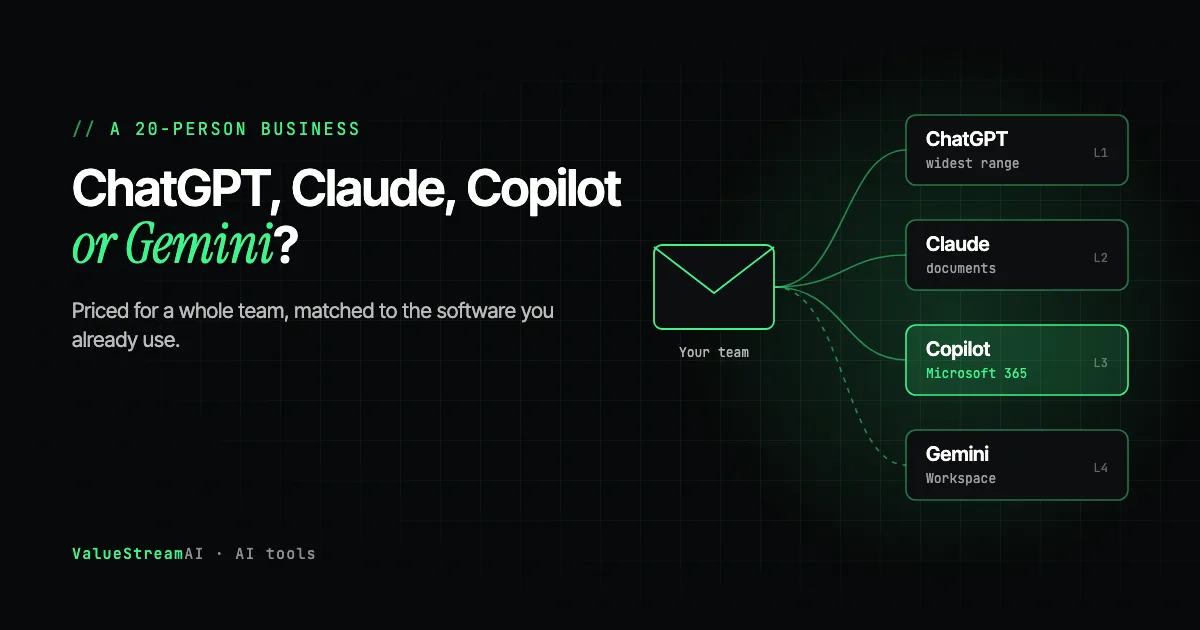
The short answer: Let your existing software decide. On Microsoft 365, choose Copilot (about $5,040 a year for 20 people as an add-on). On Google Workspace, use Gemini, which is already included in Business Standard and above. If you are on neither, or your work is varied, ChatGPT Business ($4,800 a year for 20 on annual billing) has the widest range; if your work is mostly long documents and careful writing, or finance admin on QuickBooks, Claude Team costs the same. Many 20-person firms do best with one assistant for everyone and a few seats of a second for the people who need it.
Key takeaways
- The assistant inside your email and documents gets used. That usually means Copilot or Gemini.
- For 20 people the AI licence costs $0 to about $5,000 a year, small next to the time at stake.
- Team plans of all four keep business data out of model training by default.
- Mixing works: one assistant for everyone, a second for a few specialists.
- None of them runs a process across your team and systems; that needs a workflow.
| Metric | 2026 Benchmark |
|---|---|
| ChatGPT Business, 20 users, annual | $4,800 a year ($20 a user a month) |
| Claude Team, 20 seats, annual | $4,800 a year ($20 a seat a month) |
| Copilot Business add-on, 20 users | About $5,040 a year (about $21 a user a month, partner-reported) |
| Gemini on Workspace Business Standard | Included; Workspace lists at $14 a user a month |
How We Compared Them
Five things that matter for a team of about 20:
- Fit with the software your team already lives in.
- Cost for the whole team for a year, on the plan a business would buy.
- Data handling and admin: training off by default, single sign-on, central control.
- What each does best, and where it is weaker.
- Evidence that it saves time, from studies rather than vendors.
Prices were checked on 31 October 2026. Claude and Google prices come from their pricing pages; ChatGPT prices from several independent trackers, because OpenAI's pricing page could not be loaded for our check; Copilot Business from Microsoft partners, because Microsoft's page did not load. Confirm before you buy. We do not resell any of these tools.
What Each Costs for 20 People
| Per user, annual billing | 20 users a year | What you also need | |
|---|---|---|---|
| ChatGPT Business | $20 ($25 monthly) | $4,800 | Nothing else |
| Claude Team Standard | $20 ($25 monthly) | $4,800 | Nothing else |
| Microsoft 365 Copilot Business | About $21 (partner-reported; an $18 promotional rate was reported to 31 Dec 2026) | About $5,040 | A qualifying Microsoft 365 Business plan |
| Gemini in Google Workspace | Included in Business Standard ($14 list) and above | $0 extra if already on Standard | Business Standard or above for Gemini beyond Gmail |
Gemini looks free only because you are already paying for Workspace. If you are on Business Starter, Gemini is limited to Gmail and moving 20 people to Standard costs $7 a user a month more at list price.
ChatGPT vs Claude vs Copilot vs Gemini: Where Each Is Strongest
ChatGPT: the widest range. The broadest set of tools and connected apps, plus Dots, OpenAI's always-on agents, for heavy users on Pro or Business Premium. Best when your team's work is varied and your software is mixed. Full guide: ChatGPT for small business.
Claude: documents, writing and finance admin. The strongest at long documents and careful writing, and since May 2026 the Claude for Small Business workflows connect to QuickBooks, PayPal, HubSpot, Canva and Docusign with owner approval before anything is sent or paid. Full guide: Claude for small business.
Copilot: inside Microsoft 365. It sits in Outlook, Word, Excel and Teams, where Microsoft 365 staff already work. It also has the strongest independent evidence of the four (below).
Gemini: inside Google Workspace. It sits in Gmail, Docs, Sheets and Meet, and Google's new Gemini agent can run as a coworker with its own account, permissions and audit trail. Full guide: Google's Gemini agent for business.
What the Research Says They Save
Assistants built into everyday tools save real time, mostly on email and writing. The independent evidence:
- UK government trial: 20,000 civil servants using Microsoft 365 Copilot reported saving an average of 26 minutes a day, which the government called nearly two working weeks a year (GOV.UK, 2025). Self-reported, and it ranged from 11 to 35 minutes depending on role.
- Field experiment across 66 firms: 7,137 knowledge workers with an AI assistant in their email and documents spent two fewer hours a week on email over six months (Dillon et al., Microsoft and Harvard, NBER w33795). It found no change in which tasks people did: the gain was time, not new work.
- Writing experiment: professionals took about 40% less time on writing tasks with 18% higher quality (Noy and Zhang, Science, 2023).
- Who gains most: in a study of 5,179 support agents, the gains went mainly to newer and less experienced staff (Brynjolfsson, Li and Raymond, NBER w31161).
These studies are mostly on Copilot and ChatGPT-style assistants; we know of no comparable independent study for Gemini or Claude at company scale yet. The pattern is the same across them: time saved on email, writing and summarising, with the biggest gains for less experienced staff.
Human Hours vs Automation: 20 People With an AI Assistant
Assumptions (stated as assumptions):
- 20 office staff, each saving the UK trial's average 26 minutes a day, which the government called nearly two working weeks a year each; over about 240 working days that is roughly 104 hours. Self-reported; your figure could be lower.
- An 8-hour day, so 104 hours a year per person.
- Staff time at $21.53 an hour, the US median for customer service representatives (BLS, May 2025), a deliberately low floor.
| Team | Hours saved a year | Value at $21.53/hr | AI licence cost a year |
|---|---|---|---|
| 5 people | ~520 | ~$11,200 | ~$1,200 to $1,260 |
| 20 people | ~2,080 | ~$44,800 | $0 to ~$5,040 |
| 20 people, half the trial's saving | ~1,040 | ~$22,400 | $0 to ~$5,040 |
What the numbers leave out. The time to set a policy and train people, the minutes spent checking AI output (already inside the self-reported saving), and quality: the Science study found work got better as well as faster. Even at half the government trial's figure, the licences pay for themselves several times over. Run your own numbers with the headcount vs automation calculator.
Should a 20-Person Business Use Two AI Tools?
Often, yes: one for everyone, a second for a few. Common combinations we see work:
| Main assistant (everyone) | Second (a few seats) | Why |
|---|---|---|
| Copilot | Claude Team for the people writing proposals or contracts | Copilot in Outlook and Excel; Claude for long documents |
| Gemini | ChatGPT Business for marketing or analysis | Gemini in Workspace; ChatGPT for its wider tools |
| ChatGPT Business | Claude Team for finance admin on QuickBooks | ChatGPT for range; Claude's QuickBooks workflows |
Two seats for the same person is rarely worth it. A second tool for the three or four people whose work it suits usually is.
A business on Microsoft 365 starts with Copilot and a business on Google Workspace with Gemini. A business on neither picks Claude if most work is long documents or QuickBooks admin, and ChatGPT otherwise. Then add a few seats of a second tool only for staff whose work it clearly suits, and list the processes that need a built workflow.
Where All Four Stop
Whichever you choose, the same limits apply at 20 people:
- They help each person, not the process. An order that the office books, the field team completes and accounts invoices crosses people and systems; no assistant owns it. We explain the difference in personal AI agents vs business automation.
- They only know what they can reach. A job system, practice system or old accounts package with no connection is invisible to all four.
- They are not consistent enough to run a process unchecked. Fine for drafts you read; not for records and money without checks. See are AI agents reliable?
- Patient data needs the right agreement. Standard ChatGPT and Claude team plans do not include a HIPAA BAA; see is ChatGPT HIPAA compliant.
What to Set Up Before Rolling Out to 20 People
The settings matter more than the brand. Whichever assistant you choose, a 20-person rollout goes well when five things are decided before the first login:
- Who owns it. One named person who manages seats, settings and the policy. Without an owner, licences pile up for people who have left and nobody notices which tools staff have connected.
- Which plan. A business plan, never a mix of personal accounts. Personal plans leave training settings and data retention to each employee.
- Single sign-on and offboarding. When someone leaves, their access, chats and connected apps should go with their company login, on the same day.
- Which connectors are allowed. Decide which company systems staff may connect (email, drive, CRM) and which they may not, before someone connects the accounts package on day one.
- What never goes in. Client confidential information, patient details, card numbers, staff records. Our free one-page AI policy template covers it.
Get those right and the choice between ChatGPT, Claude, Copilot and Gemini becomes much less risky, because you can change tools later without losing control of your data. Get them wrong and even the best assistant becomes a liability, because nobody knows what was shared, by whom, or where it went.
The Competitor Pulse Check
| Factor | ValueStreamAI Approach | Typical Comparison |
|---|---|---|
| Unit | A 20-person team, priced for a year | One user, monthly consumer price |
| Deciding factor | Your existing software | Benchmark scores |
| Evidence | Government and peer-reviewed studies, with caveats | Reviewer impressions |
| Mixing tools | Specific combinations and when they work | Pick one winner |
| Limits | Process ownership, reach, consistency, healthcare | Rarely covered |
How We Help a 20-Person Business Get This Right
- 01Pick by your software
Copilot for Microsoft 365, Gemini for Workspace, otherwise ChatGPT or Claude.
- 02Write the policy
What never goes in, who checks what, which plan keeps data out of training.
- 03Pilot with five people
Two keen, two sceptical, one manager. Note the time saved and the mistakes.
- 04Roll out, and list the processes
Seats for everyone who used it; a list of processes that need more than a seat.
At 20 people, the licence is the easy part. We help with the rest:
- Choosing and rolling out the right assistant, with a policy and a five-person pilot.
- Connecting your data so the assistant can answer from your customers, jobs and documents.
- Building the processes that seats cannot run, with AI inside them, checks before each action and a person on the exceptions.
That is our AI consulting work; for smaller teams see AI consulting for small business. Our best AI assistant for small business guide covers the new agents as well, and every study cited here is in our AI research library.
Frequently Asked Questions
Which is better for business: ChatGPT, Claude, Copilot or Gemini?
The one that fits the software your team already uses: Copilot for Microsoft 365, Gemini for Google Workspace. On neither, ChatGPT has the widest range and Claude is strongest on long documents and QuickBooks-based finance admin. All four keep business data out of training by default on their business plans.
How much does AI cost for a 20-person business?
On annual billing, 20 seats of ChatGPT Business or Claude Team cost about $4,800 a year, and Microsoft 365 Copilot Business about $5,040 as an add-on (checked 31 October 2026). Gemini is included in Google Workspace Business Standard and above, so it costs nothing extra if you already pay for that plan.
Is Copilot better than ChatGPT for a business on Microsoft 365?
Usually, because it works inside Outlook, Word, Excel and Teams, where staff already are. A UK government trial found self-reported savings of 26 minutes a day, and a 66-firm experiment found two fewer hours a week on email. Some teams add a few ChatGPT or Claude seats for heavier writing or analysis.
Should we use more than one AI assistant?
Often yes, but not for everyone. Give the whole team the assistant that fits your software, and a few seats of a second tool to the people whose work it clearly suits, such as Claude for contract-heavy roles. Two tools for the same person is rarely worth paying for.
How much time will an AI assistant save a 20-person team?
The largest independent trial found self-reported savings of 26 minutes a day per person, nearly two working weeks a year, and a field experiment found two fewer hours a week on email. For 20 people that is roughly 1,000 to 2,000 hours a year, worth far more than the licences.
Do AI assistants replace the need for automation?
No. They make each person faster, but they do not own processes that cross your team and systems, such as order to invoice or client intake. Those need a built workflow, which can use any of these models inside it.
What's Next
Pick by your software, write a one-page policy, and pilot with five people for two weeks. Measure the minutes saved and the mistakes caught, because those two numbers will tell you more than any comparison table, including this one. Then make a list of the processes that still depend on people copying between systems. If you would like help with either step, book a call through our AI consulting page.
Muhammad Kashif is co-founder of ValueStreamAI, leading technical delivery and AI strategy. He designs and ships custom agentic AI and healthcare automation systems for clients across the US and UK. More about Muhammad Kashif →