Most owners who end up unhappy with a website did not hire a bad designer. They hired a designer without asking the questions that mattered, and found out a year later that they did not own the domain, could not change a word without paying, and that nobody had done anything to help customers find the site. This guide gives you the questions to ask when hiring a web designer, in plain English, so that does not happen to you.
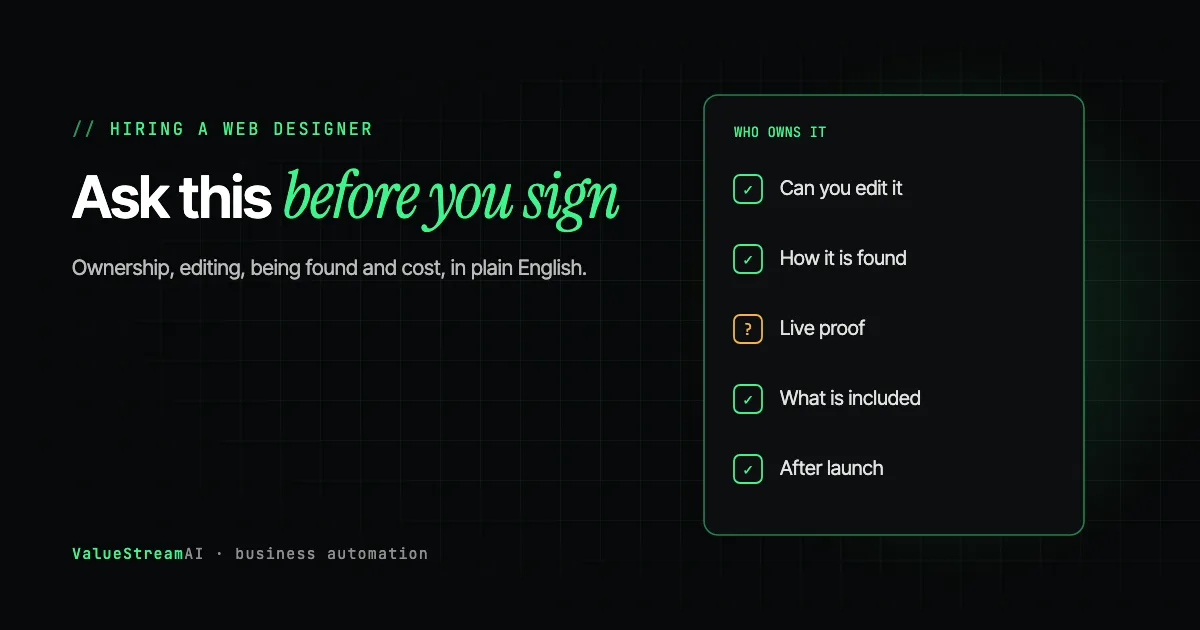
There are twenty, grouped into five areas: ownership, editing, being found on Google and ChatGPT, proof, and cost and support. For each, we explain what a good answer sounds like and which answers should worry you.
| Metric | 2026 Benchmark |
|---|---|
| Small business website price (GoodFirms survey, 2024) | About $1,000 to $7,000 |
| Can anyone guarantee a #1 Google ranking? | No (Google) |
| Time to start showing up in searches (Google) | Four months to a year |
| ChatGPT weekly users | 900 million+ (OpenAI, February 2026) |
| Our website, built to be found | $5,000 to $10,000, depending on scope |
The short answer. Before hiring a web designer, ask who will own the domain, hosting, logins and content (it should be you); whether you can add pages and projects yourself; how the site will be found on Google and by AI assistants like ChatGPT, specifically; to see live client sites you can search for yourself; and exactly what the price includes and what happens after launch. Get the answers in writing. A designer who answers clearly and plainly is usually a safer choice than one who is only cheaper.
Key takeaways
- Ownership comes first. Domain, hosting, logins and content in your name, in writing.
- You should be able to edit it. Otherwise every change is a wait and an invoice.
- "SEO included" means nothing until they say what. Ask for research, pages and the Google listing by name.
- Check proof yourself. Live client sites you can find on Google beat any mock-up.
- Compare three quotes on the same scope, not just on price.
Why These Questions Matter More Than the Design
Design is the easiest part to judge, so it is what most owners compare. The expensive problems are almost always elsewhere. In the client case studies on our site, the typical agency setups we replaced included the agency holding the hosting, domain and admin login while the client rented access; a proprietary builder or no content system at all, so every change was a support ticket and an invoice; and a handful of hand-built pages with one generic "Services" page. None of those show up in a design mock-up.
It is also harder than ever to judge a web designer from a demo. AI tools make it easy for anyone to produce a beautiful sample site in an hour. The demo has stopped being evidence. The questions below get at what a demo cannot show.
Questions to Ask a Web Designer About Ownership
1. Whose name will the domain be registered in? Good answer: "Yours, in your own account. We will help you set it up." Worry if: the designer registers it in their name or their company account "for convenience".
2. Who will own the hosting account? Good answer: "You, or we host it and you get full access and can move it any time." Worry if: you cannot move the site without their help or permission.
3. Will I get every admin login? Good answer: "Yes, on launch day, including the website, Google accounts and analytics." Worry if: logins are "kept for security" with no access for you.
4. Who owns the design, the code and the words when we finish? Good answer: "You do, once paid," written in the contract. Worry if: the contract is silent or keeps rights with the designer.
If you are already stuck with a site you do not control, recovering the domain and logins is the first step before any rebuild, which we cover in do you need a new website.
Questions About Updating the Website Yourself
5. Can I add a new page, project or service myself? Good answer: a short demonstration of the editor and a handover session. Worry if: "Just email us and we will do it."
6. What will changes cost after launch? Good answer: a clear rate, and a list of what you can do yourself for free. Worry if: vague, or "it depends" on everything.
7. What system will the site be built on, and can another developer work on it? Good answer: a widely used system or clean code that any competent developer can pick up. Worry if: a proprietary builder only they can use.
Questions About Being Found on Google and ChatGPT
This is where most websites fail. Designers often say "SEO included", which simply means "set up to be found on Google", and it is where the least work usually hides.
8. How will customers find this website? Good answer: a specific plan, starting with research into what your customers search for. Worry if: "It will be SEO-friendly" with nothing more.
9. Will you research what my customers search for before designing? Good answer: "Yes, and that research decides which pages we build." Worry if: research is not mentioned or is an optional extra.
10. Will each service and each area I serve get its own page? Good answer: "Yes, here is the proposed list of pages." Worry if: a five-page plan with one "Services" page. We explain why that matters in why your business isn't showing up on Google.
11. Will you set up my Google Business Profile and match it to the site? Good answer: "Yes, as part of launch." Worry if: "That's separate" or "you can do that yourself" without guidance.
12. How will AI assistants like ChatGPT understand my business? Good answer: plain facts on the site (who, what, where, for whom, typical prices), questions answered, and consistent details everywhere. Worry if: a blank look, or a promise to "get you ranked on ChatGPT", which nobody can guarantee. See how to get ChatGPT to recommend your business.
13. What results should I expect, and when? Good answer: honest timelines; Google's own guidance is four months to a year for this kind of work to show results. Worry if: "Page one in 30 days" or any guarantee. Google states that no one can guarantee a number one ranking.
Questions About Proof and Results
14. Can I see live websites you built for businesses like mine? Good answer: links to real client sites. Worry if: only mock-ups, templates or screenshots.
15. Do those sites appear on Google for what their customers search? Search for them yourself. Type the kind of thing their customers would search ("builder in [their town]") and see if they appear. This takes two minutes and tells you more than any portfolio.
16. How will you measure whether the website is working? Good answer: enquiries, calls and searches, from Google accounts in your name. Worry if: only design approval and "launch".
Google's own guide to hiring an SEO suggests similar questions: examples of previous work, whether they follow Google's published rules, and what results they expect, in what timeframe, and how they measure them.
Questions About Cost and Support
17. Exactly what does the price include? Good answer: a written list of pages, research, Google listing, editing training, launch checks and support period. Worry if: one line saying "website design".
18. What is not included that I might need? Good answer: a clear list (photography, copywriting, ongoing help getting found, extra pages). Worry if: surprises appear after you sign.
19. What happens after launch? Good answer: a defined support period, how to report problems, and who fixes them. Worry if: support ends the day the site goes live.
20. How fast will enquiries from the website be answered? Good answer: the form goes somewhere you will see quickly, ideally with an automatic reply. Worry if: it emails an inbox nobody checks. A fast reply is often worth more than a prettier page; see AI lead follow-up for small businesses.
Red-Flag Answers to Walk Away From
Fine only if it is in your name. Otherwise you are renting your own website.
Every change becomes a wait and an invoice.
Ask what exactly. Often it means a few settings, not research or pages.
Google says no one can guarantee a top ranking.
Ask for live client sites you can search for yourself.
| What they say | What it often means |
|---|---|
| "We'll register the domain for you" | Fine only if it is in your name; otherwise you rent your own site |
| "Just email us any changes" | Every update costs time and money |
| "SEO is included" | Ask what; often a few settings, not research or pages |
| "Guaranteed first page" | Google says no one can guarantee a top ranking |
| "We'll get you recommended by ChatGPT" | Nobody controls what AI assistants say |
| Only mock-ups, no live sites | No checkable proof of results |
If someone is selling you a separate monthly service to get you found, check it against Google's own advice: no one can guarantee a number one ranking.
How to Compare Three Quotes
Ask three designers the same questions, then score each answer from 1 to 5 in the five areas: ownership, editing, being found, proof, and support. Compare the scores before you compare prices. A cheaper quote that scores 1 on ownership and being found is usually the most expensive choice over three years, because you end up paying again.
The scores in the chart above are an illustration. Use the same five areas for your own quotes, and be suspicious of any designer unwilling to answer in writing.
How the Questions Fit Together
First confirm the domain, hosting, logins and content will be yours. Then check you can edit the site yourself. Then ask how customers will find it, with research and a page per service and area. Then check live client sites yourself on Google. Then confirm in writing what the price includes and what support follows launch. Any no means ask again or walk away.
How We Answer These Questions
Since we are asking you to put these questions to every designer, here are our answers, in writing:
- Ownership: domain, hosting, Google accounts, logins and content in your name.
- Editing: a content system you can use, with a handover session.
- Being found: research into what your customers search for decides the pages; a page per service and area; your Google listing set up; plain facts AI assistants can quote.
- Proof: live client sites and unedited Search Console data in our SEO results portfolio, including the flat ones. Naffees & Sons and PK Transporters reached average Google positions of 5.7 and 5.8 within three months of launch.
- Cost: $5,000 to $10,000, depending on scope, for a website built to be found on Google and by AI assistants, with support after launch. Ongoing help getting found from $1,500 a month. Automatic replies to enquiries as an add-on pilot from $2,000 to $3,000.
See our AI website development services, the pricing page, and, if you are still deciding whether to hire at all, should you hire someone to build your website.
What to Do After You Hire
Choosing well is half of it. A few habits keep the project on track:
- Get the scope, ownership and price in one written document before paying a deposit.
- Gather your material early: photos of real work, prices or price ranges, the services and areas you want pages for, and reviews. Missing material is the most common reason website projects slip.
- Review the page list before design starts. Check every service and area you care about has a page.
- Test the site on your own phone before launch. Tap the phone number, fill in the form, read every page.
- Ask for a handover session and practise adding a project yourself while they are there to help.
- Check your logins work on launch day, for the website, domain, hosting and Google accounts.
- Ask ChatGPT about your business a month after launch, and search Google for your main services in your town, to see how it is landing.
If Your Current Designer Fails These Questions
You do not have to start again straight away. Ask for the domain, hosting and Google accounts to be moved into your name first; that alone protects you. Then ask for a written plan for the missing pieces. If the answers stay vague, that is the point to compare other quotes, using these same twenty questions.
The Competitor Pulse Check
| Question area | ValueStreamAI answer | Common cheap-quote answer |
|---|---|---|
| Ownership | Everything in your name | Agency holds domain or logins |
| Editing | You add pages yourself | Email us changes |
| Being found | Research, page per service and area, Google listing | "SEO-friendly" |
| AI assistants | Plain facts and consistent details | Not considered |
| Proof | Live sites and Search Console data | Mock-ups |
| Price | $5,000 to $10,000, written scope | Lower, with gaps |
Frequently Asked Questions
What questions should I ask when hiring a web designer?
Ask who will own the domain, hosting, logins and content; whether you can edit the site yourself; how customers will find it on Google and AI assistants, specifically; to see live client sites; and exactly what the price includes and what support follows launch. Get the answers in writing.
What should I ask a web designer about getting found on Google?
Ask whether they research what your customers search for before designing, whether each service and area gets its own page, whether they set up your Google listing, and what results to expect and when. Be wary of guarantees; Google says no one can guarantee a number one ranking.
Who should own my website domain and hosting?
You should. The domain and hosting accounts should be registered in your name, with full logins, even if the designer helps set them up. Otherwise moving or changing your site later can be difficult or impossible.
How do I check a web designer's past work?
Ask for live client websites, not mock-ups, then search Google yourself for what those clients' customers would search. If the sites appear, the designer probably builds for search; if not, the work may look good but not bring customers.
What should a website design contract include?
A list of pages and features, research and the work to get found on Google included, ownership of the domain, hosting, logins and content in your name, editing access and training, the support period after launch, what is not included, and the payment schedule.
How much should I pay a web designer?
GoodFirms' 2024 survey put a small business website at roughly $1,000 to $7,000. Our websites, built to be found on Google and by AI assistants, cost $5,000 to $10,000 depending on scope. Compare what each quote includes, not just the price.
Should my web designer also get me found on Google?
Ideally the same team builds the site with search in mind from the start. Adding that work to a finished design often means rebuilding pages, so paying one team for both usually costs less overall.
What's Next
Put these twenty questions to every designer you are considering, including us. If you would like our answers on a call, tell us about your business and we will walk through each one and send them in writing.
→ Start here: why your website isn't generating enquiries
→ See our AI website development services
→ See our pricing, or talk to us
Syed Rayyan is co-founder of ValueStreamAI, leading research and marketing. He has run SEO for client websites since 2020, across technical audits, on-page work and link building, and leads the marketing side of every build. He also runs the firm's evaluation of emerging AI tooling and translates technical capability into clear guidance for non-technical decision-makers. Connect on LinkedIn →