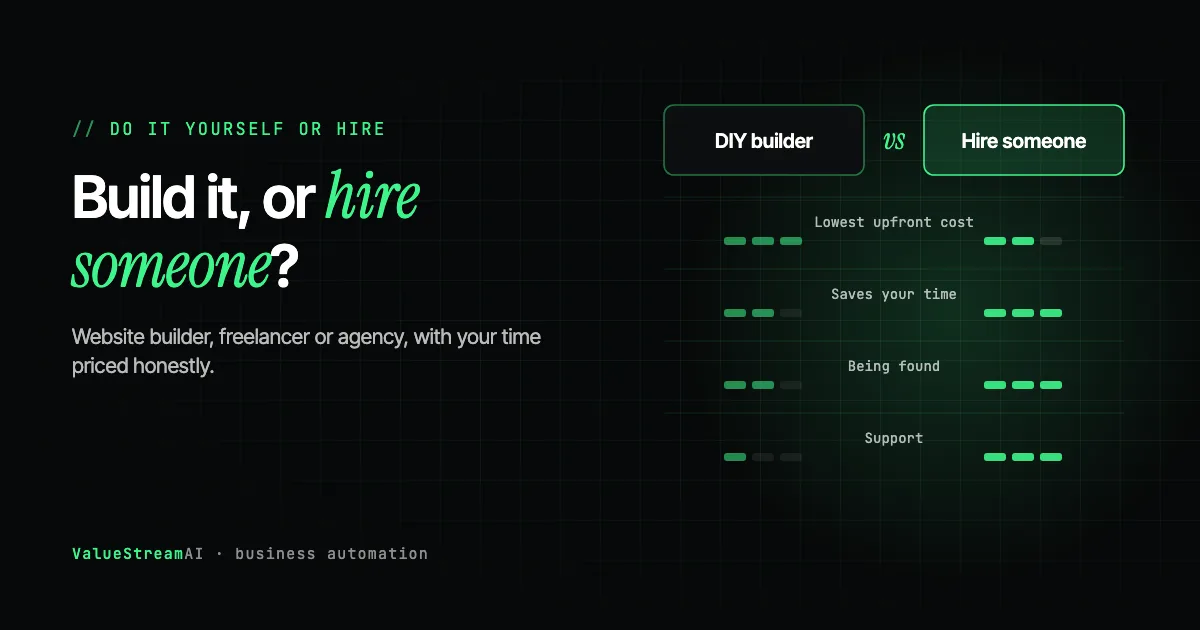
Wix, Squarespace and the new AI website builders all promise the same thing: a professional website in an afternoon, for a few dollars a month. Meanwhile web designers quote thousands. So should I hire someone to build my website, or is that money wasted when the tools are this good?
It depends on what you need the website to do. This guide compares the three realistic routes, building it yourself, hiring a freelancer, or hiring an agency, with honest costs, the hours DIY really takes, what each route usually leaves out, and a simple way to decide.
| Metric | 2026 Benchmark |
|---|---|
| DIY website builder | A few dollars to about $50 a month |
| Small business website from a provider (GoodFirms, 2024) | About $1,000 to $7,000 |
| Our website, built to be found | $5,000 to $10,000, depending on scope |
| Time for a new site to win searches (Google) | Four months to a year |
| Our estimate of DIY time | About 30 hours to build, 3 hours a week to keep up |
The short answer. Build it yourself if you mostly need an online business card, your customers come through word of mouth, and you have time. Hire someone if the website needs to bring in new customers who are searching, if one customer is worth a meaningful amount, or if your time is worth more running the business. The tools make building easy; what they do not do is research what your customers search for, plan a page for each of those searches, or get you found. That part, not the design, is what you are really paying for.
Key takeaways
- Building a website is now easy. Getting it found is not, and that is the expensive part.
- DIY is the right answer for some businesses, especially early or referral-only ones.
- Your time is a real cost. A DIY site done properly takes many hours a year.
- Freelancers vary hugely. Some are excellent; check who supports the site later.
- Whoever you hire, own the domain and logins, and make sure you can edit it yourself.
What Changed: Building Got Easy, Getting Found Did Not
A few years ago, a decent-looking website needed a designer and a developer. Today a website builder, or an AI tool that generates the whole site from a description, can produce something that looks professional in an hour. That is genuinely useful, and we use AI tools in our own work every day.
But it has split websites into two very different jobs. Building is now cheap and fast. Being found by people who have never heard of you, on Google and in ChatGPT, is as hard as ever. A beautiful site that nobody finds brings no customers. Most of the "my website brings nothing" stories we hear are not design failures; they are sites that were never set up to be found. We explain why in why your website isn't generating enquiries.
So the real question is not "can I build it myself?" (you can) but "can I make it bring customers myself?"
Should I Hire Someone to Build My Website? The Three Routes
Route 1: Build It Yourself
Website builders such as Wix and Squarespace, and newer AI builders, give you templates, hosting and an editor for a monthly fee.
Good for: a simple online presence, testing a new idea, a referral-based business that just needs to look legitimate when someone checks.
Usually missing: research into what customers search for, a proper page for each service and area, your Google listing set up, and anyone to ask when something goes wrong. Templates also make it easy to end up with five generic pages, which is the most common reason small sites do not appear on Google.
Route 2: Hire a Freelancer
A freelance designer or developer builds the site for a one-off fee.
Good for: a well-defined site at a lower price than an agency, especially if you already know what pages you need.
Usually missing: it depends entirely on the person. Many freelancers are excellent designers but do not research what customers search for or set the site up to be found on Google. Ask who will support the site in two years, and whether the domain and logins will be in your name. A freelancer who disappears can leave you unable to change your own website.
Route 3: Hire an Agency That Builds for Search
An agency builds the site around what your customers search for, sets up your Google listing and supports the site after launch.
Good for: businesses where one customer is worth a lot, where buyers research before choosing, or where the website needs to bring new customers rather than just exist.
Usually missing: at the cheap end, the same things as everyone else. Look for research before design and ownership in your name. Questions to ask when hiring a web designer gives you the exact questions.
How Much of Your Time Does DIY Really Take?
Website builders advertise how fast you can launch. What they do not show is the time it takes to make the site good and keep it working.
Our estimate, stated as an estimate: about 30 hours to build a small business site properly yourself, including writing every page, choosing photos, setting up the Google listing and fixing the problems you find. Then about 3 hours a week to keep it useful: adding projects, updating prices, writing a new page, replying to reviews.
What that time is worth depends on you. Price an hour of your time at what it earns the business:
| What an hour of your time is worth | Build (30 hours) | Upkeep for a year (3 hours a week) | First-year total |
|---|---|---|---|
| $40 | $1,200 | $6,240 | $7,440 |
| $75 | $2,250 | $11,700 | $13,950 |
| $150 | $4,500 | $23,400 | $27,900 |
The other side of the ledger: a professional build still needs some of your time (reviewing pages, answering questions, sending photos), and ongoing help costs money. Our builds cost $5,000 to $10,000, and ongoing monthly help, if you want it, starts at $1,500. Many owners take a middle path: pay once for a site built properly for search, then do the light weekly updates themselves on a system that makes it easy.
What the numbers leave out: results. Thirty hours of DIY can produce a lovely site that still does not appear when customers search, because the research and structure were never done. Hours spent are not the same as customers won.
When You Should Do It Yourself
Building it yourself is genuinely the right choice when:
- You are just starting and need to look legitimate while you test the business.
- Your work comes from referrals and the site only needs to confirm you are real.
- You enjoy it and have time, and your customers are local and easy to reach.
- Money is tight right now. A simple DIY site and a finished Google listing are far better than nothing.
When You Should Hire Someone
Hiring someone usually pays back when:
- One new customer is worth hundreds or thousands of dollars.
- Your customers research before buying, comparing options, prices and reviews.
- You need to reach people who have never heard of you, in your area or beyond.
- You serve several areas or sell several services, each of which needs its own page.
- Your time is worth more running the business than writing web pages.
- You already tried DIY and it brings nothing. That is usually a sign the missing part is search, not design. See do you need a new website.
What About ChatGPT and AI Search?
More customers now ask ChatGPT, Gemini, Claude, Perplexity or Grok for recommendations. Those assistants rely on clear facts on your website and on what other sites say about you. A five-page template with generic wording gives them little to quote. Whoever builds your site, make sure each service and area has a page that plainly states what you do, where, for whom and roughly what it costs. See how to get ChatGPT to recommend your business.
What Hiring Well Looks Like
- 01Decide the goal
Enquiries from new customers, not just an online card.
- 02Compare three quotes
Same scope, written down, ownership included.
- 03Research before design
What customers search decides the pages.
- 04Launch and hand over
Logins in your name; you can add pages yourself.
- Decide the goal. "Enquiries from new customers in these areas" is a goal. "A new website" is not.
- Get three written quotes for the same scope, including ownership of the domain, hosting and logins.
- Insist on research before design. What customers search for should decide the pages.
- Make sure you can edit it. Adding a project or a page should not need a paid request.
- Agree what happens after launch: support, fixes and who to call.
How to Decide
If the website only needs to confirm you are real and you have time, build it yourself. If it needs to bring new customers who research before buying, and one customer is valuable, hire someone who builds for search. If money is tight, start with DIY and a finished Google listing and hire later. Whoever builds it, keep ownership in your name.
What It Costs to Hire Us
Our websites are built to bring customers, not just to look good:
- Website built to be found on Google and by AI assistants: $5,000 to $10,000, depending on scope. Research into what your customers search for, a page per service and area, phone-first design, your Google listing, a system you can edit yourself, ownership in your name, and support after launch.
- Ongoing growth: from $1,500 a month, if you want new pages, reviews, listings and mentions handled for you.
- Enquiries answered automatically, as an add-on automation pilot from $2,000 to $3,000.
Two sites built this way, Naffees & Sons and PK Transporters, reached average Google positions of 5.7 and 5.8 within three months of launch (Search Console, 24 July to 22 October 2026). See our AI website development services, our pricing, and website design and SEO packages for what others charge.
Mistakes We See When Owners Build It Themselves
When we look at self-built sites, the same mistakes come up again and again. None are about talent; they are about knowing what matters.
- Writing about yourself instead of the customer's problem. "Established 2009, passionate about quality" says little. "Leaking roof in Clearwater? Same-week repairs, from about $450" answers the question the visitor arrived with.
- One page for everything. All services on one page means Google and ChatGPT have nothing specific to match to a specific search.
- Never checking it on a phone. Most visitors see your site on a phone. Text that is too small or a phone number you cannot tap loses them.
- Forgetting the Google listing. The free listing that puts you on the map is often left half-finished, or not linked to the website.
- Choosing a name or address you do not control. Some free plans put your site on the builder's own address. A domain in your own name is worth the small yearly cost.
- Launching and never touching it again. A site with prices from three years ago and no new projects tells visitors, and AI assistants, that the business may have moved on.
- Copying a competitor's wording. Duplicated text helps nobody and can make both sites look less trustworthy.
If your DIY site has a few of these, it is usually fixable. If it has most of them, it may be time for a rebuild; see do you need a new website.
How Long Each Route Takes
- Do it yourself: live in a weekend, properly finished in a few weeks of evenings, then ongoing.
- Freelancer: often a few weeks, depending on their workload and how quickly you supply material.
- Agency that builds for search: usually a few weeks, with research before design adding time at the start that saves time later.
For all three, being found on Google takes longer than being live: Google's guidance is four months to a year.
The Competitor Pulse Check
| Factor | ValueStreamAI | DIY builder | Typical freelancer |
|---|---|---|---|
| Search research before design | Always | No | Sometimes |
| Page per service and area | Yes | If you build them | Sometimes |
| Set up to be found on Google | Included | Your job | Sometimes extra |
| You can edit it | Yes | Yes | Depends on the setup |
| Ownership in your name | Yes | Yes | Check the contract |
| Support after launch | Included for a period | Help articles | Depends on the person |
| Price | $5,000 to $10,000 | A few dollars to about $50 a month | Varies widely |
Frequently Asked Questions
Should I hire someone to build my website?
Hire someone if the website needs to bring in new customers who search, one customer is worth a meaningful amount, or your time is better spent running the business. Build it yourself if you mainly need to look legitimate, work comes from referrals, and you have time.
Is it cheaper to build my own website?
In cash, yes: builders cost a few dollars to about $50 a month. In time, not always. Our estimate is about 30 hours to build a small site properly and 3 hours a week to keep it useful, which adds up quickly if your time is valuable.
Can AI build my business website for me?
AI tools can now generate a good-looking website quickly. They do not research what your customers search for, plan a page for each service and area, or get you found on Google and in ChatGPT, which is the part that brings customers.
Should I hire a freelancer or an agency to build my website?
A freelancer can be excellent value for a well-defined site. An agency is more likely to include research into what customers search for, setup to be found on Google, and ongoing support. Either way, ask who supports the site later and make sure the domain and logins are in your name.
How much does it cost to hire someone to build a website?
GoodFirms' 2024 survey put a small business website at roughly $1,000 to $7,000. Our websites, built to be found and to bring customers, cost $5,000 to $10,000 depending on scope.
Can I build the website myself and get help being found on Google later?
Yes, but check the builder lets you add a page per service and area and edit page titles and descriptions. If the structure is wrong, getting help later may start with rebuilding the site.
What's Next
Tell us what your business does and what one new customer is worth. On a free call we will tell you honestly whether DIY is enough for now or whether a site built for search would pay for itself, and what it would include.
→ See our AI website development services
→ Questions to ask when hiring a web designer
→ See our pricing, or talk to us
Syed Rayyan is co-founder of ValueStreamAI, leading research and marketing. He has run SEO for client websites since 2020, across technical audits, on-page work and link building, and leads the marketing side of every build. He also runs the firm's evaluation of emerging AI tooling and translates technical capability into clear guidance for non-technical decision-makers. Connect on LinkedIn →