Search for website design and SEO packages and you will find monthly prices from a couple of hundred dollars to $10,000 for what sounds like the same service. Ahrefs puts the usual range at $250 to $10,000 a month. Both ends are real. They are not the same service. This guide sets out what websites and SEO actually cost in 2026, what the published survey data says, what a cheap package quietly leaves out, and how to compare quotes so you are comparing like with like.
We sell both, so read our figures with that in mind. Where we quote our own prices, we say so; where we quote the market, we name the source.
| Metric | 2026 Benchmark |
|---|---|
| Most common monthly SEO retainer (Ahrefs survey of 439 providers) | $501 to $1,000 |
| Average monthly SEO retainer (same survey) | About $2,917 |
| Average SEO hourly rate (same survey) | About $111 |
| Small business website, agency (2026 pricing guides) | About $5,000 to $25,000 |
| Average Google Ads cost per click (LocaliQ, 2026) | $5.42 |
The short answer. A small business website built by an agency typically costs $5,000 to $25,000, and ongoing SEO typically $500 to $5,000 a month. An Ahrefs survey of 439 SEO providers found the most common retainer was $501 to $1,000 a month and the average about $2,917. Our builds with launch SEO cost $5,000 to $15,000 and our marketing retainers start at $900 a month. The cheapest packages usually leave out the things that move rankings: new pages, real content and fixes to the site itself.
Key takeaways
- Website and SEO prices vary by a factor of fifty because they describe very different amounts of work.
- The most common SEO retainer is $501 to $1,000 a month, but the average is nearly three times that.
- Cheap packages report; they rarely change anything. Ask what will be different on your site each month.
- Building and marketing together avoids paying twice, once for the build and again to fix it for SEO.
- Price the alternative. Compare a retainer with what the same clicks would cost on Google Ads.
Why Website and SEO Prices Vary So Much
The answer is that "SEO package" covers anything from an automated monthly report to a team writing pages, fixing your site and earning links. Price follows the work, and the work varies enormously.
A package at the bottom of the range is usually software: a tool runs, a report is produced, some directory listings are submitted. A retainer of $900 to $1,500 a month usually buys a few days of a person's time each month. A $5,000-a-month retainer buys a team. All three get described as "SEO".
Website builds vary the same way. A template site with your logo and five pages is a different product from a site with a page for every service and location, written content, structured data and a CMS you can publish from. Both are "a website".
What SEO Costs: The Survey Data
The most useful published data on SEO pricing comes from an Ahrefs survey of 439 SEO providers, each checked to confirm they actually sell SEO services.
| Pricing model | Most common | Average or range |
|---|---|---|
| Monthly retainer | $501 to $1,000 (20.4% of providers) | Average about $2,917; 68.8% charge $2,000 or less |
| Hourly | $75 to $100 an hour (about a quarter of providers) | Average about $111 an hour |
| One-off project | $2,501 to $5,000 (21.2% of providers) | 60.6% charge $1,001 or more |
Two cautions. First, the survey page was last updated in August 2024 and the data looks to have been collected in early 2023, so 2026 prices are likely somewhat higher. Second, almost every other source you will find on SEO pricing is an agency or marketplace selling SEO, so treat round-number ranges like "$500 to $5,000 a month" as directional.
What a Website Costs in 2026
Pricing guides published by agencies and freelancers in 2026 put a small business website at about $1,500 to $7,000 from a freelancer and about $5,000 to $25,000 from an agency, with DIY builders such as Wix or Squarespace costing tens of dollars a month. Those ranges come from businesses selling the work, so read them as rough. The common hidden costs are the same in every guide: content (copywriting and photography are often excluded from quotes), hosting and maintenance, and, almost never mentioned, the SEO work needed after launch to make the site visible.
Our own builds with launch SEO cost $5,000 to $15,000, including keyword research before design, the pages and content, structured data, a CMS you can publish from, and 2 to 6 months of free post-launch support. For Naffees & Sons, a construction firm, an engagement of that kind produced a 67-page site that reached an average Google position of 5.7 over three months with no link building.
What Cheap Packages Leave Out
| Included? | Cheap package (a few hundred dollars a month) | Typical agency retainer | ValueStreamAI |
|---|---|---|---|
| Keyword research that decides pages | No | Sometimes | Yes, before design |
| New pages and content | Rarely | A few articles a month | Yes |
| Technical fixes on the live site | Report only | Recommendations | Yes, we make the change |
| Link building | Low-quality directories | Yes | Where the market needs it |
| Search Console reporting | Tool-generated | Yes | Yes, plain monthly report |
| Changes to the site itself | No | Needs your developer | Yes, we build sites |
| Lead follow-up automation | No | No | Yes |
The pattern to watch for is a package that reports on your site without changing it. A monthly PDF of rankings is not SEO. If you cannot point to what is different on your site this month compared with last month (new pages, rewritten pages, fixed errors, new links), you are paying for a report.
The other common gap is between the SEO agency and the site. Many SEO agencies cannot edit the site themselves, so every recommendation becomes a ticket for your web developer, who charges separately and has other priorities. Months pass with recommendations unimplemented. A team that both builds and markets removes that gap. We cover this further in build it and market it.
What Drives the Price of a Quote
Number of pages and locations. A business serving five services in four cities may need twenty pages, each written for its own searches. This is the biggest driver of build cost and the biggest single reason sites rank; see programmatic SEO for service businesses.
Competition. A cafe in a regional town and a law firm in a capital city need very different amounts of work to rank. Competition drives the monthly SEO cost and the time to results more than anything else.
Content. Pages need words that answer buyers' questions. Somebody has to write them, and good writing on technical subjects (construction costs, freight rules, medical procedures) costs more.
Integrations. Booking systems, CRMs, payment and WhatsApp push the build price up, but they are also what turn traffic into customers.
Existing problems. A site with broken redirects, orphaned pages and duplicate content needs fixing before new work pays off. For DSL Warehouse, an online store, that meant a 100+ page technical audit first.
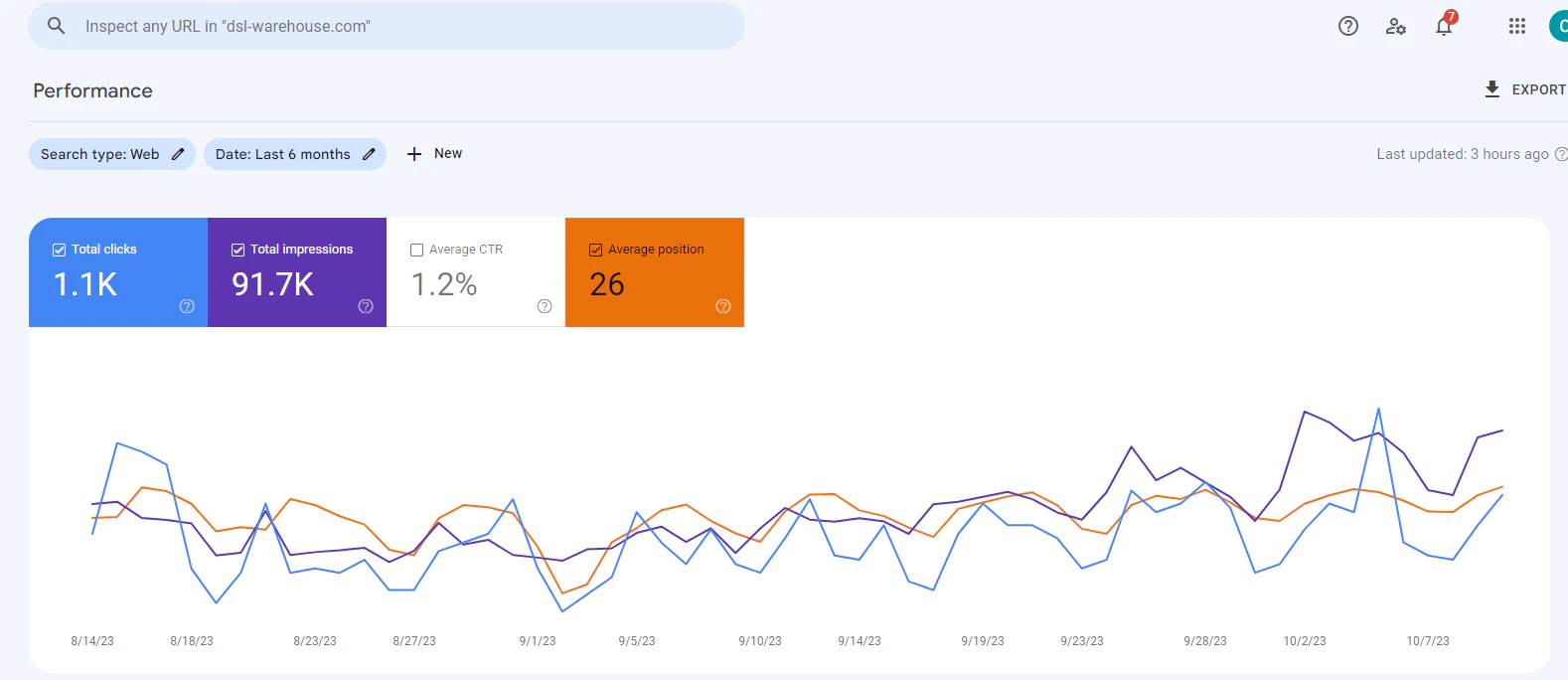
Google Search Console, dsl-warehouse.com, after a 100+ page technical audit: 1.1K clicks and 91.7K impressions in about eight weeks of data.
How to Compare Two Quotes
Ask each provider the same five questions:
- What will be different on my site each month? New pages, rewritten pages, fixes, links. Specifics, not "optimisation".
- Who makes the changes to the site? If the answer is "your developer", add your developer's cost to the quote.
- How will you report results? Insist on Google Search Console data, not only a third-party rank tracker.
- Can I see unedited results for a client like me? With the date range, and ideally the client's name.
- When would you tell me to use Google Ads instead? A provider who never says "ads" is selling one tool for every job.
Then price the alternative. At the 2026 average of $5.42 a click in LocaliQ's benchmarks, a $900 monthly budget buys about 166 ad clicks. An SEO retainer at that price should, once it ramps, earn more organic clicks than that every month. We show this break-even calculation by industry in SEO vs Google Ads.
For each quote, ask what will change on the site each month, who makes those changes, how results are reported, whether there are unedited results for a similar client, and when the provider would recommend ads instead. Add any developer costs, then compare the monthly price with what the same clicks would cost on Google Ads.
What a Monthly SEO Retainer Pays For, in Plain English
Most business owners are sold SEO in jargon: "on-page", "off-page", "backlinks", "technical". Here is what each part actually is, what it means for your business, and why you pay for it every month rather than once.
| What we do | What it means in plain English | Why it matters to you |
|---|---|---|
| Domain and website setup | We set up your web address, hosting and website, or take over the one you have | Everything else is built on it; you own it |
| Keyword research | We find the exact words your customers type into Google | You get pages for searches that bring buyers, not vanity traffic |
| Keyword planning | We turn those words into a list of pages and articles, in priority order | Every month's work goes where the money is |
| Article writing and blog posting | We write and publish articles answering your customers' real questions | Each one is a new way to be found, and it keeps working for years |
| Case studies | We turn your past projects, contracts and results into stories with proof | Strangers trust a business that shows its work |
| On-page SEO | We make every page clearly say what it is about and where you work | Google can match your pages to the right searches |
| Technical SEO | We fix what stops Google reading the site: broken links, redirects, speed | Your pages actually get indexed and shown |
| Off-page SEO and backlinks | We earn mentions and links from relevant websites, directories and partners | Google trusts sites other sites vouch for |
| Google Business Profile | We set up and maintain your map listing, photos and reviews process | You appear in the map results for local searches |
| Reporting | A plain monthly summary from Google Search Console | You see clicks, searches and enquiries, not jargon |
| Lead follow-up | Enquiries captured and answered automatically, then handed to you | Visitors become conversations, even out of hours |
Why it is monthly. Rankings are not bought once. Each month adds pages and links that compound, and competitors are doing the same work. Stop, and the existing pages keep working for a while, but nothing new is added while competitors keep publishing.
The part most businesses do not realise they have. Many established businesses are sitting on decades of experience: project files, contracts, photographs, certificates, completed jobs. None of it helps them online until someone turns it into pages a buyer can read. That is a large share of what a retainer pays for. For Naffees & Sons, decades of paper records and government contracts became documented project pages and case studies. We explain this in marketing an established business online.
Red Flags in a Website or SEO Quote
Most bad quotes are not dishonest. They are vague, and the vagueness is where the money goes. These are the signs worth stopping on before you sign.
- Guaranteed rankings or "page one in 30 days". Nobody controls Google's rankings. Google's own guidance is that SEO usually takes four months to a year. A guarantee usually means low-quality links or rankings for searches nobody makes.
- Hundreds of AI articles a month. Volume is the signature of what Google calls scaled content abuse; see AI content and Google's spam policies.
- "SEO" that is only a Google Business Profile. A map listing is one piece; see is a Google Business Profile enough?
- A fixed number of links per month. Twenty or fifty links a month sounds like progress and is often bulk directory or paid links, which Google's spam policies prohibit. The Hungry Pelican moved from unrated to an Authority Score of 16 with twelve relevant referring domains, not hundreds.
- Reporting from a rank tracker only. A chart of twenty hand-picked keywords can rise while real traffic falls. Ask for Google Search Console data: clicks, impressions and pages indexed, as a chart with dates. Totals alone can hide a single spike, as our iPeepbxs and Serenity at Heart case studies show.
- No mention of your site's pages. If the quote never says which pages will be created or rewritten, it is a reporting service.
- The site is the agency's, not yours. If you cannot take the site, the domain and the content with you when you leave, you are renting it. Our custom vs template guide covers what to own.
- No word on what happens to the enquiries. More traffic with the same slow follow-up wastes most of it. Ask how leads will be captured and answered.
A good quote names the pages, the fixes, the reporting source and who owns what, and tells you when a cheaper option would do.
The Competitor Pulse Check
| Factor | ValueStreamAI approach | Cheap SEO package | Web agency without SEO |
|---|---|---|---|
| Builds the site | Yes | No | Yes |
| Markets it afterwards | Yes | Reports on it | Sold back separately |
| Changes the site each month | Yes | No | Only on request |
| Price transparency | Published: $5,000 to $15,000 builds, $900/mo retainers | Low monthly price, unclear scope | Quote on request |
| Proof | Unedited Search Console data, named clients | Tool screenshots | Design portfolio |
Human Hours vs Automation: Publishing and Updating Pages by Hand
One recurring cost sits outside every quote: the time someone on your team spends updating the website. Here it is priced.
Assumptions: updating service pages, adding locations, posting articles and fixing small errors takes about 2, 4 or 8 hours a week, depending on the size of the site, when every change goes through a developer or a clumsy editor. The hourly rate is the US median for secretaries and administrative assistants, about $22.82 an hour (BLS, May 2024), base pay only; a developer costs much more. With a CMS built around your content (pages generated from structured records, as on our Naffees & Sons and PK Transporters builds), we assume 25% of that time remains.
| Volume | Hours by hand a year | Cost by hand | Human time with a structured CMS | Cost |
|---|---|---|---|---|
| 2 hours a week | 104 | ~$2,370 | ~26 hours | ~$590 |
| 4 hours a week | 208 | ~$4,750 | ~52 hours | ~$1,190 |
| 8 hours a week | 416 | ~$9,490 | ~104 hours | ~$2,370 |
The other side of the ledger: the structured CMS is part of the build, $5,000 to $15,000, not an add-on. What it leaves out: the pages that never get published because updating the site is a chore, which is the larger cost. Run your own figures in the hire vs automate calculator.
Where you stand today and what it would take.
- Search Console review
- Competitor check
- Ads advice where ads are better
Website, web app or AI platform with launch SEO.
- Keyword research first
- Pages, content and schema
- 2 to 6 months free support
Ongoing SEO, content and lead follow-up.
- Content and technical SEO
- Links where the market needs them
- Monthly Search Console report
Frequently Asked Questions
How much do website design and SEO packages cost?
A small business website from an agency typically costs $5,000 to $25,000, and ongoing SEO typically $500 to $5,000 a month. Our builds with launch SEO cost $5,000 to $15,000, and our marketing retainers start at $900 a month. An Ahrefs survey of 439 SEO providers found the average retainer was about $2,917 a month.
How much should a small business spend on SEO per month?
The most common retainer in the Ahrefs survey was $501 to $1,000 a month. A useful test is the Google Ads break-even: divide the monthly budget by your industry's cost per click. At $900 a month and the $5.42 average, SEO needs to earn about 166 clicks a month to beat ads, which a good campaign usually passes within the first year.
Are cheap SEO packages worth it?
Usually not, because they report on your site without changing it. If a package cannot tell you what will be different on your site each month, such as new pages, rewritten content, fixes or links, it is unlikely to move rankings. Low-quality directory links can also do harm.
Is it cheaper to get the website and SEO from the same company?
Often, yes. When one company builds and another markets, the SEO agency's recommendations become paid tickets for your developer, and the site sometimes needs rebuilding before marketing can start. One team doing both does the keyword research before the build and makes the SEO changes itself.
What does an SEO retainer include?
At ValueStreamAI: content and new pages, on-page and technical SEO on the live site, link building where your market needs it, a monthly report from Google Search Console, and the automation that follows up the leads. Ask any provider for the same list in writing, with what changes on your site each month.
Do you charge by the hour?
No. Builds are fixed price, from $5,000, agreed before work starts, and marketing is a monthly retainer from $900. The Ahrefs survey found the average SEO hourly rate was about $111, but hourly billing makes it hard to know the total.
What's Next
If you have quotes in hand and cannot tell them apart, or want a fixed price for building and marketing your site, start with a free call. We will tell you what your market needs and what it should cost, including when a cheaper option is enough.
→ See our SEO and digital marketing services
→ Read the full guide: build it and market it
→ See what building and marketing costs, or talk to us about your site
Syed Rayyan is co-founder of ValueStreamAI, leading research and marketing. He has run SEO for client websites since 2020, across technical audits, on-page work and link building, and leads the marketing side of every build. He also runs the firm's evaluation of emerging AI tooling and translates technical capability into clear guidance for non-technical decision-makers. Connect on LinkedIn →