First Source Inc is a small, certified company that represents manufacturers and keeps its own stock of specialty RF, microwave, lightwave and millimetre-wave components. It has been trading since 1985. Its buyers are engineers and purchasing teams looking for specific parts, and they search the way engineers do: by part number, frequency range, connector type and specification.
Over six months of our 2023 SEO engagement, Search Console recorded 56,200 impressions and 1,000 clicks, with an average position of 17.7. The detail that matters most is the shape of the chart: flat for three months, then a step up from July that held through October.
| Metric | April to October 2023 |
|---|---|
| Clicks from Google search | 1,000 |
| Impressions | 56,200 |
| Average click-through rate | 1.8% |
| Average position | 17.7 |
| Trading since | 1985 |
Why B2B SEO for a Specialist Supplier Is Different
The answer is that the searches are tiny, specific and valuable. An engineer looking for a particular RF connector or attenuator types something very precise. Each search might happen a handful of times a month worldwide. But the person searching has a project, a budget and a deadline, and a supplier that appears with the right part, in stock, wins the quote.
That turns the usual SEO maths upside down. There is no single big keyword to win. There are thousands of small ones, and the supplier that has a clear, crawlable page for each product family, with the specifications engineers search for written out as text, collects them all.
It is also a field where decades of experience are a real advantage that rarely shows online. A company that has supplied specialist components since 1985 knows which parts engineers ask for, which substitutes work and which manufacturers to trust. Very little of that knowledge usually makes it onto the website, and that is the gap SEO for an established supplier closes.
What Search Console Showed
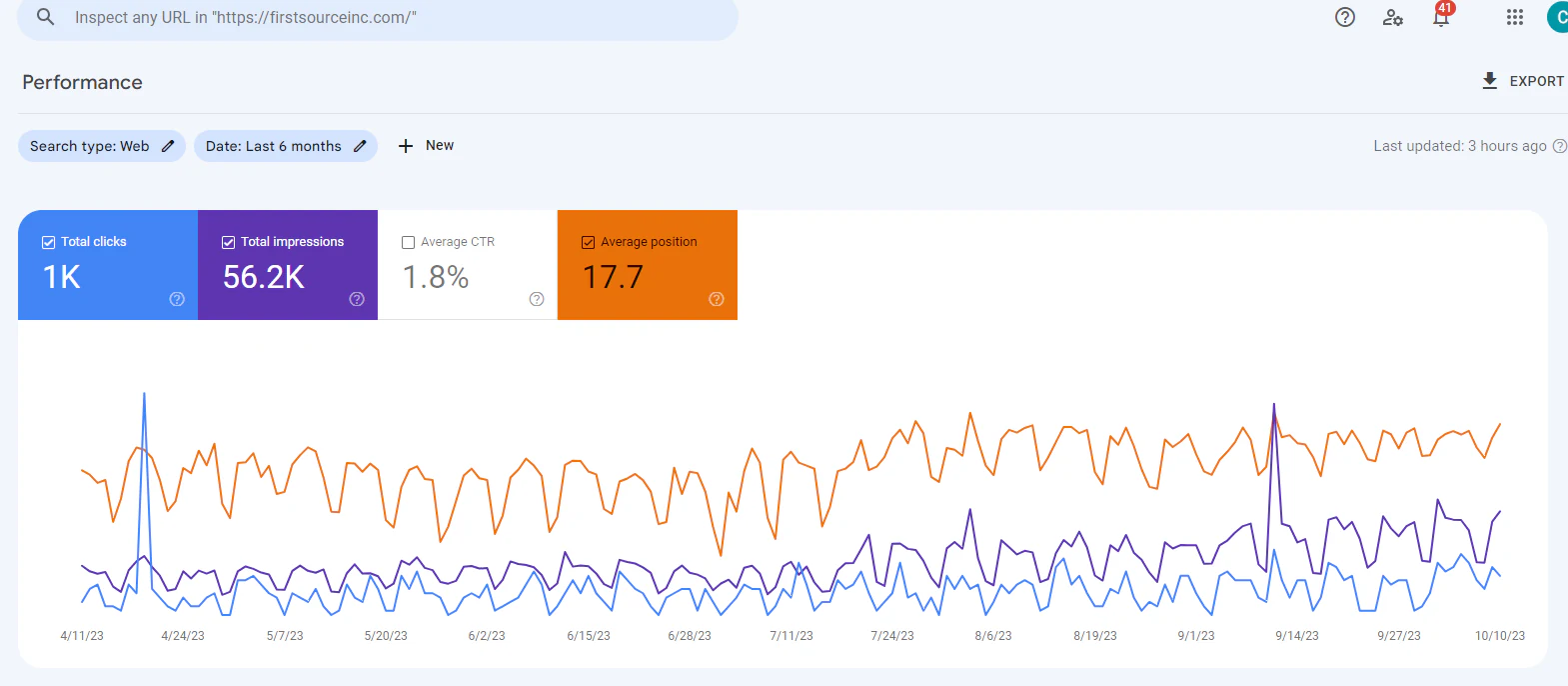
Google Search Console, firstsourceinc.com, 11 April to 10 October 2023: 1K clicks, 56.2K impressions, 1.8% CTR, average position 17.7.
This screenshot was taken in October 2023 with Search Console set to "last 6 months", during the engagement. It shows where the site stood across that window, not a before-and-after.
April to June: flat. Impressions and clicks move within a narrow band, and the average position holds steady.
From July: a step up that holds. Both the purple impressions line and the orange average-position line step up in July and stay higher through October. In Search Console the position line is drawn upside down, so the orange line rising means rankings improved. This is the normal shape of SEO on an established site: weeks of nothing visible, then a lift that sticks.
The click-through rate is typical for the field. 1.8% across every query reflects a site that appears for a very long tail of technical searches, many of them on page two. For a specialist supplier, impressions from the right engineers are the leading indicator; clicks follow as positions improve.
How an Engineer Finds a Supplier
- 01Searches a part number or specification
Precise terms: part numbers, frequency ranges, connector types.
- 02Opens a supplier page that matches
Lost here if no page matches the search.
- 03Checks stock, specs and certification
Lost here if details are missing or buried in a PDF.
- 04Requests a quote
The supplier with the clearest page usually wins it.
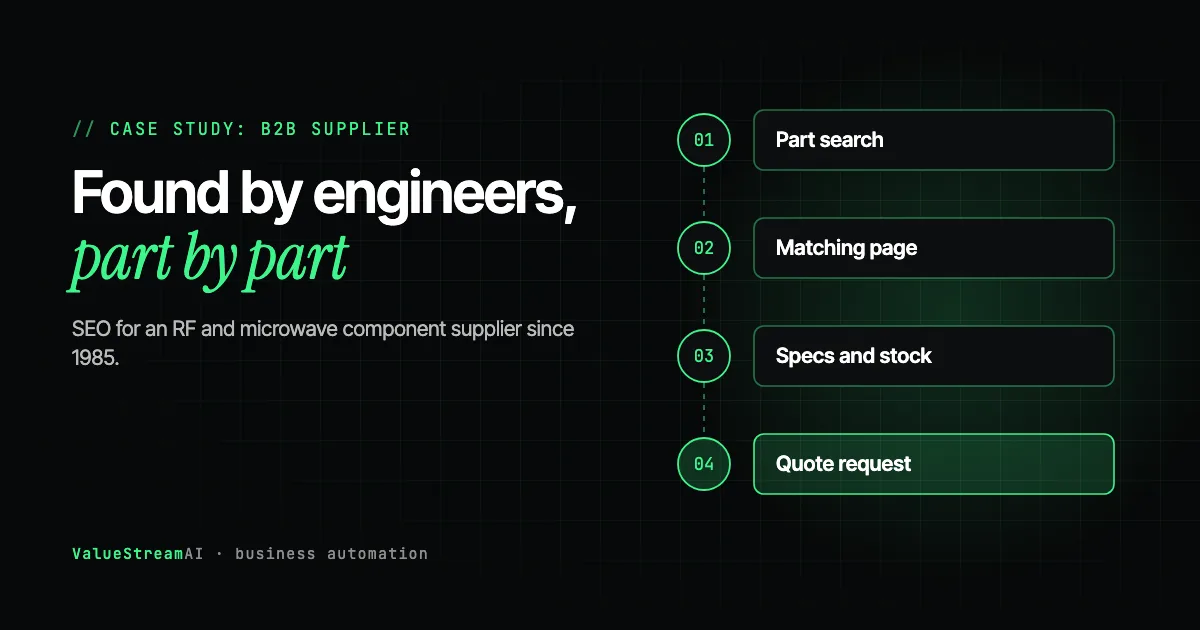
The buying path for a specialist component is short and practical. An engineer searches a part number or specification, opens the first supplier page that clearly matches, checks stock, specifications and certification, and requests a quote. A supplier loses the order at the second step if the page does not match the search, and at the third if the details are missing or buried in a PDF.
An engineer searches by part number or specification. A supplier is found when it has a crawlable page for each product family with specifications written as text, and chosen when that page shows stock, specifications and certification clearly. Decades of supplier knowledge become pages that match those searches.
What SEO for a Component Supplier Involves
This is how we approach a site like this. It is the approach in general; the screenshot above is the evidence for this client.
- A crawlable page for each product family, with the specifications engineers search for written as text, not only in a datasheet PDF.
- Manufacturer and part-number coverage, so searches for a specific brand or part land on the supplier's page.
- Certification and capability pages that answer the procurement team's questions before they ask.
- Technical health on a large catalogue: clean redirects when parts are discontinued, no orphaned product pages, no duplicate descriptions copied from manufacturers.
- Turning decades of know-how into content: substitution guides, selection guides and application notes that only a long-established supplier can write.
Organic Clicks vs Paid Clicks: Pricing the Same Traffic
Assumptions: 1,000 clicks from Search Console, 11 April to 10 October 2023, priced at LocaliQ's 2026 search advertising benchmarks (US data, updated 1 June 2026). 2026 prices applied to 2023 clicks, so read the result as scale.
| Volume | Organic clicks | At $5.42 (all industries) | At $5.87 (industrial and commercial) |
|---|---|---|---|
| Six months | 1,000 | about $5,420 | about $5,870 |
| A year at the same pace (our estimate) | about 2,000 | about $10,800 | about $11,700 |
The more important point for a specialist supplier is that many of its best searches are too rare to advertise against efficiently. A part number searched five times a month is not worth building an ad campaign around. A product page that ranks for it costs nothing per click.
The Competitor Pulse Check
| Factor | ValueStreamAI approach | Generic SEO agency |
|---|---|---|
| Keyword strategy | Thousands of part and specification searches | A few broad "electronic components" terms |
| Product content | Specifications as crawlable text | Datasheet PDFs only |
| Catalogue health | Redirects and duplicates managed as parts change | One-off audit |
| Experience | The supplier's know-how turned into guides | Generic blog posts |
| Proof | Unedited Search Console data | Rank-tracker screenshots |
What This Engagement Confirmed
Three months of flat is normal. The lift in July came after a quarter where nothing visible moved. Businesses that stop SEO after three months stop just before it starts to work. Google's own guidance is four months to a year; see how long SEO takes.
For specialist suppliers, impressions are the leading indicator. 56,200 impressions from engineers searching for specific components is the audience. Clicks and quotes follow as positions improve.
Decades of experience are an SEO asset, if they are written down. A supplier trading since 1985 knows things competitors cannot copy. We explain how to turn that into search visibility in marketing an established business online. For the full set of client results, see our SEO results portfolio.
Frequently Asked Questions
How does SEO work for a B2B component supplier?
By covering the very specific searches engineers make: part numbers, specifications, manufacturers and applications. Each product family needs a crawlable page with specifications written as text. Individually the searches are small; together they bring a steady flow of buyers with real projects.
What results did First Source Inc see?
Over six months in 2023, Search Console recorded 56,200 impressions, 1,000 clicks, a 1.8% click-through rate and an average position of 17.7, with impressions and average position stepping up from July and holding through October.
Why is the click-through rate only 1.8%?
Because a specialist catalogue appears for a very long tail of technical searches, many of them on page two. That pulls the site-wide average down. Rising impressions and improving positions for the products that sell matter more than the average.
Should an industrial supplier use Google Ads instead?
For broad, high-volume terms, ads can work. Many of a specialist supplier's best searches are part numbers searched a few times a month, which are not worth an ad campaign but are easily won by a well-built product page.
Is this a before-and-after result?
No. The screenshot was taken during the engagement with Search Console set to the last six months. The step up from July happened inside that window.
What's Next
If you run an established supplier, distributor or manufacturer and your website does not reflect what your team actually knows, start with a free call. We will look at how engineers and buyers search in your field and what your site is missing.
→ See our SEO and digital marketing services
→ See what building and marketing costs, or talk to us about your site