"How long does SEO take?" is the question every business owner asks first, and the one most agencies answer least honestly. Some promise page one in thirty days. Others say "it depends" and stop there. Neither helps you plan.
Here is the straight answer, the published evidence behind it, and what nine of our own client sites actually did, including the two where the chart went nowhere. If you are deciding whether to invest in SEO, and want to know how long SEO takes for a business like yours, this is the timeline with the data left in.
| Metric | 2026 Benchmark |
|---|---|
| Time for SEO to show results (Google) | Four months to a year |
| Random new URLs reaching the top 10 within a year (Ahrefs, 2023 crawl) | 1.74% |
| Non-empty English pages reaching the top 10 within a year (Ahrefs) | 6.11% |
| Our fastest result: The Hungry Pelican | 10 to 95 keywords in about 11 weeks |
| Our best average position: Naffees & Sons | 5.7 within a 3-month window |
The short answer. For most small businesses, SEO takes four months to a year to produce meaningful results, which is Google's own guidance. Technical fixes can show within weeks. Small local markets move in two to three months. Competitive national terms take six to twelve months or longer. Impressions rise first and clicks follow. In our client data, the fastest movers were a local cafe and two sites we built with pages matched to buyer searches.
Key takeaways
- Google says four months to a year, and the published research backs it up.
- Most new pages never reach the top 10. Ahrefs found under 2% of random new URLs did within a year.
- Local and niche is faster. A Queensland cafe went from 10 to 95 keywords in about eleven weeks.
- The build sets the pace. Two sites we built reached average positions under 6 within three months, with no link building.
- A spike is not a trend. Two of our nine sites show one burst and then a flat line.
Why SEO Takes Months, Not Weeks
The answer is that Google needs three things before it ranks a page for anything worth having: to find the page, to understand what it is for, and to trust it more than the pages already ranking. The first takes days. The second takes weeks. The third takes months, because trust is built from other sites linking to you, people choosing your result, and your pages consistently answering the search well.
Google said this itself. In its "How to hire an SEO" video, Google's Maile Ohye explained that in most cases SEOs need four months to a year to help a business first implement improvements and then see potential benefit. That is still the most useful single number, and it comes from the search engine, not from an agency.
The published research is more sobering. Ahrefs, which runs one of the largest web crawlers, has studied how long pages take to reach Google's top 10.
In its original study, only 5.7% of pages reached the top 10 within a year; those that did mostly took two to six months. Its update on a random sample of a million URLs seen in September 2023 found just 1.74% made it. When Ahrefs restricted the sample to real English content pages, the figure was 6.11%. Most pages never rank for anything competitive at all.
The way to read that is not "SEO rarely works". It is that ranking is earned: the pages that make it are the ones built and marketed to deserve it. Most pages on the web are not.
What Nine Client Sites Actually Did
These are the Search Console windows from our client sites, the same data in our SEO results portfolio.
| Site | Window | Clicks | Avg position | What the chart shows |
|---|---|---|---|---|
| Naffees & Sons (construction) | 3 months to Oct 2026 | 782 | 5.7 | Steady climb; daily impressions from about 100 to over 700 |
| PK Transporters (logistics) | 3 months to Oct 2026 | 341 | 5.8 | Steady climb; daily impressions to about 1,600; indexed pages 12 to 38 |
| The Hungry Pelican (cafe) | Jun to Aug 2025 | 1,060 | 10.4 | Clear rise from mid-June |
| Souvlaki Place (restaurant) | Apr to Oct 2023 | 538 | 12.3 | Strong April to June |
| First Source Inc (components) | Apr to Oct 2023 | 1,000 | 17.7 | Step up from July that holds |
| Forest Hills Lab (life sciences) | Apr to Oct 2023 | 2,110 | 18.5 | Steady, position improving |
| iPeepbxs (phone systems) | Apr to Oct 2023 | 446 | 23 | One spike in late May, flat otherwise |
| DSL Warehouse (online store) | About 8 weeks, 2023 | 1,100 | 26 | Rising impressions after a technical audit |
| Serenity at Heart (nonprofit) | Apr to Oct 2023 | 733 | 28.6 | One burst in May to June, flat otherwise |
The fastest: a small local market
The Hungry Pelican is a cafe in Hervey Bay, Queensland, with a five-page website. Between 23 May and 6 August 2025, Semrush recorded its ranking keywords going from 10 to 95, its backlinks from 0 to 17, and its Authority Score from unrated to 16.
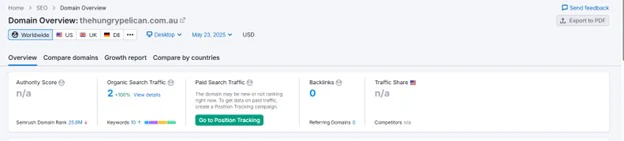
Before: Semrush, thehungrypelican.com.au, 23 May 2025.
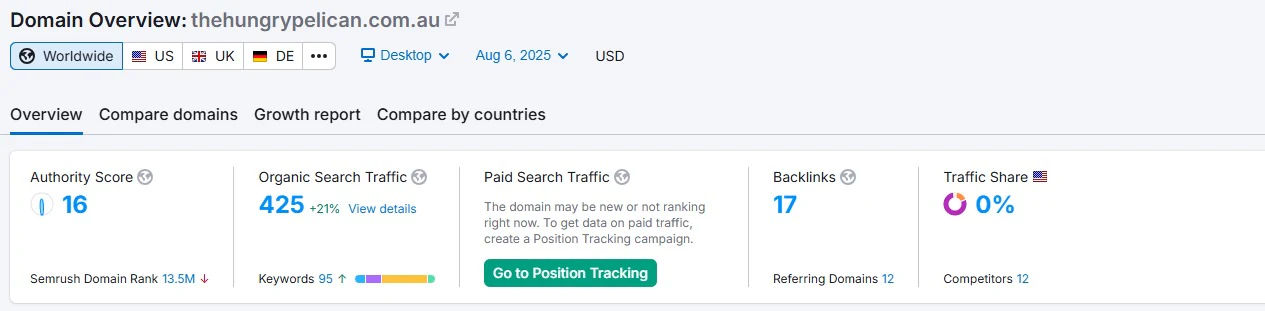
After: Semrush, thehungrypelican.com.au, 6 August 2025.
Eleven weeks is fast, and it is fast for a reason: a regional town, local searches, modest competition. A cafe in central Sydney would take longer. The full story is in the Hungry Pelican case study.
The steadiest: sites built for search
Naffees & Sons and PK Transporters are two Karachi businesses whose websites we built, with pages matched to how their buyers search: by plot size and neighbourhood for a builder, by service and city for a haulier. We did on-page SEO and content only, no link building. Over the three months to 22 October 2026, both reached average positions under 6, and both charts climb steadily rather than jumping. For PK Transporters, Search Console's indexing report shows indexed pages rising from about 12 in early August to 38, with none excluded, by mid-October. Google found the pages, then tested them, then ranked them.
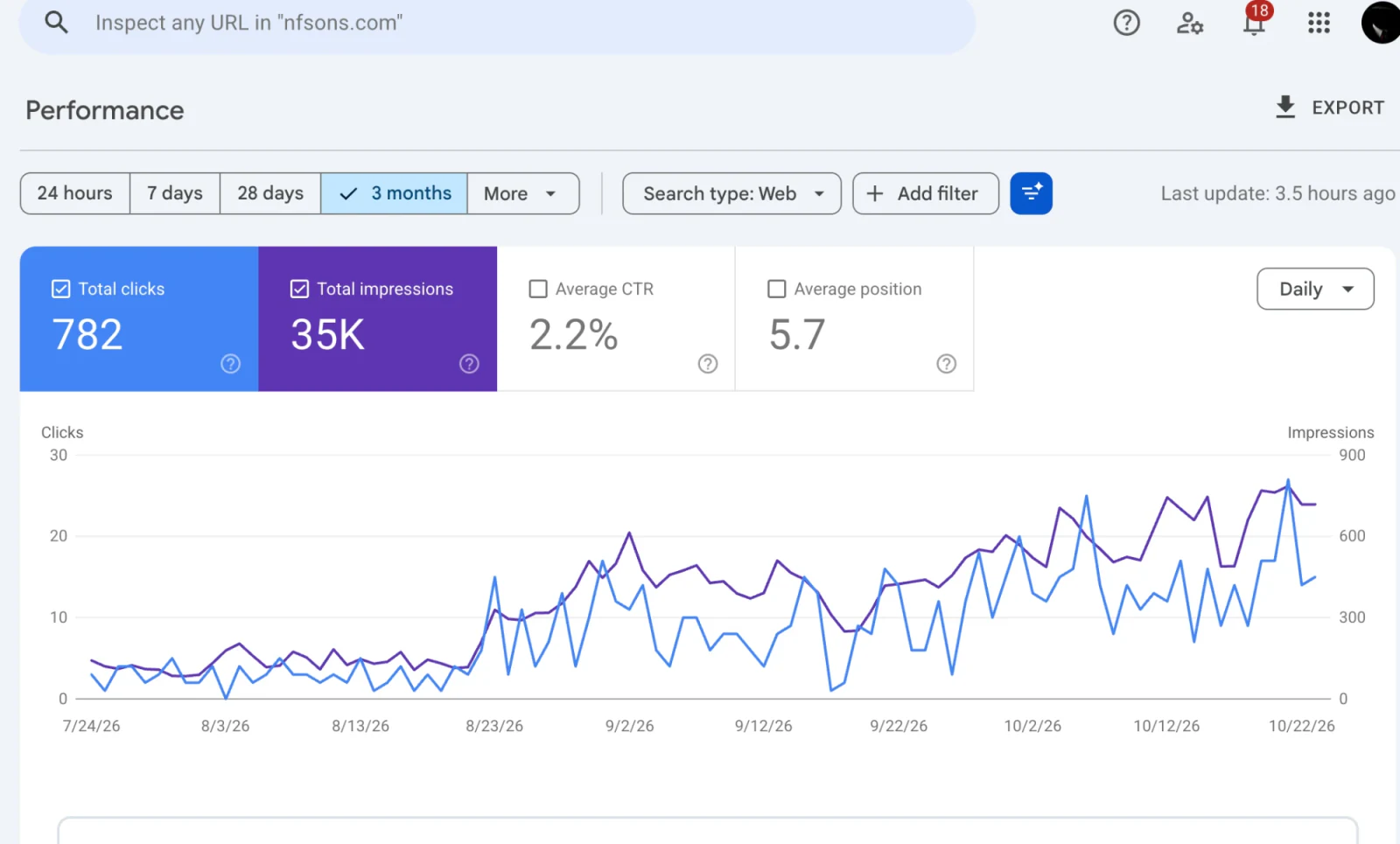
Google Search Console, nfsons.com, 24 July to 22 October 2026: 782 clicks, 35K impressions, 2.2% CTR, average position 5.7. On-page SEO and content only; no link building.
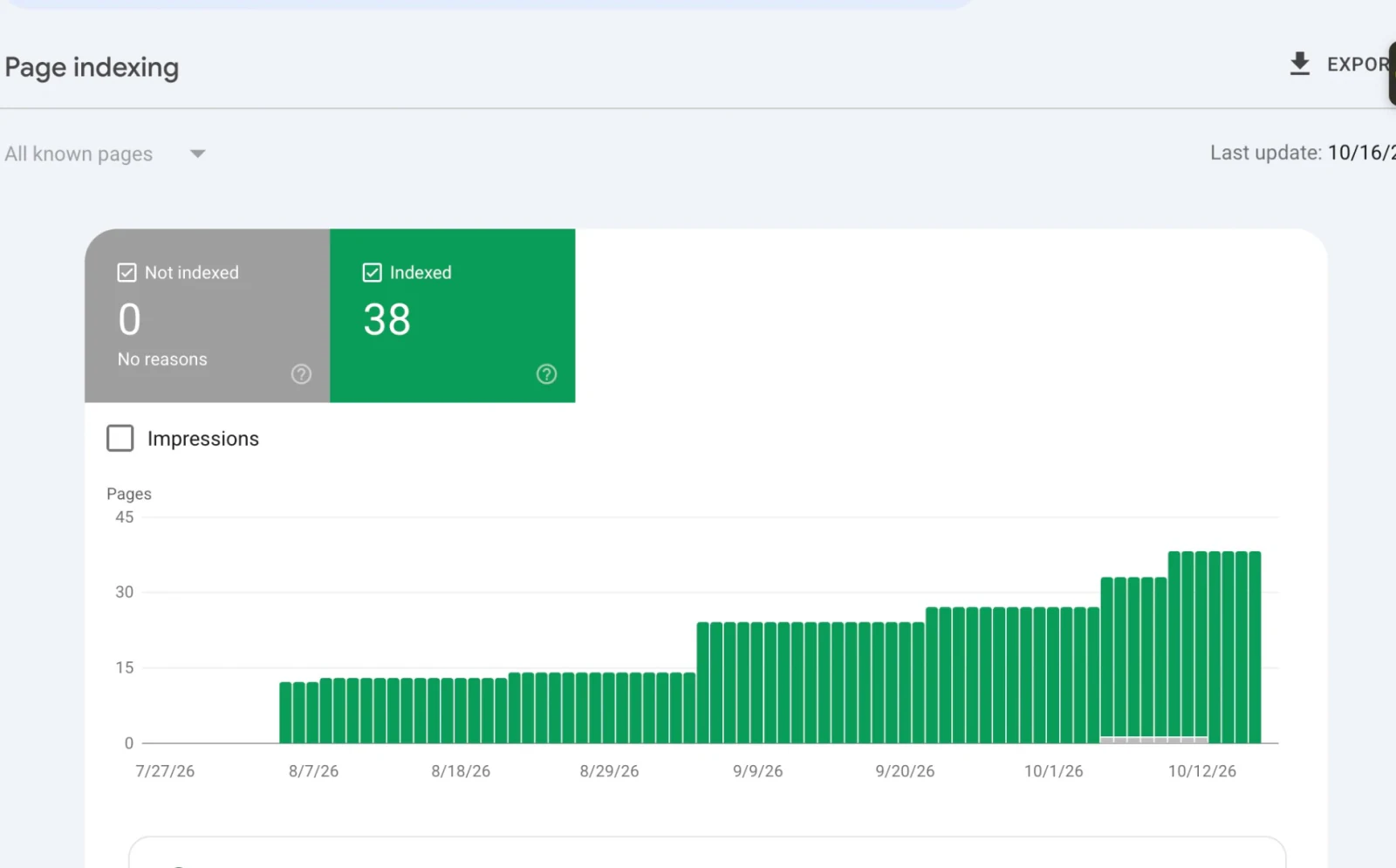
Google Search Console Page indexing, pktransporters.com, updated 16 October 2026: 38 pages indexed, 0 not indexed.
The slow lift: an established B2B site
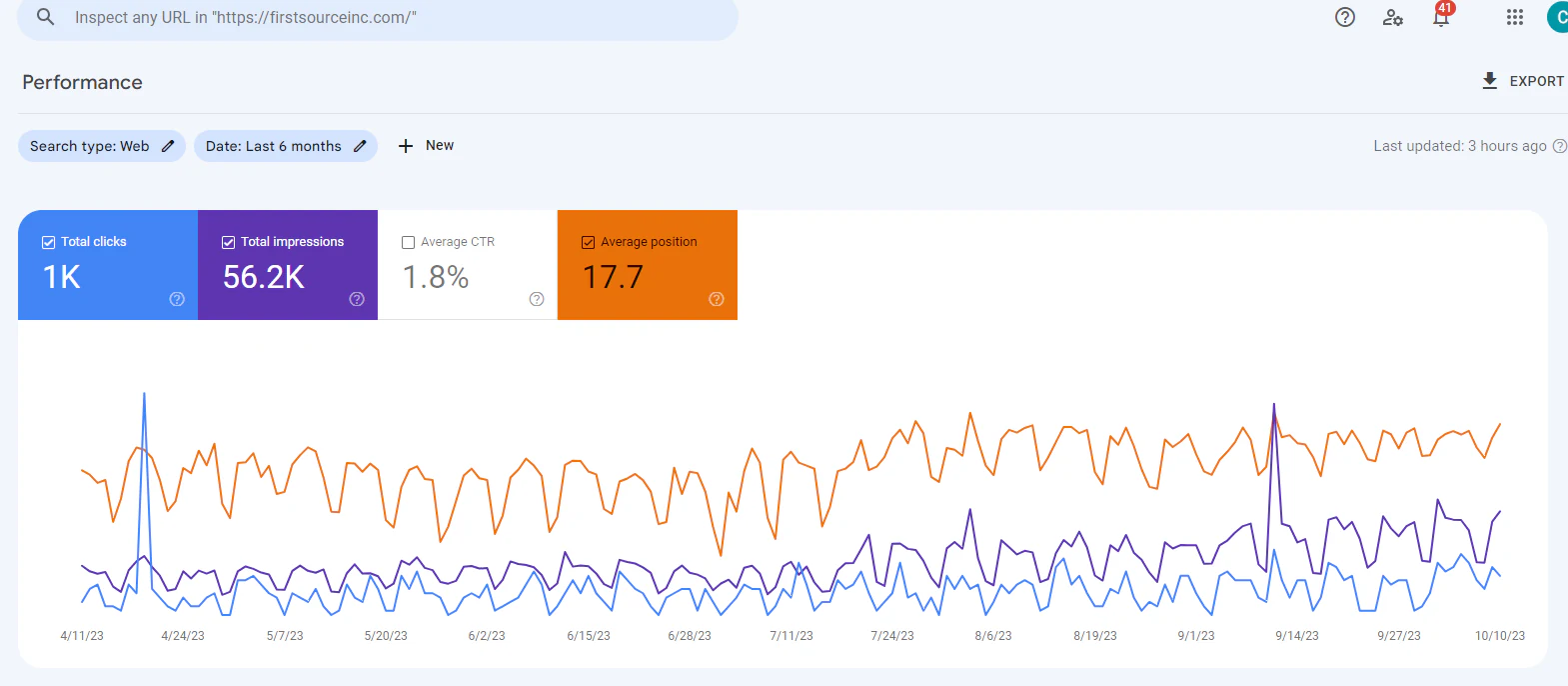
Google Search Console, firstsourceinc.com, April to October 2023: 1K clicks, 56.2K impressions, 1.8% CTR, average position 17.7.
First Source Inc, an RF and microwave component supplier, shows what slow-and-steady looks like. For the first three months the lines are flat. From July, impressions step up and the average position improves, and they hold there through October. Three months of nothing visible, then a lift that sticks: that is the normal shape of SEO on an established site. Full story: First Source Inc case study.
The ones that went nowhere
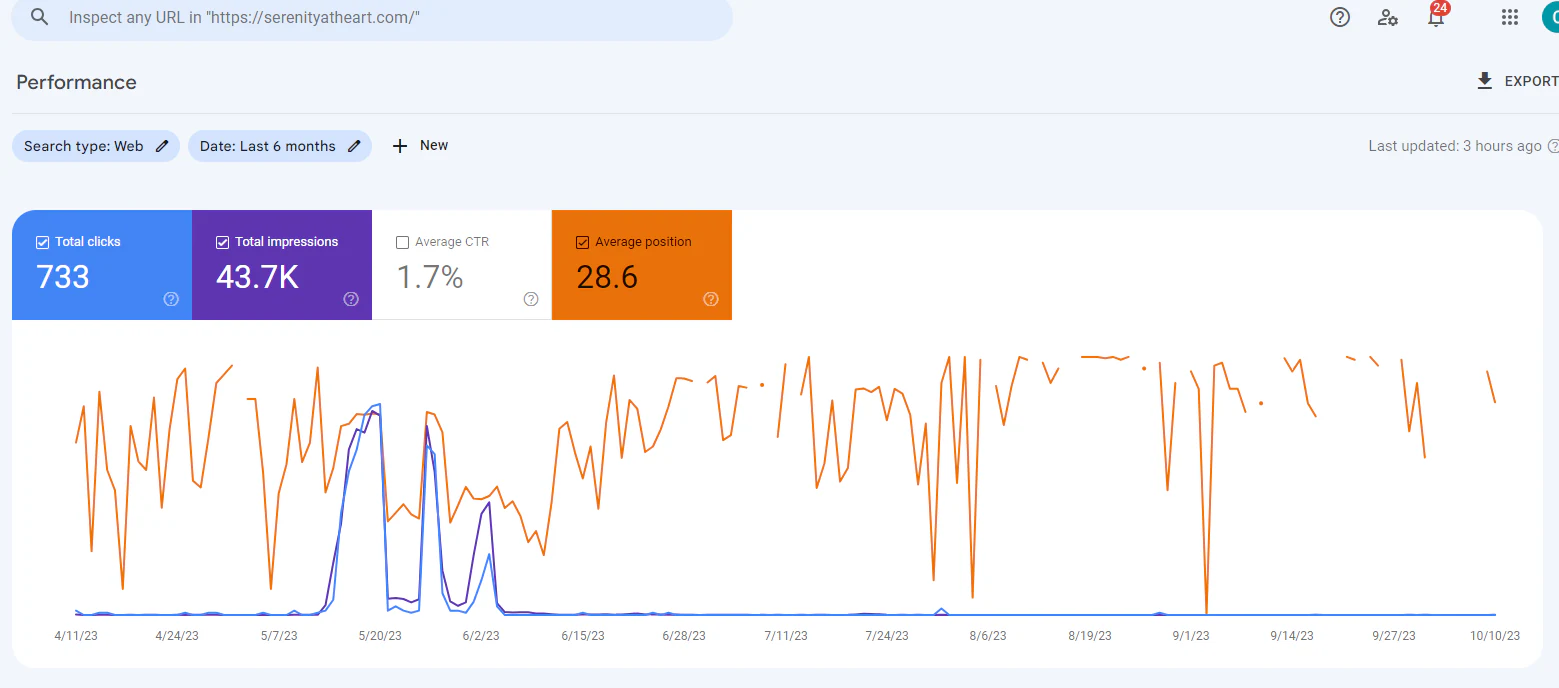
Google Search Console, serenityatheart.com, April to October 2023: 733 clicks, 43.7K impressions, 1.7% CTR, average position 28.6. Most clicks came in one burst.
Serenity at Heart, a nonprofit in Phoenix, had most of its 733 clicks in one burst between mid-May and early June 2023, and very little either side. iPeepbxs shows the same shape with a single spike in late May. Six-month totals for both look respectable. The charts show they are not trends.
This is the most important thing to understand about SEO timelines: a spike is not progress. Real SEO progress looks like the First Source or Naffees & Sons charts, a line that rises and holds. When someone reports SEO results to you, ask for the chart, not the total. Both sites are written up honestly in their own case studies: Serenity at Heart and iPeepbxs.
What Makes SEO Faster, and What Slows It Down
- 1Fixing a technical blockcan show within weeks0
- 2Small local marketfewer competitors0
- 3Pages that match buyer searchessomething specific to rank0
- 4Searches for your own nameusually first to rank0
- 5Brand-new domain, no linksno trust yet0
- 6National, competitive termsyears of incumbents0
Faster:
- Fixing a technical block. If pages are blocked from indexing, redirecting badly or orphaned, fixing it can show within weeks. DSL Warehouse recorded 91,700 impressions in about eight weeks of data after a 100+ page technical audit; see the DSL Warehouse case study.
- A small local market. Fewer competitors, simpler searches.
- Pages that match how buyers search. A page for each service and location gives Google something specific to rank.
- Searches for your own name. Usually the first thing a new site ranks for.
Slower:
- A brand-new domain with no links. Google has no reason to trust it yet. Links from relevant sites are often the bottleneck.
- National, competitive terms. "Accountant" or "CRM software" against companies that have been ranking for a decade.
- Content that says what every other page says. There is no reason for Google to rank the hundredth version of the same article.
- AI answers on informational searches. Pew found people clicked a regular result on 8% of visits when Google showed an AI summary, against 15% without. You can rank and still get fewer clicks on general questions; local and commercial searches are much less affected.
A Realistic Month-by-Month Timeline
Weeks 1 to 4: fixes and indexing. Technical blocks cleared, sitemap submitted to Search Console, pages indexed. Nothing visible to the business yet, but this is where Google finds the site.
Months 1 to 3: impressions rise first. Google starts showing pages for long-tail searches to test them. In Search Console, the impressions line moves before the clicks line. If impressions are flat by month three, something is wrong.
Months 3 to 6: clicks follow. Local and niche searches reach page one. This is where most small businesses first see enquiries they can trace to search.
Months 6 to 12: competitive terms move. As authority and content build up, harder searches start to rank. This is also where SEO starts to beat Google Ads on cost per click, as we show in SEO vs Google Ads.
Google first finds and indexes the pages, then tests them by showing them for long-tail searches, so impressions rise before clicks. If impressions are rising, clicks follow and local terms reach page one, then competitive terms move as authority builds. If impressions are flat after about three months, something is wrong and needs checking.
The Competitor Pulse Check
| Factor | ValueStreamAI approach | Typical "page one in 30 days" offer |
|---|---|---|
| Timeline promised | Four months to a year, faster for local | Thirty days |
| What is measured | Google's own Search Console data | Rankings for chosen keywords nobody searches |
| Spikes | Shown and labelled as spikes | Reported as growth |
| Fast wins | Technical fixes and local pages first | Paid or low-quality links |
| Proof | Unedited charts from nine named sites | Testimonials |
Human Hours vs Automation: Checking SEO Progress by Hand
Knowing whether SEO is working means checking it every week, and that takes time. Here is the job priced.
Assumptions: a weekly check of Search Console, rankings and enquiries, pulled into a spreadsheet and summarised, takes about 1, 2 or 4 hours a week for one site, a few locations, or several sites. The hourly rate is the US median for secretaries and administrative assistants, about $22.82 an hour (BLS, May 2024), base pay only. With an automated weekly report and alerts when something drops, we assume 20% of the time remains for a person to read it and act.
| Volume | Hours by hand a year | Cost by hand | Human time with automation | Cost with automation |
|---|---|---|---|---|
| 1 hour a week | 52 | ~$1,190 | ~10 hours | ~$240 |
| 2 hours a week | 104 | ~$2,370 | ~21 hours | ~$470 |
| 4 hours a week | 208 | ~$4,750 | ~42 hours | ~$950 |
The other side of the ledger: automated reporting is part of our marketing retainers from $900 a month rather than a separate build. What it leaves out: the value of noticing a drop the same week instead of at the end of the quarter, which is when most businesses find out. Run your own figures in the hire vs automate calculator.
Frequently Asked Questions
How long does SEO take to work for a small business?
Usually four months to a year, which is Google's own guidance. Local businesses in small markets can see results in two to three months: a Queensland cafe we worked with went from 10 to 95 ranking keywords in about eleven weeks. Competitive national terms take longer.
How long does it take a new website to rank on Google?
A new site can be indexed within days of submitting a sitemap, but ranking for searches that matter takes months. Ahrefs found only about 1.74% of random new URLs reached the top 10 within a year. Two sites we built in 2026 with pages matched to buyer searches reached average positions under 6 within a three-month window.
Why are my impressions going up but not my clicks?
That is normal in the first months. Google tests pages by showing them for long-tail searches, often on page two, before ranking them higher. Clicks usually follow rising impressions. If impressions are flat after about three months, check indexing and whether your pages match what people search.
Can SEO work faster?
Some parts can. Fixing a technical block such as pages excluded from indexing can show within weeks, and local searches move faster than national ones. Promises of page one for competitive terms in thirty days usually rely on low-quality links, which can harm a site.
How do I know if my SEO is working?
Look at Google Search Console, not a rank tracker. Rising impressions, then rising clicks, then improving average position, sustained over months, is progress. A single spike followed by a flat line is not, even if the six-month total looks good.
Is it worth doing SEO if it takes a year?
If your business will be trading in two years, usually yes, because the results keep working after the spend stops. If you need customers this month, start with Google Ads alongside it, and shift budget to SEO as organic clicks grow.
What's Next
If you want to know how long SEO would take for your business specifically, we will look at your market, your site and your competitors on a free call and give you an honest range, including when ads would be the better start.
→ See our SEO and digital marketing services
→ SEO for a new website: the first 90 days
→ Read the full guide: build it and market it
→ See what building and marketing costs, or talk to us about your site
Syed Rayyan is co-founder of ValueStreamAI, leading research and marketing. He has run SEO for client websites since 2020, across technical audits, on-page work and link building, and leads the marketing side of every build. He also runs the firm's evaluation of emerging AI tooling and translates technical capability into clear guidance for non-technical decision-makers. Connect on LinkedIn →