A construction family has been building in its city for fifty years. It has completed more than five hundred projects, including government school rehabilitation contracts going back two decades. The proof sits in filing cabinets: contracts, drawings, photographs, letters of completion. Online, a homeowner searching for a builder finds a competitor with two years of history and a better website.
This is the most common situation we see among established businesses, and the most fixable. This guide is for the owner of a family business or an established firm that has real experience and no way of showing it online. It covers how to market an established business by turning what is already in the archive into case studies, project pages and search visibility, with results from two family businesses we did exactly this for.
| Metric | 2026 Benchmark |
|---|---|
| Naffees & Sons: trading since | 1972, third generation, 500+ projects |
| Naffees & Sons: average Google position after launch | 5.7 (Jul to Oct 2026), no link building |
| PK Transporters: average Google position after launch | 5.8 (Jul to Oct 2026), no link building |
| Google's quality framework | E-E-A-T: experience comes first |
| Time for SEO to show results (Google) | Four months to a year |
The short answer. An established business usually does not need to invent marketing; it needs to publish the experience it already has. Audit the archive (project files, contracts, certificates, photographs, prices), agree what can be made public, research how buyers search, and turn the proof into project pages, case studies, cost guides and capability pages, published through a system the business can keep adding to. Google's own quality framework puts experience first. Two family businesses we did this for reached average Google positions under 6 within three months, without any link building.
Key takeaways
- The proof already exists. It is in paper, email and people's heads, not on the website.
- Experience is what Google rewards. It is the first E in E-E-A-T, and newer competitors cannot fake decades of it.
- Every finished job is a page. Project pages and case studies are the most persuasive content an established business can publish.
- Publish what buyers search for. Proof on the wrong pages helps nobody; research comes first.
- Get permission first. Client names, contracts and government work need consent and sometimes redaction.
Why Established Businesses Lose Online
The answer is that the way their customers find suppliers changed, and their reputation did not move with it.
For decades, many established businesses grew on referrals. Work came from families who had used them before, architects and engineers who trusted them, and word of mouth. That still works for the customers who already know them. It does nothing for the next generation of buyers, who start with a search engine and have no inherited relationship with any supplier.
Those buyers judge a business by what they can see in a few minutes on a phone. A firm with fifty years of history and a five-page brochure site loses to a newer firm with a well-built site, a portfolio and clear prices, even when the older firm is better at the actual work.
The irony is that the established business has more to show than anyone. It has simply never written it down anywhere a stranger can read it.
What Is Already in the Filing Cabinet
When we start with an established business, the first job is not design. It is going through what the business already has. Almost every firm with real history is sitting on the same kinds of material:
- Completed project files, each one a potential case study: the brief, the challenge, what was done, the outcome.
- Contracts, including government and large commercial work, which prove capability in a way no marketing copy can.
- Certificates, licences and memberships, which answer the procurement team's first questions.
- Photographs, before and after, on site, at scale.
- Years of quotes and prices, which can become honest cost guidance, the information buyers search for most and suppliers publish least.
- The know-how in people's heads, the questions customers ask every week, which can be answered once, in writing, for everyone.
For Naffees & Sons, a Karachi construction firm founded in 1972 and now run by the third generation, that meant decades of paper records, including government school rehabilitation contracts. For PK Transporters, a container haulage family business, it meant a fleet of 850+ owned trucks and trailers, ISO 9001:2015 certification, an electronic customs clearing licence and coverage across two dozen cities, none of which had ever been digitised or put in front of a buyer.
Why Google Rewards This Kind of Content
Google describes what it looks for in content with four words: experience, expertise, authoritativeness and trust, the framework it calls E-E-A-T. Experience comes first. Google's own guidance on content says its systems aim to reward original, high-quality content that demonstrates these qualities.
An established business has the hardest of the four to fake. A newer competitor can write about construction costs; it cannot publish fifty years of completed projects. A content agency can produce articles about freight; it cannot show a fleet register and a customs licence. Real experience, documented with real projects, is the most defensible content a business can own.
This also matters as AI writing tools flood the web with generic articles. Content anyone can generate is worth less every month. Content built from a business's own records is worth more. We cover the rules on this in AI-generated content and Google's spam policies.
From Paper to Proof: The Process
- 01Audit the archive
Gather project files, contracts, certificates and photos. Agree what can be published.
- 02Research how buyers search
Find the words customers use, so the proof lands on pages they will find.
- 03Build pages from the proof
Project pages, case studies, cost guides, capability and location pages.
- 04Publish through a CMS you can use
So the business keeps adding work as it finishes it.
- 05Market it
On-page SEO, links where needed, Search Console reporting, follow-up on enquiries.
1. Audit the archive, and agree what can be published
Gather the project files, contracts, certificates and photographs. Then decide, with the owner, what can be made public. Client names need consent. Government and commercial contracts may need details removed. A finished project can often be described by type, place and scale without naming the client. Getting this right is part of what makes the result trustworthy.
2. Research how buyers search
Proof on the wrong page helps nobody. For Naffees & Sons, research showed homeowners search by plot size ("240 square yard house construction cost") and by neighbourhood, not by "construction company". That decided where the proof went: cost guides by plot size, service pages by neighbourhood, project pages that match.
3. Build pages from the proof
- Project pages and case studies from completed jobs. Naffees & Sons' site launched with 9 documented project pages, including government contracts.
- Cost guides from years of quotes. Naffees & Sons published cost guidance by plot size, information competitors withheld.
- Capability and trust pages from certificates, fleet and licences. PK Transporters' pages put certification, fleet scale and coverage up front.
- Service and location pages for each thing buyers search for. PK Transporters launched with 21 service pages and 9 service-by-city pages.
4. Publish through a system the business can keep feeding
An established business keeps finishing projects. The website should make adding each one easy, without a developer. Both sites run on a CMS the family teams publish from themselves.
5. Market it
On-page SEO, links where the market needs them, monthly Search Console reporting, and follow-up on the enquiries. We set out what a monthly retainer covers, in plain English, in website design and SEO packages.
Start by auditing the archive of project files, contracts, certificates and photographs, and agree with the owner what can be published, removing client details where needed. Research how buyers search, then build project pages, case studies, cost guides and capability pages from the proof, publish them through a CMS the business can use, and market the site.
What Happened for Two Family Businesses
Over the three months to 22 October 2026, Google Search Console shows:
| Business | Clicks | Impressions | Average position | Link building |
|---|---|---|---|---|
| Naffees & Sons (construction, since 1972) | 782 | 35,000 | 5.7 | None |
| PK Transporters (container logistics) | 341 | 29,500 | 5.8 | None |
Daily impressions for Naffees & Sons rose from around 100 to more than 700 over the window. For PK Transporters they climbed to about 1,600 a day, with 38 pages indexed and none excluded. Neither business had any link building or other off-page work: the results came from the structure, the on-page SEO and the content built from their own records. The unedited screenshots are in our SEO results portfolio.
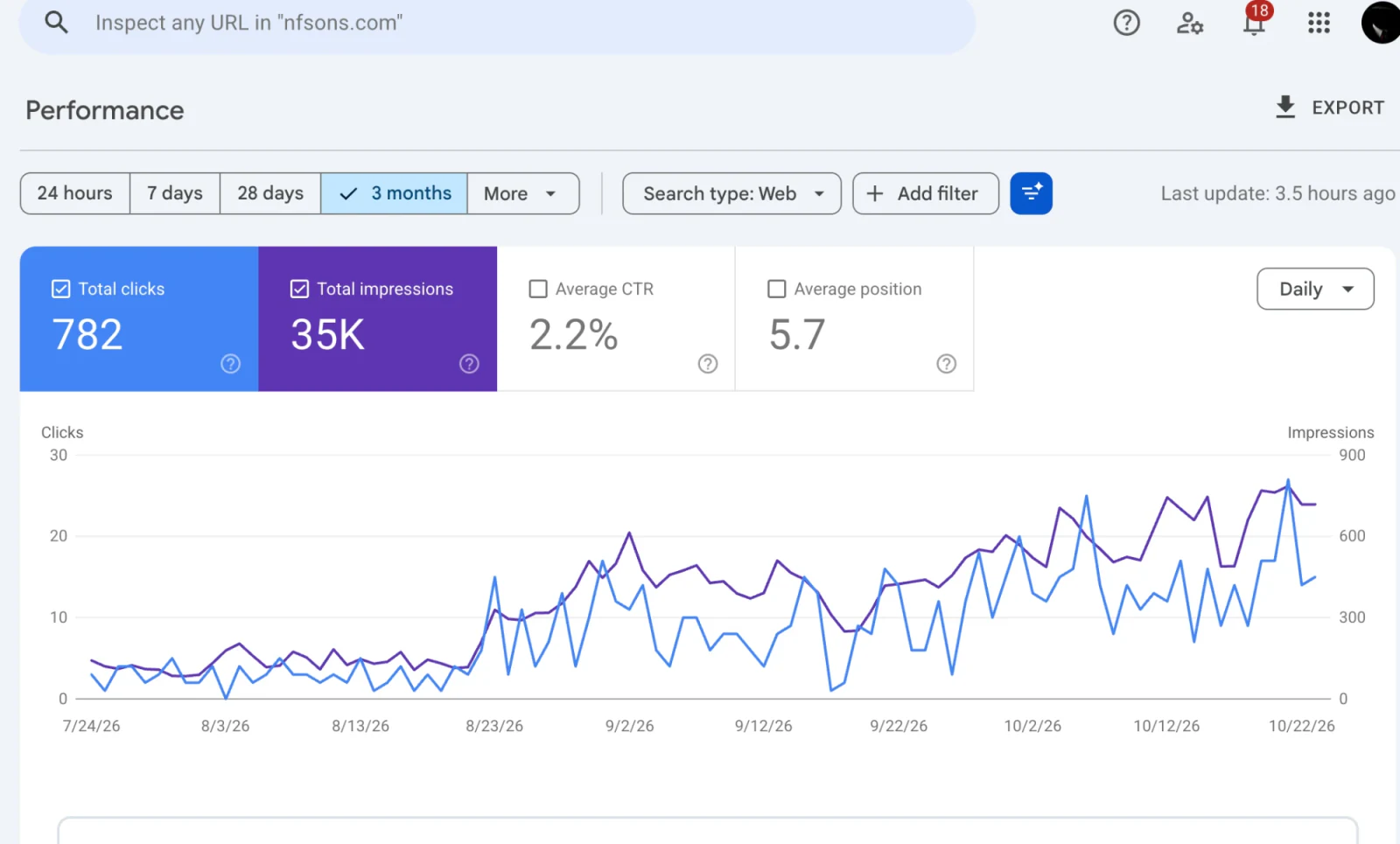
Google Search Console, nfsons.com, 24 July to 22 October 2026: 782 clicks, 35K impressions, 2.2% CTR, average position 5.7. On-page SEO and content only; no link building.
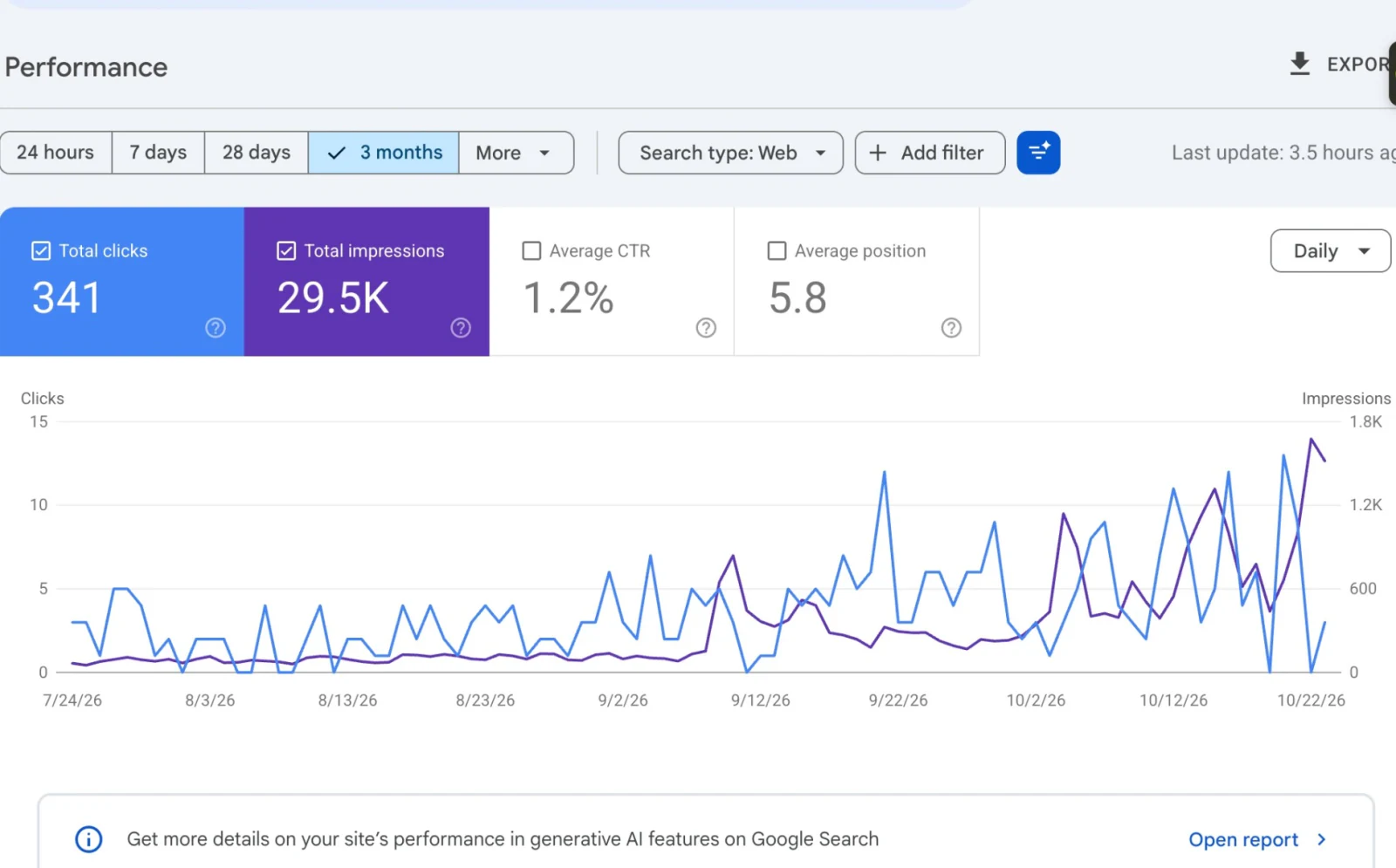
Google Search Console, pktransporters.com, 24 July to 22 October 2026: 341 clicks, 29.5K impressions, 1.2% CTR, average position 5.8. On-page SEO and content only; no link building.
For PK Transporters there was a second result nobody planned for: enquiries arrived faster than the team could answer them. An established business that becomes visible usually needs its follow-up to keep up, which is where lead follow-up automation comes in.
The same applies outside construction and freight. First Source Inc, an RF component supplier trading since 1985, shows what decades of specialist know-how look like once they are written down where engineers search.
If You Already Have a Website
Many established businesses do have a website, often built years ago, and assume that is the job done. The usual problems are the same ones: a single services page, no projects, no prices, no proof, nothing that matches what buyers type. A rebuild is not always needed; often the site can be extended with project pages, case studies and service pages, as long as old pages are redirected properly. A Google Business Profile on its own is not enough either, for reasons we cover separately.
Five Questions to Ask Before You Start
- What are the ten best jobs we have ever done, and do we have the paperwork and photos for them?
- Which clients would be happy to be named, and which projects should be described without names?
- What do customers ask us every week that our website does not answer?
- What do we know about prices that competitors refuse to publish?
- Who in the business will add new projects once the system exists, and how much time will it take them?
The answers decide the first month of work.
The Competitor Pulse Check
| Factor | ValueStreamAI approach | Typical web agency | Content mill |
|---|---|---|---|
| Starting point | Your archive and your buyers' searches | A design brief | A keyword list |
| Content | Your real projects, contracts and prices | Stock photos and generic copy | Generic articles |
| Permissions | Agreed and redacted where needed | Rarely considered | Not applicable |
| After launch | A CMS you run, plus ongoing marketing | Handover | More articles |
| Proof it works | Two family businesses under position 6, no links | Design portfolio | Word counts |
Human Hours vs Automation: Turning Project Files Into Pages
Digitising an archive is real work. Here it is priced.
Assumptions: about 6 hours per project by hand to find the files, read them, pull out the facts, write a project page and check it with the owner. Light, typical and large archives of 20, 50 and 150 projects. Hourly rate: the US median for secretaries and administrative assistants, about $22.82 an hour (BLS, May 2024), base pay only; a writer with industry knowledge costs more. With scanning, AI-assisted extraction of the facts into a structured template, and a human writing and checking each page, we assume about a third of the time remains. A person still reads every page; experience cannot be generated.
| Volume | Hours by hand | Cost by hand | Human time, assisted | Cost, assisted |
|---|---|---|---|---|
| 20 projects | ~120 | ~$2,740 | ~40 hours | ~$910 |
| 50 projects | ~300 | ~$6,850 | ~100 hours | ~$2,280 |
| 150 projects | ~900 | ~$20,540 | ~300 hours | ~$6,850 |
The other side of the ledger: this work sits inside a build from $5,000 or a marketing retainer from $900 a month. What it leaves out: the value of the result. One won contract usually outweighs the cost of documenting a hundred past ones. Run your own figures in the hire vs automate calculator.
Frequently Asked Questions
How do I market a traditional or family business online?
Start with what you already have: completed projects, contracts, certificates, photographs and prices. Agree what can be made public, research how your buyers search, and turn the proof into project pages, case studies, cost guides and service pages, published through a system you can keep adding to. Then market the site with SEO and follow up every enquiry quickly.
We have decades of experience but no digital records. Where do we start?
With the paper. Gather project files, contracts, letters and photographs, and pick the strongest twenty or so projects. Each can become a page. Naffees & Sons, a construction firm founded in 1972, launched with project pages drawn from decades of paper records, including government contracts.
Can we publish details of government or client contracts?
Only with permission and care. Client names need consent, and some contract details may need removing. A project can often be described by type, location and scale without naming the client, which still demonstrates the experience.
Why would our experience help us rank on Google?
Google's quality framework, E-E-A-T, puts experience first, alongside expertise, authoritativeness and trust. Content built from real projects is original and hard for competitors to copy, which is exactly what Google says it aims to reward.
We already have a website. Do we need a new one?
Not always. Many older sites can be extended with project pages, case studies and service pages, provided any changed URLs are redirected. If the site cannot be updated easily, or has no structure for pages by service and location, a rebuild is usually cheaper in the long run.
How long does it take to see results?
Google's guidance is four months to a year. Two family businesses we built sites for, Naffees & Sons and PK Transporters, reached average positions of 5.7 and 5.8 within three months of their Search Console windows, with no link building.
What's Next
If your business has years of real experience that nobody online can see, start with a free call. We will look at what you have and show you which of it would bring in buyers first.
→ See our SEO and digital marketing services
→ Read the Naffees & Sons case study
→ Read the full guide: build it and market it
→ See what building and marketing costs, or talk to us about your site
Syed Rayyan is co-founder of ValueStreamAI, leading research and marketing. He has run SEO for client websites since 2020, across technical audits, on-page work and link building, and leads the marketing side of every build. He also runs the firm's evaluation of emerging AI tooling and translates technical capability into clear guidance for non-technical decision-makers. Connect on LinkedIn →