The Hungry Pelican is a cafe on the Esplanade at Pialba, in Hervey Bay, Queensland. It serves breakfast, brunch and coffee to locals and to the visitors who come through a coastal tourist town. Its website is small: the sitemap lists five pages (home, food, menu, coffee and contact). In May 2025 Google barely knew it existed.
This case study is about what happened to that small site over about eleven weeks of local SEO. It is our cleanest cafe SEO result, because we have a true starting point: a Semrush snapshot taken on 23 May 2025, before the work began, and a second one on 6 August 2025. Search Console fills in the clicks between. Every screenshot below is unedited, with its date range in the caption.
| Metric | 23 May 2025 | 6 August 2025 |
|---|---|---|
| Ranking keywords (Semrush) | 10 | 95 |
| Estimated organic traffic (Semrush) | 2 | 425 |
| Backlinks | 0 | 17 |
| Referring domains | 0 | 12 |
| Authority Score | n/a | 16 |
| Google clicks, 1 June to 5 August (Search Console) | 1,060 |
Why a Cafe Is a Good Test of Local SEO
A cafe is the hardest kind of business to make a marketing case for and the easiest to measure. It is hard because each customer is worth a coffee and a meal, not a contract, so nobody can justify a big budget. It is easy to measure because the searches are simple and local: "cafe Hervey Bay", "breakfast Pialba", "brunch near me", the cafe's own name. When a cafe starts ranking, you see it within weeks rather than quarters.
It is also an honest test of whether SEO works for a small business at all, as opposed to a law firm or a software company with large customer values. If search can move the needle for a five-page cafe site in a regional town, the argument for a business with more at stake is stronger, not weaker.
The Hungry Pelican also had a problem every new site has. Google trusts sites that other sites link to. A new or unknown domain has no links, so it has no authority, so even a well-written page sits on page three. The 23 May snapshot shows exactly that: no Authority Score at all (Semrush shows "n/a" when a domain is too new or too thin to rate), zero backlinks, and ten keywords.
The Starting Point: 23 May 2025
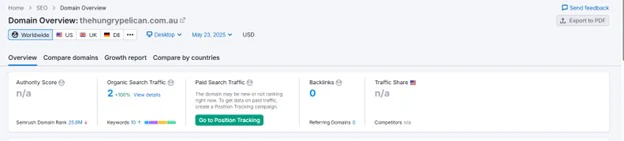
Before: Semrush Domain Overview, thehungrypelican.com.au, 23 May 2025. Authority Score n/a, organic traffic 2, 10 keywords, 0 backlinks.
Two organic visits a month by Semrush's estimate. Ten keywords, most of them likely the cafe's own name. This is what a site looks like when it exists but has not been marketed: it is technically online and practically invisible.
What We Did
The campaign had two parts, and the order matters.
On-page work first. A five-page site has nowhere to hide. Each page has to state clearly what it is about and where the business is, in the words people search. That means titles and headings that say "Hervey Bay" and "Pialba" and "breakfast" rather than "Welcome", descriptions that read like an answer, and consistent name, address and phone details across the site and the Google Business Profile. None of this is glamorous. All of it is the reason Google can match a page to a local search in the first place.
Then authority. This is the part that moved the numbers fastest. Between May and August we earned 17 backlinks from 12 referring domains. For a small local business, the useful links are local ones: directories that list cafes in the region, local listings and pages relevant to food and tourism in the area. Twelve domains is not a big number. For a domain starting from zero, it is the difference between unrated and rated.
We did not buy links, and we would not. Paid link schemes are against Google's spam policies, and a cafe has more to lose from a penalty than it has to gain.
The campaign started from a site with no authority and ten keywords. On-page work made each of the five pages clearly local, then local link building earned 17 backlinks from 12 domains, and Semrush showed 95 keywords and an Authority Score of 16 by early August.
The Result: 6 August 2025
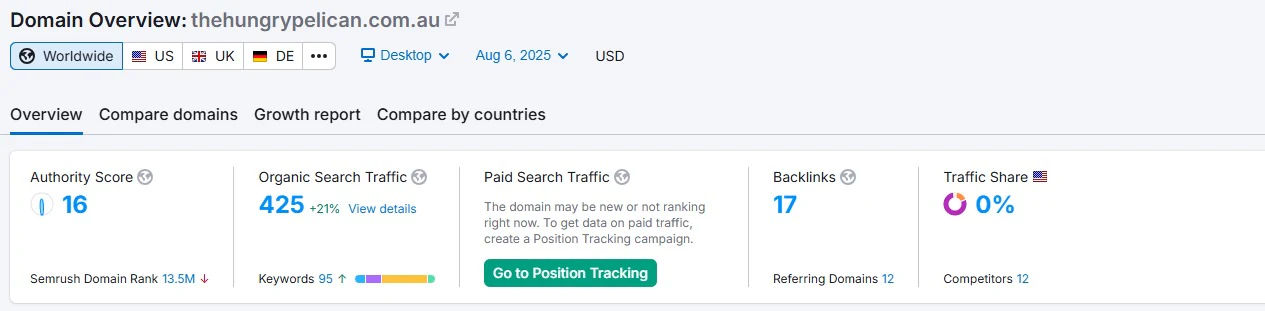
After: Semrush Domain Overview, thehungrypelican.com.au, 6 August 2025. Authority Score 16, organic traffic 425, 95 keywords, 17 backlinks from 12 referring domains.
Ninety-five keywords, up from ten. An estimated 425 organic visits a month, up from two. An Authority Score of 16 where there had been none.
A word on those Semrush figures, because they are easy to over-read. Semrush's "organic search traffic" is an estimate built from rankings and search volumes, not a count of real visits. Authority Score is Semrush's own 0 to 100 measure, not something Google uses. They are useful for before and after, because the same tool measured both dates the same way. For the real clicks, you need Google's own data.
What Google Itself Reported
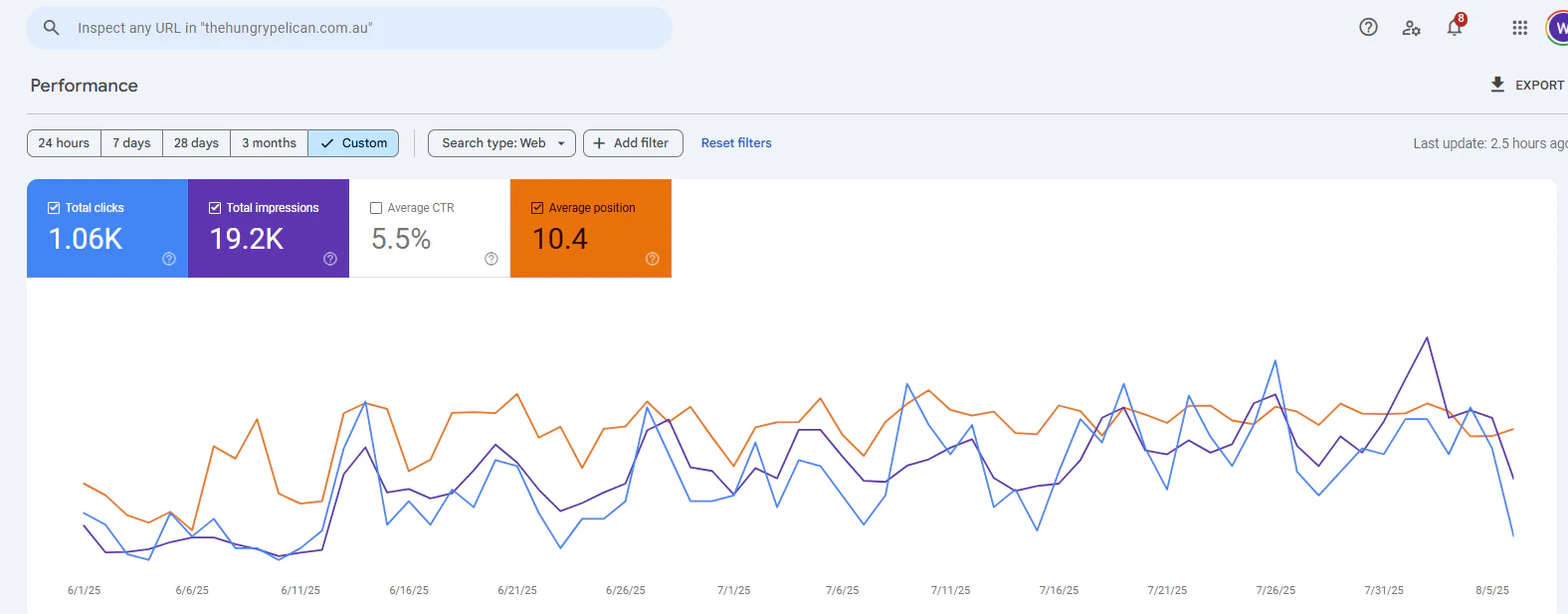
Google Search Console, thehungrypelican.com.au, 1 June to 5 August 2025: 1.06K clicks, 19.2K impressions, 5.5% CTR, average position 10.4.
Search Console is the ground truth: these are actual searches on Google and actual clicks to the site. Over 66 days the cafe had 1,060 clicks and 19,200 impressions. Read the chart from left to right and the shape is the point. Through early June the lines sit near the bottom. From mid-June they lift, and by late July both clicks and impressions are running at several times the early-June level.
The average position of 10.4 means the site's typical appearance was around the bottom of the first page or the top of the second, averaged across every query it showed up for, including long-tail ones where it ranks lower. The 5.5% click-through rate is healthy for a mix like that. Branded searches (people typing the cafe's name) usually convert at a much higher rate, and broad searches like "cafe" at a lower one.
Organic Clicks vs Paid Clicks: Pricing the Same Traffic
Every SEO result should be priced against the obvious alternative, which for a cafe is Google Ads. Here are our assumptions, stated as assumptions.
- Clicks: 1,060, from Search Console, 1 June to 5 August 2025.
- Cost per click: $2.05, the 2026 average for Restaurants & Food in LocaliQ's search advertising benchmarks (updated 1 June 2026). That is US campaign data. Australian cafe CPCs can differ, so treat the result as an order of magnitude.
- Branded searches: some of these clicks came from people searching the cafe's name. A cafe would rarely pay for those, so the real ads saving is lower than the headline.
| Volume | Organic clicks | Same clicks on Google Ads (at $2.05) | What it cost organically |
|---|---|---|---|
| This 66-day window | 1,060 | about $2,170 | The campaign: on-page work and link building |
| A year at the late-July run rate (our estimate) | several thousand | several times the window figure | Ongoing upkeep, much smaller than the launch work |
1,060 clicks at $2.05 each. A US benchmark: Australian cafe CPCs can differ, so treat this as an order of magnitude.
Many cafe searches include the cafe's name. You would rarely pay for those, so the real ads saving is smaller than the headline.
When an ad budget stops, clicks stop the same day. Rankings and links earned in these eleven weeks keep working after the campaign.
The honest reading. At $2.05 a click, restaurant advertising is among the cheapest in any industry LocaliQ tracks. A cafe could buy a lot of clicks for the cost of an SEO campaign, and for a short promotion that is the right call. The case for SEO here is not that it beats ads on day one. It is what happens afterwards: when an ad budget stops, the clicks stop the same afternoon. The 17 links and the rankings built in these eleven weeks did not switch off on 6 August. That is the part you own.
If you want to run the same comparison for your own business, our SEO vs Google Ads guide walks through it with the benchmark CPCs for each industry.
The Competitor Pulse Check
How this campaign compares with the two options a cafe owner is usually offered.
| Factor | ValueStreamAI approach | Typical cheap local SEO package |
|---|---|---|
| Starting point | Semrush and Search Console baseline before any work | No baseline, so no honest before and after |
| Links | 17 relevant links from 12 domains | Hundreds of directory or paid links, with penalty risk |
| Reporting | Google's own Search Console data | Rank-tracker screenshots for hand-picked keywords |
| Advice on ads | Told plainly when ads are the better buy | SEO sold as the answer to everything |
| After the campaign | The cafe keeps the rankings and links | Rankings fade if links were low quality |
What This Engagement Confirmed
A new domain needs authority before content can do its job. Ten keywords to ninety-five did not happen because the five pages became brilliant. It happened because Google started trusting the domain enough to rank the pages it already had. For most new sites, links are the bottleneck, and the work to earn them is unglamorous and local.
Small numbers of the right links beat large numbers of the wrong ones. Twelve referring domains. That is all. Relevant and local mattered more than volume.
Measure with Google's data, and use third-party tools for direction. The Semrush before-and-after is a clean story. The Search Console chart is the proof, because it counts real clicks.
This is the contrast with our build projects. For Naffees & Sons and PK Transporters we did no link building at all: we built large, content-rich sites, and on-page work and content carried them to an average position of about 6. The Hungry Pelican had the opposite shape: a five-page site that needed authority. The right campaign depends on which problem you have, which is why we look before we quote. The full set of results is in our SEO results across nine client sites.
Frequently Asked Questions
How long does local SEO take for a cafe or restaurant?
For The Hungry Pelican, keywords went from 10 to 95 in about eleven weeks, and Search Console clicks rose clearly from mid-June. That is quick, and it reflects a small local market with modest competition. Google's own guidance is that SEO usually takes four months to a year, and busier cities or more competitive terms sit at the longer end.
What did the SEO campaign for The Hungry Pelican include?
On-page optimisation of the site's five pages, so each one clearly states what it offers and where, consistent business details, and local link building that earned 17 backlinks from 12 referring domains. We did not buy links.
Is Semrush organic traffic the same as real visitors?
No. Semrush estimates traffic from rankings and search volumes. Google Search Console counts real clicks from Google search, which is why this case study shows both: Semrush for a consistent before and after, Search Console for the actual clicks.
Is SEO worth it for a cafe when Google Ads clicks are cheap?
Restaurant ad clicks average about $2.05 in LocaliQ's 2026 US data, so ads are a reasonable choice for a short promotion. SEO is worth it when you plan to be trading for years, because the rankings and links keep working after you stop paying, while ad traffic stops the same day.
How many backlinks does a small local business need?
Fewer than most people think, if they are relevant. The Hungry Pelican went from unrated to an Authority Score of 16 with 17 backlinks from 12 domains. Local and industry relevance matter more than volume.
Can you show results for other kinds of business?
Yes. Our portfolio case study shows unedited Search Console data for nine client sites, including a construction firm, a logistics company, an online electronics store and a Toronto restaurant.
What's Next
If you run a cafe, restaurant or any local business with a website that nobody finds, the first step is a short look at where you stand: how many keywords you rank for, whether your domain has any authority, and whether your pages say clearly where you are. We do that on a free call, and we will tell you if ads are the better buy for now.
→ See our SEO and digital marketing services
→ Read the restaurant and cafe SEO guide
→ See what building and marketing costs, or talk to us about your site