Every small business owner who has looked at marketing has had the same pitch twice. The Google Ads person says SEO takes too long and you need customers now. The SEO person says ads are throwing money away and you need to own your traffic. Both are partly right, and neither usually shows you the numbers.
This guide does. We took the real organic clicks from our client sites, straight out of Google Search Console, and priced them at what Google Ads would have charged for the same clicks in each client's industry. Then we worked out when ads are the better buy, where the break-even point sits for paying an SEO retainer, and how AI answers in search change the picture. If you are weighing SEO vs Google Ads for a small business, this is the comparison with the numbers left in.
| Metric | 2026 Benchmark |
|---|---|
| Average Google Ads cost per click, all industries (LocaliQ) | $5.42 |
| Cheapest: restaurants and food | $2.05 a click |
| Among the most expensive: legal services | $9.87 a click |
| US searches that send a click to any website (SparkToro, 2024) | About 36% |
| Time for SEO to show results (Google) | Four months to a year |
The short answer. Google Ads buys clicks today and stops the day you stop paying. SEO costs more up front, takes four months to a year, and then keeps earning clicks without a per-click charge. For a business that will be trading in two years, SEO usually wins on cost per customer once it ramps; ads win for testing offers, launches, seasonal pushes and industries where clicks are very cheap. Most small businesses should run a small ads budget while SEO builds, then shrink it.
Key takeaways
- Our clients' organic clicks would have cost roughly $38,000 at US Google Ads rates for their industries, across the windows we measured.
- Ads are cheap in some industries. At $2.05 a click, a restaurant can buy a lot of traffic for the price of an SEO campaign.
- The break-even point is concrete. $900 a month buys about 166 clicks at the average CPC. An SEO campaign that earns more than that each month is cheaper.
- AI answers reduce clicks on informational searches. Commercial and local searches are less affected.
- SEO is not free. You pay for content, fixes and links, and you wait.
Why SEO vs Google Ads Is the Wrong Fight
The answer is that they do different jobs, and the businesses that do best use each for what it is good at.
Google Ads rents attention. You pay per click, the clicks arrive the day the campaign goes live, and they stop the moment the budget stops. That makes ads ideal for anything time-bound: a launch, a seasonal offer, an event, or testing whether a message works at all before you build pages around it.
SEO builds an asset. You pay for the work up front: research, pages, content, technical fixes and, where needed, links. There is no charge per click. Results take months. But a page that ranks keeps earning clicks next month and the month after, without a bid deciding whether it appears.
The real question for a small business is not which one is better. It is how much of each, and when.
What Google Ads Costs in 2026
LocaliQ's 2026 search advertising benchmarks, updated 1 June 2026 and drawn from thousands of its customers' campaigns, put the average cost per click across all industries at $5.42. The spread between industries is wide.
| Industry | Average CPC | Average cost per lead |
|---|---|---|
| Legal services | $9.87 | $131.63 |
| Home and home improvement | $8.33 | $90.92 |
| Dentists | $8.00 | $72.97 |
| Personal services | $7.17 | $54.60 |
| Health and fitness | $6.17 | $67.36 |
| Business services | $5.87 | $93.69 |
| Industrial and commercial | $5.87 | $75.19 |
| Shopping and retail | $4.14 | $49.40 |
| Real estate | $3.22 | $102.51 |
| Restaurants and food | $2.05 | $30.57 |
These are US averages. Clicks in the UK, Australia, Canada and especially South Asia are usually cheaper, and any individual campaign can be well above or below them. They are still the most widely used published benchmark, and they make the comparison concrete.
Our Clients' Organic Clicks, Priced as Ads
We took the clicks from each client's Search Console window and multiplied them by the LocaliQ average for the closest industry. This is the number an SEO agency usually waves around as "traffic value", the same idea tools like Ahrefs report: what the traffic you earned would cost if you bought it.
| Client | Search Console window | Organic clicks | Closest LocaliQ industry (CPC) | Same clicks as ads |
|---|---|---|---|---|
| Forest Hills Lab (life sciences) | 6 months, 2023 | 2,110 | Health and fitness ($6.17) | ~$13,020 |
| Naffees & Sons (construction) | 3 months, 2026 | 782 | Home improvement ($8.33) | ~$6,510 |
| First Source Inc (RF components) | 6 months, 2023 | 1,000 | Industrial and commercial ($5.87) | ~$5,870 |
| DSL Warehouse (networking store) | About 8 weeks, 2023 | 1,100 | Shopping and retail ($4.14) | ~$4,550 |
| iPeepbxs (phone systems) | 6 months, 2023 | 446 | Business services ($5.87) | ~$2,620 |
| The Hungry Pelican (cafe) | 66 days, 2025 | 1,060 | Restaurants and food ($2.05) | ~$2,170 |
| PK Transporters (logistics) | 3 months, 2026 | 341 | Business services ($5.87) | ~$2,000 |
| Souvlaki Place (restaurant) | 6 months, 2023 | 538 | Restaurants and food ($2.05) | ~$1,100 |
| Total | 7,377 | ~$37,850 |
Before anyone quotes that total, here are the caveats that keep it honest:
- It is not money saved. Nobody would have bought every one of these clicks. Many were people searching the business by name, which a business rarely pays for.
- The CPCs are US 2026 prices. Naffees & Sons and PK Transporters are in Karachi, The Hungry Pelican in Queensland and Souvlaki Place in Toronto, where clicks are cheaper. Read their rows as "what the same volume would cost a US business in that industry".
- The windows are different lengths and years. This is a sum of evidence, not one period.
What the table does show is the shape of the argument. Every one of these businesses earned the equivalent of thousands of dollars of search traffic without a per-click bill, and kept the pages that earned it. The full screenshots are in our SEO results portfolio.
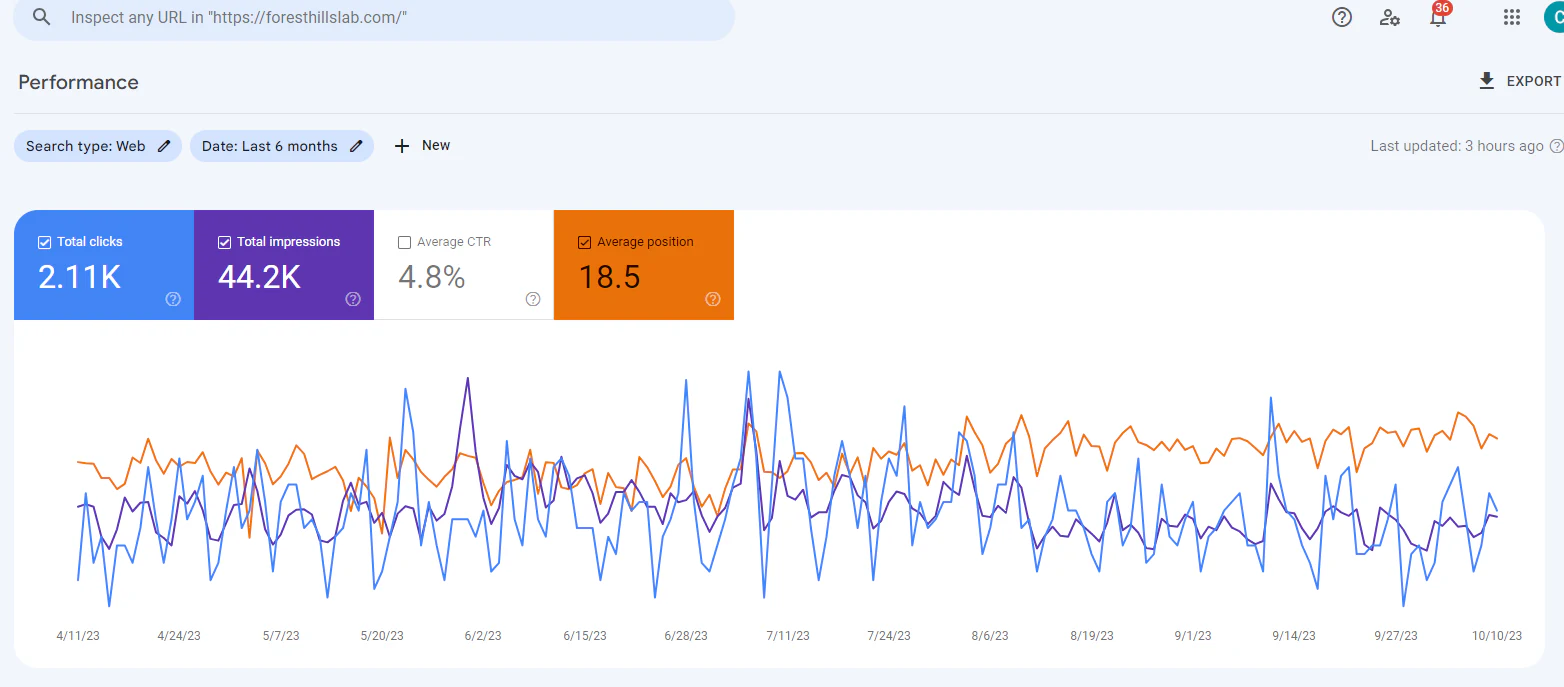
Google Search Console, foresthillslab.com, April to October 2023: 2.11K clicks, 44.2K impressions, 4.8% CTR, average position 18.5. The largest click count in our portfolio.
Renting vs Owning: Why the Curves Cross
The simplest way to see the difference is to put the two on a chart of cumulative clicks.
That chart is a model, not client data, and we label it that way. It shows $900 a month on ads at the average CPC, about 166 clicks a month, run for six months and then stopped, against an SEO campaign that starts at 50 clicks a month and builds to 400. Ads are ahead at month six. Once the budget stops, ads add nothing, while SEO keeps adding, and in this model it passes the ads total between month six and month nine. Where exactly the lines cross depends on your industry, your competition and how good the SEO work is, which is why we do not promise a month.
The real data shows the same shape. Naffees & Sons, a construction firm whose site we built, started its three-month Search Console window on a handful of clicks a day. By late October 2026, most days brought between about 10 and 25, with daily impressions up from around 100 to more than 700, and no link building and no ad spend behind it.
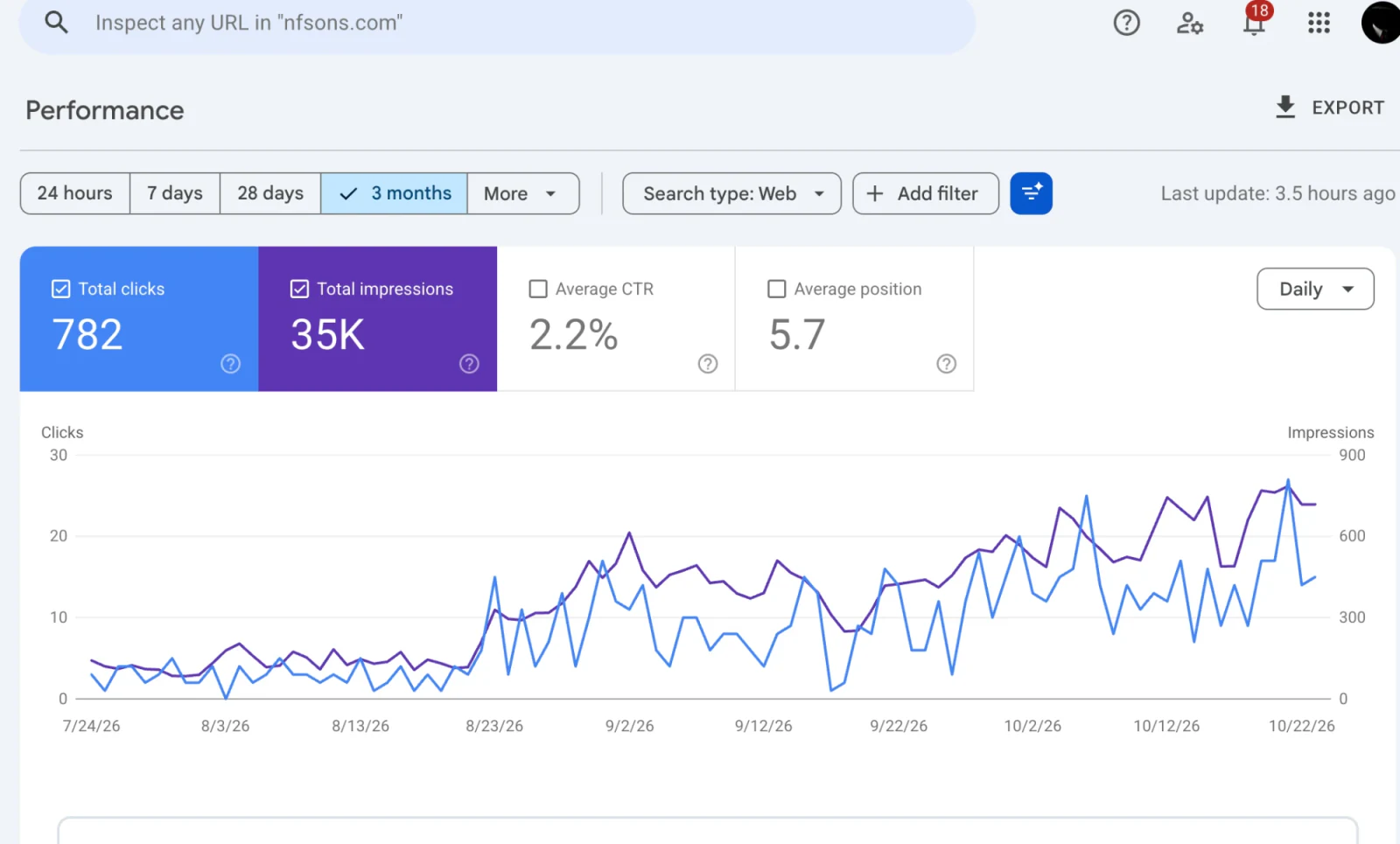
Google Search Console, nfsons.com, 24 July to 22 October 2026: 782 clicks, 35K impressions, 2.2% CTR, average position 5.7. On-page SEO and content only; no link building.
The Break-Even Point for an SEO Retainer
Here is the calculation most small businesses never see, using our own retainer price as the budget.
At $900 a month, Google Ads buys about 166 clicks at the $5.42 average, about 108 in home improvement at $8.33, and about 439 in restaurants at $2.05. That is the bar. An SEO campaign at the same monthly price is the cheaper source of traffic once it earns more organic clicks a month than those numbers, and it carries on earning after you stop paying.
Two things follow:
- In expensive industries, SEO wins sooner. A home improvement business needs only about 108 organic clicks a month to beat the ads equivalent. A law firm needs even fewer.
- In cheap industries, ads stay competitive for longer. A cafe needs about 440 organic clicks a month to beat the same budget spent on ads. The Hungry Pelican averaged about 480 a month in its first Search Console window, but a cafe running a short promotion is still better served by ads, as our Hungry Pelican case study says plainly.
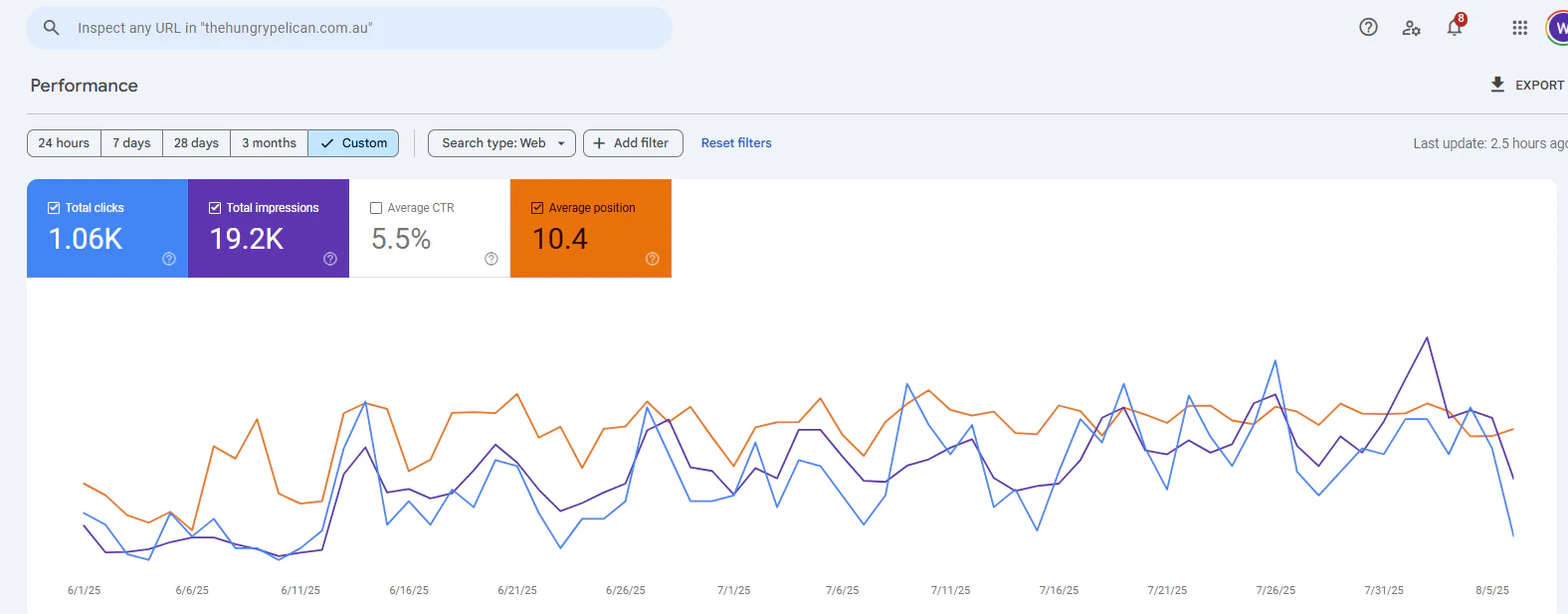
Google Search Console, thehungrypelican.com.au, 1 June to 5 August 2025: 1.06K clicks in 66 days, about 480 a month: above the roughly 440-click restaurant bar, and still rising.
Where Meta Ads Win, Where Google Ads Win, and Where SEO Wins
Google Ads is not the only paid option, and for some businesses it is not the best one. Facebook and Instagram ads (Meta ads) work differently, and being honest about the difference saves a lot of wasted budget.
Meta ads reach people who are not searching. They interrupt someone scrolling with something they did not know they wanted. That suits low-ticket, visual, impulse products: a $40 candle, a new snack, a gym's first-month offer, a Shopify store testing whether a product sells at all. Clicks are cheap. LocaliQ's Facebook benchmarks (updated 23 September 2026) put the average cost per click for traffic campaigns at $0.60, against $5.42 on Google search, and the average cost per lead at about $27. If you want to know within a week whether strangers will buy a product, Meta ads are usually the fastest and cheapest test.
Google Ads reaches people who are already searching. Someone typing "emergency plumber near me" or "container transport Karachi to Lahore" has a need right now. That suits urgent and local services and anything where the buyer knows what they want. The clicks cost more because the intent is higher.
SEO reaches people who research before they buy. A family choosing a builder for a house, a factory choosing a freight partner, a clinic choosing software: these are high-ticket, considered purchases where the buyer reads, compares and comes back several times. They trust businesses that answer their questions in detail, and they rarely buy from an ad they scrolled past. That is where an established business with years of real experience has an advantage, if that experience is written down where buyers can find it; see marketing an established business online.
| Channel | Best for | Typical ticket size | How fast | When you stop paying |
|---|---|---|---|---|
| Meta ads | Testing products, impulse and visual buys | Low | Days | Stops the same day |
| Google Ads | Urgent needs, people searching right now | Low to high | Same day | Stops the same day |
| SEO | Considered, high-ticket services and products | Medium to high | Months | Keeps working |
The honest rule: if you sell a low-priced product and want to know quickly whether it sells, start with Meta ads. If you sell an urgent local service, use Google Ads while SEO builds. If you sell a high-ticket service that people research, SEO is where most of your customers will eventually come from, and ads are the bridge, not the plan.
When Google Ads Is the Better Buy
Ads are the better choice when:
- You need customers this month. SEO will not deliver them in time.
- The offer is temporary. A seasonal sale, an event, a launch week.
- You are testing a message. Ads tell you within days which headline and audience convert. Put that learning into your pages.
- Clicks in your industry are cheap and competition for rankings is fierce. Sometimes buying is simply cheaper than earning.
- You have not confirmed anyone wants the product. Spend a small amount on ads to find out before investing months in SEO.
SEO is the better choice when you plan to be trading in two years, your industry's clicks are expensive, your buyers research before they buy, or you are tired of a monthly bill that resets to zero.
How AI Answers Change the Maths
Fewer searches end in a click than most people assume, and AI summaries push that further.
SparkToro's 2024 zero-click study found that only 360 of every 1,000 US Google searches send a click to the open web, and 58.5% end with no click at all. A Pew Research Center study of real browsing in March 2025 found people clicked a traditional result on 8% of visits when Google showed an AI summary, against 15% without one.
This is the contrarian point an SEO agency rarely prints: organic clicks for informational questions are shrinking. If your SEO plan is a blog that answers general questions, expect fewer clicks per ranking than you would have got three years ago.
It matters much less for the searches that make money. "Builder near me", "container transport Karachi", "cafe Hervey Bay" and "RF connector supplier" are local and commercial searches where people want a business, not a summary. Our best-performing client results are all in that category. And ads are affected too: when an AI summary takes the top of the page, ads compete for less attention as well.
If you need customers this month or the offer is temporary, use Google Ads. If you will be trading for years, invest in SEO, and if you need early customers too, run a small ads budget while SEO builds and reduce it as organic clicks pass the break-even point.
The Competitor Pulse Check
| Factor | ValueStreamAI approach | Ads-only agency | SEO-only agency |
|---|---|---|---|
| Recommends ads when they are the better buy | Yes, and says so in writing | Always | Rarely |
| Shows real Search Console data | Yes, for named clients | Ads dashboards only | Often rank charts |
| Builds the pages SEO needs | Yes, we build sites and apps | No | Asks for a developer |
| Prices the comparison | Break-even per industry | No | "Traffic value" with no caveats |
| Follow-up automation for the leads | Yes | No | No |
Human Hours vs Automation: Managing Ads by Hand
One cost people leave out of the ads side is the time it takes to run them. Here it is priced.
Assumptions: managing a small Google Ads account by hand (checking search terms, adding negative keywords, adjusting bids and budgets, pausing poor ads) takes about 2, 4 or 8 hours a week for light, typical and heavy accounts. As a floor for the hourly rate we use the US median for secretaries and administrative assistants, about $22.82 an hour (BLS, May 2024); a skilled ads manager costs several times more. With automated rules, reporting and alerts, we assume 30% of the time remains for a person, because ads still need human judgement.
| Volume | Hours by hand a year | Cost by hand (floor) | Human time with automation | Cost (floor) |
|---|---|---|---|---|
| 2 hours a week | 104 | ~$2,370 | ~31 hours | ~$710 |
| 4 hours a week | 208 | ~$4,750 | ~62 hours | ~$1,420 |
| 8 hours a week | 416 | ~$9,490 | ~125 hours | ~$2,850 |
The other side of the ledger: setting up automated reporting and rules is a small part of a marketing retainer from $900 a month, not a separate build. What it leaves out: the cost of mistakes. An untended ads account that keeps paying for irrelevant searches can waste more in a month than the time saved. Run your own figures in the hire vs automate calculator.
Frequently Asked Questions
Is SEO better than Google Ads for a small business?
For a small business that will be trading for years, SEO is usually cheaper per customer once it ramps, because organic clicks carry no per-click charge and keep coming after you stop paying. Google Ads is better for testing offers, launches, seasonal pushes and getting customers this month. Most small businesses do best with a small ads budget while SEO builds.
How much does Google Ads cost per click in 2026?
LocaliQ's 2026 benchmarks put the average at $5.42 across industries, from about $2.05 for restaurants to $9.87 for legal services. These are US averages; most other countries are cheaper, and individual campaigns vary widely.
How long does SEO take compared with Google Ads?
Google Ads can send traffic the day a campaign goes live. SEO usually takes four months to a year to show results, according to Google's own guidance. In our client data, sites we built reached average positions under 6 within three months, and a new cafe site went from 10 to 95 ranking keywords in about eleven weeks.
What is the break-even point between SEO and Google Ads?
Divide your monthly SEO budget by your industry's cost per click. At $900 a month and the $5.42 average, that is about 166 clicks. Once SEO earns more organic clicks than that each month, it is the cheaper source of traffic, and it keeps earning if you stop paying.
Do AI Overviews make SEO worthless?
No, but they reduce clicks on informational searches. Pew found people clicked a traditional result on 8% of visits when Google showed an AI summary, against 15% without. Local and commercial searches, where people want a business rather than an answer, are much less affected, and those are the searches that bring customers.
Should I use Meta ads or Google Ads?
It depends on what you sell. Meta ads (Facebook and Instagram) are best for low-ticket, visual products and for testing whether a product sells, with average traffic clicks around $0.60 in LocaliQ's 2026 data. Google Ads is better for urgent services people actively search for. For high-ticket services that buyers research, SEO usually brings most customers over time.
Should I stop Google Ads once SEO is working?
Reduce them rather than stop them outright. Keep the campaigns that still pay for themselves, such as your brand name if competitors bid on it, and seasonal offers. Cut the ones that buy clicks your organic pages now earn for free.
What's Next
If you are spending on Google Ads and wondering whether SEO would be cheaper, or doing neither and unsure where to start, we will run the break-even calculation for your industry on a free call and tell you which one to lead with.
→ See our SEO and digital marketing services
→ Read the full guide: build it and market it
→ How long does SEO take? What nine client sites show
→ See what building and marketing costs, or talk to us about your site
Syed Rayyan is co-founder of ValueStreamAI, leading research and marketing. He has run SEO for client websites since 2020, across technical audits, on-page work and link building, and leads the marketing side of every build. He also runs the firm's evaluation of emerging AI tooling and translates technical capability into clear guidance for non-technical decision-makers. Connect on LinkedIn →