Nobody searches "greek food near me" to read about Greek food. They are hungry, they are nearby, and they will choose somewhere to eat in the next hour. A restaurant that ranks first for that search is not winning traffic. It is winning tables.
This guide covers restaurant SEO for independent restaurants and cafes: what Google says it ranks local results on, what to fix first, how to stop delivery apps outranking you for your own name, and whether it is worth it when restaurant ad clicks are cheap. It uses unedited Search Console data from two food businesses we have worked with: a Greek restaurant in Toronto that ranked at position 1 for "greek food near me", and a Queensland cafe that went from 10 to 95 ranking keywords in eleven weeks.
| Metric | 2026 Benchmark |
|---|---|
| Google's local ranking factors (Google) | Relevance, distance, prominence |
| Can you pay for a better local ranking? (Google) | No |
| Average Google Ads cost per click, restaurants (LocaliQ, 2026) | $2.05 |
| Souvlaki Place, "greek food near me" | Position 1, 14.1% CTR site-wide |
| The Hungry Pelican, ranking keywords in 11 weeks | 10 to 95 |
The short answer. Google ranks local results on relevance, distance and prominence, and says you cannot pay for a better local ranking. For a restaurant, that means: make your own site rank first for your name, state one location identically everywhere, use the words people search (cuisine, meal, neighbourhood), make the menu, hours and ordering easy on a phone, and build reviews and a few relevant local links. Restaurant ads are cheap, at about $2.05 a click, so SEO's value is showing up first every day without a budget, and keeping customers off commission-taking platforms.
Key takeaways
- Google ranks local results on relevance, distance and prominence. You control relevance and prominence.
- Own your name first. Many restaurants lose name searches to delivery apps and directories.
- Use the neighbourhood's own words. People searched "queensway" and "etobicoke", not only "Toronto".
- Small numbers are normal. A few hundred impressions for "near me" searches is a strong result for one location.
- Ads are cheap for restaurants. SEO wins on consistency and ownership, not on cost alone.
Why Restaurant SEO Is Different
The answer is intent and geography. Restaurant searches are made by people close by who are about to decide, and Google only shows local results to people near enough to visit.
That has two consequences. First, the volumes are small: one location will never get the search traffic of an online store, and it does not need to. Second, almost every search is a buying search. Someone typing "brunch Pialba" or "souvlaki near me" is not researching.
Google is unusually open about how it ranks these results. Its Business Profile help page says local results are mainly based on three things:
- Relevance: how well your profile and site match what someone searched.
- Distance: how far you are from the person searching. You cannot change this.
- Prominence: how well known the business is, which Google reads from reviews, links, articles and listings across the web.
Google also states plainly: "There's no way to request or pay for a better local ranking on Google." Relevance and prominence are where the work goes.
What It Looks Like When It Works: Souvlaki Place
Souvlaki Place is a Greek restaurant on The Queensway in Etobicoke, in Toronto's west end. Over six months in 2023 its site ranked at position 1 for "greek food near me", "greek near me" and "food near me".
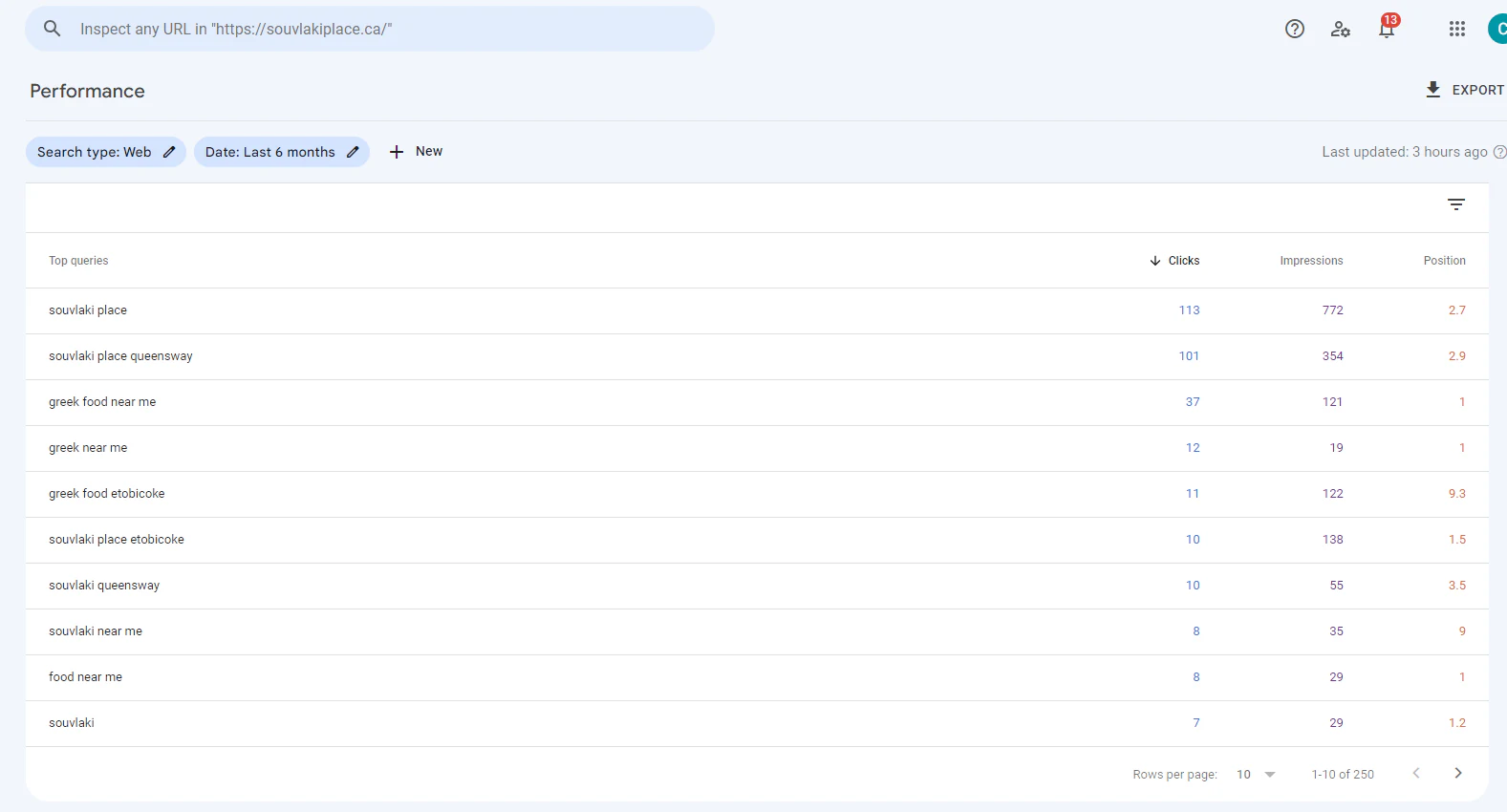
Google Search Console top queries, souvlakiplace.ca, April to October 2023. Position 1 for "greek food near me", "greek near me" and "food near me".
- 1souvlaki placeposition 2.70
- 2souvlaki place queenswayposition 2.90
- 3greek food near meposition 10
- 4greek near meposition 10
- 5greek food etobicokeposition 9.30
- 6food near meposition 10
Two things stand out. Most clicks came from name searches: "souvlaki place", "souvlaki place queensway", "souvlaki place etobicoke". These people already knew the restaurant and wanted the menu or the address, and the restaurant's own site, not a delivery app, answered them. And the near-me searches ranked first. "greek food near me" turned 121 impressions into 37 clicks, about 31%.
Across 250 queries, the site's click-through rate was 14.1%, several times what most business sites see. The full analysis is in the Souvlaki Place case study.
What It Looks Like From Zero: The Hungry Pelican
The Hungry Pelican is a cafe on the Esplanade at Pialba in Hervey Bay, Queensland, with a five-page website. In May 2025 Semrush showed no Authority Score, 10 ranking keywords and no backlinks.
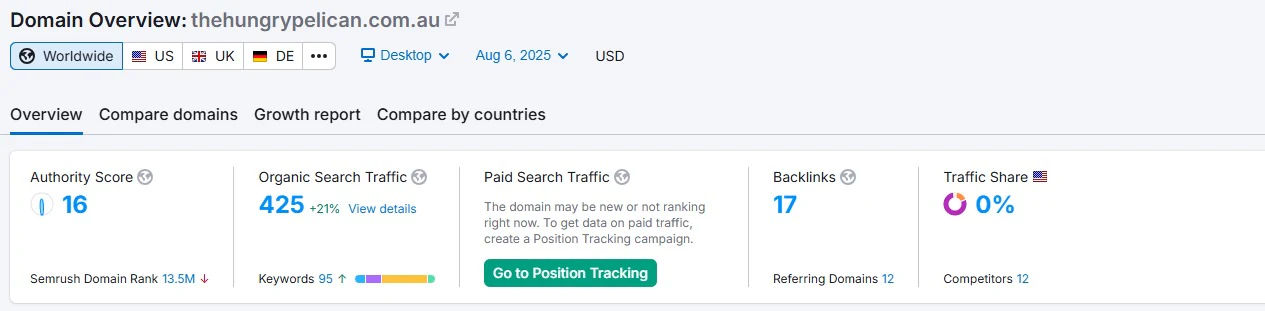
Semrush, thehungrypelican.com.au, 6 August 2025: 95 keywords (10 in May), Authority Score 16 (unrated in May), 17 backlinks from 12 referring domains.
By 6 August 2025, after on-page work on the five pages and local link building, it had 95 ranking keywords, an Authority Score of 16 and 17 backlinks from 12 domains. Search Console recorded 1,060 clicks between 1 June and 5 August. That is prominence being built: a small number of relevant local links telling Google the cafe is known in its area. Full story: The Hungry Pelican case study.
Restaurant SEO, Step by Step
- 01Own your name
Your site, not a delivery app or directory, should rank first when people search your restaurant's name.
- 02One location, stated the same everywhere
Name, address and phone identical on the site, Google Business Profile and listings.
- 03Pages for how people search
Cuisine, meal and neighbourhood words: breakfast, brunch, Greek, the street, the suburb.
- 04The hungry person's questions
Menu, hours, address and ordering, readable on a phone in seconds.
- 05Local prominence
Reviews and a handful of relevant local links and listings.
1. Own your own name
Search your restaurant's name. If a delivery app, a directory or a review site ranks above your own website, you are sending your most loyal customers through a platform that charges you for them. Your site should state your restaurant's name clearly in its title and headings, load quickly on a phone, and be linked from your Google Business Profile.
2. One location, stated the same way everywhere
Name, street address and phone number, written identically on your website, your Google Business Profile, and every listing. Inconsistencies make it harder for Google to be confident which business is which.
3. Use the words people actually search
Look at the Souvlaki Place queries: "queensway", "etobicoke", "greek", "souvlaki", "near me". People search by cuisine, by dish, by meal (breakfast, brunch), and by neighbourhood or street, not only by city. Put those words on your pages naturally, especially in titles and headings. The Hungry Pelican's site title today reads "Hervey Bay Cafe | The Hungry Pelican, Pialba QLD": place, type and name in one line.
4. Answer the hungry person's questions in seconds
Menu, opening hours, address, phone and how to order or book, all readable on a phone without hunting. A menu as a photographed PDF is hard for both people and search engines to read; a menu as text on a page is easy for both.
A profile on its own is not the whole job; we explain why in is a Google Business Profile enough?
5. Build local prominence
Reviews on your Google Business Profile, and a handful of relevant local links: local directories, tourism and what's-on sites, local press, suppliers and neighbouring businesses. The Hungry Pelican moved from unrated to an Authority Score of 16 with twelve referring domains. Relevance beats volume.
Google ranks local restaurant results on relevance, distance and prominence. Distance is fixed. Relevance improves with the right words on the site and profile and a consistent location. Prominence improves with reviews and relevant local links. Both lead to a higher local ranking, which cannot be bought.
Is Restaurant SEO Worth It When Ads Are Cheap?
Restaurant search ads are among the cheapest of any industry. LocaliQ's 2026 benchmarks put the average cost per click for restaurants and food at $2.05, against $5.42 across all industries.
So be honest about the maths. The Hungry Pelican's 1,060 clicks in 66 days would have cost about $2,170 at that rate, and Souvlaki Place's 538 clicks over six months about $1,100, and many of those were name searches a restaurant would rarely pay for. For a short promotion, ads are a reasonable buy. We work through the break-even in SEO vs Google Ads.
The case for restaurant SEO is not cheaper clicks. It is three other things:
- You appear first every day, at lunch on a Tuesday and on a public holiday, without a budget deciding whether you show.
- You keep the customer. Ranking first for your own name keeps people on your site rather than on a platform that takes a commission on the order.
- It lasts. The rankings and links built in a campaign keep working after it ends.
What to Measure Each Month
Restaurant search numbers are small, so measure the right ones or the trend will be lost in the noise.
Name searches versus discovery searches. In Google Search Console, open the queries report and split it in two: searches that contain your restaurant's name, and everything else. Name searches tell you whether you own your brand; discovery searches ("brunch near me", the cuisine, the suburb) tell you whether you are winning new customers. Souvlaki Place's split was about 224 clicks from name searches and 93 from discovery searches in its top ten queries over six months.
Position for the three or four searches that matter. "Your cuisine near me", "your cuisine plus your suburb", "your meal plus your suburb". For a single location these will have small impressions, so look at position and whether it holds month to month.
Click-through rate. A rising click-through rate on the same searches usually means your title and description are doing their job. Souvlaki Place averaged 14.1%.
Google Business Profile actions. Calls, direction requests and website clicks from your profile show what local search is producing beyond your website.
Enquiries and bookings. The only number that pays the rent. If search traffic rises and bookings do not, look at the menu, hours and booking path on a phone.
The Competitor Pulse Check
| Factor | ValueStreamAI approach | Delivery app listing | Restaurant website template |
|---|---|---|---|
| Who owns the customer | You | The platform | You, if anyone finds the site |
| Ranks for your own name | Your site, first | Often above your site | Not by default |
| Near-me and neighbourhood searches | Built into the pages | Platform's algorithm | Rarely |
| Cost per order | None | Commission | None |
| Proof | Search Console data from named restaurants | Platform dashboards | None |
Human Hours vs Automation: Answering Booking and Order Enquiries
Better visibility brings more calls, messages and booking requests. Here is the cost of answering them by hand.
Assumptions: about 4 minutes per enquiry (a booking request, a question about hours or the menu, a large-order enquiry) to read and answer by phone, message or email. Light, typical and busy volumes of 50, 150 and 300 a week, over 52 weeks. Hourly rate: the US median for secretaries and administrative assistants, about $22.82 an hour (BLS, May 2024), base pay only. With automated replies for routine questions and online booking, we assume 20% of the time remains for the enquiries that need a person.
| Volume | Hours by hand a year | Cost by hand | Human time with automation | Cost with automation |
|---|---|---|---|---|
| 50 a week | ~173 | ~$3,960 | ~35 hours | ~$790 |
| 150 a week | ~520 | ~$11,870 | ~104 hours | ~$2,370 |
| 300 a week | ~1,040 | ~$23,730 | ~208 hours | ~$4,750 |
The other side of the ledger: a booking and reply automation starts from $5,000. For a single small cafe at 50 enquiries a week, it would take over a year to pay back on hours, and a booking widget may be all you need. For a busy restaurant or a group, it pays back far sooner. What it leaves out: the bookings lost when the phone rings during service and nobody answers. Run your own figures in the hire vs automate calculator.
Frequently Asked Questions
How do restaurants rank for "food near me"?
Google ranks local results on relevance, distance and prominence. A restaurant improves relevance with the right words on its site and Google Business Profile (cuisine, meal, neighbourhood) and a consistent location, and prominence with reviews and relevant local links. Souvlaki Place ranked at position 1 for "food near me" and "greek food near me".
Can I pay Google for a better local ranking?
No. Google states there is no way to request or pay for a better local ranking. You can buy ads, which appear separately and are labelled as sponsored, but the local results themselves are earned.
How long does restaurant SEO take?
Often weeks to a few months, because the market is local. The Hungry Pelican, a cafe in Hervey Bay, went from 10 to 95 ranking keywords in about eleven weeks. A restaurant in a busy city centre with many competitors will take longer.
Why does a delivery app rank above my restaurant for my own name?
Delivery apps and directories have very strong domains and a page for almost every restaurant. If your own site does not state your name clearly, load fast and link from your Google Business Profile, they can outrank you. Fixing that keeps your regular customers on your site instead of a commission-taking platform.
Is SEO worth it for a single cafe?
Usually, if it is done in proportion. Restaurant ad clicks average about $2.05, so a big SEO retainer may not pay for itself for one small cafe. A focused campaign, like The Hungry Pelican's on-page work and local links, can make the cafe the first result in its area for years.
Should my menu be a PDF?
Ideally not as the only version. A menu written as text on a web page is readable on any phone and by search engines, which helps you appear for dishes people search for. Keep a PDF for printing if you like, but put the menu on a page too.
What's Next
If your restaurant or cafe does not rank first for its own name, or does not appear for "near me" searches in your neighbourhood, start with a free look at where you stand. We will tell you what to fix first, and if ads would be the better buy for now.
→ See our SEO and digital marketing services
→ Read the Souvlaki Place case study
→ Read the full guide: build it and market it
→ See what building and marketing costs, or talk to us about your site
Syed Rayyan is co-founder of ValueStreamAI, leading research and marketing. He has run SEO for client websites since 2020, across technical audits, on-page work and link building, and leads the marketing side of every build. He also runs the firm's evaluation of emerging AI tooling and translates technical capability into clear guidance for non-technical decision-makers. Connect on LinkedIn →