Medicare pays for medical equipment and supplies with a higher error rate than almost anything else it buys. CMS's 2025 error rate testing put improper payments for durable medical equipment, prosthetics, orthotics and supplies at 24.1%, against 6.6% for Medicare fee-for-service as a whole. DME documentation compliance automation exists to close that gap at the cheapest possible moment: after the order arrives and before the claim goes out.
The important word in that statistic is "improper", not "fraudulent". MedPAC's June 2026 report found that documentation deficiencies caused 68% of all improper payments across Medicare fee-for-service. For equipment suppliers that usually means an order missing an element, notes that do not support the item, or a delivery record nobody signed.
This guide is for owners and billing managers at small and mid-size DME and HME suppliers, and the billing companies that serve them. It covers exactly which documents Medicare expects, how an automated pre-bill check works, where it fits next to your billing software, and what it costs.
The short answer: DME documentation compliance automation reads every order, set of notes and proof of delivery for a claim, checks them against Medicare's published documentation list and your commercial payers' rules, and holds back any claim that fails, with the reason, for a person to fix. It does not submit anything. A pilot covering your highest-volume product lines runs $5,000 to $15,000.
Key takeaways
- Equipment and supplies ran a 24.1% Medicare improper payment rate in CMS's 2025 report, the first rise since 2015.
- Documentation, not fraud, drives most of it: 68% of improper Medicare fee-for-service payments came from documentation deficiencies, per MedPAC.
- Medicare publishes the checklist. The required elements for an order and a proof of delivery are written down in CMS article A55426, which makes them ideal for automated checks.
- The check that matters most is consistency: the order, notes and delivery record must agree with each other, not just exist.
- The system holds claims back; people fix them. Nothing is billed automatically.
| Metric | 2026 Benchmark |
|---|---|
| Improper payment rate, DME and supplies | 24.1% (CMS CERT 2025, claims July 2023 to June 2024) |
| Same rate, fiscal 2025 | 24.2% (MedPAC, June 2026) |
| Overall Medicare fee-for-service rate | 6.6% (MedPAC, fiscal 2025) |
| Improper payments caused by documentation deficiencies | 68% (MedPAC, June 2026) |
| How long suppliers must keep proof of delivery | 7 years from date of service (CMS article A55426) |
CMS 2025 CERT report, claims July 2023 to June 2024. The first increase since 2015. MedPAC's June 2026 report gives 24.2% for fiscal 2025.
MedPAC, fiscal 2025. Equipment and supplies run at several times the program-wide rate.
Across all of Medicare fee-for-service, per MedPAC. Most improper payments are paperwork failures, not fraud.
Why DME Documentation Compliance Automation Pays Off
DME documentation compliance automation pays off because Medicare equipment claims fail on a short, published list of documentation requirements, and checking that list by hand on every order is exactly the repetitive, error-prone work people do badly at volume.
The numbers come from two primary sources. CMS's 2025 Comprehensive Error Rate Testing report found a 24.1% improper payment rate for equipment and supplies on claims from July 2023 to June 2024, the first increase since 2015, as reported by O&P EDGE. MedPAC's June 2026 report to Congress put the fiscal 2025 rate at 24.2%, against 6.6% for Medicare fee-for-service overall, and found documentation deficiencies behind 68% of all improper fee-for-service payments, according to Mobility Management.
Medicare's contractors have started reacting. In February 2026, CGS, the equipment contractor for Jurisdictions B and C, announced pre-payment medical record review of urological supply claims from new suppliers, noting the category continues to rank high in error rate testing. A March 2026 announcement extended pre-payment review for new suppliers to six more groups, including orthotics, CPAP, surgical dressings, glucose monitors, diabetic shoes and ostomy supplies. Pre-payment review means claims are held until the paperwork is examined. A supplier whose paperwork is already checked before billing is in a much stronger position when that happens.
What Medicare Actually Requires: The Published Checklist
The best thing about Medicare equipment documentation is that it is written down. CMS's Standard Documentation Requirements article (A55426) lists the elements. Every one of them can be checked automatically.
The standard written order
A standard written order must contain:
- The patient's name or Medicare Beneficiary Identifier
- The order date
- A general description of the item
- The quantity to be dispensed, if applicable
- The treating practitioner's name or NPI
- The treating practitioner's signature
The order must reach the supplier before the claim is submitted. Some items need it before delivery, plus a face-to-face visit within the six months before the order, according to CGS's order guidance. CGS also notes stamped signatures are not typically acceptable.
Proof of delivery
For delivery straight to the patient, proof of delivery must be a signed and dated document showing the patient's name, the delivery address, a description of the items, the quantity delivered, the date delivered and the patient's (or designee's) signature. For shipped items, it must link your records to the carrier's, for example through a tracking number, and include evidence of delivery. Suppliers must keep it for 7 years from the date of service.
Medical records
The patient's record must contain enough about their condition to support the type and quantity of items ordered. For continued need, the documentation must be timely, which CMS defines as a record from the preceding 12 months unless a specific policy says otherwise.
Refills
A routine prescription for refills is not needed, but the refill request must be documented before shipment, with the patient's name, each item requested, their confirmation that they need it, and the date. CMS states that an attestation written afterwards is not sufficient.
Your commercial and Medicaid payers have their own versions of these lists. A good system holds each payer's checklist separately.
How an Automated Pre-Bill Check Works
An automated pre-bill check runs once per claim, just before billing, and looks at every document behind it together.
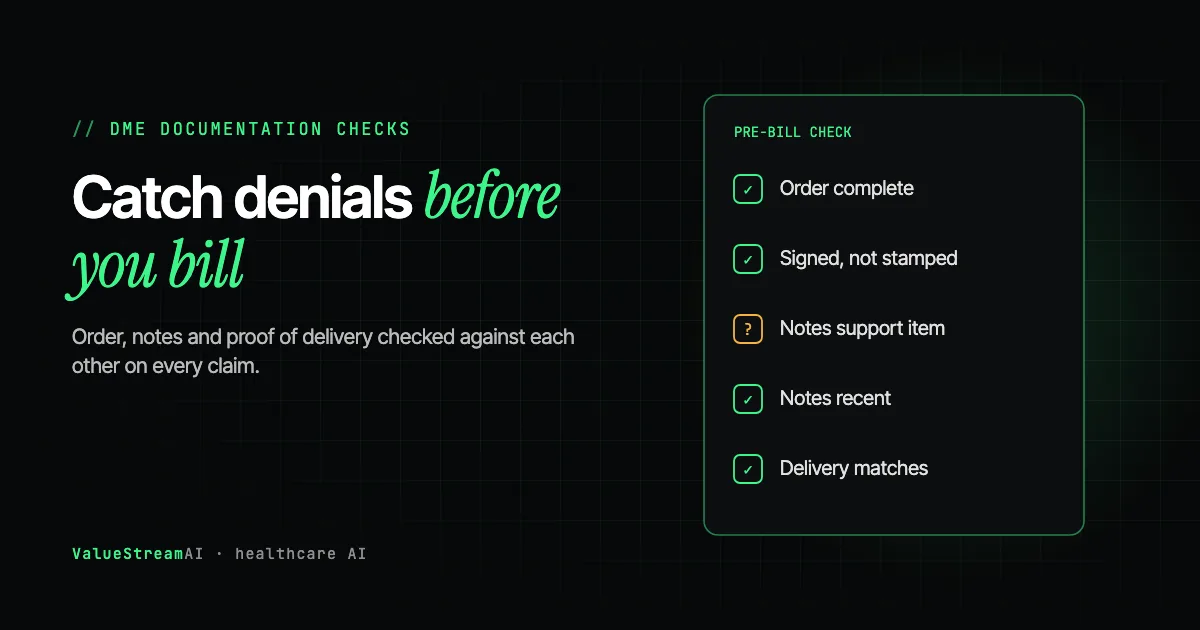
For each claim ready to bill, the system gathers the order, the medical notes and the proof of delivery, and reads each one. It checks that the order has every required element, the notes support the item and are recent enough, and the proof of delivery is signed, dated and matches the order. If every check passes the claim is released to billing. If any check fails, the claim is held with the reason and the page, and a person fixes it.
Step 1: gather. The system pulls every document for the claim from your billing system and document store: the order, the notes, the delivery record, any refill request.
Step 2: read. An AI model reads each document and pulls out the fields: names, dates, item descriptions, quantities, signatures, NPI. This is the commodity part. Any modern model does it well, including on scans and handwriting.
Step 3: check. Plain code compares the fields against the checklist and against each other. This is where the value is. The checks that catch the most are not "is there an order" but "do the documents agree":
- Does the order date fall before the delivery date?
- Does the quantity delivered match the quantity ordered?
- Is the patient's name the same on all three documents?
- Is the latest supporting note within 12 months of the date of service?
- Does the item on the delivery record match the item on the order?
Step 4: hold or release. Claims that pass go to billing. Claims that fail are held, with the specific failure and the page it was found on, in a queue your billing team works through.
The reason the checks live in code rather than in the AI model is simple. A model is excellent at reading a date and unreliable at reasoning about whether one date is 12 months before another. Code is the opposite. We have watched models return confident, well-formatted answers that were wrong on exactly this kind of comparison, so the model reads and the code decides.
Intake Check or Pre-Bill Check? You Want Both
There are two good moments to check documentation, and they catch different things.
| Moment | What it catches | What it cannot catch yet |
|---|---|---|
| At intake, when the order arrives | Missing order elements, missing signature, missing face-to-face note | Delivery problems, because delivery has not happened |
| Before billing | Everything, including delivery record and consistency across all documents | Nothing, but fixing a problem here can mean going back to a prescriber after delivery |
Intake checks are cheaper per problem, because the fix is a fax back to the prescriber before anything ships. Pre-bill checks are complete. The fax referral intake automation guide covers the intake half; most suppliers start with whichever one is closest to their worst denial reason.
Where It Fits With Your Billing Software
Most equipment suppliers run Brightree, NikoHealth or a similar billing system, and many of those systems have their own claim scrubbing. A claim scrubber checks the claim: codes, modifiers, formatting. It generally does not read the scanned order and delivery record behind the claim and check they agree. That is the gap a documentation check fills.
Before any build, settle three things:
- What your billing system already checks. Switch on anything you are paying for and not using. A custom build should only cover the gap.
- Which failures hold a claim and which only warn. Agree this with your billing lead before anything is built. A missing signature should hold the claim; a note that is eleven months old might only warn. The most frustrating feedback we hear after a launch is "it is working as designed, but it is not what we wanted", and it almost always traces back to this conversation not happening in week one.
- How documents are stored. If orders and delivery records are attached in the billing system and it has an API, the check can read them directly. If they live in a shared drive or a fax archive, part of the work is connecting that store. This is the step owners most often underestimate. In our experience the project is rarely slowed by the AI; it is slowed by discovering in week three that a key system has no way to get documents out.
The Competitor Pulse Check
| Factor | ValueStreamAI pre-bill checks | Billing system claim scrubber | Outsourced audit service | Manual review |
|---|---|---|---|---|
| Reads scanned orders and delivery records | Yes | Usually no | Yes, by people | Yes |
| Checks documents agree with each other | Yes, in code | Rarely | Yes | If time allows |
| Runs on every claim | Yes | Yes | Usually a sample | Rarely |
| Your payers' rules | Written for your payers | Vendor rules | Auditor's knowledge | Staff memory |
| Cost model | Fixed build plus maintenance | Included in subscription | Per audit or per claim | Staff time |
| Who owns the rules | You | Vendor | Auditor | Staff |
An outsourced audit service is genuinely the right choice for some suppliers, especially before a known audit. Automated checks are better at catching problems on every claim, every day.
Human Hours vs Automation: Pre-Bill Documentation Checks
The assumptions (our estimate, replace with yours).
- Unit of work: one claim's documentation (order, notes, delivery record).
- Staff alone: 10 minutes to open each document, check the elements, compare them and note any gap.
- Staff with AI: 1.5 minutes for a person to confirm a released claim on a spot-check basis and to work held claims.
- Rate: US median wage for medical records specialists, $24.59 an hour (BLS, May 2025). Base pay, not loaded cost.
That is about $4.10 of staff time per claim when staff work alone, against about $0.61 when they work with AI.
What your billing team still does. Works every held claim: calls the prescriber for a missing signature, gets a delivery ticket re-signed, decides whether a note truly supports the item. Spot-checks a sample of released claims each week to confirm the checks are not letting problems through. And owns the rule list, because only your team knows when a payer has started behaving differently from its written policy. The AI does the reading and the comparing; the judgement and the release to billing stay with people.
| Volume | Staff alone: hours a year | Staff alone: cost | Staff with AI: hours a year | Staff with AI: cost |
|---|---|---|---|---|
| 200 orders a month | 400 | $9,836 | 60 | $1,475 |
| 1,000 orders a month | 2,000 | $49,180 | 300 | $7,377 |
| 5,000 orders a month | 10,000 | $245,900 | 1,500 | $36,885 |
The other side of the ledger. A pilot on your highest-volume product lines is $5,000 to $15,000; a full pre-bill workflow is $15,000 to $40,000, plus running costs and maintenance as payer rules change.
What the numbers leave out, and it is the bigger number. Many suppliers do not check every claim by hand today, so the honest comparison is often not "hours saved" but "claims that were never checked, now checked". The value is in the denials and recoupments that do not happen. We cannot price that without your own denial data, but at a 24.1% category error rate it is usually larger than the staff time.
Run your own figures in the hire vs automate calculator or put a yearly figure on it with the AI automation ROI calculator, or see sample documents priced both ways in what medical billing automation costs per document.
What DME Documentation Compliance Automation Costs
DME documentation compliance automation costs $5,000 to $15,000 for a pilot on two or three product lines and $15,000 to $40,000 for a full pre-bill workflow with commercial payer rules. These are our published prices as of October 2026.
Your two or three highest-volume product lines, checked against Medicare rules, run beside your billing team.
- Order and delivery checks
- Accuracy report on your own orders
Every order checked before billing, with commercial payer rules and an exception queue.
- Payer-specific checklists
- Audit pack per claim
For billing companies running pre-bill checks for many suppliers.
- Per-client rule sets
- Separated data
See our pricing, estimate your project with the automation quote tool, or read about our healthcare AI development service. If your documents arrive through a system with no export or API, the legacy EHR extraction case study shows how we get records out anyway.
Risks and Limits
- A check is only as good as its rule. Payer policies change. Someone has to own the rule library, which is why a payer policy knowledge base pairs well with this work.
- The system cannot judge clinical necessity. It can check that a note exists, is recent and mentions the condition. Whether the note truly supports the item is a judgement for a qualified person.
- Do not let it bill. Keep release to billing a human action, at least until months of parallel results justify anything else.
- Patient data rules apply. Anyone whose system handles the documents needs a business associate agreement, or the reading model can run on a server you control.
Frequently Asked Questions
What is DME documentation compliance automation?
DME documentation compliance automation is software that reads the order, medical notes and proof of delivery behind each equipment claim, checks them against Medicare and payer documentation rules and against each other, and holds any claim that fails for a person to fix before billing.
What documents does Medicare require for a DME claim?
A standard written order with six elements, medical records that support the item and quantity, proof of delivery that is signed and dated, and for refills a documented request before shipment. CMS lists these in its Standard Documentation Requirements article, A55426.
Why is the DME improper payment rate so high?
CMS's 2025 testing found 24.1% for equipment and supplies. MedPAC found documentation deficiencies behind 68% of improper Medicare fee-for-service payments, so most of the problem is incomplete or inconsistent paperwork rather than fraud.
Does my billing software's claim scrubber already do this?
Usually only partly. Claim scrubbers check the claim's codes and format; most do not read the scanned order and delivery record and check they agree. Check what yours does before buying anything new.
How much does a pre-bill documentation check cost?
A pilot costs $5,000 to $15,000 and a full workflow $15,000 to $40,000, based on our published pricing, plus running costs and maintenance.
Can automation decide if a claim is medically necessary?
No. It can confirm that a supporting note exists, is recent and names the condition. Whether it truly supports the item is a decision for a qualified person.
What's Next
Send us 50 claims' worth of documents with patient details removed, or let us use synthetic ones, and we will show you which would have been held, why, and what the checks would cost at your volume.
This post is part of our guide to revenue cycle automation for small practices. Related: fax referral intake automation, prior authorization automation, and our deep dive on why checking documents against each other beats reading them.
Muhammad Kashif is co-founder of ValueStreamAI, leading technical delivery and AI strategy. He designs and ships custom agentic AI and healthcare automation systems for clients across the US and UK. More about Muhammad Kashif →