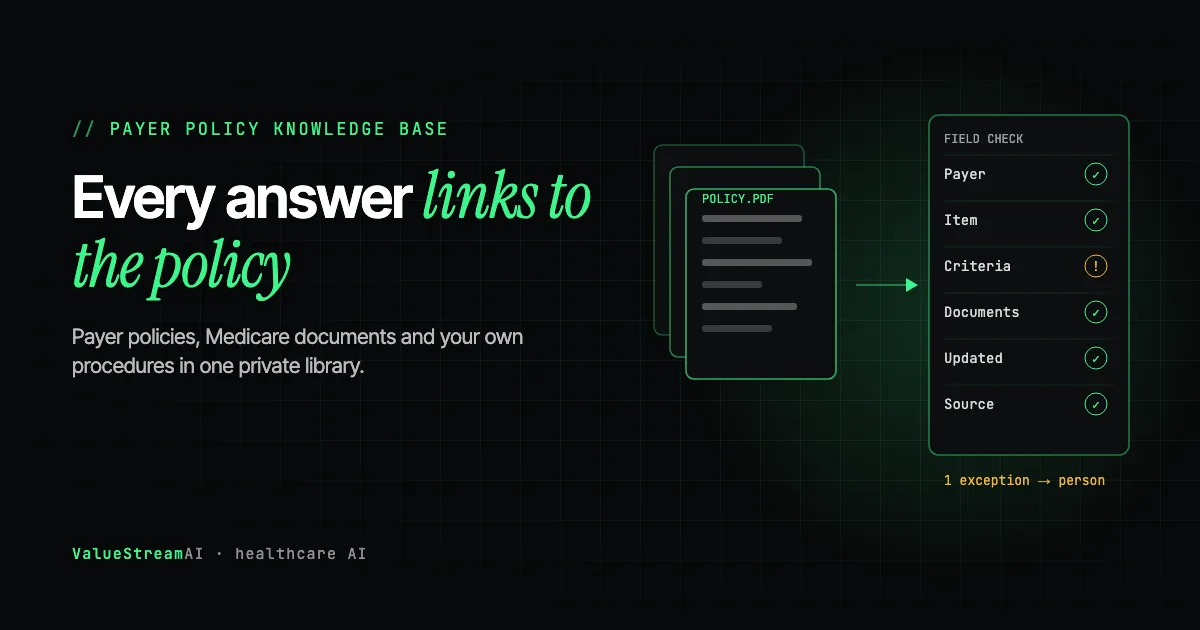
Ask a billing team where a payer's rule lives and you will usually get three answers: "in the policy PDF somewhere", "in the spreadsheet Maria keeps", and "ask Maria". A payer policy knowledge base replaces all three with one place to ask. A team member types a question in plain English, such as "Does this payer need prior authorization for this item, and what notes do they want?", and gets an answer drawn from the current policy text, with a link to the exact paragraph it came from.
This guide is for billing managers and owners at small practices, equipment suppliers and billing companies. It covers what goes into a policy knowledge base, why the AI subscription you may already pay for cannot do this, how to keep it current, and what it costs.
The short answer: A payer policy knowledge base is a private, searchable library of the payer policies, Medicare coverage documents, internal procedures and past appeal outcomes your team relies on. It answers questions in plain English, always links to the source paragraph, says when it cannot find an answer, and supplies the current rule to your automated intake, prior authorization and pre-bill checks. A first version typically costs $5,000 to $15,000.
Key takeaways
- Most denials trace back to a rule someone did not know or forgot. Missing or inaccurate data was the top denial cause for 50% of providers in Experian Health's 2025 survey.
- A general AI chat subscription does not know your payers' current policies. It knows what was in its training data, which may be out of date and is never your own procedures.
- Every answer must cite its source. An answer without a link to the policy paragraph should not be trusted for billing.
- The knowledge base is the foundation for every other automation. Intake checks, prior authorization packets and appeals all need the current rule.
- It can run entirely on your own server, with open models, so patient and business data never leave your control.
| Metric | 2026 Benchmark |
|---|---|
| Top denial cause: missing or inaccurate data | 50% of providers (Experian Health, 2025) |
| Providers saying clean claims are harder than a year ago | 68% (Experian Health, 2025) |
| How often the standard denial reason code list is updated | Three times a year (CMS) |
| Medicare coverage policies | Published free in the CMS Medicare Coverage Database |
Why a Payer Policy Knowledge Base Matters
A payer policy knowledge base matters because every billing decision depends on a rule, and in most small billing teams those rules live in people's heads. When the person who knows leaves, goes on holiday or is simply busy, the rule goes with them.
The rules also move. Medicare publishes its coverage policies, including Local Coverage Determinations and their billing articles, in the free Medicare Coverage Database, and they are revised regularly. The standard denial reason code list is updated three times a year, according to CMS. Commercial payers publish their own medical and coverage policies on their websites and change them on their own schedules.
Experian Health's State of Claims 2025 survey found that 68% of providers say clean claims are harder to submit than a year earlier, and missing or inaccurate data was the top denial cause. A team working from last year's version of a policy produces exactly that kind of denial.
Why Your AI Subscription Cannot Do This
Many practices now pay for ChatGPT, Claude or Copilot and reasonably assume it can answer policy questions. It cannot, for a simple reason: the subscription bought you a very good reader, not a library.
A general AI tool knows what was in its training data. It has never seen your payers' current policies, your internal procedures, the note your team wrote about how one payer treats a particular item, or the outcomes of your past appeals. Ask it a specific coverage question and it will produce a fluent answer that may be out of date, may be about a different payer, and will not tell you which.
The missing piece is unglamorous. Someone has to collect the policies and documents from wherever they live, put them into a consistent shape, and load them somewhere the AI can search. That collection work, not the AI model, is most of the job. It is also why, in our experience, internal AI projects stall: the licence is bought, nobody builds the library, and the tool is quietly abandoned. Our post on AI knowledge management covers the general version of this problem.
What Goes Into a Payer Policy Knowledge Base
A useful policy knowledge base for a small billing team holds four kinds of material.
1. Medicare coverage documents. National and Local Coverage Determinations and their billing articles from the Medicare Coverage Database, plus documentation requirements such as the CMS Standard Documentation Requirements article for equipment suppliers.
2. Commercial and Medicaid payer policies. The medical policies, prior authorization lists and billing guidelines each payer publishes for the services and items you bill.
3. Your own procedures and payer notes. The internal procedures, checklists, and the hard-won notes your team keeps about how each payer actually behaves. This is usually the most valuable material and the least organised.
4. Past appeal outcomes. Which appeals won, which lost, and what evidence made the difference. Over time this becomes the best guide to what a payer will accept.
How It Answers a Question
The knowledge base works in three steps, and the third is what makes it safe for billing.
Step 1: find. When a team member asks a question, the system searches the library for the passages most likely to contain the answer. Modern search finds passages by meaning, not just matching words, so "does the CPAP need a sleep study" finds a policy paragraph about "polysomnography" even though the words differ.
Step 2: answer. An AI model reads only the passages it found and writes a short answer in plain English.
Step 3: cite or decline. Every answer links to the exact paragraphs it relied on, with the policy name and its last update date. If the search found nothing relevant, the system says so plainly rather than guessing.
A billing team member asks a question. The system searches the library of payer policies, Medicare documents, internal procedures and appeal outcomes for relevant passages. If relevant passages are found, the AI writes a short answer using only those passages and links each point to its source paragraph and update date. If nothing relevant is found, the system says it could not find an answer and suggests who to ask.
The "say so" branch is not a nice-to-have. A billing answer that sounds confident and is wrong costs a denial. A system that admits it does not know costs a phone call. We design every knowledge base to prefer the phone call.
That branch is also the quickest way to judge any knowledge base a vendor shows you. Ask what it does when it cannot find a relevant document. A thin search tool renamed as a "billing agent" will talk about how the prompt is worded; a system built for billing work will show you the fallback path. Notice too whether the demo only ever answers questions. A knowledge base on its own reads and answers; it does not act. That is why ours feeds the automated checks described below rather than being sold as an agent in its own right.
Keeping It Current
A policy knowledge base is only as good as its most recent update. Three habits keep it honest.
- Scheduled refresh. Public sources such as the Medicare Coverage Database and payer policy pages are checked on a schedule, and changed documents are reloaded.
- Show the date. Every answer shows when its source was last updated, so a team member can see at a glance if it might be stale.
- One owner. Someone on the billing team owns the internal procedures and payer notes. The system makes their updates instantly available to everyone; it cannot replace their judgement about what the update should say.
- 01Scheduled refresh
Medicare documents and payer policy pages are checked on a schedule and changed documents reloaded.
- 02Show the date
Each answer shows when its source was last updated, so stale rules are visible at a glance.
- 03One owner
One person on the billing team owns procedures and payer notes; the system shares their updates instantly.
Payer website terms differ, so how public policies are collected should be agreed for each payer. Many teams start with the policies they download today anyway, and automate collection later.
What the Knowledge Base Feeds
A policy knowledge base is useful on its own, but its bigger value is as the shared source of rules for every other automation in the revenue cycle:
- Fax referral intake checks each referral against the required items for that payer.
- Pre-bill documentation checks run each payer's documentation list on every claim.
- Prior authorization packets pull the current policy criteria before matching evidence from the chart.
- Denial and appeal drafting cites the policy version an appeal relies on.
Built once, it saves each of those systems from maintaining its own copy of the rules. That is the difference between a set of disconnected tools and one system that improves as a whole.
Private by Design
A policy knowledge base mostly holds public policies and internal procedures, not patient records, which makes privacy simpler than in other revenue cycle work. But the questions your team asks often mention patients, and appeal outcomes can contain clinical detail.
The safest design runs the whole thing on a server you control. The pieces are open and well established: an open embedding model such as BGE-M3 (MIT licence) for search, an open language model for writing answers, and a simple chat screen your team types into. Our free models directory lists current options with their licences checked, and the self-hosted document AI guide covers servers and monthly costs. If you prefer a cloud AI service, it needs a business associate agreement wherever patient details may appear.
The Competitor Pulse Check
| Factor | ValueStreamAI policy knowledge base | General AI chat subscription | Payer policy databases | Shared drive and spreadsheets |
|---|---|---|---|---|
| Your payers' current policies | Yes, refreshed on schedule | No | Yes, for covered payers | If someone saved them |
| Your own procedures and payer notes | Yes | No | No | Yes, scattered |
| Answers in plain English | Yes | Yes | Usually search only | No |
| Links every answer to its source | Always | Sometimes | Yes | Not applicable |
| Feeds automated checks | Yes | No | Sometimes, via export | No |
| Can run on your own server | Yes | No | No | Yes |
Commercial policy databases, including the coverage database GenHealth.ai sells alongside its agents, are a good option for organisations that want breadth across many payers without maintaining anything. A custom knowledge base suits teams whose most valuable knowledge is their own procedures and payer notes, which no database contains.
Human Hours vs Automation: Policy Lookups
The assumptions (our estimate, replace with yours).
- Unit of work: one policy question, such as "does this need authorization" or "what documentation does this payer want for this item".
- Staff alone: 8 minutes to find the right policy, search it, check it is current, and interpret it, or to find the colleague who knows.
- Staff with the knowledge base: 1.5 minutes to read the answer and click through to the cited paragraph to confirm.
- Rate: US median wage for medical records specialists, $24.59 an hour (BLS, May 2025). Base pay.
That is about $3.28 of staff time per lookup when staff work alone, against about $0.61 when they work with AI.
The knowledge base answers; your staff decide. Every answer is a starting point with a link. The team member reads the cited paragraph before acting on it, and the person who owns your payer notes keeps them current. What disappears is the hunting: the right policy, the right version and the right paragraph arrive together, in seconds, instead of after ten minutes of searching or a wait for the one colleague who knows.
| Volume | Staff alone: hours a year | Staff alone: cost | Staff with AI: hours a year | Staff with AI: cost |
|---|---|---|---|---|
| 200 lookups a month | 320 | $7,869 | 60 | $1,475 |
| 1,000 lookups a month | 1,600 | $39,344 | 300 | $7,377 |
| 5,000 lookups a month | 8,000 | $196,720 | 1,500 | $36,885 |
The other side of the ledger. A first knowledge base covering your top payers and internal procedures is $5,000 to $15,000; connecting it to intake, prior authorization and pre-bill checks is part of a $15,000 to $40,000 workflow build. Add hosting and the time someone spends keeping internal notes current.
What the numbers leave out. The cost of the wrong answer: a denial caused by an out-of-date rule, and the risk that only one person knows how a key payer behaves. The lookups that never happened because someone guessed are also invisible here.
Run your own figures in the hire vs automate calculator.
What a Payer Policy Knowledge Base Costs
A payer policy knowledge base for a small billing team costs $5,000 to $15,000 for a first version covering your main payers, Medicare documents and internal procedures, and is typically included in a $15,000 to $40,000 revenue cycle workflow build when it feeds automated checks. These are our published prices as of October 2026. Running costs are hosting (a cloud AI service or your own server) and maintenance.
See our pricing, estimate your project with the automation quote tool, or read about our healthcare AI development service.
Frequently Asked Questions
What is a payer policy knowledge base?
A payer policy knowledge base is a private, searchable library of payer policies, Medicare coverage documents, internal procedures and past appeal outcomes. Billing staff ask questions in plain English and get answers that link to the exact source paragraph.
Can ChatGPT answer payer policy questions?
Not reliably. A general AI tool has not seen your payers' current policies or your own procedures, so it may give a fluent answer that is out of date or about the wrong payer. A knowledge base answers only from documents you have loaded and cites them.
How do you keep payer policies up to date?
Public sources are checked on a schedule and changed documents reloaded, every answer shows its source's update date, and one person on the team owns internal procedures and payer notes.
Can the knowledge base run without sending data to an AI company?
Yes. Open search and language models can run on a server you control, so no AI vendor sees your questions or documents. If you use a cloud AI service instead, it needs a business associate agreement wherever patient details may appear.
How much does a medical billing knowledge base cost?
A first version costs $5,000 to $15,000 based on our published pricing, plus hosting and maintenance. It is usually included when it is built as part of a larger revenue cycle workflow.
What should we load first?
Start with the policies and internal notes for your three highest-volume payers and the services or items that cause the most denials. That is where most lookups and most mistakes happen.
What's Next
Send us your top three payers and the questions your team asks most often. We will load their public policies and a sample of your procedures into a test knowledge base and show you the answers, with citations, before you commit.
→ Book a free knowledge base review
This post is part of our guide to revenue cycle automation for small practices. For private AI more broadly, see self-hosted AI vs cloud APIs and protecting business data when using AI.
Muhammad Kashif is co-founder of ValueStreamAI, leading technical delivery and AI strategy. He designs and ships custom agentic AI and healthcare automation systems for clients across the US and UK. More about Muhammad Kashif →