A physician in the US now handles about 39 prior authorization requests a week, and those requests eat about 13 hours of staff and physician time, according to the AMA's late-2024 survey of 1,000 physicians. That is roughly 20 minutes per request, most of it spent finding the right policy, digging through notes for the evidence it asks for, and filling in a form. Prior authorization automation for small practices takes that assembly work off your team, while keeping the decision to submit with a person.
This guide is for practice managers, billing leads and owners at small specialty practices, medical equipment suppliers and outpatient providers who are drowning in prior authorizations but are too small for an enterprise platform. It covers what can safely be automated, what should not be, how the 2026 federal rules change the picture, and what a build costs.
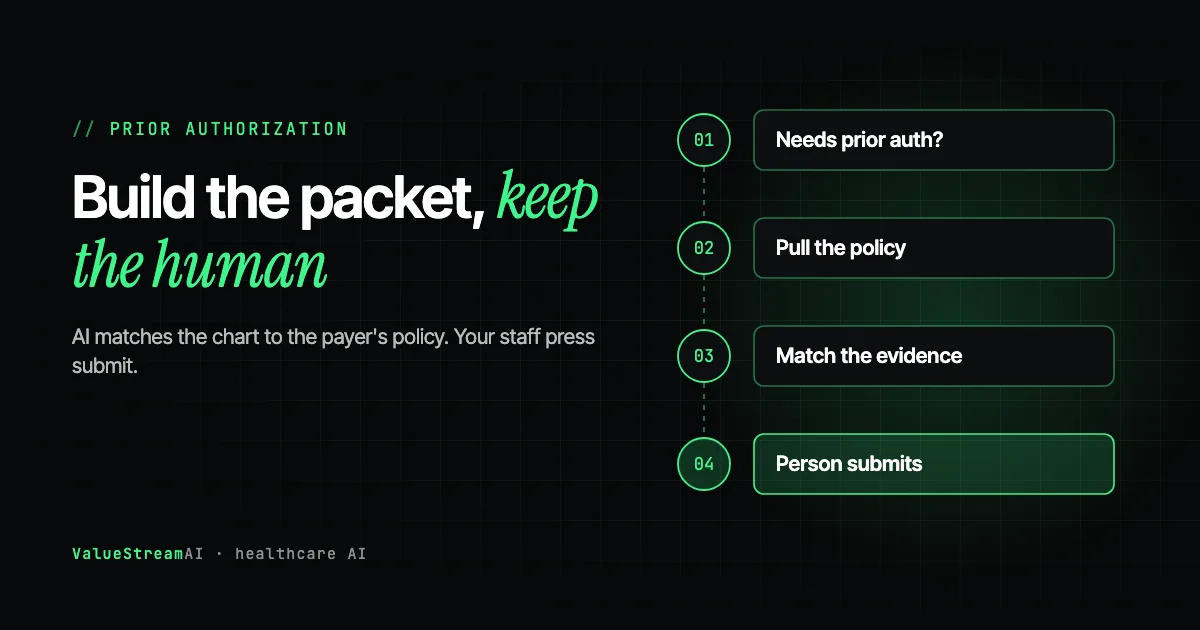
The short answer: Prior authorization automation for small practices should build the packet, not make the decision. The system checks whether a service needs authorization, pulls the payer's current policy, finds the matching evidence in the patient's notes with page references, and flags any criterion with no evidence. A staff member reviews and submits. At 20 minutes per request by hand, a practice sending 200 requests a month spends about 800 staff hours a year on assembly alone.
Key takeaways
- 39 requests and 13 hours a week, per physician, in the AMA's late-2024 survey; 40% of physicians have staff who work only on prior authorization.
- Only 40% of prior authorizations are electronic (2025 CAQH Index). The rest still go by portal, phone or fax.
- New federal deadlines started in 2026: impacted payers must decide standard requests in 7 days and urgent ones in 72 hours.
- Automate the packet, not the judgement. Finding evidence and matching it to policy criteria is assembly work. Deciding whether to submit is clinical.
- Authorization problems are the second biggest denial cause, cited by 35% of providers in Experian Health's 2025 survey.
| Metric | 2026 Benchmark |
|---|---|
| Prior authorizations per physician, per week | 39 (AMA survey, late 2024) |
| Staff and physician time per week | About 13 hours (AMA) |
| Physicians with staff working only on prior auth | 40% (AMA) |
| Prior authorizations submitted electronically | 40%, up from 31% (CAQH Index 2025 vs 2023) |
| Providers citing authorizations as a top denial cause | 35% (Experian Health, 2025) |
Why Prior Authorization Automation for Small Practices Matters
Prior authorization automation matters most for small practices because the work does not shrink with the practice. A three-physician practice faces the same payer policies, the same portals and the same evidence requirements as a hospital department, without a dedicated authorization team.
The AMA survey figures, reported by HMP Global in May 2026, show the scale: 39 requests per physician per week, 13 hours of staff time, 40% of physicians with staff working exclusively on prior authorization, and 89% of physicians linking prior authorization to higher burnout.
It also costs money directly. In Experian Health's State of Claims 2025 survey, authorizations were the second most common denial cause (35%), behind only missing or inaccurate data (50%). A request that was never sent, or sent without the evidence the policy required, turns into a denial weeks later.
And electronic submission is still the minority. The 2025 CAQH Index found 40% of medical prior authorizations are now fully electronic, up from 31% two years earlier, as reported by AJMC. The other 60% still involve a portal, a phone call or a fax.
What Prior Authorization Automation Should and Should Not Do
The most important design decision is where the line sits between assembly and judgement.
| Task | Automate? | Why |
|---|---|---|
| Check whether this service needs prior auth for this payer | Yes | It is a lookup against a published list |
| Find the payer's current coverage policy | Yes | It is retrieval from a known source |
| Find evidence in the notes for each criterion | Yes, with page references | It is reading and matching, and a person checks every citation |
| Flag criteria with no evidence | Yes | It is a comparison |
| Fill in the request form | Yes | It is data entry |
| Decide whether the evidence is clinically sufficient | No | It is a clinical judgement |
| Submit the request | No, a person presses submit | It is a commitment made on the practice's behalf |
| Track the response and chase deadlines | Yes | It is status checking |
This split is not just caution. Payers are moving the same way on their side. Under Medicare's WISeR model, the CMS FAQ states that technology can speed reviews and drive towards auto-approval, but "non-affirmations will require the review of a human clinician and cannot be performed solely by technology." If the payer's own AI needs a human to say no, a practice's AI should not be the one to say yes.
How the Packet Gets Built
A prior authorization packet is a bundle of evidence answering one question: does this patient meet this payer's criteria for this service? Building it is a five-step job.
- 01Does this need prior auth?
Check the payer's list for this service or item, so nobody spends 20 minutes on a request that is not needed.
- 02Pull the policy criteria
Find the payer's coverage policy for this service and list what it asks for.
- 03Match the evidence
Find each piece of evidence in the patient's notes and cite the page.
- 04Flag the gaps
List any criterion with no evidence, so the clinician can add it or decide not to submit.
- 05A person submits
Staff review the packet and send it. The system tracks the response.
1. Does it need authorization at all? Each payer publishes which services and items need prior authorization. Checking this first stops your team spending 20 minutes on a request the payer does not require, and catches the ones they would otherwise forget.
2. Pull the current policy. The criteria live in the payer's coverage policy, and policies change. The system retrieves the current version from your payer policy knowledge base and lists each criterion.
3. Match evidence from the chart. For each criterion, the system searches the patient's notes, imaging reports and prior treatments, and quotes the passage with its date and page. Your reviewer sees the criterion, the quote and the source side by side.
4. Flag the gaps. Any criterion with no matching evidence is listed plainly: "Policy requires six weeks of conservative treatment. No physical therapy notes found." The clinician can add the missing information or decide the request is not ready.
5. A person submits. Through the payer portal, by fax, or through an electronic route where the payer supports one. The system then tracks the response and alerts your team as decision deadlines approach.
An order arrives and the system checks whether the payer requires prior authorization for this service. If not, the order proceeds. If it does, the system pulls the current policy criteria, matches evidence from the patient's notes with page references, and flags any criterion without evidence. A staff member reviews the packet. If evidence is missing, the clinician adds it or decides not to submit. When the packet is complete, staff submit it and the system tracks the response.
Before any of this is built, sit down with the clinicians who sign off requests and agree what "ready to submit" means for your top services: which evidence must be present, which is nice to have, and when a request should not go out at all. It is a one-hour conversation before the build and a frustrating rebuild after it.
The page references are what make this safe. An AI model can misread or overstate what a note says. A reviewer who can click straight to the quoted passage catches that in seconds. A packet without citations asks the reviewer to trust the model, and you should not.
What Changed in 2026: The Federal Rules
Two federal changes matter for small practices this year. Neither removes the need to assemble evidence.
CMS-0057-F: decision deadlines and the 2027 API
CMS's Interoperability and Prior Authorization Final Rule requires impacted payers (Medicare Advantage, Medicaid and CHIP programmes, and some exchange plans) to:
- Decide standard requests within 7 calendar days and urgent requests within 72 hours, from January 2026. Exchange plan issuers are excluded from these deadlines.
- Give a specific reason for every denial.
- Publish prior authorization metrics every year.
- Offer a prior authorization API from January 1, 2027.
Drug prior authorizations are excluded from the decision-deadline and API provisions. Employer-sponsored plans are not impacted payers under the rule.
What this means for a small practice: faster decisions from some payers, and from 2027 an electronic route to submit. What it does not mean: the API carries your evidence, it does not find it. Someone still has to match the chart to the criteria.
WISeR: prior authorization comes to traditional Medicare
The WISeR model brings prior authorization to selected services in traditional Medicare in six states: Arizona, New Jersey, Ohio, Oklahoma, Texas and Washington, from January 2026 to December 2031. Examples include skin substitutes, knee arthroscopy for knee osteoarthritis and electrical nerve stimulation. Technology companies run the reviews, aiming for auto-approval where possible, but a licensed human clinician must review every non-affirmation. Providers can skip prior authorization, in which case the claim goes to pre-payment medical review instead.
72 hours for urgent requests, from January 2026, for Medicare Advantage, Medicaid and CHIP. Excludes drug prior authorizations.
From January 1, 2027, for impacted payers only. Employer plans are outside the rule, and the API does not assemble your evidence for you.
Arizona, New Jersey, Ohio, Oklahoma, Texas and Washington, 2026 to 2031. Any denial must be reviewed by a licensed human clinician.
If your practice is in one of the six states and bills any of the selected services, prior authorization is now part of your traditional Medicare workflow, not just your Medicare Advantage one.
Platforms, Payer Tools and Custom Builds
Several kinds of product compete here. Be clear about which problem each solves.
- Payer portals and clearinghouse tools handle submission. They do not read your notes.
- Revenue cycle platforms such as GenHealth.ai, which began by helping payers meet the CMS prior authorization rule, offer prior authorization agents for providers and equipment suppliers. They are strongest for mid-size organisations on the billing systems they support.
- EHR add-ons from your EHR vendor may handle requests for common services inside your existing workflow. Check before you buy anything.
- A custom build fits when your specialty or payer mix is not well covered, you want the evidence-matching tied to your own policy library, or you want prior authorization to share one system with intake and pre-bill checks.
The Competitor Pulse Check
| Factor | ValueStreamAI custom build | Revenue cycle platforms | Payer portal alone | Generic AI chat tools |
|---|---|---|---|---|
| Checks if prior auth is needed | Yes, against your payers' lists | Yes, for supported payers | Sometimes | No |
| Matches chart evidence to policy criteria | Yes, with page references | Varies by product | No | Only what someone pastes in, no citations to your chart |
| Uses current payer policy | From your policy library | Vendor library | Yes, for that payer | Training data, often out of date |
| Who submits | Your staff | Configurable | Your staff | Not applicable |
| Data location | Your choice, including your own server | Vendor cloud | Payer | Vendor cloud |
| Pricing | Fixed build plus maintenance | Quoted | Free | Per seat |
Privacy, Liability and Accuracy
Patient data. Prior authorization packets carry the most sensitive clinical information in the revenue cycle. Any party whose system touches them needs a business associate agreement, or the AI can run on a server you control. Our guide to what AI agents may do with patient data covers both US and UK rules.
Liability. A request submitted on the practice's behalf is the practice's statement. Keeping a person on submission is not only good practice; it keeps responsibility where it already sits.
Accuracy. AI models are not deterministic: the same note can be summarised slightly differently on two runs. That is why the design relies on quoted passages and page references rather than summaries, and why yes/no checks such as "is this service on the payer's list" are done in code, not by the model. Expect real requests to find problems testing did not: in our experience the first hundred real cases through any new system surface a handful of failure modes nobody anticipated. Keep full human review on every packet through that period and beyond.
Human Hours vs Automation: Prior Authorization Packets
The assumptions.
- Unit of work: one prior authorization request.
- Staff alone: 20 minutes. This is derived from the AMA's figures: 13 hours for 39 requests is 20 minutes each.
- Staff with AI: 5 minutes for a staff member to check the cited evidence, resolve flagged gaps with the clinician and submit. This is our estimate.
- Rate: US median wage for medical records specialists, $24.59 an hour (BLS, May 2025). Base pay. Where a physician or nurse does part of the work, the real cost per hour is much higher.
That is about $8.20 of staff time per request when staff work alone, against about $2.05 when they work with AI.
Why the remaining five minutes are the most important ones. In those minutes a staff member opens each quoted passage and checks it says what the packet claims, takes any flagged gap to the clinician, and decides whether the request is ready. Prior authorization has the most human time left over of any workflow in this series, and that is correct: it is the one closest to a clinical judgement. The AI takes away the searching, the policy lookup and the form filling; it does not take away the decision.
| Volume | Staff alone: hours a year | Staff alone: cost | Staff with AI: hours a year | Staff with AI: cost |
|---|---|---|---|---|
| 200 requests a month | 800 | $19,672 | 200 | $4,918 |
| 1,000 requests a month | 4,000 | $98,360 | 1,000 | $24,590 |
| 5,000 requests a month | 20,000 | $491,800 | 5,000 | $122,950 |
The other side of the ledger. A prior authorization pilot on one or two high-volume services is $5,000 to $15,000; a workflow covering your main payers is $15,000 to $40,000, plus running costs and maintenance as policies change.
What the numbers leave out. Requests that go out complete the first time are approved faster, so patients start treatment sooner and fewer requests turn into appeals. Fewer missed authorizations also means fewer authorization denials. Neither is in the table.
Run your own numbers in the hire vs automate calculator or the ROI calculator.
What Prior Authorization Automation for Small Practices Costs
Prior authorization automation for a small practice costs $5,000 to $15,000 for a pilot on one or two high-volume services, and $15,000 to $40,000 for a workflow across your main payers, connected to your EHR and policy library. These are our published prices as of October 2026; billing companies building for many practices should expect $40,000 or more.
See our pricing, estimate your project with the automation quote tool, or read about our healthcare AI development service.
Frequently Asked Questions
What is prior authorization automation for small practices?
Prior authorization automation for small practices is software that checks whether a service needs authorization, pulls the payer's current policy, finds the matching evidence in the patient's notes with page references, and prepares the request. A staff member reviews and submits it.
Can AI submit prior authorizations on its own?
It can technically, but we do not recommend it. A request is a statement made on the practice's behalf, and even under Medicare's WISeR model a human clinician must review every denial. Keep a person on submission.
How long does a prior authorization take to complete by hand?
The AMA's late-2024 survey found 39 requests per physician per week taking about 13 hours of staff and physician time, which works out to about 20 minutes per request.
Does the 2027 prior authorization API make automation unnecessary?
No. The CMS-0057-F API gives impacted payers an electronic route to receive requests from January 2027. It does not find the evidence in your notes or match it to the policy, and employer plans are not covered.
Which practices are affected by the WISeR model?
Providers billing selected services to traditional Medicare in Arizona, New Jersey, Ohio, Oklahoma, Texas and Washington, from January 2026 to December 2031. Examples include skin substitutes, knee arthroscopy and electrical nerve stimulation.
How much does prior authorization automation cost?
A custom pilot costs $5,000 to $15,000 and a fuller workflow $15,000 to $40,000, based on our published pricing. Platforms quote per organisation.
What's Next
Pick the one service your team spends the most time authorising. We will map the payer criteria, build the packet for ten synthetic or de-identified cases, and show you the time difference before you commit.
→ Book a free prior authorization review
This post is part of our guide to revenue cycle automation for small practices. Related: catching denials before you bill, fax referral intake automation, and how a behavioral health billing validation layer checks authorizations against session notes.
Muhammad Kashif is co-founder of ValueStreamAI, leading technical delivery and AI strategy. He designs and ships custom agentic AI and healthcare automation systems for clients across the US and UK. More about Muhammad Kashif →