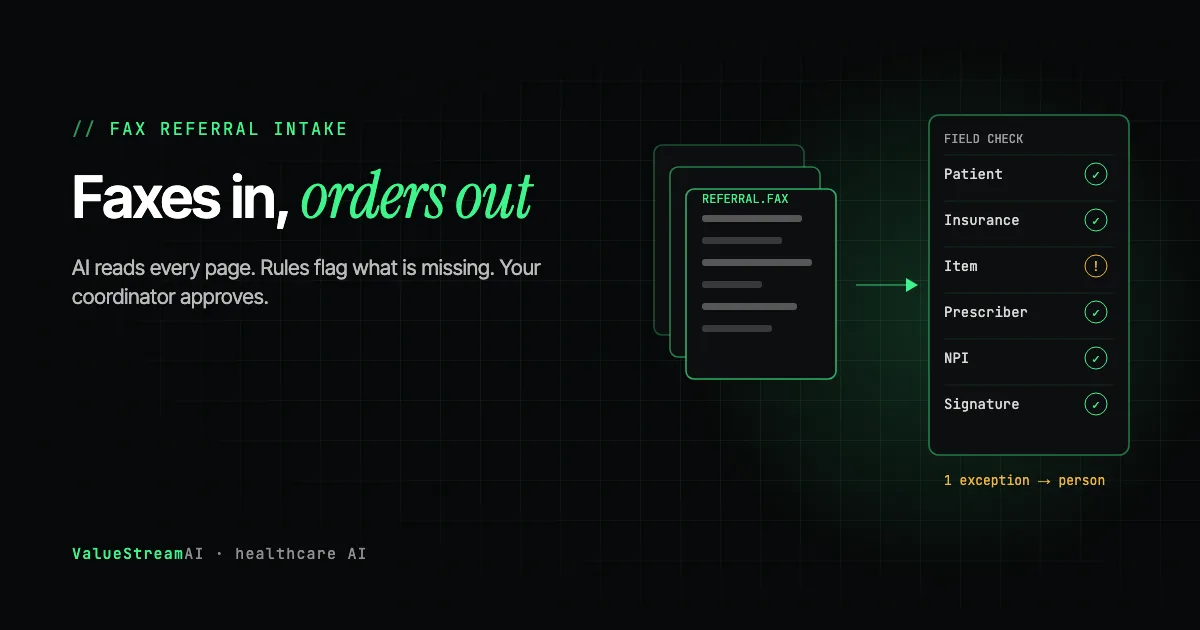
Every morning, in most medical equipment suppliers and specialty practices, someone opens the fax queue and starts typing. A referral arrives as a 9-page image. Somewhere in it is the patient's name, their insurance, the item ordered, the prescriber's NPI and a signature, if it was signed. Fax referral intake automation reads those pages, pulls the details out, checks what is missing, and puts a finished order in front of your intake coordinator to approve.
This guide is for owners and intake managers at small and mid-size DME suppliers, sleep and respiratory providers, home health agencies and specialty practices that still receive most referrals by fax or emailed PDF. It covers how the automation works, why the old "fax OCR" tools disappointed, what to check before you buy, and what it costs.
The short answer: Fax referral intake automation uses an AI model to read each faxed page, including handwriting, then plain rules check that every required item is present before a person approves the order into your billing system. For a supplier taking a few hundred referrals a month, a custom intake pilot runs $5,000 to $15,000. Larger teams on Brightree should also price platforms such as Tennr, Parachute AI Intake and GenHealth.ai.
Key takeaways
- Faxed and PDF referrals still dominate intake at many equipment suppliers, as NikoHealth put it in July 2026, and each one is keyed in by hand.
- Reading the fax is no longer the hard part. AI models read new layouts and handwriting without anyone building a template.
- The valuable step is the missing-item check: catching the absent signature or note before you call the patient, not after the claim is denied.
- Missing or inaccurate data is the top denial cause, cited by 50% of providers in Experian Health's 2025 survey.
- Keep a person on approval. The system prepares the order; your coordinator releases it.
| Metric | 2026 Benchmark |
|---|---|
| Top denial cause: missing or inaccurate data | 50% of providers (Experian Health, 2025) |
| Incomplete or inaccurate patient registration as a denial cause | 32% of providers (Experian Health, 2025) |
| Referral documents processed by Tennr | More than 10 million a month (company figure, June 2025) |
| US median wage, medical records specialists | $24.59 an hour (BLS, May 2025) |
Why Fax Referral Intake Automation Matters for Small Providers
Fax referral intake automation matters because intake is where most revenue cycle errors are born and where they are cheapest to fix. A wrong date of birth typed at intake becomes an eligibility failure, then a denial, then an appeal. Found at intake, it is a ten-second correction.
Experian Health's State of Claims 2025 survey found that the top three denial causes were missing or inaccurate data (50% of respondents), authorizations (35%) and incomplete or inaccurate patient registration (32%). Two of those three start at intake.
The fax is not going away soon. Referring offices send what their systems send, and for many that is still a fax. NikoHealth, which makes billing software for equipment suppliers, wrote in July 2026 that "faxed and PDF referrals still dominate intake at many enterprise DME organizations", and that referral intake shows the clearest payoff of any automation in the sector. If that is true for large suppliers with integration budgets, it is more true for small ones.
What Fax Referral Intake Automation Actually Does
A fax referral intake system does five jobs in order. Each one replaces a step your coordinator does by hand today.
- Collects every incoming referral automatically. From your fax service (eFax, RingCentral and Faxage all offer ways to pull incoming faxes), a shared inbox or a portal download. Nobody has to open and forward anything.
- Sorts the pages. A 9-page fax might hold the order, two pages of clinical notes, an insurance card and a cover sheet. The system labels each page so the right fields come from the right place.
- Reads the fields. Patient name, date of birth, insurance member ID, item or service, diagnosis, prescriber name and NPI, order date and signature. Modern AI models read layouts they have never seen and most handwriting.
- Checks what is missing. This is the step that pays for the system. Plain rules compare what was found against what this payer and this item require, and list what is absent or inconsistent.
- Puts a finished order in a queue. Your coordinator sees the extracted order next to the original pages, approves it into your billing system, or sends the drafted request for missing items back to the prescriber.
A fax arrives and is pulled in automatically. The pages are sorted and the fields read. Rules check whether everything this payer and item require is present. If everything is present, the order goes to the coordinator to approve into the billing system. If something is missing, a request to the prescriber is drafted and the coordinator reviews it before it is sent.
Why the Old Fax OCR Tools Disappointed
If you tried fax OCR software five or ten years ago and gave up, you were not wrong. Older tools worked from templates: someone drew boxes on a sample form telling the software where each field lived. That worked for the one form it was built for and failed on everything else.
Referral intake is the worst possible case for templates. Every referring office sends its own layout, half the important information is in free-text clinical notes, and signatures and dates are often handwritten. A supplier with 200 referring offices would need 200 templates, and they would break every time an office changed its letterhead.
AI document reading removes the template. The model reads the page the way a person does, so a new prescriber's form works on day one. What it does not remove is the need for checking. A model reads a date that is in the wrong field as faithfully as one in the right field, and it can misread a smudged digit with full confidence. That is why the checks belong in plain code, not in the model: whether a date is before another date, or whether an NPI has ten digits, is arithmetic, and code gets arithmetic right every time.
The Missing-Item Check Is Where the Money Is
The single most valuable thing a fax referral intake system does is tell your coordinator, at the moment the referral arrives, exactly what is missing.
For a Medicare equipment order, the list is published. Medicare requires a standard written order before a claim is submitted, which must include the patient's name or Medicare number, the order date, a description of the item, the quantity where more than one item is dispensed, the treating practitioner's name or NPI, and the practitioner's signature, according to CGS, the Medicare equipment contractor's own guidance and the CMS Program Integrity Manual, chapter 5. Some items also need a face-to-face visit within six months before the order.
A system that knows this list for each payer and item can turn every incoming fax into one of two outcomes:
| Outcome | What the coordinator sees | What happens next |
|---|---|---|
| Complete | Extracted order beside the original pages, all checks passed | Approve into the billing system |
| Incomplete | The same, plus a list: "No practitioner signature on page 3. No face-to-face note within six months." | Send the drafted request to the prescriber, or call |
Catching an unsigned order at intake costs a fax back to the prescriber. Catching it after delivery costs a denial, and catching it in a Medicare audit can cost the payment. The deeper version of these checks, run again just before billing, is covered in automated documentation checks for DME.
Writing Into Your Billing System
Reading and checking are only useful if the result lands where your team works. How it lands depends on what your billing or practice system allows.
Here is the quick test we ask every client to run: for each system the order must reach, does it have an API or an official integration option? If yes, the intake system writes the order through that door, and the build is predictable. Brightree and NikoHealth both work with intake partners, and most EHRs including athenahealth, eClinicalWorks and Epic offer API programmes, though access depends on your account.
If the answer is no, the system can still enter the order the way a person does, by working the screen. It is a legitimate route and sometimes the only one. It is also more fragile: it breaks when the vendor redesigns a page, so it costs more to maintain. We built exactly this kind of route for a medical billing company whose documents arrived through Egress secure email, a staff-facing tool with no developer API. The Egress medical billing case study shows how the system opened each message the way a staff member would, read the attachments and produced structured patient records, and what production would need on top of the one-to-two-week MVP.
Our guide to webhooks and APIs for practice managers explains these routes without the jargon.
Buy a Platform or Build Your Own?
Fax referral intake is the most crowded corner of revenue cycle automation, which is good news for buyers.
- Tennr raised a $101 million Series C in June 2025, reads referrals from fax, portal and email with its own document model, and says it processes more than 10 million documents a month. It integrates with NikoHealth.
- Parachute Health AI Intake converts faxed and paper equipment orders into digital orders inside Parachute's ordering network.
- GenHealth.ai offers order intake for equipment suppliers as part of a wider set of agents, and writes into Brightree and NikoHealth.
Buy one of these if you are mid-size or larger, your billing system is one they support, and your referral mix is mainstream. You get a mature product and the vendor carries maintenance.
Build if your volume is too small to be a priority for an enterprise vendor, your referrals come in unusual shapes (specialty forms, a regional payer, a home-grown spreadsheet), your billing system is not supported, or you want to own the system without per-document fees. A build is also the answer when intake is one part of a larger workflow you want under one roof, such as intake feeding pre-bill checks and prior authorization. Billing companies receiving referrals for many practices should read AI automation for medical billing companies, because one intake pipeline can serve every client.
There is also a free option worth trying first: check whether your billing system or fax service already offers an intake feature you have not switched on. And if your volume is very low, a free template can show the basic pattern: our document processing templates include open invoice-reading workflows you can run yourself. None of them carries the payer-specific checks or patient-data safeguards this guide describes, so treat them as a way to learn, not as a production intake system.
The Competitor Pulse Check
| Factor | ValueStreamAI custom intake | Intake platforms (Tennr, Parachute, GenHealth) | Doing it by hand |
|---|---|---|---|
| New form layouts | Read without templates | Read without templates | Read by a person |
| Missing-item rules | Written for your payers and items, in code you can read | Vendor's rules library | From the coordinator's memory |
| Billing systems | Any with an API, or through the screen | Supported systems only | Any |
| Pricing | Fixed build, optional maintenance | Quoted, often usage-based | Staff time |
| Who owns it | You | Vendor | You |
| Best for | Small and growing teams, unusual workflows | Mid-size and larger on supported systems | Very low volume |
Privacy: Where the Faxes Go
Every referral is protected health information, so the intake system's data path matters as much as its accuracy.
If the system uses a cloud AI service, that provider must sign a business associate agreement, and so must the developer if they can see live data. Our explainer on what AI agents are allowed to do with patient data covers this for both US and UK rules.
The alternative is to run the reading model on a server you control. Open document models now read faxes well enough for this job, and a single mid-range GPU server is enough for most small suppliers. The self-hosted document AI guide covers which models, which servers and the monthly cost. Either way, build and test on synthetic referrals first; Synthea generates realistic fake patients for exactly this.
Human Hours vs Automation: Referral Intake
The assumptions (our estimate, replace with yours).
- Unit of work: one faxed or emailed referral.
- Staff alone: 12 minutes to open the fax, read every page, key the order into the billing system and check for missing items.
- Staff with AI: 2 minutes for the coordinator to compare the extracted order with the original pages and approve it, or send the drafted request for missing items.
- Rate: US median wage for medical records specialists, $24.59 an hour (BLS, May 2025). Base pay, not loaded cost.
That is about $4.92 of staff time per referral when staff work alone, against about $0.82 when they work with AI.
What the coordinator still does in those two minutes. Compares each extracted field with the highlighted spot on the original page, confirms anything the system marked as uncertain, decides whether a missing item must be chased before delivery or can follow, and releases the order. The AI never enters an order into your billing system on its own. That is deliberate: the referral is the first document in the revenue cycle, and a wrong date of birth approved here travels through eligibility, delivery and billing before anyone looks at it again.
| Volume | Staff alone: hours a year | Staff alone: cost | Staff with AI: hours a year | Staff with AI: cost |
|---|---|---|---|---|
| 200 referrals a month | 480 | $11,803 | 80 | $1,967 |
| 1,000 referrals a month | 2,400 | $59,016 | 400 | $9,836 |
| 5,000 referrals a month | 12,000 | $295,080 | 2,000 | $49,180 |
The other side of the ledger. An intake pilot is $5,000 to $15,000 and a full intake workflow $15,000 to $40,000, plus AI or server running costs and maintenance as payers and forms change. At 200 referrals a month the saving is close to $10,000 a year, so a pilot pays back slowly and the case rests on fewer denials. At 1,000 a month it pays back well inside a year.
What the numbers leave out. Speed. A referral entered the same morning is a patient called the same day, and in competitive equipment categories the first supplier to call often gets the order. Patients are already waiting: AMN Healthcare's 2025 survey of 1,391 physician offices in 15 large metro areas found an average of 31 days for a new-patient appointment across six specialties, up 19% since 2022 (AMN Healthcare). Days lost in a fax queue are added on top. Errors avoided at intake also never become denials, which the table does not count.
Try your own figures in the hire vs automate calculator, or see the full document-by-document comparison in what medical billing automation costs per document.
What Fax Referral Intake Automation Costs
Fax referral intake automation costs $5,000 to $15,000 for a pilot on one fax line and your most common referral types, and $15,000 to $40,000 for a full intake workflow written into your billing system. These are our published prices as of October 2026.
One fax line, your most common referral types, run alongside your intake team.
- Missing-item checklist
- Side-by-side accuracy report
Every intake channel, written into your billing system, with an approval queue.
- Prescriber follow-up drafts
- Audit trail per referral
GenHealth.ai, Tennr or Parachute AI Intake, for mid-size teams on supported systems.
- Vendor carries maintenance
- Usage-based pricing is common
Running costs are small next to staff time: AI usage per page if you use a cloud model, or a monthly server if you self-host, plus maintenance. Platforms quote per organisation; ask whether you pay per page, per referral or per seat, because that decides how the cost grows.
See our pricing, get a quick estimate from the automation quote tool, or read about our healthcare AI development service.
How to Run a Fair Pilot
A good pilot proves accuracy on your own referrals before anything changes for your team.
- Pick one fax line and the three most common referral types.
- Run in parallel for two to four weeks. Your coordinators work as normal; the system processes the same faxes in the background.
- Compare field by field. For every referral, did the system read the same patient, item, prescriber and dates? Did it flag the same missing items your team found, and any they missed?
- Agree the go-live bar in advance. For example: every field the system is unsure of must be flagged, not guessed.
- Switch on one referral type at a time.
- Never test against your live billing system. During the pilot the system writes to a review screen or a test copy, not to real patient records. We have been called in to clean up after a test wrote bad data into a live system, and it takes far longer to undo than to prevent.
This is also where you learn whether your billing system can be written to directly or needs the screen route, which changes the maintenance cost.
Frequently Asked Questions
What is fax referral intake automation?
Fax referral intake automation is software that collects incoming faxed and emailed referrals, reads the patient, insurance, item and prescriber details, checks what is missing, and prepares an order for a person to approve into the billing system.
Can AI read handwritten referrals and signatures?
Modern AI document models read most handwriting, and they can tell whether a signature is present. They can still misread a smudged digit, which is why uncertain fields should be flagged for a person rather than guessed.
Does fax referral intake automation work with Brightree?
Usually, yes. Brightree works with intake partners, and a custom system can write orders through an available integration or, where none exists, through the screen the way a person does.
How much does fax referral intake automation cost?
A custom intake pilot costs $5,000 to $15,000 and a full workflow $15,000 to $40,000, based on our published pricing. Platforms such as Tennr, Parachute and GenHealth.ai quote per organisation.
Is automated fax intake HIPAA compliant?
It can be, if every party handling the faxes signs a business associate agreement, or if the reading model runs on a server you control. Build and test on synthetic records before any real patient data is used.
Will it replace my intake coordinators?
No. It removes the retyping and the hunt for missing items, so coordinators spend their time on approvals, prescriber follow-up and patient calls. A person still releases every order.
What's Next
Send us one week of faxed referrals with patient details removed, or let us generate synthetic ones, and we will show you what the system reads, what it flags as missing, and what it would cost at your volume.
This post is part of our guide to revenue cycle automation for small practices. Next in the series: catching denials before you bill and prior authorization automation. For the wider picture of AI on the front desk, see patient intake and front desk automation.
Muhammad Kashif is co-founder of ValueStreamAI, leading technical delivery and AI strategy. He designs and ships custom agentic AI and healthcare automation systems for clients across the US and UK. More about Muhammad Kashif →