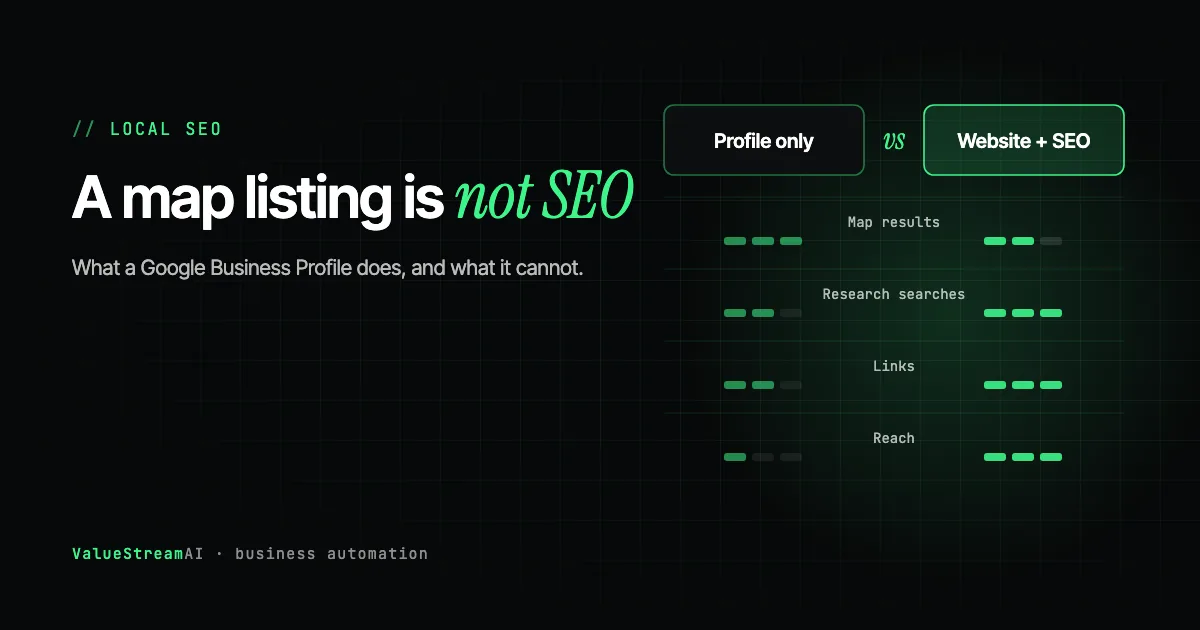
"We already did our SEO. We set up the Google listing." We hear it often, and it is understandable: a Google Business Profile is free, quick to set up, and puts your business on the map. It is a useful start. It is not SEO, and treating it as the whole job is one of the most common reasons a business stays invisible for the searches that matter.
This guide answers a plain question for business owners: is a Google Business Profile enough? It covers what a profile does well, what it cannot do, what Google itself says decides local rankings, and how a profile and a website work together.
| Metric | 2026 Benchmark |
|---|---|
| Google's local ranking factors (Google) | Relevance, distance, prominence |
| What prominence is based on (Google) | Links to your business and your reviews, among other things |
| Can you pay for a better local ranking? (Google) | No |
| Souvlaki Place: "greek food near me" | Position 1 for its website |
| Naffees & Sons: average position, website | 5.7, no link building |
The short answer. No. A Google Business Profile is your listing on the map, and it matters for people nearby who are ready to call. But Google says local ranking also depends on prominence, which it bases partly on how many websites link to your business and how many reviews you have, and the profile itself cannot earn links. Most buyers research before they call, with searches like "how much does it cost" and "best builder for", and those are won by websites with real pages, not by map listings. Do both: a complete profile and a website built for search.
Key takeaways
- A profile is a listing, not a strategy. It helps people already looking for a business nearby.
- Google names links and reviews as prominence signals. A profile alone earns neither links nor much depth.
- Research searches are won by websites. Costs, comparisons, guides and case studies need pages.
- The two work together. The profile links to the site; the site's details match the profile.
- You cannot pay for map rankings. Google says so plainly.
What a Google Business Profile Does Well
A profile is the listing that appears in Google Maps and the map pack at the top of local results. It shows your name, category, hours, phone number, address or service area, photos and reviews, with buttons to call, get directions or visit your website.
It is excellent for the last step of a buyer's journey: someone nearby who needs a business now and wants a phone number, opening hours or directions. For a cafe, a plumber or a pharmacy, that is a large share of searches. Every local business should have one, completed properly.
What a Profile Cannot Do
The limits are structural, not a matter of effort.
It cannot answer detailed questions. A homeowner researching "240 square yard house construction cost" or a factory manager comparing container hauliers wants detail: costs, process, examples, what is included. A profile has room for a description and a list of services. It cannot hold a cost guide, a case study or a comparison.
It cannot rank for research searches. Those searches return websites and articles, not map listings. If you only have a profile, you are absent from every search a buyer makes before deciding to call.
It cannot earn links. Google names links as part of prominence (more on that below). Other websites link to useful pages: guides, projects, resources. They do not link to a map listing.
It works only near you. Map results depend heavily on distance. A website can rank for searches across a city, a region or a country.
What Google Says Decides Local Rankings
Google's own Business Profile help page says local results are mainly based on relevance, distance and prominence. On prominence, it says it means how well known a business is, and that this factor is also based on information like how many websites link to your business and how many reviews you have. It also says plainly that there is no way to request or pay for a better local ranking.
Read that carefully and the answer to "is a profile enough?" is in Google's own words. Two of the signals it names, links from other websites and the overall strength of your presence online, are built by a website and the marketing around it, not by the listing itself.
How Buyers Actually Search
Most purchases above a few dollars follow the same path: research, compare, then call. The map listing only appears at the end.
- Researching: "how much does a new roof cost", "container transport rates Karachi", "best accountant for small business". Websites and articles win these.
- Comparing: reviews, examples of past work, "X vs Y". Websites, case studies and review pages win these.
- Ready to call: "roofer near me", opening hours, phone number. The map listing does well here.
A business with only a profile appears at the last step, often alongside competitors the buyer has already read about on their websites.
Our client data shows what a website adds. Souvlaki Place, a Greek restaurant in Toronto, ranked its website at position 1 for "greek food near me", "greek near me" and "food near me", and near the top for every version of its name.
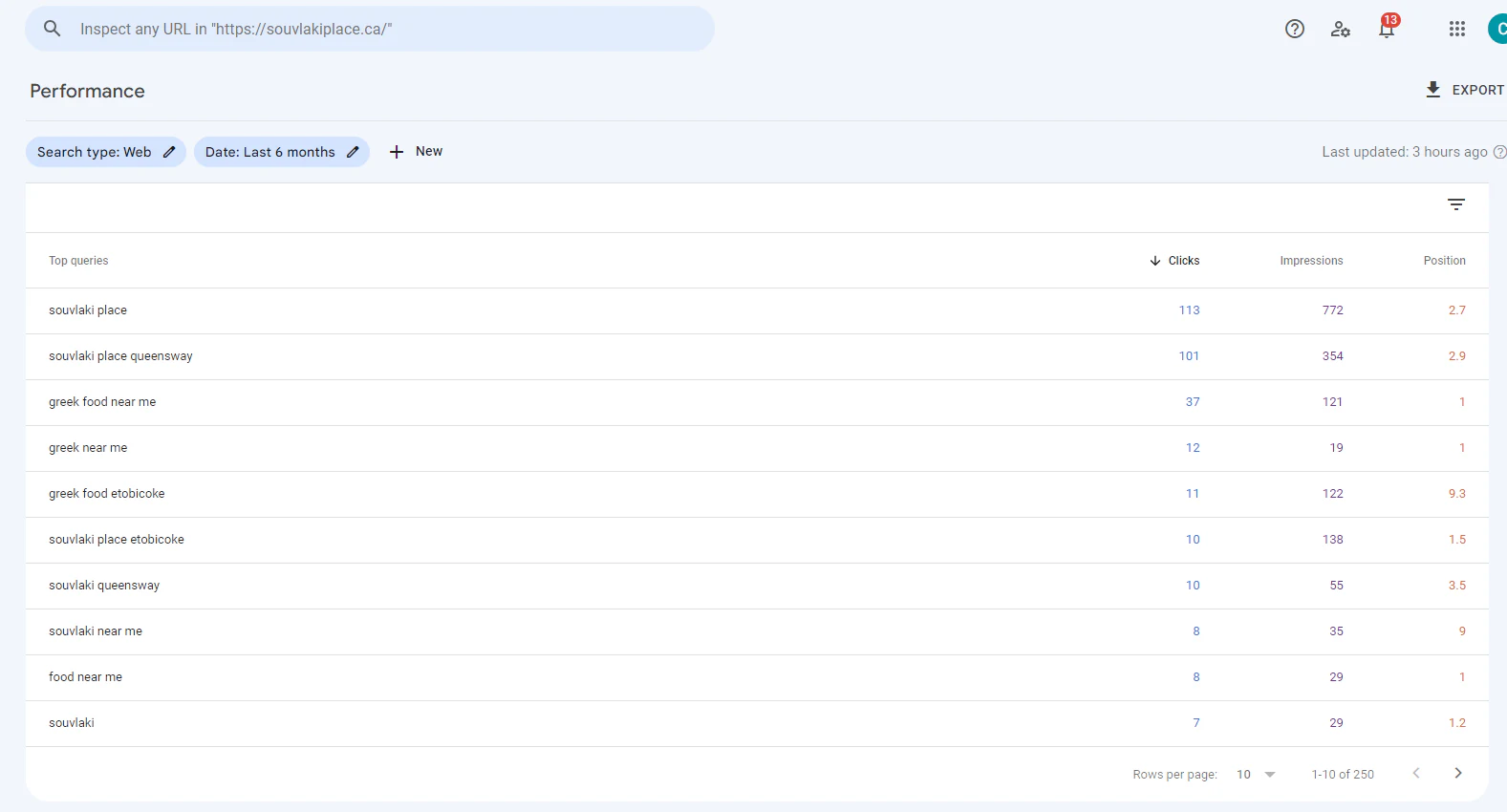
Google Search Console for the website souvlakiplace.ca, April to October 2023: position 1 for "greek food near me" and "food near me", 250 ranking queries. Website results, separate from the map listing.
For higher-value services the gap is bigger. Naffees & Sons, a construction firm, reached an average position of 5.7 across every query its website appeared for in three months, ranking for cost and neighbourhood searches no map listing could hold.
How a Profile and a Website Work Together
- 01Complete the profile
Category, hours, services, area, photos, and the website link.
- 02Match the details everywhere
Name, address and phone identical on the site, profile and listings.
- 03Build the website pages
A page for each service and area, with projects and prices.
- 04Earn links and reviews
The two prominence signals Google names.
- Complete the profile properly: the right primary category, hours, services, service area, real photos, and a link to the most relevant page on your website.
- Match the details everywhere: business name, address and phone number written identically on the website, the profile and other listings.
- Build the website pages: one for each service and each area you serve, with projects, prices and answers to buyer questions. See SEO for a new website.
- Earn the prominence signals Google names: reviews on the profile, and links to the website from relevant local and industry sites.
A profile helps buyers who are nearby and ready to call. Buyers who are still researching or comparing search for costs, guides and examples, which websites win. Google also bases prominence partly on links to the business and on reviews, so a profile works best alongside a website built for search.
Setting Up a Profile Properly
A profile done well is still worth an afternoon. The essentials:
- The right primary category. It is one of the strongest relevance signals the profile has. Choose the category that describes what customers actually come to you for, then add secondary categories for other services.
- Accurate hours, including holidays. Nothing loses trust faster than arriving at a closed door.
- Services and a description in your customers' words. "House construction and renovation in Clifton and DHA" says more than "quality builders".
- Real photos. Your premises, your team, your finished work. Stock images add nothing.
- A link to the right page. Point the website link at the most relevant page, not always the homepage. A multi-location business should link each profile to that location's page.
- A habit of asking for reviews, and replying to every one, good or bad.
Common Profile Mistakes
Keyword-stuffed business names. Adding "Best Plumber Karachi Cheap" to your business name breaks Google's guidelines for Business Profiles and can get the listing suspended. Use your real name.
Inconsistent details. A different phone number on the website, the profile and a directory makes Google less sure which is right.
Fake or bought reviews. They break Google's policies and erode trust with real customers who notice.
Set up and forgotten. Old hours, a disconnected number or an unanswered string of reviews tell searchers the business may not be active.
Service-Area Businesses
Builders, hauliers, cleaners and other businesses that go to the customer can list the areas they serve and hide their street address if customers do not visit it. That keeps the profile accurate. It also makes the website more important, not less: a page for each area you serve is how you appear for searches in places your office is not.
How to Tell Which One Is Working
Measure the profile and the website separately, because they do different jobs.
For the profile, Google's Business Profile performance view shows how many people found you on Search and Maps, and what they did: calls, direction requests, website clicks and messages. These are ready-to-buy actions. If they rise, the profile is doing its job.
For the website, Google Search Console shows every search the site appeared for, its position and the clicks it earned. Split the searches into three groups: your business name, "near me" and local searches, and research searches such as costs, comparisons and guides. A business with only a profile will see almost nothing in the third group, which is usually where the higher-value customers start.
For both, count enquiries. Ask new customers how they found you, and tag website forms and WhatsApp messages by source. Visibility only matters if it turns into conversations; that is where lead follow-up automation helps a busy team keep up.
A simple monthly check of those three things tells you whether to spend the next month on the profile, the website or the follow-up.
The Competitor Pulse Check
| Factor | ValueStreamAI approach | "SEO package" that is only a profile |
|---|---|---|
| Map listing | Completed and kept current | Set up |
| Website pages for research searches | Built and written | None |
| Links and prominence | Earned to the website | None |
| Consistency across listings | Checked | Sometimes |
| Reporting | Search Console and profile insights | Profile views |
Human Hours vs Automation: Keeping Listings and Reviews Up to Date
Profiles need upkeep: hours, holidays, photos, posts, and replies to every review. Here is that job priced.
Assumptions: about 1 hour a week per location by hand to update details, add photos and posts, check other listings match, and reply to reviews. One, five and twenty locations, over 52 weeks. Hourly rate: the US median for secretaries and administrative assistants, about $22.82 an hour (BLS, May 2024), base pay only. With listings managed from one place, alerts for new reviews and drafted replies a person approves, we assume 30% of the time remains.
| Volume | Hours by hand a year | Cost by hand | Human time, assisted | Cost, assisted |
|---|---|---|---|---|
| 1 location | 52 | ~$1,190 | ~16 hours | ~$360 |
| 5 locations | 260 | ~$5,930 | ~78 hours | ~$1,780 |
| 20 locations | 1,040 | ~$23,730 | ~312 hours | ~$7,120 |
The other side of the ledger: profile upkeep is part of a marketing retainer from $900 a month. What it leaves out: unanswered reviews, which cost more than the time to answer them. For multi-location schema and listings, see local SEO schema for multi-location businesses. Run your own figures in the hire vs automate calculator.
Frequently Asked Questions
Is a Google Business Profile enough for SEO?
No. A profile puts you on the map for nearby people ready to call, which matters. But buyers research before they call, and those searches are won by websites. Google also says local prominence is based partly on how many websites link to your business and how many reviews you have, which a profile alone does not build.
What is the difference between Google Business Profile and SEO?
A Google Business Profile is one listing on Google Maps and local results. SEO is the wider work of getting your business found across search: website pages for each service and area, content that answers buyer questions, technical health, links from other sites, reviews and a consistent presence everywhere.
Do I still need a website if I have a Google Business Profile?
Yes, for almost any business that sells something worth researching. A website holds your services, prices, projects and case studies, ranks for research and comparison searches, and earns links. The profile then links to it.
How do I rank higher on Google Maps?
Google says local results are based on relevance, distance and prominence, and that you cannot pay for a better ranking. Complete your profile accurately, keep your details consistent everywhere, earn reviews, and build a website that other relevant sites link to.
How many Google reviews does a business need?
There is no fixed number. Google says more reviews and positive ratings can help local ranking, so the practical aim is a steady flow of genuine reviews and a reply to every one. A business with a few recent, detailed reviews often looks more trustworthy to a searcher than one with many old, short ones, and buying reviews breaks Google's policies.
Is GMB the same as Google Business Profile?
Yes. Google My Business was renamed Google Business Profile. Both names refer to the same free listing.
Can a website rank for "near me" searches?
Yes. Souvlaki Place's website ranked at position 1 for "greek food near me" and "food near me" in Search Console, separately from its map listing.
What's Next
If your business has a profile and little else, or a website that does not rank, start with a free call. We will look at both and tell you what would bring in the buyers who research before they call.
→ See our SEO and digital marketing services
→ Read the full guide: build it and market it
→ See what building and marketing costs, or talk to us about your site
Syed Rayyan is co-founder of ValueStreamAI, leading research and marketing. He has run SEO for client websites since 2020, across technical audits, on-page work and link building, and leads the marketing side of every build. He also runs the firm's evaluation of emerging AI tooling and translates technical capability into clear guidance for non-technical decision-makers. Connect on LinkedIn →