You can now build a working app in a weekend. AI coding tools have made that real for people who have never written a line of code, and for development teams they have cut weeks off every project. What they have not done is bring a single customer to the door. Sensor Tower data reported in July 2026 showed new App Store apps nearly doubling in a year, while downloads grew 2%. More things are being built than ever, and the same number of people are finding them.
This guide is for the business owner or founder who wants both halves done: the website development and SEO, the app and the marketing, the build and the customers. It covers what to build so you can be found, how SEO compares with Google Ads, how long it really takes, what it costs, and what results look like, using unedited Search Console data from nine of our client sites.
We are a company that builds and markets, so read this with that in mind. Where we quote our own prices or results, we say so. Where we quote the market, we name the source.
| Metric | 2026 Benchmark |
|---|---|
| New App Store apps, H1 2026 vs H1 2025 (Sensor Tower) | About 560,000, roughly double |
| App Store downloads, same period | Up 2% |
| Average Google Ads cost per click, all industries (LocaliQ, 2026) | $5.42 |
| Visits clicking a result when Google shows an AI summary (Pew, 2025) | 8%, vs 15% without |
| Time for SEO to show results (Google) | Four months to a year |
The short answer. If you plan to be in business for years, build your site or app for search from day one and market it with content and SEO, using Google Ads only to test offers or cover the first months. Do both with one team, so the people who build the site are accountable for whether anyone finds it. Expect four months to a year, not four weeks. Our best results came from sites we built and marketed ourselves: average Google positions under 6 within three months, with no link building.
Key takeaways
- Building is no longer the hard part. AI tools made it cheap; finding customers did not get cheaper.
- SEO and ads do different jobs. Ads rent traffic that stops when you stop paying. SEO builds traffic you keep.
- The site structure decides most of the result. Two sites we built from scratch reached average positions of 5.7 and 5.8 without a single built link.
- Different sites need different campaigns. A new five-page cafe site needed authority; a big online store needed technical fixes; a new business needed the right pages.
- Traffic is not the goal. Enquiries are, and the follow-up decides whether they become customers.
Why Building and Marketing Belong Together in 2026
The answer is that AI split them further apart than they have ever been, and the gap is now where most new businesses fail.
Until recently, building software was expensive and slow, so the hard part of launching a product was obvious: get it built. In 2026 that is no longer true. Tools like Cursor, Claude Code, Lovable, Bolt and Replit let a founder go from idea to working app in days. The Sensor Tower figures reported by The New York Times put it in one line: about 560,000 new apps in the first half of 2026, close to the roughly 600,000 released in the whole of 2025, while downloads grew just 2%.
That is the problem in plain numbers. Twice as many products are competing for the same attention. Coding has become the easy part. Distribution, getting the right people to find you, has become the hard part. We wrote about this in more depth in coding is easy, distribution is hard.
The usual way businesses handle the two halves makes this worse. One company builds the site, hands it over, and leaves. A second company is hired months later to market it, and its first job is often to tell you the site needs rebuilding: no pages for the services people search for, slow templates, no structured data, everything on one page. You pay twice, and you lose the months in between.
There is also a group of buyers this hits hardest: established and family businesses with decades of real experience (completed projects, contracts, certificates) sitting in filing cabinets. Naffees & Sons had twenty to thirty years of paper records, including government contracts; PK Transporters was a generational family business nobody had ever digitised. Turning that archive into pages a stranger can read is a large part of what we do, and we explain it in marketing an established business online.
There is a second, quieter problem. AI made a polished demo cheap to produce, so a convincing website or app is no longer evidence that the people who built it understand what makes it work. We see this regularly: a project that looks finished, with no pages a search engine can match to a buyer's question, and nobody on the original team who can explain why. A demo used to cost about what competence cost. It no longer does, so judge a builder by what their past sites achieved in search, not by how the homepage looks.
What "Build It and Market It" Actually Involves
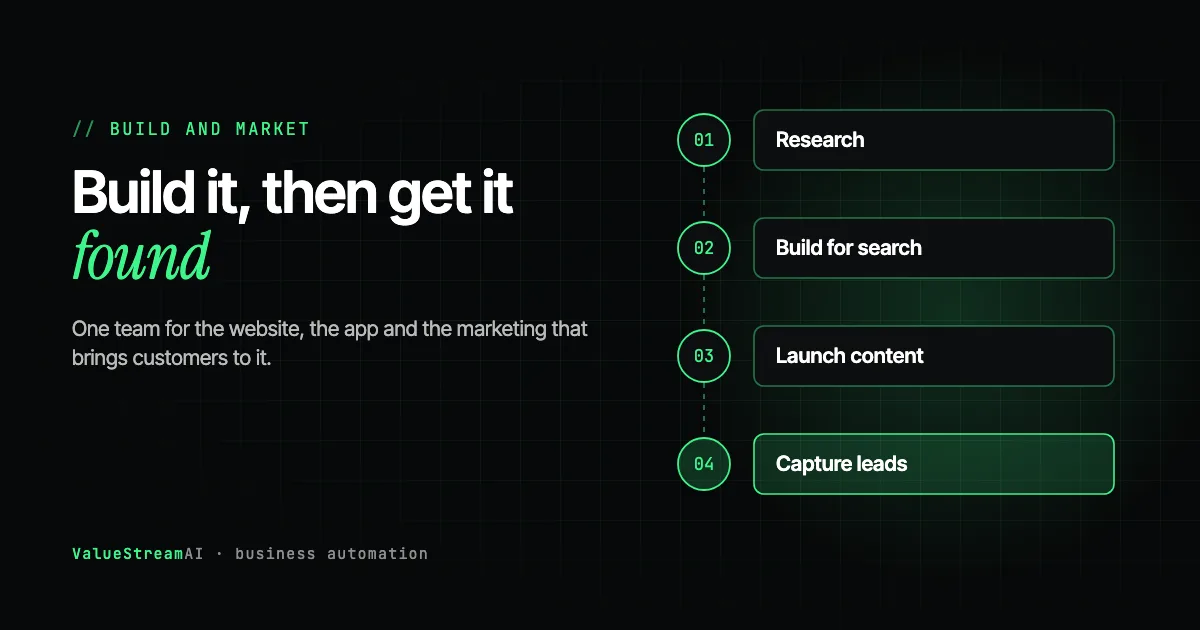
Building and marketing is five stages, and the order matters more than any one of them.
- 01Research how buyers search
The searches decide the pages. This comes before any design.
- 02Build for search
Structure, speed and schema in the build, not bolted on later.
- 03Launch with content
Service pages, cost guides and answers to buying questions on day one.
- 04Earn authority and fix what breaks
Links where the market needs them, technical fixes as the site grows.
- 05Capture and follow up
Forms, WhatsApp and automated follow-up so visits become customers.
1. Research how buyers search, before design
The searches decide the pages. For Naffees & Sons, a construction firm in Karachi, research showed homeowners search by plot size ("240 square yard house construction cost") and by neighbourhood, not by "construction company". That one finding produced seven plot-size cost guides and a page for each neighbourhood. No design brief would have found it.
2. Build for search
A site built for search has one page per service and per location, loads fast on a phone, and carries structured data that tells Google what the business is. We cover the technical choices in our web development for search visibility guide and the trade-offs in Next.js vs WordPress. The business owner does not need to understand the details. They need to know the site was built by people who will be judged on whether it ranks.
3. Launch with content
A new site with five thin pages has nothing for Google to rank. Launch with the pages that answer buying questions: what each service costs, how long it takes, what is included, where you work. For PK Transporters, a container logistics company, that meant a page for each service in each city.
4. Earn authority and fix what breaks
Some sites need links from other sites before Google trusts them. Some need technical repairs as they grow. Which one you need depends on the site, and we show both below.
5. Capture and follow up
Traffic is not the goal. A visitor who does not become an enquiry is a vanity number, and an enquiry that waits two days for a reply often goes to a competitor. This is where marketing meets the automation side of our work: forms and WhatsApp matched to how your customers actually get in touch, then automated follow-up that replies, qualifies and logs every lead. Our guide to AI lead follow-up and CRM automation covers that part.
With two vendors, the builder hands over a site and leaves, and the marketer often has to fix or rebuild it before marketing can start. With one team, keyword research shapes the build, content launches with the site, and marketing and follow-up continue on the same foundation.
SEO vs Google Ads: Renting Traffic or Owning It
Google Ads rents you traffic; SEO builds traffic you keep. Both are useful, and which one you lean on depends on how long you plan to be in business.
LocaliQ's 2026 search advertising benchmarks put the average cost per click across all industries at $5.42, from about $2.05 for restaurants to $9.87 for legal services. Those clicks arrive the day a campaign goes live, which makes ads the right tool for testing an offer, covering a launch, or filling a quiet month. The moment you stop paying, the clicks stop.
SEO works the other way round. You pay for the work up front (research, content, fixes, links), there is no charge per click, and the results arrive slowly. But once a page ranks, it keeps earning clicks month after month. Google's own guidance, from its "How to hire an SEO" video, is that SEO typically needs four months to a year to show results.
| Factor | SEO | Google Ads |
|---|---|---|
| Cost per click | None; you pay for the work | $5.42 average in 2026 (LocaliQ) |
| Speed | Four months to a year | Same day |
| When you stop paying | Pages keep ranking for months | Traffic stops the same day |
| What you own | Pages, rankings, content | Nothing that keeps working |
| Best for | Businesses planning to be here in two years | Testing, launches, seasonal pushes |
Google is not the only paid channel. Meta ads (Facebook and Instagram) reach people who are not searching, at about $0.60 a click for traffic campaigns in LocaliQ's 2026 Facebook benchmarks. They are the right tool for low-ticket, visual products and for a Shopify store testing whether something sells. For a high-ticket service that buyers research for weeks, they rarely carry the sale; search does.
Most of our clients do both in sequence: a small ads budget for the first few months while SEO builds, then a smaller one as organic traffic takes over. We price this out with real client clicks in SEO vs Google Ads for small businesses.
What Results Look Like: Nine Client Sites
These are unedited Search Console figures from client sites we have worked on. The full set, with every screenshot and the flat results as well as the strong ones, is in our SEO results portfolio.
| Client | Business | Window | Clicks | Impressions | Avg position | Work |
|---|---|---|---|---|---|---|
| Naffees & Sons | Construction, Karachi | 3 months to Oct 2026 | 782 | 35,000 | 5.7 | Built by us, content, no links |
| PK Transporters | Logistics, Karachi | 3 months to Oct 2026 | 341 | 29,500 | 5.8 | Built by us, content, no links |
| The Hungry Pelican | Cafe, Queensland | Jun to Aug 2025 | 1,060 | 19,200 | 10.4 | On-page and local links |
| DSL Warehouse | Networking store | About 8 weeks, 2023 | 1,100 | 91,700 | 26 | Technical audit, 100+ pages |
| Souvlaki Place | Restaurant, Toronto | Apr to Oct 2023 | 538 | 3,820 | 12.3 | Local SEO, 14.1% CTR |
Three lessons come out of this table, and each one points to a different kind of campaign.
Sites we built and marketed did best, with no link building at all. Naffees & Sons and PK Transporters reached average positions of 5.7 and 5.8 across every query in three months. We did only on-page SEO and content for both: no outreach and no link building. Daily impressions for Naffees & Sons climbed from around 100 to more than 700 over the window, and for PK Transporters to about 1,600. That is what happens when the site structure matches how buyers search from the first day.
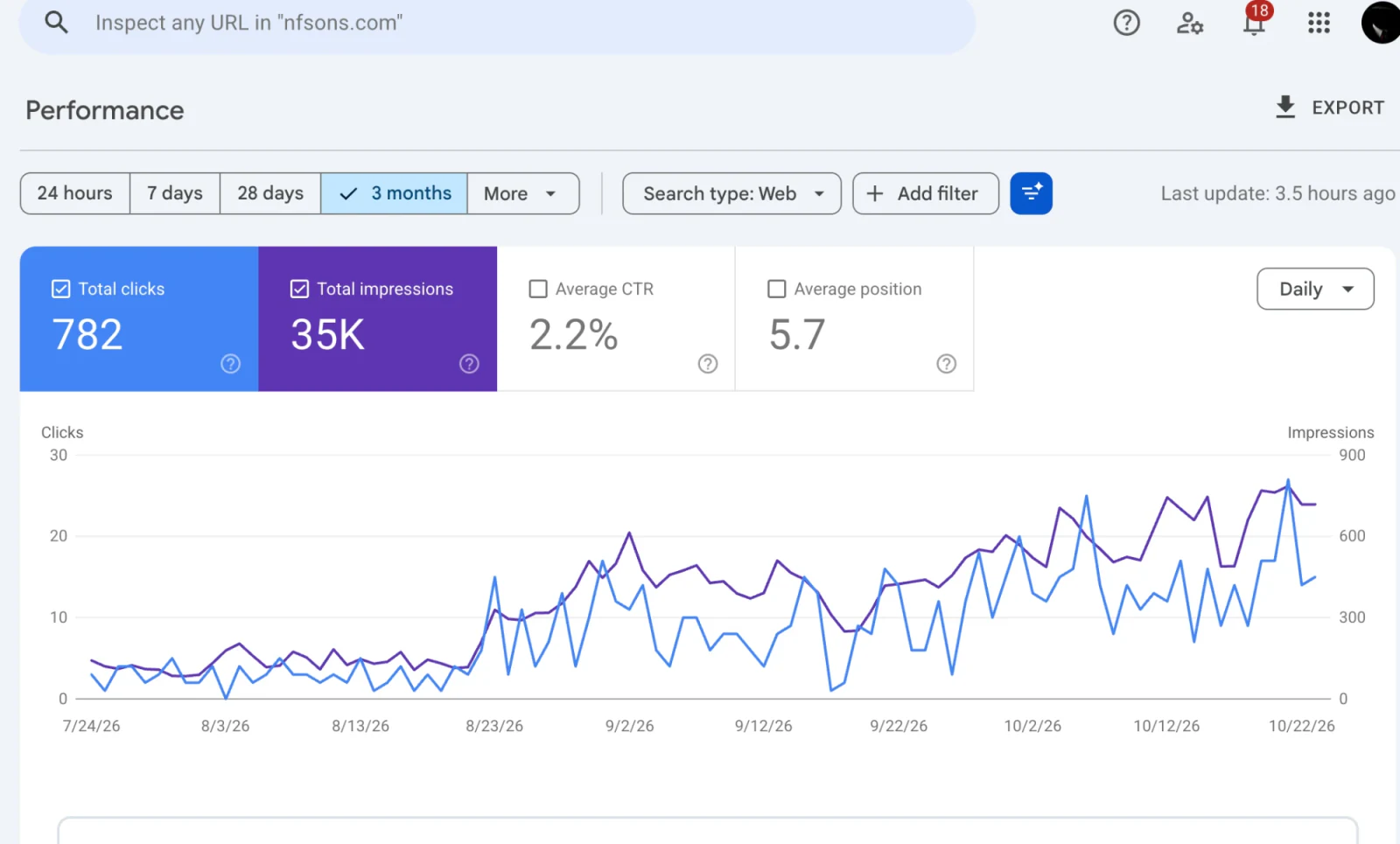
Google Search Console, nfsons.com, 24 July to 22 October 2026: 782 clicks, 35K impressions, 2.2% CTR, average position 5.7. On-page SEO and content only; no link building.
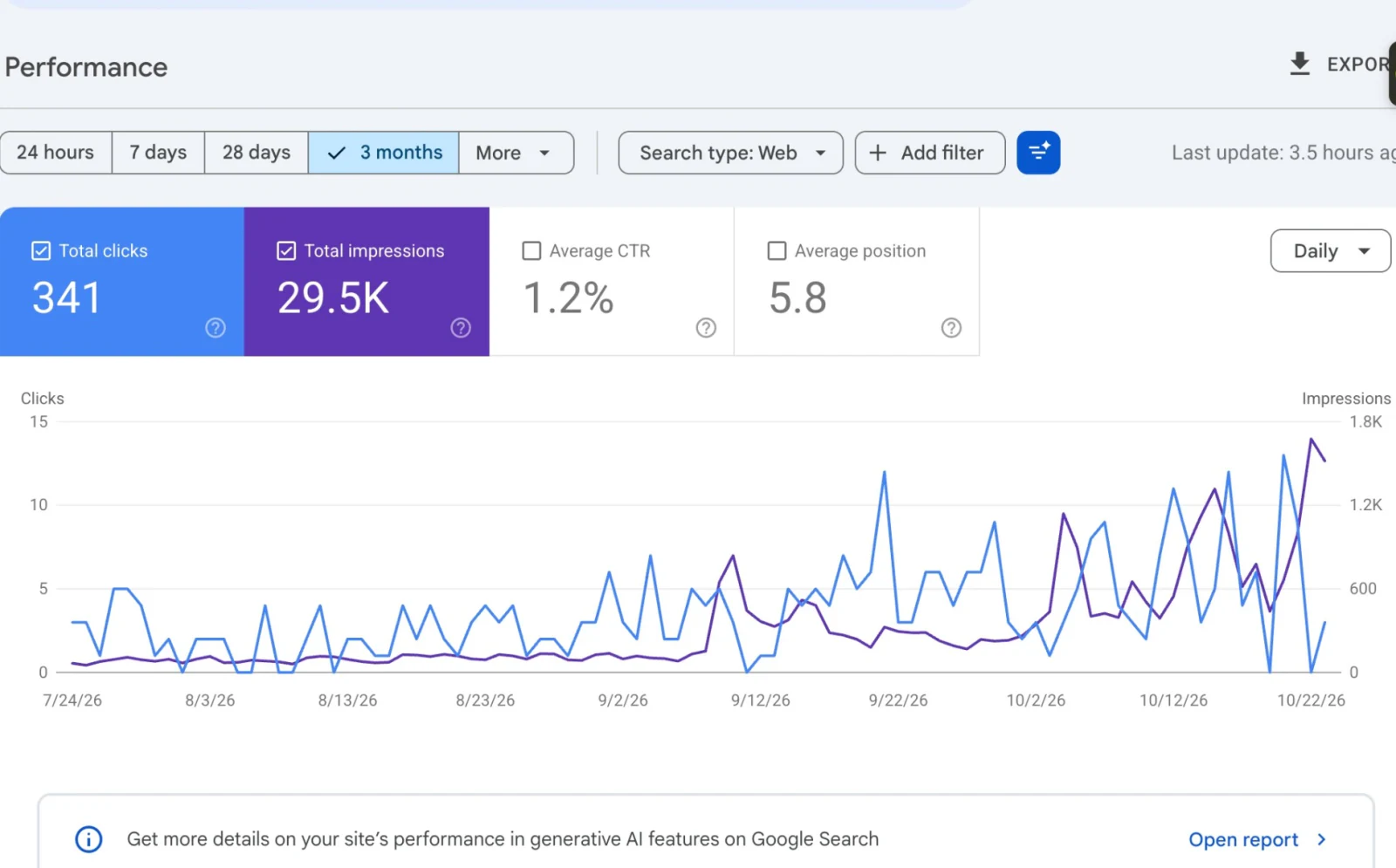
Google Search Console, pktransporters.com, 24 July to 22 October 2026: 341 clicks, 29.5K impressions, 1.2% CTR, average position 5.8. On-page SEO and content only; no link building.
A new, small site needs authority. The Hungry Pelican is a five-page cafe site that Google barely knew in May 2025. Local link building, 17 backlinks from 12 domains, took it from 10 to 95 ranking keywords in about eleven weeks.
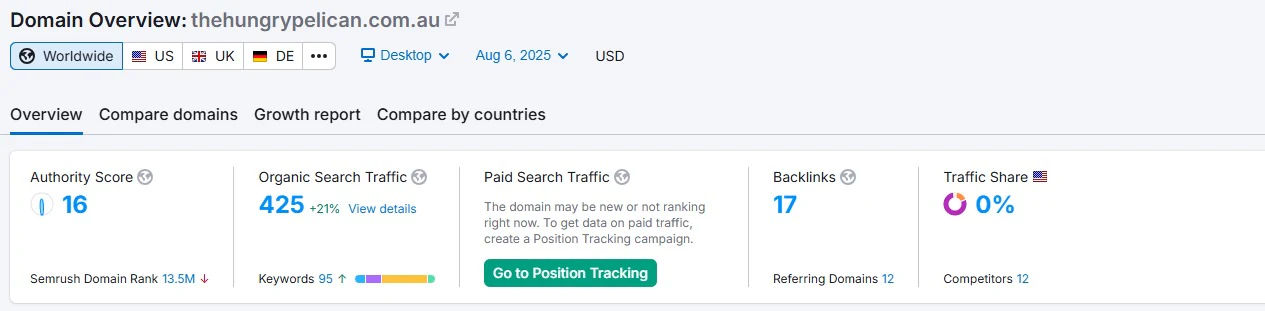
Semrush, thehungrypelican.com.au, 6 August 2025: Authority Score 16 (unrated in May), 95 keywords (10 in May), 17 backlinks from 12 referring domains (0 in May).
A big site needs technical work first. DSL Warehouse, an online store with thousands of product pages, had redirect, linking and content problems across more than 100 pages. Once fixed, Search Console recorded 91,700 impressions in about eight weeks of data.
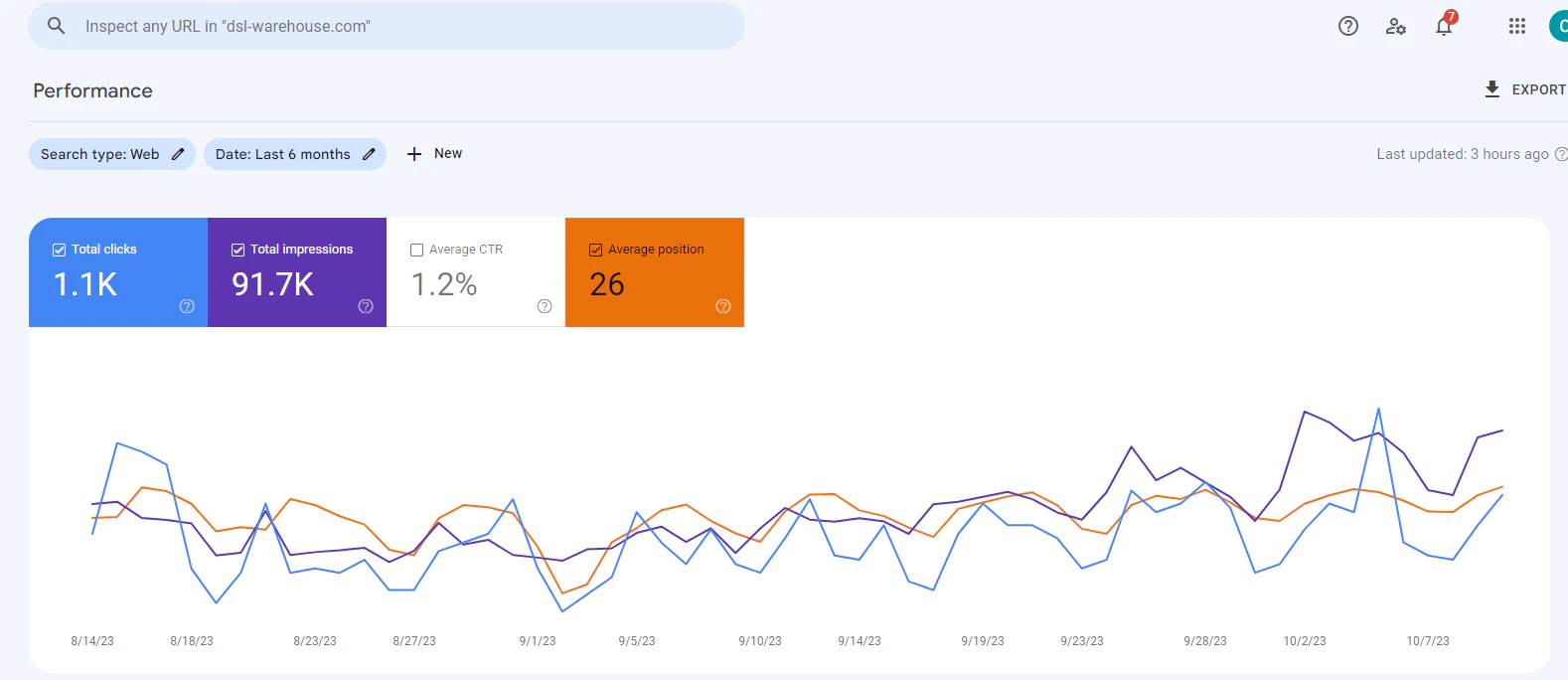
Google Search Console, dsl-warehouse.com, data from mid-August to early October 2023: 1.1K clicks, 91.7K impressions, 1.2% CTR, average position 26.
The point for a buyer is simple. Anyone who sells the same SEO package to every business has not looked at your site. The right campaign depends on whether your problem is structure, authority or technical health.
How Long It Takes
The honest answer is four months to a year for most businesses, faster in small local markets, slower for competitive national terms.
Google's own guidance gives that four-to-twelve-month range. Ahrefs found that only a small share of new pages reach Google's top 10 within a year at all: 1.74% of a random sample of a million URLs, rising to about 6% when only real English content pages are counted. Pages that rank do so because someone made them deserve it.
Our client data fits that picture. The Hungry Pelican moved within weeks, but it is a cafe in a regional town with modest competition. Naffees & Sons and PK Transporters show steady climbs over three months after launch. We go through the timeline month by month in how long SEO takes, and what to do in the first three months of a new site in SEO for a new website.
Getting Found in AI Search Too
AI answers now sit above the search results for many questions, and they change who gets the click.
A Pew Research Center study of 900 US adults' real browsing found that when Google showed an AI summary, people clicked a traditional result on 8% of visits, against 15% when it did not. Only 1% clicked a link inside the summary itself. Fewer clicks are available for informational questions, and the ones that remain go to sources the AI trusts.
What does not change is that AI tools build their answers from the web. The pages that get quoted are the ones that state an answer plainly, use comparison tables, answer real questions in FAQ form, and describe the business consistently everywhere it appears. That is the same content good SEO produces, which is why we build it into the same work rather than selling it as a separate product. And for a local business, the searches that matter most, someone looking for a builder, a cafe or a haulier near them right now, are still decided on Google's map and results.
The Competitor Pulse Check
| Factor | ValueStreamAI approach | Typical web agency | Typical SEO agency |
|---|---|---|---|
| Builds the site | Yes, websites, web apps and AI platforms | Yes | No; often asks for a rebuild |
| Keyword research before design | Yes, it decides the pages | Rarely | After the site exists |
| Markets it afterwards | Yes, same team | Sold back as a separate retainer | Yes |
| Follow-up automation | Yes, forms, CRM and AI follow-up | No | No |
| Proof | Unedited Search Console data for named clients | Portfolio screenshots of designs | Selected rank charts |
Two points from our own experience sit behind this table. First, one project is never one skillset: a site that ranks and converts needs design, development, content, technical SEO and automation, and hiring each in-house is several roles. Second, ask who you will actually work with. The founder who sells you the project should still be on the calls when it is being built and marketed. At ValueStreamAI, Syed Rayyan, who wrote this guide, leads the marketing side himself.
Human Hours vs Automation: Following Up Every Enquiry
Marketing produces enquiries. Answering them quickly is where most small businesses lose the customer, so here is that job priced both ways.
Assumptions: each enquiry takes about 10 minutes by hand to read, reply to, log in a spreadsheet or CRM, and chase once. Light, typical and heavy volumes of 20, 50 and 100 enquiries a week, over 52 weeks. The hourly rate is the US median for secretaries and administrative assistants, about $22.82 an hour (Bureau of Labor Statistics, May 2024), base pay only. After automation, we assume 15% of the time remains for a person to review replies and handle the enquiries that need a human. Automation is never zero people.
| Volume | Hours by hand a year | Cost by hand | Human time with automation | Cost with automation |
|---|---|---|---|---|
| 20 enquiries a week | ~173 | ~$3,950 | ~26 hours | ~$590 |
| 50 enquiries a week | ~433 | ~$9,880 | ~65 hours | ~$1,480 |
| 100 enquiries a week | ~867 | ~$19,780 | ~130 hours | ~$2,970 |
The other side of the ledger: a follow-up automation build starts from $5,000, plus maintenance. At 20 enquiries a week the hours saved take about a year and a half to cover a $5,000 build, and we would say so. From around 50 a week, they cover it in well under a year.
What the numbers leave out: speed. An enquiry answered in two minutes at 9pm is worth more than one answered at 10am the next day, and that difference does not show up in an hourly rate. Run your own numbers in the hire vs automate calculator.
What It Costs
Your site, your market, and whether SEO is worth it for you yet.
- Where you rank today
- What is holding the site back
- A straight answer if ads are better for now
Website, web app or AI platform built for search. Most fall between $5,000 and $15,000.
- Keyword research first
- Content and schema at launch
- 2 to 6 months free support
Content, technical SEO, links where needed, and lead follow-up automation.
- Monthly Search Console reporting
- No long contract
- Sized to your market
Our builds with launch SEO start at $5,000, and most fall between $5,000 and $15,000 depending on the number of pages, integrations and content. Every build includes 2 to 6 months of free post-launch support. Ongoing marketing retainers start at $900 a month. For market context, an Ahrefs survey of 439 SEO providers found the most common monthly retainer was $501 to $1,000, and the average about $2,917. The full breakdown, including what cheap packages leave out, is in website design and SEO packages: what they cost.
Who should not buy this. If you need customers this month, start with Google Ads, not SEO. If your business will not exist in its current form in a year, do not invest in long-term rankings. And if you only need a simple brochure site in a market with no competition, a template builder may be enough; we explain when in custom website vs template builder. We would rather tell you that on the first call than sell you a retainer you do not need.
The Full Series
| Question | Guide |
|---|---|
| I built an app with AI. Why is nobody finding it? | Coding is easy, distribution is hard |
| How do I launch and market an AI product? | How to market an AI product |
| Should I spend on SEO or Google Ads? | SEO vs Google Ads, priced with real clicks |
| How long will it take? | How long SEO takes: nine client sites |
| What should it cost? | Website design and SEO packages |
| I am launching a new site. What first? | SEO for a new website: the first 90 days |
| I run a restaurant or cafe. | Restaurant and cafe SEO |
| My site has hundreds of pages and something is wrong. | What a technical SEO audit includes |
| We have decades of experience nobody online can see. | Marketing an established business online |
| Isn't our Google Business Profile enough? | Why a map listing is not SEO |
| Will AI content get us penalised? | AI content and Google's spam policies |
| Show me the results. | Nine client sites · The Hungry Pelican · DSL Warehouse · Souvlaki Place · Forest Hills Lab · First Source · Serenity at Heart · iPeepbxs |
| How should the site be built in the first place? | Web development for search visibility |
Frequently Asked Questions
Is it better to hire one company for website development and SEO?
Usually, yes. When one company builds the site and another markets it, the marketer often has to fix or rebuild parts of the site before marketing can start. One team that does keyword research before the build, launches with content and markets afterwards avoids that rework, and is accountable for whether the site is found.
How long does it take for a new website to show up on Google?
A new site can be indexed within days of submitting a sitemap, but ranking for searches that matter takes longer. Google's own guidance is four months to a year. Two sites we built in 2026 reached average positions under 6 within three months of their Search Console windows starting.
Is SEO or Google Ads better for a new business?
Google Ads is faster, and SEO lasts. A new business with no rankings often runs a small ads budget for the first few months while SEO builds, then reduces it as organic traffic grows. The average 2026 cost per click across industries was $5.42 in LocaliQ's benchmarks.
I built my app with AI tools. Can you market it?
Yes. We usually start by reviewing the build for search and conversion problems, because AI-built apps often launch without pages a search engine can match to a buyer's question. Then we market it with content, SEO and, where it fits, a launch ads budget.
How much do website development and SEO cost together?
Our builds with launch SEO start at $5,000, most between $5,000 and $15,000, and ongoing marketing retainers start at $900 a month. An Ahrefs survey of SEO providers put the average monthly retainer at about $2,917.
Does AI search mean SEO no longer works?
No, but it changes which clicks are available. Pew found people clicked a regular result on 8% of visits when Google showed an AI summary, against 15% without one. AI tools build their answers from web pages, so clear, factual content that answers questions is what gets cited, and local searches are still decided on Google's results.
Can I see real results before I hire you?
Yes. Our case studies show unedited Search Console and Semrush screenshots for named clients, with date ranges on every image, including two sites where the chart is flat.
What's Next
If you have a website or app that nobody finds, or you are about to build one and want it found from day one, start with a free call. We will look at where you stand and tell you plainly what it would take, including when ads or a template are the better answer.
→ See our SEO and digital marketing services
→ See unedited results from nine client sites
→ Read: coding is easy, distribution is hard
→ See what building and marketing costs, or talk to us about your site
Syed Rayyan is co-founder of ValueStreamAI, leading research and marketing. He has run SEO for client websites since 2020, across technical audits, on-page work and link building, and leads the marketing side of every build. He also runs the firm's evaluation of emerging AI tooling and translates technical capability into clear guidance for non-technical decision-makers. Connect on LinkedIn →