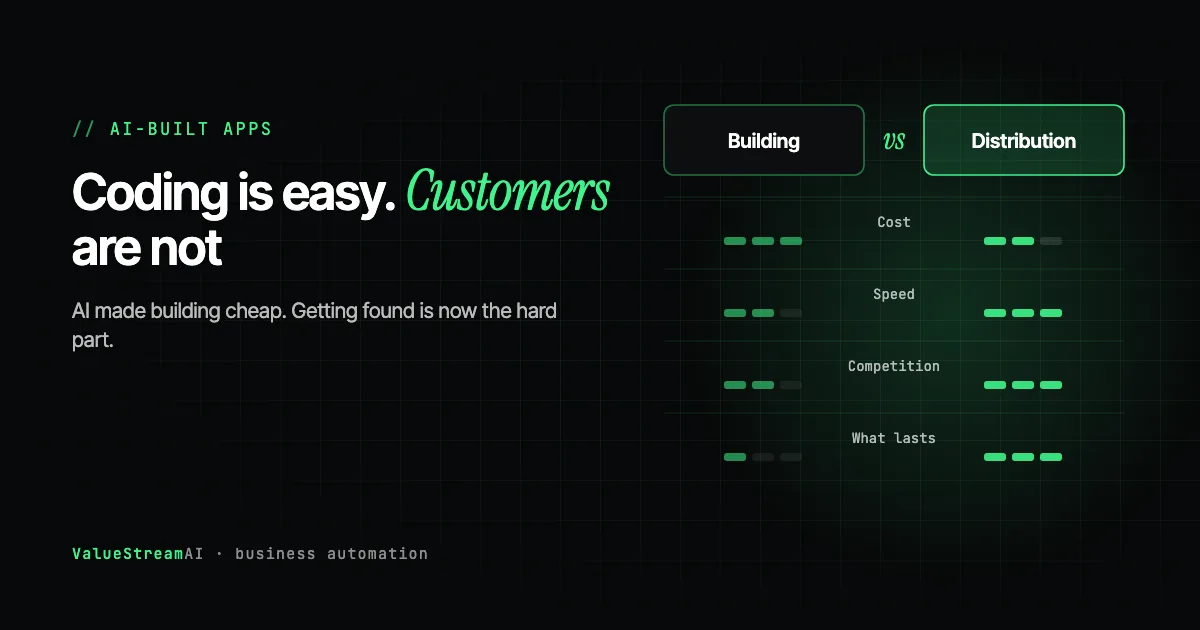
You can now go from idea to working app in days with an AI coding tool. It works, it looks good, and then very often nothing happens. Nobody finds it. The founder expected building to be the hard part, and it turned out to be the easy part.
That is now the normal story, and the numbers show it. This guide is for the non-technical founder or business owner who has built (or is about to build) an app, platform or website with AI, and needs to know how to get users for your app without wasting the money AI saved on the build. It covers why distribution got harder, what to fix in an AI-built app before you spend a penny on marketing, which channels actually work, and what it costs.
| Metric | 2026 Benchmark |
|---|---|
| New App Store apps, H1 2026 (Sensor Tower) | About 560,000, roughly double the prior year's pace |
| App Store downloads, H1 2026 | 17.6 billion, up 2% |
| Experienced developers using AI on mature code (METR, 2025) | 19% slower, while feeling faster |
| Average Google Ads cost per click (LocaliQ, 2026) | $5.42 |
| Visits clicking a result when Google shows an AI summary (Pew, 2025) | 8%, vs 15% without |
The short answer. AI coding tools made it cheap to build, so far more products now compete for the same customers. Before you market an AI-built app, make sure search engines can read it, give each audience its own page, and add a way to capture sign-ups. Then launch to people you can reach directly, test your message with a small ads budget, and build search traffic that keeps working after the ads stop. Budget for marketing at least what you spent building.
Key takeaways
- Supply exploded, demand did not. New apps roughly doubled in a year; downloads grew 2%.
- Many AI-built apps are hard for Google to read. Fix rendering, pages and titles before marketing.
- There is no single channel. Launch to your own network, test with ads, and build SEO for the long run.
- Marketing costs at least as much as the build now. The build got cheap; customers did not.
- The demo is not the product. A good-looking app tells customers nothing about whether it solves their problem.
Why Getting Customers Became the Hard Part
The answer is supply. When building gets cheap, everyone builds, and the number of products competing for each customer's attention goes up.
Sensor Tower's figures, reported by The New York Times in July 2026, show it clearly. About 560,000 new apps reached the App Store in the first half of 2026, nearly as many as the roughly 600,000 released in all of 2025, and well above the recent low of about 420,000 in 2022. Downloads rose 2%, to 17.6 billion. The coverage widely attributes the surge to "vibe coding": building software by describing it to an AI rather than writing the code.
The same thing is happening on the web, just less visibly. Every week, thousands of new SaaS products, AI tools and small business sites go live, built in days rather than months. Most of them are competently built. Most of them are found by almost nobody.
That is why we say coding is easy now, and distribution is hard. Distribution means the ways customers find you: search, ads, communities, partners, app stores, word of mouth. None of it got cheaper or faster because AI writes code.
The Catch in "AI Made Coding Easy"
AI made starting easy. It did not make everything about software easy, and that matters for how you judge what you have built.
A non-technical founder can now get a working first version in days with tools like Lovable, Bolt or Replit.
In METR's 2025 trial, experienced open-source developers took 19% longer with AI tools on their own large codebases, while believing they were faster.
Downloads grew 2% in H1 2026 while new apps roughly doubled. AI did nothing for distribution.
A randomised trial by the research group METR in 2025 gave 16 experienced open-source developers 246 real tasks on large codebases they knew well, with and without AI tools. With AI, they took 19% longer, while believing afterwards that the tools had made them about 20% faster. It is one small study on early-2025 tools and very experienced developers, and it does not mean AI tools are useless. It does mean that "it felt fast" and "it was fast" are different claims.
For a founder, the practical point is narrower. The parts of software AI handles best are the parts you see first: screens, flows, a working demo. The parts it handles worst are the invisible ones: how the app behaves when something goes wrong, how it stores data, how it handles a thousand users instead of ten, and whether a search engine can read it. A polished demo used to cost about what competence cost. It no longer does. So the fact that your app looks finished tells you very little about whether it is ready to market.
This is not an argument against building with AI. We use AI tools heavily ourselves. It is an argument for checking the invisible parts before you spend money sending people to the visible ones. Our guide on choosing an AI development company gives four questions that surface the difference, and they work just as well on an app you built yourself.
What to Fix Before You Spend on Marketing
The short answer: make sure Google can read every page, give each audience and use case its own page, and give visitors a way to sign up or get in touch. Marketing an app that fails these checks is paying to send people to a door that is locked.
1. Can search engines read your pages?
Many AI app builders have produced single-page apps that build each page in the visitor's browser with JavaScript. A search engine fetching the page first sees a near-empty shell. Google can render JavaScript, but slowly and not always completely, and many AI crawlers do not render it at all. Lovable's own deployment FAQ says its React single-page apps are client-rendered by default and recommends enabling prerendering so crawlers receive full HTML. Some builders have since moved new projects to server rendering, so check which yours uses rather than assuming.
The test anyone can run: open your page, choose "View page source" in the browser, and search for a sentence you can see on screen. If it is not in the source, a crawler may not see it either.
2. Does each audience get its own page?
A single landing page that tries to speak to everyone ranks for nothing. If your app serves dentists and physiotherapists, each needs a page. If it solves three problems, each needs a page. If you sell in five cities, each may need one. This is how Naffees & Sons and PK Transporters, two businesses whose sites we built, reached average Google positions of 5.7 and 5.8 within three months with no link building at all: a page for each thing a buyer searches for.
3. Does every page have its own title and description?
AI-built apps often ship with one title on every page, usually the app's name. Each page needs a title that says what it is about in the words people search, and a description that reads like an answer.
4. Is the site connected to Google?
Add a sitemap, verify the site in Google Search Console and submit the sitemap. Without it you are guessing. With it, you can see within days which pages Google has indexed and which searches you appear for.
5. Can a visitor become a lead?
A sign-up, a booking form, a WhatsApp button, a demo request: something that turns a visit into a conversation, and something that follows up automatically when they do. Our guide to AI lead follow-up covers that side.
Before spending on marketing, check that search engines can read each page, that each audience has its own page, that pages have their own titles and descriptions, that the site is connected to Google Search Console with a sitemap, and that visitors can sign up or get in touch. Fix any that fail, then start marketing.
Which Marketing Channels Work for a New App
There is no single channel. The founders who get traction combine one fast channel to learn, and one slow channel that lasts.
Search: slow to start, then it lasts. People search for the problem your app solves long before they search for your app's name. A page that answers "how to schedule staff rotas for a small clinic" can bring in the right users every day for years. Google's own guidance is that SEO usually takes four months to a year, so start it on day one, not when the ads stop working.
Google Ads: fast, and it stops when you stop. At an average of $5.42 a click across industries in LocaliQ's 2026 benchmarks, ads are the quickest way to find out whether your message works. Use a small budget to learn which headline and which audience convert, then put that learning into your pages. We compare the two in detail in SEO vs Google Ads.
Communities you already belong to. Industry groups, forums and professional networks where you are a known member. Cheap and fast, but it does not scale on its own, and it only works if you are useful there rather than promotional.
Launch sites and directories. A launch on a product directory can bring a spike of attention. Treat it as a spike, not a channel: in our SEO results portfolio, two of the nine client sites show exactly that shape, one burst of traffic and then a flat line.
Partnerships and integrations. If your app works with a tool your customers already use, that tool's marketplace and partner pages can be a steady source of users.
App Store optimisation. For a mobile app, your store listing's title, screenshots and description matter as much as a website's pages do. With twice as many new apps competing, a listing that says clearly who the app is for stands out.
What Search Looks Like When It Works
The best evidence that search compounds is a before-and-after on the same site. The Hungry Pelican, a small cafe in Queensland, is not an app, but its numbers show what happens when a new domain with no authority is marketed properly.
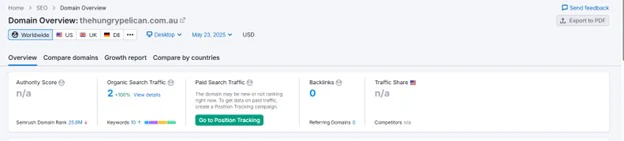
Before: Semrush, thehungrypelican.com.au, 23 May 2025. No Authority Score, 10 keywords, 0 backlinks.
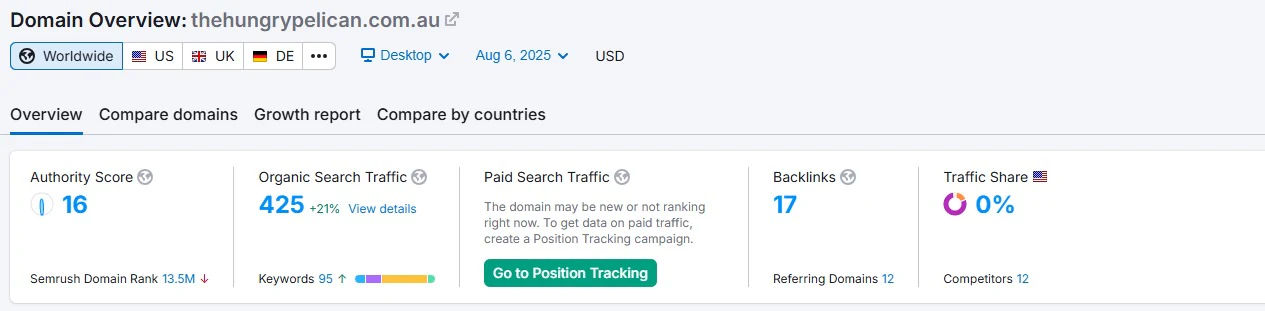
After: Semrush, thehungrypelican.com.au, 6 August 2025. Authority Score 16, 95 keywords, 17 backlinks from 12 referring domains.
Ten keywords to 95 in about eleven weeks. The full story, and what it would have cost to buy the same clicks, is in The Hungry Pelican case study. A new app domain starts in exactly the same place: unknown to Google, with no links and no authority.
A Realistic Six-Month Plan
Weeks 1 to 2: fix the build. Rendering, one page per audience, titles and descriptions, sitemap, Search Console, sign-up capture.
Weeks 2 to 4: launch to people you can reach. Your own network, the communities you belong to, relevant directories. The goal is the first fifty real users and their feedback, not traffic.
Months 1 to 3: test the offer with a small ads budget. Learn which message and which audience convert. Keep the budget small; you are buying information.
Months 1 to 6: build search. Pages for the problems your users search for, comparison pages against the alternatives, answers to their questions. This is the part that is still working in month twelve.
Months 4 to 6: cut what does not earn its cost. As organic sign-ups grow, reduce the ads to the campaigns that still pay for themselves.
The Competitor Pulse Check
| Factor | ValueStreamAI approach | Marketing-only agency | Doing it yourself |
|---|---|---|---|
| Fixes the build for search | Yes, we are developers | Asks you to find a developer | Possible if you know what to check |
| Pages for each audience | Built and written | Written, if the site allows it | Time you are not spending on the product |
| Ads and SEO together | One plan, one team | Often ads-led | Hard to judge what is working |
| Sign-up capture and follow-up | Built and automated | Not their job | Manual |
| Proof | Unedited Search Console data for named clients | Case studies | None yet |
Human Hours vs Automation: Replying to Every New Sign-Up
A launch that works brings sign-ups and enquiries faster than a founder can answer them. Here is that job priced both ways.
Assumptions: 8 minutes per new sign-up or enquiry to read it, reply personally, log it and send one follow-up. Light, typical and heavy volumes of 25, 75 and 150 a week, over 52 weeks. The hourly rate is the US median for secretaries and administrative assistants, about $22.82 an hour (Bureau of Labor Statistics, May 2024), base pay only. A founder's own hour is worth more. After automation, 15% of the time remains for a person to handle replies that need a human.
| Volume | Hours by hand a year | Cost by hand | Human time with automation | Cost with automation |
|---|---|---|---|---|
| 25 a week | ~173 | ~$3,960 | ~26 hours | ~$590 |
| 75 a week | ~520 | ~$11,870 | ~78 hours | ~$1,780 |
| 150 a week | ~1,040 | ~$23,730 | ~156 hours | ~$3,560 |
The other side of the ledger: a follow-up automation build starts from $5,000, plus upkeep. At 25 a week the saving takes well over a year to cover that; at 75 or more, it covers it within the first year. What it leaves out: speed, which matters more than hours. A sign-up welcomed in two minutes converts better than one welcomed tomorrow. Run your own numbers in the hire vs automate calculator.
What It Costs to Market an App
The honest rule of thumb in 2026: budget at least as much for getting customers as you spent on building. The build got cheap; the customers did not.
For context, an Ahrefs survey of 439 SEO providers found the most common monthly SEO retainer was $501 to $1,000, with an average of about $2,917. Our own builds with launch SEO start at $5,000, and ongoing marketing retainers at $900 a month. If you have already built the app yourself, we start with a review of the build for search and conversion problems, then market it.
Who should not spend on marketing yet: if you have not yet confirmed that ten people want what you built, talk to those ten people first. Marketing amplifies a product that works; it cannot rescue one that does not. And if you need a few early customers this month, a small, tightly targeted ads campaign will tell you more, faster, than any SEO work.
Frequently Asked Questions
How do I get users for an app I built with AI?
Fix the build first: make sure search engines can read every page, give each audience its own page, and add sign-up capture. Then launch to people you can reach directly, test your message with a small ads budget, and build search traffic that keeps working. Budget at least as much for marketing as you spent building.
Is an app built with Lovable or Bolt bad for SEO?
Not necessarily, but check how it renders. Lovable's own documentation says its React single-page apps are client-rendered by default and recommends prerendering so crawlers receive full HTML. Open "View page source" on a live page: if the text you see on screen is not in the source, fix rendering before marketing.
Why is nobody finding my new app?
Usually for three reasons together: search engines cannot fully read the pages, there is one page trying to speak to everyone, and nobody outside the founder's network has been told it exists. New App Store apps roughly doubled in a year while downloads grew 2%, so launching is no longer enough to be noticed.
Should I use Google Ads or SEO to launch an app?
Both, for different jobs. Ads are fast and tell you which message works; they stop the day you stop paying. SEO is slow, typically four months to a year by Google's own guidance, but the traffic keeps coming. Start both early and shift budget towards SEO as it grows.
How much should I spend marketing a new app?
At least as much as you spent building it. Our marketing retainers start at $900 a month, and an Ahrefs survey put the average SEO retainer at about $2,917 a month. If you have not yet confirmed people want the product, spend on talking to users before spending on marketing.
Can you market an app another developer built?
Yes. We start with a review of the build for search and conversion problems, fix what blocks marketing, and then run the marketing. We build websites, web apps and AI platforms ourselves, so we can make the fixes rather than send you back to the original developer.
What's Next
If you have built an app, platform or website and need customers to find it, start with a free call. We will check whether search engines can read it, tell you what to fix first, and give you a realistic plan and budget.
→ See our SEO and digital marketing services
→ Read the full guide: build it and market it
→ How to market an AI app or SaaS launch
→ See what building and marketing costs, or talk to us about your site
Syed Rayyan is co-founder of ValueStreamAI, leading research and marketing. He has run SEO for client websites since 2020, across technical audits, on-page work and link building, and leads the marketing side of every build. He also runs the firm's evaluation of emerging AI tooling and translates technical capability into clear guidance for non-technical decision-makers. Connect on LinkedIn →