Marketing an AI product in 2026 has three problems ordinary software does not. Buyers are wary of AI in a way they are not wary of, say, accounting software. Every competitor makes the same claim ("AI-powered", "saves hours", "agentic"), so the claim says nothing. And a growing share of buyers now ask ChatGPT, Perplexity or Google's AI for a recommendation before they ever see your site.
This guide is a launch plan for the non-technical founder who has built, or paid to build, an AI app, platform or SaaS and needs to know how to market an AI product to people who will pay for it. It covers positioning wary buyers trust, the pages that rank, the proof that persuades, how AI assistants decide what to recommend, and how to budget.
| Metric | 2026 Benchmark |
|---|---|
| People wary of AI's trustworthiness (Melbourne and KPMG, 47 countries) | 54% |
| New App Store apps, H1 2026 (Sensor Tower) | About 560,000, roughly double the prior year's pace |
| Visits clicking a result when Google shows an AI summary (Pew, 2025) | 8%, vs 15% without |
| Average Google Ads cost per click (LocaliQ, 2026) | $5.42 |
| US searches that send a click to any website (SparkToro, 2024) | About 36% |
The short answer. Position your AI product around one job for one type of buyer, not around the AI. At launch, publish a page for each use case and audience, fair comparison pages against the tools buyers already use, a published price, a plain-English data and security page, and real proof. Test your message with a small ads budget, build search content that keeps working, and make sure the facts about your product are consistent everywhere, because that is what AI assistants repeat.
Key takeaways
- Sell the job, not the AI. "Books your appointments" beats "AI-powered scheduling agent".
- Wary buyers need answers before a demo. Price, data handling and proof, on the site.
- Comparison pages are where buyers decide. Write fair ones against the incumbents.
- AI assistants recommend what the web consistently says. Keep your facts the same everywhere.
- Demos are cheap now. Results are not. Lead with real outcomes.
Why AI Products Are Harder to Market
The answer is trust and sameness. Buyers are wary of AI, and every AI product sounds alike.
The University of Melbourne and KPMG's 2025 global study of trust in AI, which surveyed 48,340 people in 47 countries, found that while 73% report benefits from AI, 54% remain wary of its trustworthiness. A business buyer considering an AI tool is usually asking three questions before they ask about features: where does my data go, what happens when it gets something wrong, and what will it cost when usage grows?
Sameness is the second problem. Search any category and the top results all claim to be AI-powered, to save hours and to be easy to set up. When everyone makes the same claim, buyers discount it entirely. And because AI tools made building cheap, there are more of these products than ever: Sensor Tower data shows new App Store apps roughly doubling in a year while downloads grew 2%. We explore that wider shift in coding is easy, distribution is hard.
Positioning: Sell the Job, Not the AI
The short answer: describe the job your product does for one type of buyer, in the words that buyer uses.
A clinic manager does not search for "agentic AI scheduling orchestration". They search for "automatic appointment reminders" or "reduce no-shows". A logistics coordinator searches "extract data from bills of lading", not "intelligent document processing". Your positioning should start from those searches. The AI is how the product does the job; it is not the reason anyone buys.
Three tests for your homepage headline:
- Would a buyer type these words into Google? If not, they will not find it.
- Could a competitor use the same sentence? If yes, it says nothing.
- Does it name who it is for? "For independent physiotherapy clinics" is worth more than "for businesses of all sizes".
A related warning, from what we see when we are asked to review products before marketing them: a polished demo is no longer evidence of a working product. AI made demos cheap to produce. Buyers increasingly know this, so the founders who win lead with outcomes customers have measured, not with the demo.
The Pages That Win at Launch
Use-case and audience pages
One page per job and one per type of buyer. These are what search engines rank and what assistants cite. A single homepage trying to speak to everyone ranks for nothing. This is the same principle that took two sites we built, Naffees & Sons and PK Transporters, to average Google positions of 5.7 and 5.8 within three months without any link building: a page for each thing a buyer searches.
Alternatives and comparison pages
Searches like "{competitor} alternatives" and "{your product} vs {competitor}" are some of the highest-intent searches there are: the buyer has a budget and is choosing. Write these fairly. Say who the competitor suits better, cite their own pricing page with the date you checked it, and never invent ratings. A comparison that only praises you reads as an ad and does not get cited by search engines or by AI assistants. A fair one does.
A published price
AI products often have usage-based costs, and buyers have heard stories of surprise bills. A clear pricing page, including what happens at higher usage, removes one of the biggest reasons not to try. "Contact us for pricing" on a self-serve AI tool loses buyers who will not book a call to find out.
A data and security page in plain English
Which AI models you use, whether customer data is used for training, where it is stored, what is logged, and how a customer deletes it. For healthcare, finance and legal buyers this page is read before the homepage. Write it for a non-technical reader.
A proof page
Named customers, real numbers, dated screenshots. If you have no customers yet, run a small paid pilot with two or three and measure it honestly. We publish unedited Search Console results for our own clients, including the flat ones, in our SEO results portfolio, because a results page that shows only the best chart persuades nobody who has seen a few.
Getting Recommended by AI Assistants
AI assistants recommend what the web consistently says about a product. You cannot pay for a recommendation, but you can make yourself easy to recommend.
When a buyer asks an assistant for "the best AI scheduling tool for a small clinic", the assistant typically searches the web, reads comparison and review pages, and names products that the sources it trusts describe consistently. The practical steps:
- Answer-first pages. Each use-case page should state, in its first two sentences, what the product does and who it is for. That is what gets quoted.
- Comparison tables and FAQs. Assistants extract tables and question-and-answer blocks cleanly.
- Consistent facts everywhere. Your price, your main use case and your target customer should read the same on your site, your directory listings, your app store page and your founder's profiles. Contradictions make an assistant less likely to state anything about you.
- Third-party mentions. Directory listings, partner pages and reviews on sites assistants already read.
This matters, but keep it in proportion. Pew Research Center found people clicked a regular result on 8% of Google visits that showed an AI summary, against 15% without one, so informational traffic is shrinking. Searches with clear buying intent, "{product} pricing", "{competitor} alternative", still send people to websites, and those are the ones that sign up.
A 90-Day Launch Plan
Days 1 to 14: fix the build for search. Make sure crawlers can read your pages (many AI-built apps render in the browser; check "View page source"), give every page its own title and description, add a sitemap and verify the site in Google Search Console. Add sign-up capture and an automated welcome.
Days 7 to 30: publish the six pages. Use cases, audiences, alternatives, pricing, data and security, proof.
Days 14 to 45: launch to people you can reach. Founders' networks, the communities your buyers are in, relevant directories and launch sites. Expect a spike, not a channel.
Days 30 to 90: test messages with a small ads budget. At an average of $5.42 a click in LocaliQ's 2026 benchmarks, a few hundred dollars tells you which headline and which audience convert. Put what you learn into your pages.
Days 30 onwards: build search content. One substantial page a week on a problem your buyers search for. This is the part still working in month twelve. Google's own guidance is that SEO usually takes four months to a year, so start now. We set out the realistic timeline in how long SEO takes.
First fix the build so search engines can read it and sign-ups are captured. Then publish use-case, audience, alternatives, pricing, data and proof pages. Launch to people you can reach directly, test messages with a small ads budget, and build search content that keeps working, feeding what the ads teach you back into the pages.
What Search Growth Looks Like From Zero
A new product domain starts where any new business does: unknown to Google, no links, no authority. The closest analogue in our client data is The Hungry Pelican, a small cafe site that went from 10 to 95 ranking keywords in about eleven weeks once it was marketed properly.
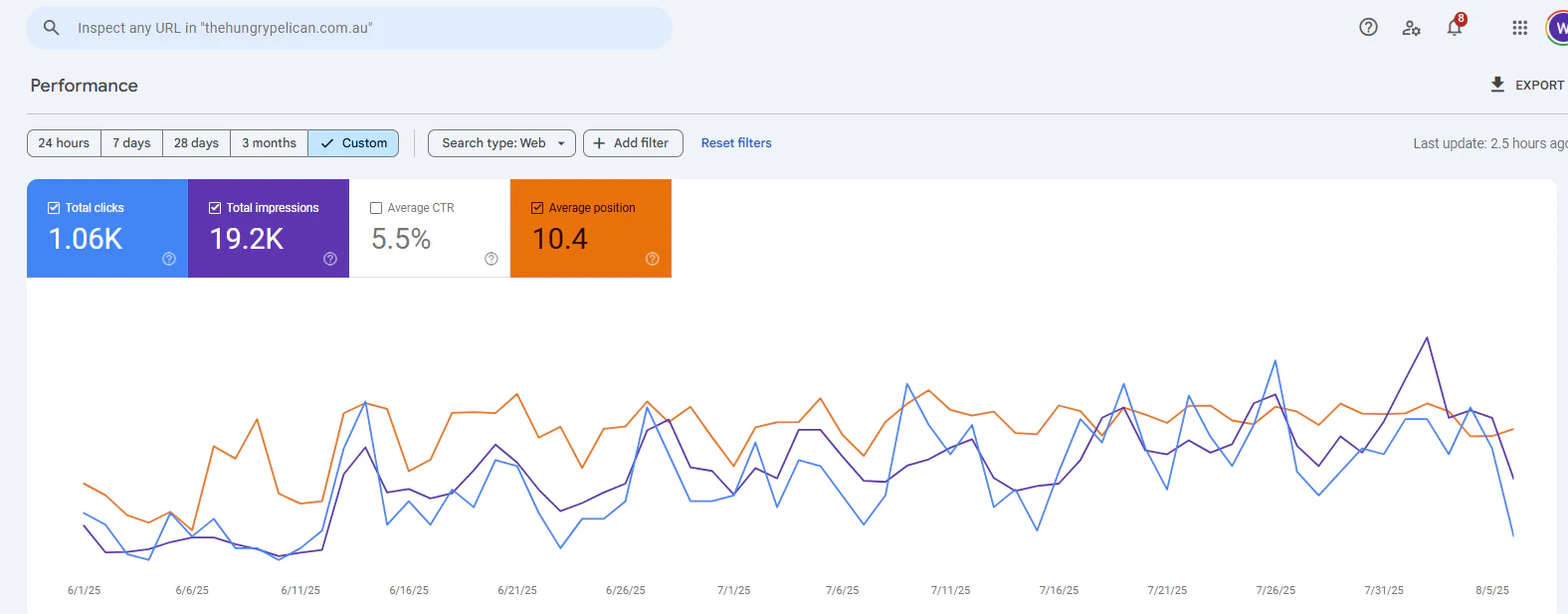
Google Search Console, thehungrypelican.com.au, 1 June to 5 August 2025: 1.06K clicks, 19.2K impressions, average position 10.4. Flat in early June, rising from mid-June.
The shape is the lesson: flat, then a lift once the domain earns some trust. An AI product in a crowded category will take longer than a cafe in a regional town, but the shape is the same. Read the Hungry Pelican case study for what drove it.
Budget
- SEO and content45%45
- Test ads20%20
- Proof and case studies15%15
- Communities and partnerships10%10
- Lead follow-up automation10%10
The rule of thumb we give founders: budget at least as much for getting customers in the first year as you spent building. If the build cost $10,000, plan a first-year marketing budget of at least that. The split above is our suggestion for a product with no audience yet, weighted towards search because it compounds; it is not survey data.
For context, an Ahrefs survey of 439 SEO providers found the average monthly SEO retainer was about $2,917. Our marketing retainers start at $900 a month, and builds with launch SEO from $5,000. Our website design and SEO packages guide explains what different budgets buy.
Who should not spend on marketing yet: if ten real users have not yet confirmed they want the product, talk to them first. Marketing scales something that works; it cannot fix a product nobody wants.
The Competitor Pulse Check
| Factor | ValueStreamAI approach | Growth or launch agency | Freelance marketer |
|---|---|---|---|
| Fixes the product for search | Yes, we build AI apps and platforms | Asks your developers | Rarely |
| Understands what the AI does | Yes, we build agents and automations | Marketing view only | Varies |
| Comparison pages | Fair, sourced, dated | Often one-sided | Varies |
| Data and security page | Written by people who know the stack | From your notes | From your notes |
| Lead follow-up automation | Built in | Separate tool | No |
Human Hours vs Automation: Handling Demo Requests
A launch that works produces demo requests and trial sign-ups faster than a founder can handle them. Here is that job priced.
Assumptions: about 18 minutes per demo request by hand to qualify it, reply, schedule a call, send reminders and log it. Light, typical and heavy volumes of 10, 30 and 60 a week, over 52 weeks. Hourly rate: the US median for secretaries and administrative assistants, about $22.82 an hour (BLS, May 2024), base pay only; a founder's hour costs more. With automated qualification, scheduling and reminders, we assume 15% of the time remains for the requests that need a person.
| Volume | Hours by hand a year | Cost by hand | Human time with automation | Cost with automation |
|---|---|---|---|---|
| 10 a week | ~156 | ~$3,560 | ~23 hours | ~$530 |
| 30 a week | ~468 | ~$10,680 | ~70 hours | ~$1,600 |
| 60 a week | ~936 | ~$21,360 | ~140 hours | ~$3,200 |
The other side of the ledger: a qualification and scheduling automation starts from $5,000. At 10 a week the hours saved take well over a year to cover it; at 30 or more, well under. What it leaves out: speed. A demo request answered in minutes converts far better than one answered the next day. See our guide to AI sales agents, and run your own figures in the hire vs automate calculator.
Frequently Asked Questions
How do you market an AI product?
Position it around one job for one type of buyer rather than around the AI. Publish pages for each use case and audience, fair comparison pages, a clear price, a plain-English data page and real proof. Then launch to people you can reach, test messages with a small ads budget, and build search content that keeps working.
How do I get my AI tool recommended by ChatGPT?
You cannot pay for it, but you can make it easy. Publish clear, answer-first pages for each use case, fair comparison tables and FAQs, and keep your product's facts identical across your site, directories and profiles. Assistants tend to recommend products that trusted sources describe consistently.
What is the best marketing channel for a new AI SaaS?
There is no single one. Search and content compound over time, ads are fastest for testing messages, and communities and partnerships help early. Most founders combine one fast channel to learn and one slow channel that lasts.
Should I publish pricing for an AI product?
Usually yes. Buyers are wary of usage-based AI costs, and a clear price page, including what happens at higher usage, removes a reason not to try. "Contact us for pricing" loses self-serve buyers who will not book a call to find out.
How much should I spend marketing an AI app?
At least as much in the first year as you spent building it. Our marketing retainers start at $900 a month; an Ahrefs survey put the average SEO retainer at about $2,917 a month. Confirm that real users want the product before spending heavily.
Can you market an AI product someone else built?
Yes. We start by reviewing the product for search and conversion problems, fix what blocks marketing, then run the launch. Because we build AI agents and platforms ourselves, we can explain what the product does accurately, which matters for wary buyers.
What's Next
If you have built an AI product and need a launch plan that wary buyers will trust, start with a free call. We will review the product, tell you which pages and fixes come first, and give you a realistic budget.
→ See our SEO and digital marketing services
→ Read: coding is easy, distribution is hard
→ Read the full guide: build it and market it
→ See what building and marketing costs, or talk to us about your site
Syed Rayyan is co-founder of ValueStreamAI, leading research and marketing. He has run SEO for client websites since 2020, across technical audits, on-page work and link building, and leads the marketing side of every build. He also runs the firm's evaluation of emerging AI tooling and translates technical capability into clear guidance for non-technical decision-makers. Connect on LinkedIn →