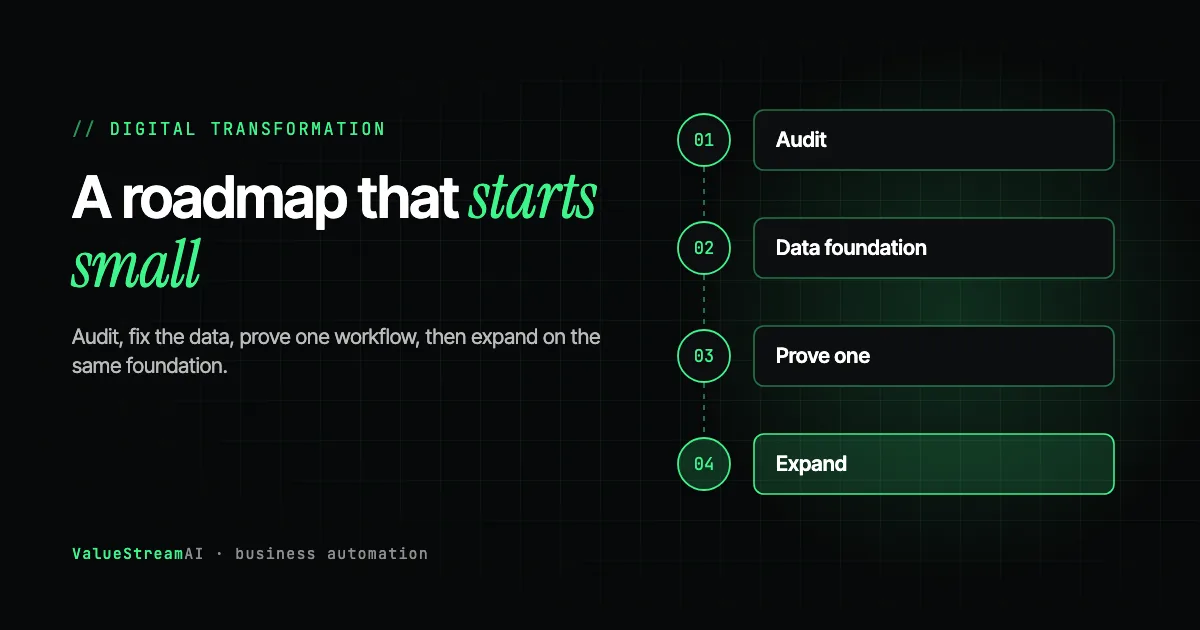
"Digital transformation" sounds like something for banks and airlines: multi-year programmes, consultants on every floor, budgets with seven figures. For a small business it means something much more practical: getting the information your business runs on into a usable shape, and letting software handle the repetitive work around it. This digital transformation roadmap for small business sets out that process step by step, starting with AI, and explains why the scariest statistic in the field is probably not true.
| Metric | 2026 Benchmark |
|---|---|
| UK firms with 10+ staff using AI (ONS, June 2026) | About 35%, up from 12% in Sept 2023 |
| AI technologies per adopting UK firm (same period) | About 1.6, up from 1.4 |
| US businesses using AI (Census, Dec 2025 to May 2026) | 17% to 20% |
| Evidence behind the "70% of transformations fail" claim (Hughes, 2011) | None found |
Sources: the Office for National Statistics, the US Census Bureau, and Mark Hughes, "Do 70 per cent of all organizational change initiatives really fail?", Journal of Change Management 11(4), 2011 (abstract).
Why a Digital Transformation Roadmap for Small Business Looks Different
The short answer: a small business transforms one workflow at a time, and the "programme" is the order you do them in, not a budget line.
Large organisations need formal transformation programmes because they have hundreds of teams that could buy hundreds of disconnected tools. A small business has a handful of tools and one decision-maker. What it lacks is not governance but time and a clear starting point.
The ONS data shows the real gap. Adoption among UK firms with ten or more staff has roughly tripled since 2023. But the average firm using AI uses only about 1.6 kinds of it, barely more than in 2023. Adoption is wide and shallow: lots of businesses have tried a chat tool, few have changed how work actually flows. A good roadmap is about depth, not about trying more tools.
The Myth That Stops Small Businesses Starting
A 2011 review traced the figure and found no valid empirical evidence behind it. It is repeated, not measured.
A small business transforms one workflow at a time. The programme is the sequence, not a budget line.
A chat tool cannot see your scattered data. The work is getting that data into one usable place.
You may have read that 70% of digital transformations fail. It appears in countless articles and sales decks. When Mark Hughes reviewed the published sources for the figure in 2011, he found no valid and reliable empirical evidence to support it. It traces back to books and articles that stated it rather than measured it.
That does not mean transformation is easy. It means the number is not a reason to avoid starting. What does go wrong, in our experience, is predictable:
- Starting with tools instead of the work. Buying software before knowing which task it should fix.
- Skipping the data. Building on information that is spread across email, spreadsheets and memory.
- Doing everything at once. Five projects in parallel, none finished.
- Forgetting people. A new process nobody was trained on, owned by nobody.
The roadmap below is designed around those four failure points.
The Digital Transformation Roadmap, Step by Step
Step 1: Audit your tools, data and hours (weeks 1 to 2)
Start with three lists.
- Tools. Every piece of software the business runs on: CRM, booking, accounting, email, file storage, spreadsheets.
- Data. Where the important information actually lives: customer records, jobs, invoices, stock.
- Hours. Which tasks take the most staff time. A simple log kept for a week or two is enough. Our guide to finding tasks to automate walks through it.
Then run one test on the tools list: for each tool, does it offer an API (a documented way for other software to connect to it), an MCP server (a newer standard that lets AI tools plug in) or a documented integration? When the answer is yes for your key tools, automation is very likely to go smoothly. When a core tool has no way in, that tool may need replacing before anything else can happen. Most owners do not know this about their own software, and it is far cheaper to find out in week one than mid-project.
Step 2: Fix the data foundation (weeks 2 to 4)
This is the step most roadmaps skip, and the one that decides whether everything after it works.
A common assumption is that a ChatGPT or Claude subscription makes a business "AI-enabled". It does not. A chat tool can only work with what you paste into it. The information your business runs on is scattered across systems, and the real work is getting the important parts into one usable, up-to-date place. Technically this is called ETL (extract, transform, load), but the idea is simple: one reliable source for the records that matter.
- 01Scattered data
Email, spreadsheets, three apps and people's memory.
- 02One source
Key records pulled into one place, kept in sync.
- 03First workflow
Built on the foundation and measured.
- 04Next workflows
Reuse the same data access, so each costs less.
For a small business this rarely means a large data project. It usually means choosing which system is the "home" for customers and jobs, and connecting the others to it. If you want AI to answer questions from your own documents, see our guide to AI knowledge management. Before connecting anything, read how to protect business data when using AI.
Step 3: Prove one workflow (weeks 4 to 6)
Pick the single task from your audit that costs the most hours and follows the same steps most of the time. Build it, measure it against the manual version, and decide what to do next based on the numbers.
The safest way to buy this is a fixed-scope pilot: one workflow, a fixed price, running in about 14 days. Ours start at $5,000, with most between $5,000 and $15,000. We describe the two weeks in what a 14-day AI pilot actually looks like.
Step 4: Expand on the same foundation (months 2 to 6)
Once one workflow works, add the next, reusing the same data access and connections. This is where the foundation pays for itself: the second and third automations cost less than the first because the hard part is already done.
The mistake to avoid is building each new automation as a standalone tool with its own data access and wiring. Two disconnected bots are not a transformation. They are two dead ends.
Our most successful longer engagements follow exactly this sequence over six to eight months: audit, decide what to bring in, build the data layer, prove one use case, then expand as the business learns what it can now ask.
Step 5: People and habits (ongoing)
Every workflow needs a named owner in the business, a short explanation for the people affected, and a regular look at what the automation is doing. Our guide to getting employees to use AI covers the people side, and our AI policy template gives you a starting document.
Audit tools, data and hours. If a key tool cannot connect, fix or replace it first. Then fix the data foundation so important records live in one place. Prove one workflow with a fixed-scope pilot and measure it. If it pays back, expand to the next workflow on the same foundation, with a named owner for each. If not, choose a different task from the audit.
Human Hours vs Automation: The Roadmap Priced in Hours
Assumptions: a small business working through three workflows in order. Workflow 1, enquiry handling and CRM updates: 10 hours a week by hand. Workflow 2, invoice processing: 6 hours a week. Workflow 3, weekly reporting: 4 hours a week. After automation, 15% of time remains for review and exceptions on the first two, and 10% on reporting. Hourly rate: US median for secretaries and administrative assistants, about $22.82 an hour (BLS, May 2024), base salary only.
| Workflow | Hours by hand a year | Cost by hand | Human time automated | Cost automated |
|---|---|---|---|---|
| 1. Enquiries and CRM | 520 | ~$11,870 | ~78 hours | ~$1,780 |
| 2. Invoices | 312 | ~$7,120 | ~47 hours | ~$1,070 |
| 3. Reporting | 208 | ~$4,750 | ~21 hours | ~$480 |
| All three | 1,040 | ~$23,730 | ~146 hours | ~$3,330 |
The other side of the ledger: the first workflow as a pilot from $5,000, then the second and third under a retainer from $1,500 a month for teams of up to about fifteen people. Because they share a foundation, the second and third take less build time than the first. Across all three, the yearly saving of about $20,400 covers that within the first year. Our pricing page sets out what each option includes, and the free automation quote tool gives you a ballpark price for your own workflow in five questions, with no email required.
What the numbers leave out: cleaner data, faster answers to customers, and reports you can trust. They also leave out the biggest benefit of a shared foundation: questions you can now ask of your own business that you could not before.
Try your own figures in the hire vs automate calculator.
Digital Transformation Consulting for Small Businesses: What to Expect
If you bring in outside help, a good digital transformation consultant for a small business should:
- Start with your hours and your data, not with a product to sell.
- Check your tools' integration options before promising anything.
- Prove one workflow before proposing a programme.
- Build on a shared foundation rather than a set of disconnected tools.
- Leave you with documentation and a named owner for each workflow.
Be wary of anyone proposing a multi-year roadmap and a governance board for a 20-person company. That is enterprise transformation at small-business prices. For a fuller comparison, see AI consulting for SMEs vs enterprises.
What to Do Before You Spend Anything
Several of the most useful steps in this roadmap cost nothing but time.
- List every tool you pay for. Many small businesses discover subscriptions nobody uses, and tools that overlap.
- Check which tools already have AI features. Your email, office suite, CRM or accounting software may already include features you are paying for and not using.
- Log the hours for two weeks. The log will tell you more about where to start than any assessment.
- Find out who holds every admin login. Lost access is one of the most common causes of project delays.
- Write down one example of a good result. For the task you want to fix first, describe what "done right" looks like.
Roadmap Checklist
| Step | Done when | Typical owner |
|---|---|---|
| 1. Audit | Tools, data and hours listed; integration check done | Owner or operations lead |
| 2. Data foundation | One home for customers and jobs, others connected | Operations lead, with help |
| 3. First workflow | Pilot live and measured against the manual version | Person who did the work |
| 4. Expand | Next workflow reuses the same connections | Operations lead |
| 5. People | Each workflow has a named owner and a review rhythm | Owner |
If you get stuck on a step, the answer is usually to go back one. A workflow that keeps failing usually points to a data problem. A data problem that will not resolve usually points to a tool that cannot connect.
Signs Your Transformation Is Working
- Hours are falling on the tasks you automated, measured against the log from step one.
- The same information is typed in once, not copied between systems.
- Questions get answered faster, by customers and staff alike.
- New workflows take less time to build than the first one did, because they reuse the foundation.
- People own their workflows, reviewing exceptions without being asked.
If the hours are not falling, return to the audit and check whether the task was the right one to start with.
The Competitor Pulse Check
| Factor | ValueStreamAI Approach | Typical digital transformation consultancy |
|---|---|---|
| Starting point | Audit of tools, data and hours | Maturity assessment and workshops |
| Data | Foundation fixed before building | Assumed to be ready |
| First deliverable | One working workflow in about 14 days | A roadmap document |
| Expansion | Each workflow reuses the same foundation | Separate projects per department |
| Engagement shape | Six to eight month partnership when it fits | Multi-year programme |
Frequently Asked Questions
What is a digital transformation roadmap for a small business?
It is a step-by-step plan for moving your business's work onto connected software: audit your tools, data and hours, fix where important information lives, prove one automated workflow, then expand on the same foundation while training the people involved.
How long does digital transformation take for a small business?
The first measured result can arrive within about six weeks: two weeks of audit, a short data clean-up and a 14-day pilot. Expanding across several workflows usually takes months, and our most successful longer engagements run six to eight months.
Is it true that 70% of digital transformations fail?
There is no good evidence for it. A 2011 review in the Journal of Change Management traced the claim to its published sources and found no valid empirical basis. Transformations do go wrong, but for predictable reasons: starting with tools, skipping the data, doing everything at once and ignoring people.
Where should a small business start with digital transformation?
Start with an audit of the tools you use, where your important data lives and which tasks take the most hours. Check each tool can connect to others. Then pick the single biggest repetitive task and prove it with a pilot.
How much does digital transformation cost for a small business?
A first workflow as a fixed-price pilot starts at $5,000, with most between $5,000 and $15,000. Further workflows usually run under a retainer from $1,500 a month for teams of up to about fifteen people. Costs rise if key tools cannot connect and need replacing.
Do I need a digital transformation consultant?
Not always. If your tools are few, well connected and someone has time, you can work through the roadmap yourself. A consultant helps most when data is scattered, tools do not connect, or nobody in the business has time to lead it.
What's Next
If you want help with the first steps, book a free call through our AI consulting for small business page. We will look at your tools and data, find the task worth proving first, and tell you what it would cost.
For related reading, see how to implement AI in your business, our AI implementation roadmap, and the full AI for small business guide.
Prefer to talk it through? Contact us with a short description of the task, or check our pricing first.
Syed Rayyan is co-founder of ValueStreamAI, leading research and marketing. He runs the firm's evaluation of emerging AI and healthcare tooling and translates technical capability into clear guidance for non-technical decision-makers. Connect on LinkedIn →