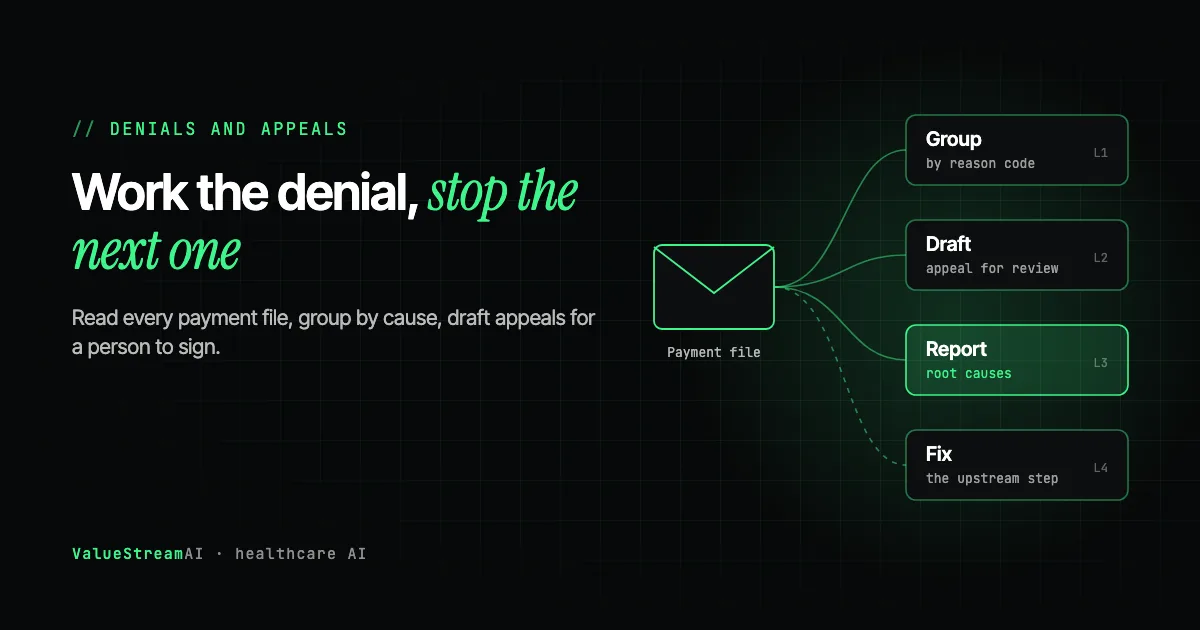
Every payment file a practice receives is a report card. Somewhere in it are the claims that were denied, each with a standard code saying why. In most small practices and equipment suppliers, those denials are worked one at a time, by whoever has time, and the same cause repeats for months because nobody has a moment to count. Denial and appeal letter automation reads every payment file, groups the denials by reason, finds the cause behind the repeats, and drafts the corrections and appeals for a person to review and sign.
This guide is for billing managers and owners at small practices, equipment suppliers and billing companies. It covers what is in a payment file, what can safely be automated, how to turn denial data into fewer denials, and what it costs.
The short answer: Denial and appeal automation reads each electronic payment file (the 835 or ERA), lists every denied line with its reason code in plain English, groups denials by cause, pulls the documents for each claim, and drafts a correction or appeal letter that quotes the record. A person decides whether to appeal and signs every letter. The bigger return is the monthly report showing which upstream step causes the repeats, so they stop.
Key takeaways
- Denials are rising: 41% of providers face denial rates of 10% or higher, per Experian Health's 2025 survey.
- Every denial already arrives with a standard reason code, set by national code committees and required under HIPAA. That makes grouping and counting straightforward to automate.
- Working denials is half the job; preventing them is the other half. Grouping by cause shows which intake or documentation step to fix.
- Draft, do not send. An appeal is a formal statement on the practice's behalf; a person signs every one.
- Deadlines matter. Medicare's first-level appeal must be filed within 120 days of receiving the initial determination; commercial payer windows vary.
| Metric | 2026 Benchmark |
|---|---|
| Providers with denial rates of 10% or higher | 41% (Experian Health, 2025) |
| Top denial cause: missing or inaccurate data | 50% of providers (Experian Health, 2025) |
| Second cause: authorizations | 35% of providers (Experian Health, 2025) |
| Providers saying clean claims are harder than a year ago | 68% (Experian Health, 2025) |
| Medicare first-level appeal deadline | 120 days from receipt of the initial determination (CMS) |
Why Denial and Appeal Letter Automation Matters Now
Denial and appeal automation matters now because denials are rising and the staff to work them are not. Experian Health's State of Claims 2025 survey of 250 revenue cycle professionals found that 41% of providers face denial rates of 10% or higher, 54% say claim errors are increasing, and 68% say clean claims are harder to submit than a year earlier. 82% said reducing denials is a priority.
The same survey found the top causes are the ones covered elsewhere in this series: missing or inaccurate data (50%), authorizations (35%) and incomplete or inaccurate registration (32%). That matters, because it means most denials point back to a fixable step: intake, prior authorization or pre-bill documentation checks. Denial automation is where you find out which one.
What Is in a Payment File
Most payers now send payment information electronically as an electronic remittance advice, a standard file format known as the 835. Some still send paper explanations of benefits, which can be scanned and read the same way.
Each claim line in the file carries codes explaining any adjustment:
- Claim adjustment reason codes (CARCs) say why a line was not paid as billed. They are set by a national code committee with payer, provider and vendor members, updated three times a year, and published by X12, according to CMS.
- Remittance advice remark codes (RARCs) add detail. CMS maintains this list.
- Group codes say who is responsible for the amount, for example the provider under a contract, or the patient.
Under HIPAA, payers must use these approved codes rather than their own, as CMS explains. That is what makes denials so automatable: every denial, from every payer, arrives labelled in the same language.
Some common reason codes your team will recognise, in plain English:
| Code | What it means in plain English | Usually points back to |
|---|---|---|
| 16 | The claim is missing information or has a billing error | Intake or claim entry |
| 197 | Required authorization or notification was missing | Prior authorization |
| 50 | The payer does not consider the service medically necessary | Documentation |
| 29 | The time limit for filing has expired | Billing workflow |
Always check the exact wording against the current X12 code list, because codes are added and retired several times a year.
What Denial and Appeal Automation Does
- 01Read the payment file
Find every denied or reduced line and its standard reason codes.
- 02Group by reason
Put denials with the same cause together, by payer, item and referring office.
- 03Pull the documents
Gather what is needed to correct or appeal each claim.
- 04Draft the correction or appeal
Draft the letter quoting the record and the payer's policy, for a person to review.
- 05Fix the cause upstream
Show which intake or documentation step produced the repeat denials.
1. Reads every payment file as it arrives. No denied line is missed because nobody opened the file.
2. Translates and groups. Each denial is labelled in plain English and grouped by cause, payer, item or service, and referring office. A billing manager sees "23 denials this month for missing authorization, 17 of them from one payer, all for the same item" instead of 23 separate lines.
3. Pulls the documents. For each denied claim, the system gathers the order, notes, authorization and delivery record from your billing system and document store.
4. Drafts the correction or appeal. Simple errors get a corrected claim ready for review. Medical necessity and authorization denials get a drafted appeal letter that quotes the relevant passages from the patient's record, with dates and pages, against the payer's policy criteria from your policy knowledge base.
5. Tracks deadlines. Each appeal has a filing window. Medicare's first-level appeal, a redetermination, must be filed within 120 days of receiving the initial determination, according to CMS. Commercial windows vary by contract. The system alerts your team before any deadline passes.
6. Reports root causes. Once a month, a short report shows where denials came from and which upstream step to fix.
A payment file arrives and the system reads every denied line and its reason code. Denials are grouped by cause. For each denial, the documents are pulled and a correction or appeal is drafted. A person decides whether to appeal or write off, then signs and sends. Separately, the grouped causes go into a monthly report that shows which upstream step to fix, which reduces the same denials in future payment files.
The Part Most Denial Tools Skip: Fixing the Cause
Working denials faster is useful. Not getting them is better. The most valuable output of denial automation is often not an appeal letter at all. It is a table like this, every month:
| Cause | Denials this month | Where it comes from | Fix |
|---|---|---|---|
| Missing authorization, one payer, one item | Count from your file | Prior authorization check skipped for this payer | Add the item to the authorization checklist |
| Missing information, one referring office | Count from your file | That office's fax layout puts the NPI on page 4 | Add an intake check for that office |
| Filing time limit | Count from your file | Claims held in a queue too long | Alert on queue age |
The pattern we see repeatedly is that a handful of causes account for most denials, and each one traces to one step in the workflow. A practice that fixes those steps spends less time on appeals in every following month. That is why denial automation belongs in the same system as intake and documentation checks: the data from one improves the others.
Drafting Appeals Without Overclaiming
An appeal letter is a formal statement made on the practice's behalf, so how the draft is built matters.
Quote, do not summarise. A good draft quotes the passages from the record that meet each policy criterion, with dates and pages. A reviewer can check each quote in seconds. A summary written by an AI model can overstate what the notes say, and a reviewer has no quick way to tell.
Cite the policy version. Payers change policies. The draft should name the policy and the version it relies on.
Flag weak appeals. If the record does not support a criterion, the draft should say so plainly rather than paper over it. Some denials are correct, and appealing them wastes time.
Confirm it arrived, do not assume it. A portal screen saying "submitted" or a fax confirmation is not proof that the payer received and logged the appeal. We learned how far apart those can be on our own medical voice platform: about 1 in 21 message-taking calls had the AI tell the caller it had logged their message without actually doing so, while the platform's own success flag reported those calls as fine. Proof is the record on the other side. For appeals, that means checking claim status with the payer, not trusting the confirmation screen.
A person signs. Always. AI models are not deterministic, and the same record can be summarised differently on two runs. In our experience that is manageable when the output is quotes a person checks, and risky when it is prose a person skims.
Platforms and Alternatives
- Your billing system's denial module. Most billing platforms offer denial worklists and reporting. Check what yours does first; it may be enough.
- Revenue cycle platforms such as GenHealth.ai include denials and appeals among their agents, mainly for mid-size equipment suppliers and health plans.
- Outsourced denial management services work denials with their own staff. Right for some practices, especially with a large backlog.
- A custom build fits when you want denials tied to your own intake and documentation checks, need reporting your billing system does not offer, or run billing for several clients. For that last case, see AI automation for medical billing companies, where a per-client root cause report becomes a service you can sell.
The Competitor Pulse Check
| Factor | ValueStreamAI custom build | Billing system denial module | Outsourced denial service | Working denials by hand |
|---|---|---|---|---|
| Reads every payment file | Yes | Yes | Yes | When time allows |
| Groups by root cause across payers | Yes, your way | Standard reports | Varies | Rarely |
| Drafts appeals quoting the record | Yes, with page references | Templates | Yes, by people | By hand |
| Feeds fixes back to intake and checks | Yes, same system | No | No | No |
| Who signs appeals | Your staff | Your staff | The service | Your staff |
| Cost model | Fixed build plus maintenance | Subscription | Percentage or per claim | Staff time |
Human Hours vs Automation: Working Denied Claims
The assumptions (our estimate, replace with yours).
- Unit of work: one denied claim line.
- Staff alone: 15 minutes to find it, look up the code, pull the documents, work out the cause and prepare a correction or appeal.
- Staff with AI: 4 minutes for a person to check the drafted correction or appeal, decide and sign.
- Rate: US median wage for medical records specialists, $24.59 an hour (BLS, May 2025). Base pay.
That is about $6.15 of staff time per denial when staff work alone, against about $1.64 when they work with AI.
What the biller still decides. Whether each denial is worth appealing or should be written off, whether the drafted letter's quotes really answer the payer's reason, and whether to sign. The AI does the finding, the grouping, the document gathering and the first draft. Deciding which fights to pick with a payer, and putting the practice's name to an appeal, are human jobs.
| Volume | Staff alone: hours a year | Staff alone: cost | Staff with AI: hours a year | Staff with AI: cost |
|---|---|---|---|---|
| 200 denials a month | 600 | $14,754 | 160 | $3,934 |
| 1,000 denials a month | 3,000 | $73,770 | 800 | $19,672 |
| 5,000 denials a month | 15,000 | $368,850 | 4,000 | $98,360 |
The other side of the ledger. A denial reporting and drafting pilot is $5,000 to $15,000; a full workflow connected to your billing system and policy library is $15,000 to $40,000, plus running costs and maintenance.
What the numbers leave out. Two things, both larger than the staff time: denials that are appealed instead of quietly written off because nobody had time, and denials that stop happening because their cause was fixed upstream. Neither can be priced without your own denial history.
Run your own figures in the hire vs automate calculator or put a yearly figure on it with the AI automation ROI calculator, and see all four core billing documents priced both ways in what medical billing automation costs per document.
What Denial and Appeal Letter Automation Costs
Denial and appeal automation costs $5,000 to $15,000 for a pilot covering payment file reading, grouping and the monthly root cause report, and $15,000 to $40,000 for a full workflow that drafts appeals and connects to your billing system. These are our published prices as of October 2026. Billing companies running it for many clients should expect $40,000 or more.
See our pricing, get an estimate from the automation quote tool, or read about our healthcare AI development service. Patient data handling rules apply here as everywhere else; our guide to what AI agents may do with patient data covers them.
Frequently Asked Questions
What is denial and appeal letter automation?
Denial and appeal letter automation is software that reads electronic payment files, lists denied claims with their reason codes in plain English, groups them by cause, gathers the documents for each, and drafts corrections or appeal letters for a person to review and sign.
What is an 835 file?
An 835 is the standard electronic remittance advice payers send with payment information. Each claim line includes standard adjustment reason codes explaining any amount not paid, which is what makes denials straightforward to read and group automatically.
Can AI write medical appeal letters?
AI can draft them, quoting the relevant passages from the patient's record and the payer's policy with references. A person should review every draft, decide whether to appeal and sign the letter.
How long do I have to appeal a Medicare denial?
A Medicare first-level appeal, called a redetermination, must be filed within 120 days of receiving the initial determination, according to CMS. Commercial payer deadlines vary by contract.
What are the most common reasons claims are denied?
In Experian Health's 2025 survey, the top causes were missing or inaccurate data (50% of providers), authorizations (35%) and incomplete or inaccurate patient registration (32%).
How much does denial management automation cost?
A custom pilot costs $5,000 to $15,000 and a full workflow $15,000 to $40,000, based on our published pricing. Outsourced denial services usually charge a percentage or per claim.
What's Next
Send us three months of payment files with patient details removed. We will show you your denials grouped by cause, which upstream steps they trace to, and what automating the work would cost.
This post is part of our guide to revenue cycle automation for small practices. For eligibility and the difference between rule-based bots and AI, see the claims billing automation guide.
Muhammad Kashif is co-founder of ValueStreamAI, leading technical delivery and AI strategy. He designs and ships custom agentic AI and healthcare automation systems for clients across the US and UK. More about Muhammad Kashif →