Plenty of successful small businesses run on a Facebook page, a Google listing and word of mouth. So when someone says you must have a website, it is fair to push back: do I need a website for my business, really, in 2026? Especially now that people ask ChatGPT for recommendations?
This guide gives an honest answer, including the cases where you can manage without one for now. It compares what a website, a Facebook page and a Google listing each actually do, explains why AI assistants make owning a website matter more rather than less, and sets out what a website costs.
| Metric | 2026 Benchmark |
|---|---|
| Google searches a year | More than 5 trillion (Google, 2025) |
| ChatGPT weekly users | 900 million+ (OpenAI, February 2026) |
| Share of website visits from normal search | 42.75% (SE Ranking, 2026) |
| Cost of a Google listing or Facebook page | Free |
| Our website, built to be found | $5,000 to $10,000 for most sites, up to $15,000 for larger ones |
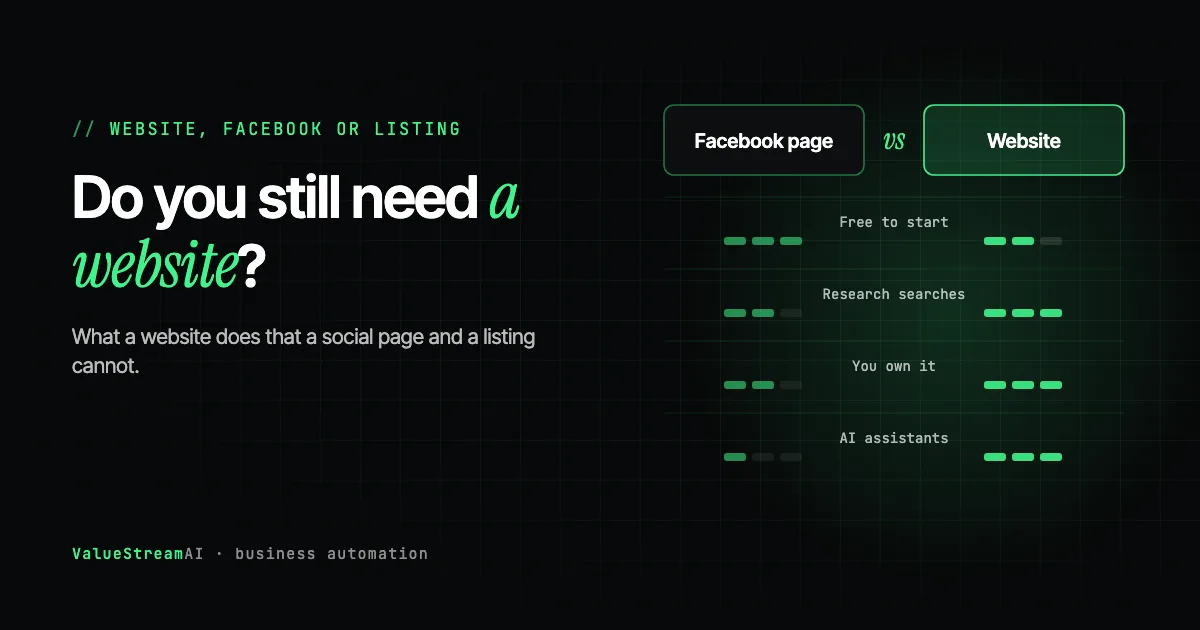
The short answer. Most businesses that want customers beyond word of mouth need a website. A Google listing puts you on the map and a Facebook page keeps existing customers in touch, but neither ranks for the research searches buyers make before choosing ("how much does it cost", "best builder for"), neither can hold your prices, projects and answers in depth, and neither is yours: the platform sets the rules. AI assistants like ChatGPT also lean on websites when they recommend businesses. A small business that is fully booked through referrals can manage without one for now; a business that wants to grow usually cannot.
Key takeaways
- A Google listing is essential and free, but it is a listing, not a strategy.
- A Facebook page is for people who already know you. It rarely wins new customers from search.
- A website is the only one you own. No platform can change its rules or suspend it.
- AI assistants read websites. Without one, there is little for ChatGPT to quote about you.
- Fully booked on referrals? You can wait. Even then, a simple site helps referrals check you out.
Do I Need a Website for My Business, or Is Facebook Enough?
A Facebook page is good at one thing: staying in touch with people who already follow you. It is where regulars see your news, offers and photos. It is weak at the job that grows a business, which is being found by people who have never heard of you.
When someone searches Google for "kitchen fitter in Tampa" or "how much does a garden room cost", the results are mostly websites and articles. Facebook pages rarely rank for those research searches, and a Facebook post from three months ago is hard to find even for people looking for it. Your page also lives by Facebook's rules: what it shows, to whom, and whether your account stays active.
Use Facebook as well as a website, not instead of one. Link the two, and let the website do the job of answering questions and winning new customers.
Is a Google Listing Enough on Its Own?
A Google Business Profile is the free listing that shows your business on Google Maps and in the map results, with your hours, phone number, photos and reviews. Every local business should have one, finished properly. For someone nearby who needs you right now, it is often the first thing they see.
But Google says local results are based on relevance, distance and prominence, and that prominence draws partly on links from other websites and on reviews (Google Business Profile Help). A listing alone cannot rank for research searches, cannot hold a cost guide or a case study, and only works near your location. We explain the gap in detail in is a Google Business Profile enough.
Who Can Manage Without a Website for Now
An honest answer includes the businesses that do not need one yet:
- You are fully booked through referrals and turning work away.
- Your customers find you on a marketplace that brings enough work, such as a booking platform in your trade.
- You are testing an idea and want to see if anyone buys before spending money.
Even then, a simple one-page site with what you do, where, and how to contact you helps referrals check you are real before they call. Many people look a business up before contacting it, even when a friend recommended it.
Who Really Needs One
You almost certainly need a website if:
- People research before buying from you. Builders, clinics, accountants, solicitors, suppliers, anyone where a customer compares options for weeks.
- One customer is worth a lot. A single job paying for the website changes the maths entirely.
- You want customers beyond your immediate area or beyond your current network.
- You sell to other businesses. Buyers expect to find specifications, certifications and contact details on a proper site.
- You have proof to show. Projects, case studies, prices and reviews need a home that you control.
Why AI Assistants Make a Website Matter More
More customers now ask ChatGPT, Gemini, Claude, Perplexity or Grok "who is a good roofer near me?" before they search. Those assistants recommend businesses they can find clear, trustworthy information about, and a website that plainly says what you do, where, for whom and at what price is one of the best sources they have.
A Facebook page with a few posts, or a listing with a two-line description, gives an assistant little to work with. A website with a page per service, real prices and answered questions gives it plenty. We explain how assistants choose in how to get ChatGPT to recommend your business.
Google still matters more for visits: in SE Ranking's 2026 study, normal search sent 42.75% of website visits and AI platforms 0.32% (SE Ranking). A website serves both.
What a Website Does That Nothing Else Can
It answers questions before the call. "Do you work in my area?", "How much roughly?", "Have you done jobs like mine?" Answered on your website, those questions bring customers who are ready to buy.
It ranks for what people search before choosing. A page per service and area can appear for searches a listing never will. Two sites we built this way, Naffees & Sons and PK Transporters, reached average Google positions of 5.7 and 5.8 within three months of launch (Search Console, 24 July to 22 October 2026).
It turns your history into proof. Many established businesses have decades of projects in a filing cabinet and nowhere to show them. A website turns them into project pages and case studies that win trust. We explain how in marketing a business with decades of experience.
It is yours. You own the domain and the content. No algorithm change decides who sees it, and no platform can suspend it.
It can reply for you. A website form can feed an automatic reply and a follow-up system, so no enquiry sits unanswered overnight. See AI lead follow-up for small businesses.
Can You Build It Yourself?
Yes, and for some businesses a simple do-it-yourself site is the right start. Website builders cost little each month and get you online quickly. They work well for a simple online presence.
They tend to fall short when you need a page for every service and area, real search research behind the pages, or growth over time without rebuilding. We compare the options honestly in custom website vs template and should you hire someone to build your website.
A Sensible Order to Do Things In
- 01Google listing
Verified, right category, hours, photos, reviews.
- 02Social page
Where your customers already spend time.
- 03A website you own
A page per service and area, prices, projects, contact.
- 04Grow it
New pages, reviews, mentions on other sites.
- Set up and finish your Google listing. Free, and it puts you on the map today.
- Keep a social page where your customers are. Free, and good for regulars.
- Get a website you own, with a page per service and area, your prices or price ranges, projects, reviews and a clear way to contact you.
- Grow it: new pages, more reviews, mentions on other sites.
How the Pieces Fit Together
New customers search Google or ask an AI assistant. The Google listing catches nearby, ready-to-call searches. The website catches research searches and gives AI assistants facts to quote. The social page keeps existing customers in touch. All three point to the website, where the customer gets in touch.
What Does a Business Website Cost?
The range is wide, from a few dollars a month on a website builder to tens of thousands for a large custom build. Our breakdown of website design and SEO packages shows what each price level usually includes.
Our own builds are for businesses that want the website to bring customers, not just exist:
- Website built to be found on Google and by AI assistants: $5,000 to $10,000 for most sites, up to $15,000 for larger ones. Research into what your customers search for, a page per service and area, your Google listing set up, a system you can update yourself, and support after launch.
- Ongoing growth, if you want it: from $900 a month, including website management and maintenance, for new pages, reviews, listings and mentions.
See our AI website development services and the pricing page.
What Should a Small Business Website Have?
If you decide you do need one, a website that brings customers needs more than a nice design. In plain terms:
- A clear first screen: what you do, where, and how to contact you, readable on a phone in three seconds.
- A page for each main service, explaining what is included, who it is for and roughly what it costs.
- A page for each area you serve, if you cover more than one town.
- Proof: past projects with photos, reviews, and any certifications or memberships.
- Plain facts about the business: founding year, who runs it, where you are based, so customers and AI assistants can confirm you are real.
- Answers to common questions, in your own words and with your own figures.
- An easy way to get in touch: a tap-to-call number, a short form, and a fast reply.
- A system you can edit yourself, so adding a project does not need a developer.
- Ownership in your name: the domain, hosting and logins.
If a website you are being quoted for is missing several of these, ask why. Questions to ask when hiring a web designer turns this list into questions you can put to any designer.
Common Reasons Owners Put It Off
"Everyone finds me through word of mouth." Often true, and those people still look you up before calling. A website reassures them; its absence can make them wonder.
"It's expensive." A simple site can cost very little. A website built to bring new customers costs more, and is judged on whether one or two new customers a year pay for it.
"I don't have time to manage it." That is a reason to choose a website you can update in minutes, or to have someone manage it, not a reason to have none.
"Nobody uses websites any more, they use ChatGPT." AI assistants largely recommend businesses based on what websites and other sites say about them. Fewer clicks does not mean less need for the page that gets quoted.
How Long Does It Take to Get a Website Live?
A simple do-it-yourself site can be live in a weekend. A website built to bring customers usually takes a few weeks, most of it spent on the parts that matter: researching what customers search for, writing a page per service and area, and gathering photos and projects. Our builds typically take a few weeks from the first call to launch, depending on how many pages are needed and how quickly material arrives.
Being found takes longer than being live. Google's guidance is that this kind of work usually takes four months to a year to show results, faster in small local markets. That is why it is worth starting before you urgently need the customers.
The Competitor Pulse Check
| Factor | ValueStreamAI website | Facebook page only | Google listing only |
|---|---|---|---|
| Found for research searches | Yes, a page per search | Rarely | No |
| Found nearby on the map | Supports the listing | No | Yes |
| Prices, projects, answers | In depth | Posts scroll away | Short description |
| Who owns it | You | The platform | The platform |
| Read by AI assistants | Plain facts to quote | Limited | Limited |
| Cost | $5,000 to $15,000 build | Free | Free |
Frequently Asked Questions
Do I need a website for my business?
If you want customers beyond word of mouth, almost certainly yes. A website ranks for the research searches buyers make, holds your prices and proof, is the only channel you own, and gives AI assistants facts to quote. A business fully booked through referrals can manage without one for now.
Do I need a website for my small business if I have a Facebook page?
Usually yes. A Facebook page keeps existing customers in touch but rarely ranks for the searches new customers make, and you do not control its rules. Use both, with the Facebook page pointing to your website.
Is it still worth having a website in 2026?
Yes. Google handles more than 5 trillion searches a year and still sends most website visits, and AI assistants like ChatGPT draw heavily on websites when they recommend businesses. A website matters more, not less, as more people ask AI for recommendations.
Is a Google Business Profile enough without a website?
It is enough to appear on the map for nearby searches, and it is free. It cannot rank for research searches or hold detailed prices and projects, and Google says prominence draws partly on links from other websites, which a listing alone cannot earn.
Can I make my own website for my business?
Yes. Website builders are inexpensive and fine for a simple presence. They tend to fall short when you need many service and area pages built around what customers search for, or want to grow without rebuilding.
How much does a website for a small business cost?
It ranges from a few dollars a month on a builder to tens of thousands for large custom builds. Our websites, built to be found on Google and by AI assistants, cost $5,000 to $10,000 for most sites, up to $15,000 for larger ones.
How long does it take to build a business website?
A simple do-it-yourself site can be live in a weekend. A website built to bring customers usually takes a few weeks, mostly spent on research, writing a page per service and area, and gathering photos and projects. Being found on Google then takes four months to a year, according to Google.
What's Next
If you are deciding whether a website is worth it for your business, tell us what you do, where, and what one new customer is worth. On a free call we will tell you honestly whether you need a website now, a simple one, or nothing beyond your listing yet.
→ Start here: why your website isn't generating enquiries
→ See our AI website development services
→ See our pricing, or talk to us
Syed Rayyan is co-founder of ValueStreamAI, leading research and marketing. He has run SEO for client websites since 2020, across technical audits, on-page work and link building, and leads the marketing side of every build. He also runs the firm's evaluation of emerging AI tooling and translates technical capability into clear guidance for non-technical decision-makers. Connect on LinkedIn →