The question behind how to scale your business without hiring is rarely "how do I avoid employing people." It is "how do I handle 50% more customers next year without the overhead, management load and risk of growing the team by 50%." For an established business with 20 to 100 people, AI automation is now the most practical answer to that question, because the work that grows fastest with volume is usually the most repetitive: enquiries, data entry, scheduling, invoices, follow-ups and reports.
This guide explains where automation absorbs growth, where it does not, how the cost of the next hire compares with automating the work, and why the first automation is the start of something rather than the end. It is written for owners who want to grow without turning into a recruitment company.
| Metric | 2026 Benchmark |
|---|---|
| US median pay, administrative assistant | $47,540/year base (BLS, May 2025) |
| Productivity gain for newer staff with AI assistance | 34% (NBER w31161) |
| Our scoped automation pilot | $5,000 to $15,000 |
| Content studio output after automation (our case study) | 3 posts a day, up from 3 a week |
Why Growth Breaks Small Teams
Growth in an established business rarely fails on the work customers pay for. It fails on the work around it. Twice the customers means twice the enquiries, twice the quotes, twice the invoices, twice the scheduling, and twice the data typed from one system into another. That administrative layer scales in a straight line with volume, and in most businesses nobody owns it. It is spread in small pieces across everyone's day.
So the team absorbs it, then stretches, then starts dropping things: the enquiry answered the next day, the invoice not checked, the follow-up that never happens. At that point the owner hires. The new person takes months to recruit and months more to become productive, and the cycle repeats at the next step up.
Automation breaks the straight line. Manual admin cost grows with every extra customer. Automated admin cost is mostly a one-off build plus a slowly growing amount of human oversight. That is the entire economic argument, and the chart below shows it for one workflow.
The Four Levers That Absorb Growth Without New Hires
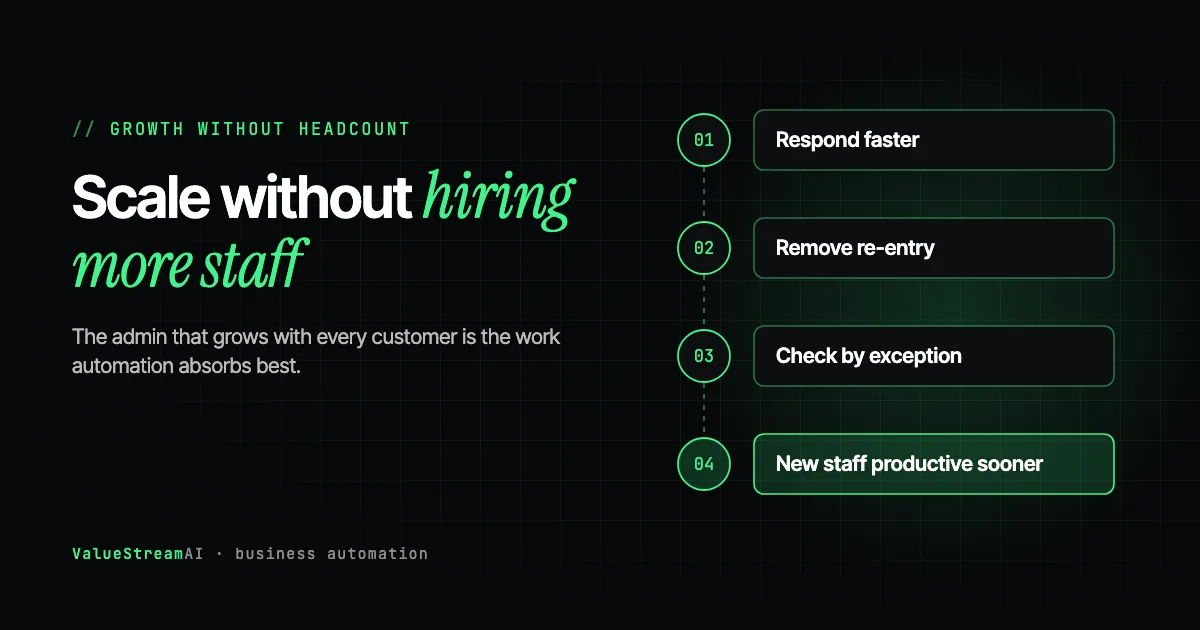
In every business we have worked with, the capacity to grow without hiring comes from the same four places.
- 01Respond
Enquiries, calls and leads answered in minutes, around the clock.
- 02Remove re-entry
Data typed once, flowing between systems automatically.
- 03Check by exception
People review only the records that fail a rule.
- 04Make new staff productive faster
AI assistance closes the gap between new and experienced people.
Lever 1: respond faster at the front door
More customers means more enquiries, more calls and more leads, and they increasingly arrive outside office hours. AI can respond to every new enquiry within minutes, answer missed calls, qualify leads and book appointments, then hand the real conversations to your people. This does not just save time. It wins work that used to go to whoever answered first. See AI lead follow-up and CRM automation and AI receptionists for business phone calls.
Lever 2: remove re-entry in the middle office
The same customer's details typed into the CRM, the quoting tool and the accounts package is three times the work and three chances for error, and it doubles when volume doubles. Automating that flow is usually the single largest hours saving. See how to automate data entry and copy-paste work.
Lever 3: check by exception in the back office
Instead of a person checking every invoice, order or form, automation checks them all against your rules and sends only the ones that fail to a person. At ten times the volume, the person reviews ten times the exceptions, not ten times the documents. We describe this pattern in back-office AI automation.
Lever 4: make new and existing staff more productive
When you do hire, AI assistance shortens the time it takes a new person to perform like an experienced one. The strongest evidence comes from a study of 5,179 customer support agents (Brynjolfsson, Li and Raymond, NBER working paper w31161): AI assistance raised productivity by 14% on average and by 34% for novice and lower-skilled workers, with little gain for the most experienced. For a growing business, that means each hire becomes useful sooner. It is also the strongest argument that AI helps your team rather than replaces it, a topic we cover in will AI replace my employees.
Which levers your AI subscription already covers, and which it does not
Only one of the four levers comes in the box. Lever 4, individual productivity, is largely what Copilot, Gemini, ChatGPT and Claude subscriptions now provide: faster drafting, summarising and research for each person. Buy it, train people on it, and expect real but modest gains.
Levers 1 to 3 do not come in the box, and they are where growth capacity actually comes from. A chat assistant does not answer the 9pm enquiry unless someone asks it to. It does not move the order from the email into the ERP and the accounts package. It does not check 400 invoices against purchase orders while the team is asleep. Those levers need workflows that run on every trigger, across your systems, with a person reviewing only the exceptions. That is the difference between a team that types faster and a business that handles twice the volume with the same people.
What Scaling Without Hiring Looked Like in Real Projects
The pattern is easier to believe with real numbers attached, so here are three from our own case studies.
A content business wanted to grow its YouTube Shorts output without growing its editing team. We built an automated video studio that took channels from three posts a week to three a day, cutting production time by around 90%. The same people now oversee far more output. Full detail in the content automation case study.
A sales team was spending its days building prospect lists by hand. A natural-language sales bot that turned plain-English requests into clean lead lists from Apollo.io reclaimed about 25 hours per SDR per week, time that went back into selling. See the B2B prospecting bot case study.
Atlin's HR team faced roughly 6,000 applicants for a five-role campaign with no way to sort them. Rather than hiring temporary coordinators, they had a pipeline built in about two weeks that turned each role into a clean spreadsheet and CV folder. See the HR applicants case study.
The Real Comparison: Your Next Hire vs Automating the Work
Owners rarely compare automation with doing nothing. They compare it with the next hire. So here it is, plainly.
An administrative assistant in the US earns a median of $47,540 a year (Bureau of Labor Statistics, May 2025). That is base pay. Recruiting, onboarding, management time, equipment, payroll taxes and benefits come on top. A scoped automation pilot with us costs $5,000 to $15,000 once, plus the human oversight that remains (we estimate about 15% of the original hours) and ongoing maintenance.
But the comparison is not as simple as the two bars suggest, and we should be honest about why.
A person does many things. An administrative hire answers phones, handles awkward customers, notices problems and covers for colleagues. An automation does one workflow. If your bottleneck is spread across ten small tasks, a hire may genuinely be the better answer.
An automation does one thing at any volume. If your bottleneck is one workflow that grows with every customer, automation wins, and keeps winning as you grow.
One automation is never one skill set. If you are thinking of hiring someone to build automations in-house instead, remember that a production automation touches front end, back end, data, testing, deployment and monitoring. Even staffing those at the cheapest rates is expensive, and one generalist stretched across all of them rarely works. We do the full arithmetic in AI automation agency vs in-house hire.
The hire vs automate calculator runs this comparison with your own figures.
Human Hours vs Automation: One Workflow as the Business Grows
Here is one administrative workflow priced both ways as volume grows. These are assumptions, not client figures.
The assumptions. Today the workflow takes 20 hours a week of administrative time. The rate is $22.86 an hour (BLS, May 2025, administrative assistants, base pay), 52 weeks. After automation, 15% of the hours remain for review and exceptions (our estimate). The build is a $10,000 scoped pilot, counted in year one. Volume growth adds hours in direct proportion by hand.
| Volume | Hours by hand per year | Cost by hand | Human time after automation | Year-one automated cost (incl. build) |
|---|---|---|---|---|
| Today | 1,040 | ~$23,800 | ~156 hours | ~$13,570 |
| +50% growth | 1,560 | ~$35,700 | ~234 hours | ~$15,350 |
| +100% growth | 2,080 | ~$47,500 | ~312 hours | ~$17,130 |
| +200% growth | 3,120 | ~$71,300 | ~468 hours | ~$20,700 |
At today's volume, the automation roughly halves the cost in year one, including the build. At double the volume, the manual version has become a full-time role (2,080 hours) while the automated version needs about 312 hours of a person's time. From year two, the build cost disappears from the automated column, leaving oversight and maintenance.
The other side of the ledger. Maintenance is ongoing, and higher volume surfaces more unusual cases, so oversight grows slowly rather than staying flat. Budget for both.
What the numbers leave out. Speed and consistency. A business that answers in five minutes instead of five hours, and checks every invoice instead of most of them, grows differently. Read how much can AI actually save my business for the full method, or try the savings calculator.
Where Scaling With AI Does Not Work
Automation is not a universal growth strategy, and pretending otherwise is how businesses end up with expensive systems nobody trusts.
When the bottleneck is expertise, not admin. If growth is limited by how many qualified engineers, accountants or clinicians you have, automating the admin around them helps, but it does not create more experts.
When the work is mostly relationships. Account management for your largest clients should get more human attention as you grow, not less.
When processes are not stable. If every new customer is handled differently, standardise first. Automating chaos produces faster chaos.
When you cut too far. Klarna's CEO said in May 2025 that cost had been "a too predominant evaluation factor" in its AI-first customer service push, resulting in lower quality, and the company began hiring human agents again. The goal is capacity, not the smallest possible team.
If the bottleneck is one repetitive workflow that grows with volume, automate it. If it is expertise or client relationships, hire. If it is many small varied tasks, a hire may be better. If the process is unstable, standardise it first and then reassess.
Why the First Automation Is the Start, Not the Finish
The businesses that scale furthest on automation treat the first project as a foundation, not a gadget. Here is the pattern we see.
One automation is a point solution: valuable, but capped at that one task. Two or three automations built separately, each with its own way of reading your data, become two or three things to maintain, with the same customer recorded three different ways. The businesses that keep compounding build a shared foundation: one clean view of customers and records, common logging and common guardrails. On that foundation, the third and fourth automations cost far less than the first.
You do not need to build the foundation up front. You do need to decide, at the second automation, whether you are building separate gadgets or a system. That decision is cheap at two and expensive at six. Our AI agent ecosystem case study shows what the system version looks like for a 40-doctor network: voice, scheduling, forms, payments and ticketing on one governed foundation. For the broader view, see AI agents for business automation and how to cut operational costs with AI automation.
How to Start Scaling Without Hiring in the Next 90 Days
- Find the workflow that grows fastest with volume. Our two-week automation audit shows how.
- Price it both ways using the table above or the hire vs automate calculator.
- Check your systems will let automation in, using the 90-second test in AI automation and your existing software.
- Pilot it with a person approving outputs, then measure.
- Tell your team what you are doing and why. Growth without hiring should mean less tedious work for the people you have, and they should hear that from you. See how to get employees to use AI.
Typical timelines are in how long AI automation takes to implement, and costs by budget are on our pricing page. For a scoped estimate on your own bottleneck, use the automation quote tool; our AI automation development service explains how a growth-focused build runs.
Free resources. Our free tools hub brings together the hire vs automate, ROI and savings calculators used in this guide. If your growth bottleneck is at the front door, our verified CRM automation templates and customer support templates are a no-cost way to test the idea first. For private AI that stays on your own servers, see the free AI models directory.
The Competitor Pulse Check
| Factor | ValueStreamAI Approach | Typical "Scale With AI" Advice |
|---|---|---|
| Starting point | The workflow that grows fastest with volume | A list of tools to try |
| Hire vs automate | Priced both ways, including when hiring wins | Automation always wins |
| Team | Capacity for existing people | Smaller headcount as the goal |
| Second automation | Shared foundation decided early | Each tool bought separately |
| Proof | Our own case study numbers | Unsourced percentages |
| Pricing | Published tiers from $5,000 | Subscriptions per seat |
| Overlap with Copilot, ChatGPT or Gemini | Builds only what built-in assistants cannot: unattended, cross-system, checked, private | Often rebuilds drafting and summarising you already pay for |
Frequently Asked Questions
Can AI help my business grow without hiring more employees?
AI can help your business grow without hiring by automating the administrative work that increases with every customer: enquiries, data entry, scheduling, invoices and follow-ups. It works best on one repetitive workflow at a time, while hiring remains the right answer for expertise and client relationships.
How can I scale my business without increasing staff?
Scale without increasing staff by finding the workflow that grows fastest with volume, automating it with a person reviewing exceptions, and repeating for the next bottleneck. Respond to enquiries faster, remove duplicate data entry, check documents by exception, and use AI assistance to make new staff productive sooner.
Is AI automation cheaper than hiring another employee?
For a single repetitive workflow, AI automation is usually cheaper than a hire. A US administrative assistant earns a median of $47,540 a year in base pay, while a scoped automation pilot costs $5,000 to $15,000 plus oversight and maintenance. A hire is better when the work is varied, relational or needs judgement.
Can AI help my employees handle more customers?
Yes. AI helps employees handle more customers by answering routine questions, drafting replies, routing requests and handling data entry, leaving people the conversations that need them. Research on 5,179 support agents found AI assistance raised productivity 14% on average and 34% for newer staff.
How much can AI save a growing business?
AI saves a growing business the most where admin cost grows with volume. On our assumptions, a workflow costing about $23,800 a year by hand today would cost about $47,500 at double the volume, while the automated version would cost about $17,100 in year one including a $10,000 build.
When should a business hire instead of automating?
Hire instead of automating when growth is limited by expertise, when the work is mainly relationship management, when the bottleneck is many small varied tasks rather than one repetitive workflow, or when the process is not yet stable enough to describe.
What's Next
Find the one workflow that will hurt most if your customer numbers double next year. That is your first automation, and probably the cheapest growth you will buy.
→ Read the complete AI for small business guide.
→ Compare the next hire with automation in the hire vs automate calculator.
→ Or talk to us and we will price your growth bottleneck both ways, honestly, including telling you if a hire is the better answer.
Muhammad Kashif is co-founder of ValueStreamAI, leading technical delivery and AI strategy. He designs and ships custom agentic AI and healthcare automation systems for clients across the US and UK. More about Muhammad Kashif →